Find the Best Hardscaping Contractors for Your Business
No obligation • Fast responses • Nationwide coverage

Why you can trust Landscape Atlas
Landscape Atlas is a leading United States resource for evaluating landscaping, lawn care, and outdoor service providers. Our team researches each category in depth, focusing on service quality, safety, and customer experience. Listings and rankings are based on independent criteria and user feedback, and companies cannot pay to influence our assessments or recommendations.
Search providers near you
Best Hardscaping Contractors in North Dakota Ranked
Hardscaping transforms your outdoor living space with durable, functional structures like patios, walkways, and retaining walls. In North Dakota, these projects require specialized knowledge to withstand the state's extreme freeze-thaw cycles, heavy snow loads, and expansive soils. This guide helps you understand the materials, climate considerations, and local requirements for a successful project, connecting you with experienced professionals who can bring your vision to life.
Understanding Hardscaping for North Dakota Climates
Hardscaping refers to the non-living, structural elements of your landscape. In North Dakota, this means designing with resilience as a top priority. The primary challenge is the climate: deep winter frost, dramatic temperature swings, and significant precipitation can cause materials to crack, shift, and heave if not installed correctly. A well-executed hardscape project not only adds beauty and value to your property but also solves practical problems like drainage and erosion, creating usable outdoor space for much of the year.
Successful projects here rely on two key principles: a properly prepared, compacted base that extends below the frost line, and integrated drainage systems to manage snowmelt and rain. Local contractors familiar with these conditions will select materials and techniques proven to perform in the region.
Popular Hardscape Projects and Materials
Patios and Walkways
These are foundational elements for creating outdoor living and dining areas.
- Materials: Popular choices include interlocking concrete pavers, stamped concrete, and natural stone like flagstone or slate. Pavers are often favored for their flexibility and resistance to cracking.
- Climate-Specific Installation: A deep base of compacted gravel and sand is critical to prevent shifting. Contractors often use polymeric sand in paver joints, which hardens to resist moisture penetration and weed growth. All surfaces must be sloped slightly (typically 1-2%) to ensure water drains away from your home's foundation 1.
Driveways
Your driveway must handle vehicle weight and the wear from snow removal equipment.
- Materials: Poured concrete and asphalt are common, with pavers offering a premium, durable alternative.
- Climate-Specific Installation: Base layers are thicker than in milder climates. Concrete often includes reinforcing wire mesh to prevent cracks from spreading. In areas with municipal snowplows, the apron (the section from the street to the sidewalk) may need to be wider and reinforced. Proper grading is essential to prevent water from pooling and freezing 2.
Retaining Walls
These structures manage soil erosion, create level areas on sloped lots, and add dramatic visual interest.
- Materials: Segmental concrete blocks (designed for walls), natural stone, and pressure-treated timber are standard options.
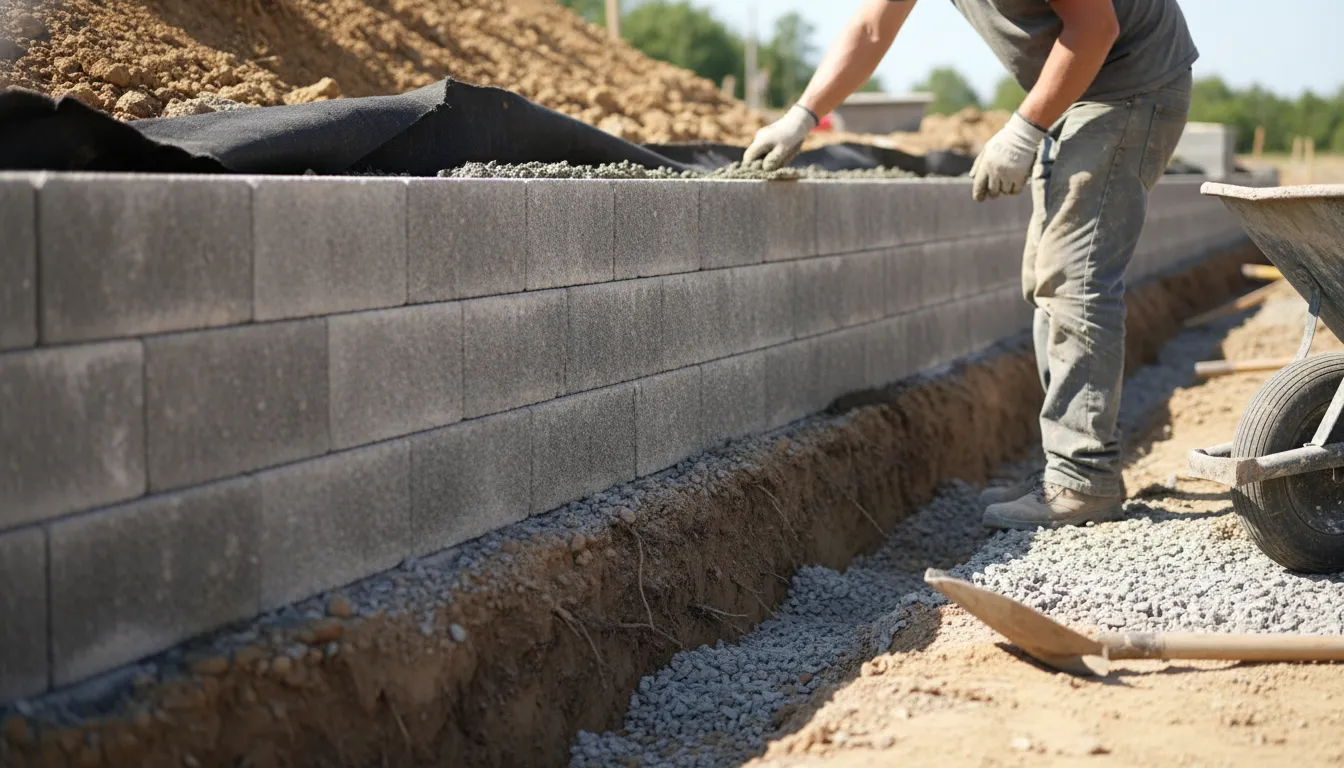
- Climate-Specific Installation: Drainage is the most critical factor. Walls require a footing installed below the frost line and a perforated pipe (French drain) behind the wall to channel water away. Geotextile fabric and geogrid reinforcement are used for taller walls to handle the lateral pressure of wet, frozen soil.
Permits, Codes, and Planning in North Dakota
Before breaking ground, understanding local regulations is essential for a legal and safe project.
- Permits: Driveway installations almost always require a permit from your city's engineering or building department. Retaining walls over a certain height (commonly 3-4 feet) also typically need a permit. Fees vary; for example, a driveway permit in Grand Forks costs around $30 3.
- Inspections: Permitted projects will likely require inspections at key stages, such as after base preparation and before the final surface is applied.
- Site Plans: For new driveways or significant alterations, you will need to submit a site plan. This drawing shows the project's location relative to property lines, utilities, and existing grades 4.
- Governing Codes: North Dakota follows the International Building Code (IBC) and International Residential Code (IRC) with state-specific amendments. Your local contractor should be familiar with these requirements 5.
Find the perfect hardscaping contractors for your needs
Get personalized recommendations and expert advice
Cost Considerations for Hardscaping
Hardscaping is an investment, and costs in North Dakota are influenced by material choices, site complexity, and the necessary climate-proofing techniques. Always obtain detailed, written estimates from multiple contractors.
- Patios & Walkways: Generally range from $10 to $30+ per square foot for pavers or stamped concrete. Natural stone and complex designs will be at the higher end of this range or above.
- Driveways: Concrete or asphalt driveways typically cost $30 to $70+ per linear foot. Paver driveways range from $20 to $50+ per square foot.
- Retaining Walls: Installed costs typically fall between $20 and $50+ per square foot of the wall face, heavily dependent on height, materials, and the required drainage and reinforcement systems.
Key factors affecting your final price include:
- Site Preparation: Extensive excavation, tree/root removal, or grading.
- Base Materials: The depth and type of gravel base needed for frost protection.
- Drainage Systems: Adding French drains, catch basins, or other water management features.
- Material Selection: Premium materials like natural stone or high-end pavers.
- Labor: The complexity of the design and local labor rates.
Working with a Professional: Key Steps
- Check Local Codes: Start by contacting your city's Building Safety or Engineering Department to understand permit requirements for your specific project 6.
- Get Detailed Quotes: Seek bids from several licensed and insured local hardscaping contractors. A good quote should itemize materials, labor, site prep, drainage, permit fees, and a projected timeline.
- Review Portfolios and References: Look at examples of their past work, especially projects that are a few years old, to see how they have held up to North Dakota winters. Ask for and contact references.
- Discuss the Details: A reputable contractor will proactively discuss frost depth, base specifications, drainage plans, and material choices suitable for your area.
- Consider Complementary Landscaping: To create a cohesive, low-maintenance yard, discuss integrating native plants and xeriscaping principles, which are well-suited to the regional climate and can reduce long-term watering needs 7.
Frequently asked questions
Sources
Footnotes
-
Types of Hardscaping in Delaware County, PA | Disabatino Inc - https://www.disabatinoinc.com/what-are-the-different-types-of-hardscaping-elements-and-their-applications-in-a-landscape/ ↩
-
Minnesota Asphalt Driveway Installation - https://blacktopconcepts.com/minnesota/residential-asphalt-paving/driveway-installation/ ↩
-
Residential Project Guide | City of Grand Forks, ND - https://www.grandforksgov.com/government/city-departments/building-safety/residential-projects ↩
-
What is a site plan? - https://cityofwinnsboro.org/DocumentCenter/View/636/What-is-a-site-plan-pdf ↩
-
North Dakota State Building Code - https://www.commerce.nd.gov/sites/www/files/documents/Community%20Services/Building%20Codes/2023NDStateBuildingCodeBook.pdf ↩
-
Building Codes - North Dakota Department of Commerce - https://www.commerce.nd.gov/community-services/building-codes ↩
-
Living Landscapes in North Dakota: - https://mcscd.com/wp-content/uploads/2012/01/ndpmcpu6598.pdf ↩