Find the Best Land Clearing Contractors for Your Business
No obligation • Fast responses • Nationwide coverage

Why you can trust Landscape Atlas
Landscape Atlas is a leading United States resource for evaluating landscaping, lawn care, and outdoor service providers. Our team researches each category in depth, focusing on service quality, safety, and customer experience. Listings and rankings are based on independent criteria and user feedback, and companies cannot pay to influence our assessments or recommendations.
Search providers near you
Best Land Clearing Contractors in Alaska Ranked
Land clearing in Alaska is the essential first step for construction, agriculture, or creating usable outdoor space. It involves the removal of trees, stumps, brush, and other obstacles from a parcel of land. In Alaska, this process is uniquely governed by a need to balance development with the state's sensitive and often protected ecosystems. Navigating local regulations, protecting wetlands, and implementing effective erosion control are not just best practices-they are often legal requirements. This guide provides practical information to help you understand the process, costs, and critical considerations for site clearing projects across the Last Frontier.
Boreal Tree Care
1728 Logan St, Anchorage, AK 99508
Boreal Tree Care is a locally owned tree service company based in Anchorage, AK, offering a wide range of tree care and land clearing services. Their certified arborists provide tree removal, pruning, stump grinding, land clearing, and pest management, including treatments for spruce bark beetle infestations. They serve residential and commercial clients from Anchorage to surrounding areas such as Talkeetna, Seward, and Tutka Bay. Boreal Tree Care has nearly two decades of combined industry experience and specializes in technical tree rigging, close-quarters felling, and remote property work. They also offer emergency and storm damage mitigation services.
Yardigans AK
4340 Tikishla St, Anchorage, AK 99504
Yardigans AK is a locally owned and operated full-service property maintenance company based in Anchorage, AK. They offer a wide range of lawn care and landscaping services including mowing, trimming, pruning, fertilizing, weed control, tree service, stump grinding, land clearing, brush removal, and yard restoration. Their approach includes detailed yard maintenance from the edges inward, debris removal, and optional contractual agreements for ongoing care. Yardigans AK also handles extensive cleanups, dump runs, and light arborist tasks, supporting the beautification of the Anchorage area.
Paul's Tree Service
Anchorage, AK
Paul's Tree Service is a professional tree care company based in Anchorage, AK, serving Southcentral Alaska. They provide a variety of services including tree removal, stump grinding, land clearing, and brush removal for both residential and commercial clients. The company employs ISA Certified Arborists and uses modern equipment to safely handle trees of all sizes. Established in 2007, Paul's Tree Service also offers specialized winter services such as roof shoveling and ice dam removal to address seasonal challenges in the area.
AAA TREE SERVICE LLC
421 S Lake St, Wasilla, AK 99654
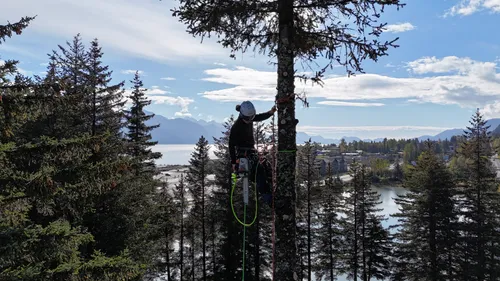
AAA TREE SERVICE LLC is a locally owned and operated tree care company serving Anchorage, AK, and surrounding areas including Wasilla and Seward. They offer a range of services such as tree removal, stump grinding, brush chipping, pruning, and treatment. The company employs ISA-certified arborists and experienced heavy equipment operators to handle tasks safely and efficiently. They specialize in managing hazardous trees and provide emergency call-outs on weekends.
Alaska Premier Services
8240 Hartzell Rd #3, Anchorage, AK 99507
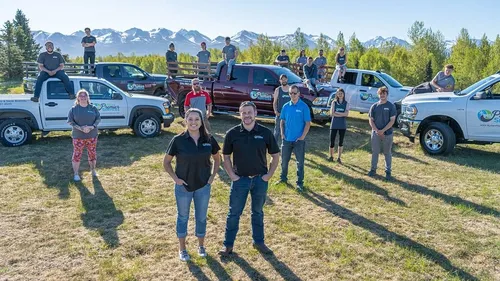
Alaska Premier Services is a landscaping and lawn care company based in Anchorage, AK. They provide a range of services including lawn mowing, lawn fertilization, weed control, land clearing, brush removal, hardscaping with pavers and retaining walls, as well as snow plowing and winter maintenance. Their capabilities include comprehensive yard cleanups and landscaping projects, with experience in creating rock beds and leveling lawns. The company has been serving the Anchorage area for several years, offering both summer and winter services to maintain properties year-round.
Understanding Alaska's Land Clearing Regulations
Before any equipment touches the ground, understanding the regulatory landscape is paramount. Alaska's vast wilderness includes numerous protected areas, wetlands, and sensitive habitats that are governed by a mix of local, state, and federal rules.
Key Permit Considerations:
- Local Municipal Permits: Requirements vary by borough and city. In Anchorage, for example, a Storm Water Pollution Prevention Plan (SWPPP) is required for land disturbances over one acre.
- State and Federal Oversight: Projects near wetlands, shorelines, or waterways will likely need additional permits from state agencies and potentially the U.S. Army Corps of Engineers. Disturbing these areas without proper authorization can result in significant fines and restoration orders.
- Protected Species and Areas: Special rules apply to areas with unique environmental features, archaeological sites, or critical fish and wildlife habitat. A preliminary site assessment is crucial to identify these constraints.
Environmental Protection and Best Practices
Successful land clearing in Alaska goes beyond mere removal; it's about responsible land management. The primary goals are to prevent soil erosion, protect water quality, and maintain ecological balance.
Erosion and Sediment Control (ESC): This is the cornerstone of any clearing project. An Erosion and Sediment Control Plan (ESCP) or SWPPP details how you will manage stormwater runoff and prevent displaced soil from entering streams, rivers, or neighboring properties. Key techniques include:
- Phased Clearing: Clearing only the areas needed for immediate work to minimize exposed soil.
- Silt Fences and Barriers: Installing perimeter controls to trap sediment on-site.
- Runoff Management: Grading slopes to direct water away from disturbed areas and into stabilized outlets or infiltration basins.
- Revegetation: Promptly planting native grasses, groundcovers, or shrubs to stabilize the soil. Using native species is encouraged to prevent the spread of invasive plants 1.
Tree and Vegetation Management: Not all vegetation needs to go. Protecting desirable trees from root damage or trunk injury during clearing is important for future landscaping and erosion control. When felling trees, they should be directed into the cleared area to minimize impact on surrounding forest 2. Furthermore, identified invasive plant species should be completely removed from the site to prevent their spread 3.
Find the perfect land clearing contractors for your needs
Get personalized recommendations and expert advice
Equipment and Methodologies for Alaskan Terrain
The rugged Alaskan terrain demands the right equipment and methods. The choice depends on the vegetation density, soil type, slope, and the intended end use of the land.
Common Equipment:
- Bulldozers: Ideal for pushing over trees, moving large piles of debris, and initial grading on larger parcels.
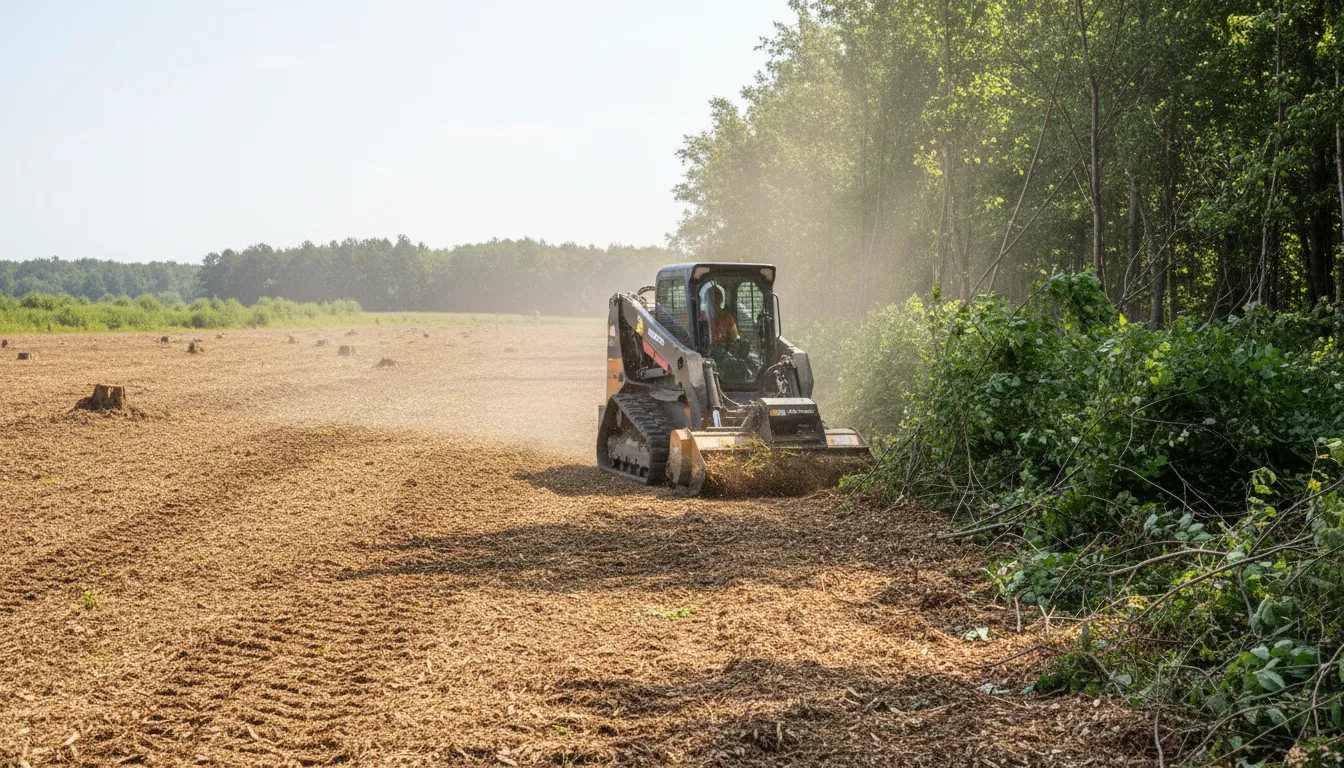
- Forestry Mulchers: A highly effective tool that clears brush and small to medium trees while simultaneously grinding them into a protective layer of mulch. This mulch helps control erosion and can enrich the soil.
- Excavators and Skid Steers: Used for stump removal, digging, and precise clearing in tighter spaces or for smaller projects.
- Chippers and Grinders: For processing felled trees and brush into usable wood chips or haul-away material.
Method Selection: For a heavily wooded lot, a common approach might involve a bulldozer for initial clearing, followed by an excavator for stump removal, and a forestry mulcher for finishing underbrush. On a brushy lot with sensitive soil, a forestry mulcher alone might be the best choice to minimize soil disturbance and provide instant erosion control.
Cost Factors for Land Clearing in Alaska
The cost of clearing land in Alaska is highly variable, influenced by acreage, vegetation density, terrain difficulty, accessibility, and disposal requirements. Below is a general cost framework based on available data.
Cost by Project Scale:
- Small Lots (Under 1 Acre): For light brush clearing, costs can range from $100 to $2,000. For a full acre of moderate clearing, expect estimates between $800 and $5,870.
- Large Lots (3+ Acres): Costs for larger parcels typically start around $6,000 and can exceed $11,800, scaling upward with density and complexity. Per-acre rates for large, open tracts can be as low as $800 to $1,200.
- Equipment Rental (Daily Rates): If managing the project yourself, consider rental costs: bulldozers ($800-$1,200), forestry mulchers ($1,000-$1,800), and skid steers ($300-$500) 4 5.
What Influences Price?
- Acreage and Density: More acres and denser woods (large trees, thick underbrush) mean more time and fuel.
- Terrain and Accessibility: Steep slopes, rocky ground, or remote sites with poor road access increase difficulty and cost.
- Debris Disposal: Hauling away logs, stumps, and brush to a landfill or recycling center adds transportation and tipping fees. On-site burning or chipping may reduce this cost.
- Permitting and Planning: The time and potential consultant fees required to develop SWPPPs and secure necessary permits are a real part of the project budget.
Planning Your Land Clearing Project: A Step-by-Step Approach
A well-planned project saves time, money, and prevents regulatory headaches.
- Site Assessment: Walk the property. Identify wetland boundaries, stream banks, desirable trees to save, slope directions, and soil types. Consider hiring a professional for an environmental assessment.
- Regulatory Research: Contact your local municipal planning department (e.g., Anchorage Development Services) and the Alaska Department of Natural Resources to determine exactly which permits apply to your project 6 7.
- Develop a Plan: Create a simple site plan outlining the area to be cleared and your ESC measures. For larger projects, a formal SWPPP/ESCP drafted by a professional is a wise investment 8 9.
- Obtain Quotes: Get detailed written estimates from several experienced contractors. Ensure they understand and account for local permit requirements and erosion control in their quote and timeline.
- Execute with Care: Once permits are in hand, clearing can begin. Supervise the work to ensure it follows the approved plan, especially the protection of buffer zones near water and the installation of silt fences.
Frequently asked questions
Sources
Footnotes
-
Streambank Revegetation and Protection: A Guide for Alaska Erosion Control - https://www.adfg.alaska.gov/index.cfm?adfg=streambankprotection.erosion ↩
-
ITEM P151 CLEARING AND GRUBBING - https://dot.alaska.gov/stwddes/dcsspecs/assets/pdf/aptspecs/sections/earthwork.pdf ↩
-
Chapter 21.07 - Effective January 1, 2014) | Anchorage, AK - https://library.municode.com/ak/anchorage/codes/code_of_ordinances?nodeId=TIT21LAUSPLNECOFFJA12014_CH21.07DEDESTNECOFFJA12014_21.07.060TRCO&showChanges=true ↩
-
How Much Does Land Clearing Cost | Ace Pro Forestry - https://aceproforestry.com/how-much-is-land-clearing/ ↩
-
How Much Does it Cost to Clear Land in 2026? - Lawn Love - https://lawnlove.com/blog/land-clearing-cost/ ↩
-
municipality of anchorage - https://www.muni.org/departments/ocpd/development-services/codes-handouts/handouts/handoutag09.pdf ↩
-
PART THREE - Alaska Department of Natural Resources - https://dnr.alaska.gov/mlw/planning/mgtplans/scenic-resources/pdf/Part_3_General.pdf ↩
-
Assembly Committee Document 7.2.E - Muni.org - https://www.muni.org/Departments/OCPD/Planning/Projects/t21/Chapter%207%20Section%202%20PZC%20Documents/4-Chap%207%20Sec%202%20Issue%20Response%20for%20Landscaping%20subsection.pdf ↩
-
- Erosion and Sediment Control - Manual Template - https://dot.alaska.gov/stwddes/desbridge/assets/pdf/hwydrnman/ch16_all.pdf