Find the Best Land Clearing Contractors for Your Business
No obligation • Fast responses • Nationwide coverage

Why you can trust Landscape Atlas
Landscape Atlas is a leading United States resource for evaluating landscaping, lawn care, and outdoor service providers. Our team researches each category in depth, focusing on service quality, safety, and customer experience. Listings and rankings are based on independent criteria and user feedback, and companies cannot pay to influence our assessments or recommendations.
Search providers near you
Best Land Clearing Contractors in Delaware Ranked
Land clearing is the process of removing trees, brush, stumps, and other obstacles to prepare a site for construction, agriculture, or other development. In Delaware, this work is more than just heavy machinery; it's a regulated activity critical for protecting the state's waterways and preventing soil erosion. Understanding local rules and hiring experienced professionals is essential for a successful, compliant project. This guide explains the key regulations, processes, and considerations to help you plan your land clearing project in Delaware and connect with qualified local specialists.
Understanding Delaware's Regulatory Landscape
Before any equipment arrives on site, understanding Delaware's environmental regulations is the first and most crucial step. The state's primary concern is managing sediment and stormwater runoff from disturbed soil, which can pollute streams, rivers, and the Chesapeake Bay watershed.
The cornerstone regulation is the Delaware Sediment and Stormwater Management Program. A fundamental rule is that any land-disturbing activity-including clearing, grading, and excavation-that impacts 5,000 square feet or more requires an approved Sediment and Stormwater Management Plan before work begins 1. This plan details how erosion will be controlled and sediment will be contained on-site.
Certain activities are exempt from this plan requirement, including small projects under the 5,000 sq. ft. threshold, normal agricultural management practices (with a conservation plan), and some commercial forestry operations that have approval from the Department of Natural Resources and Environmental Control (DNREC) 2. For larger sites over 20 acres, the state mandates phased clearing and stabilization, meaning one section must be fully stabilized with vegetation or mulch before grading can begin on the next 3. This prevents massive areas of exposed soil.
The Importance of Streamside Management Zones (SMZs)
One of Delaware's most important protective measures is the preservation of Streamside Management Zones (SMZs). These are vegetated buffers along streams, rivers, and other waterways that are legally protected during site work.
The rules are strict: existing trees and vegetation within an SMZ must be preserved wherever possible to stabilize banks and filter runoff 4 5. Felling trees directly across a stream is prohibited, and dragging logging debris through a stream is not allowed. If any damage to a stream bank occurs, immediate repair is required. Loggers and land clearing operators must follow Best Management Practices (BMPs) outlined in the state's forestry manual to minimize impact in these sensitive areas 5. Preserving these zones is not just good practice; it's a regulatory requirement that contractors must know how to navigate.
Erosion and Sediment Control: A Mandatory Practice
Controlling erosion isn't an afterthought in Delaware; it's an integral part of the land clearing process mandated by law. The principle is "immediate stabilization": any area of bare soil exposed by clearing must be covered as quickly as possible to prevent soil loss.
Common control measures you'll see on a professional site include:
- Silt Fences: Temporary barriers that filter sediment out of runoff water.
- Check Dams: Small dams built in ditches to slow water flow and allow sediment to settle.
- Mulching or Seeding: Applying straw mulch, hydroseed, or other materials to protect soil and promote new plant growth.
- Proper Site Grading: Shaping the land to manage water flow away from exposed areas.
Furthermore, Delaware requires that personnel responsible for installing and maintaining these controls have completed state-approved training in erosion and sediment control 6. This ensures the team on the ground understands how to implement the plan effectively.
The Land Clearing Process: From Planning to Completion
A well-executed site preparation project follows a logical sequence. Here's what you can typically expect:
- Site Assessment & Planning: A professional will visit your property to evaluate the density of vegetation (brush, trees, stumps), terrain, soil type, and the presence of any wetlands or streams. This assessment determines the scope, equipment needed, and regulatory hurdles.
- Permitting & Plan Submission: For projects over 5,000 sq. ft., your contractor should handle the submission and acquisition of the necessary Sediment and Stormwater Management Plan approval from the appropriate Delaware agency (often DNREC or a county conservation district).
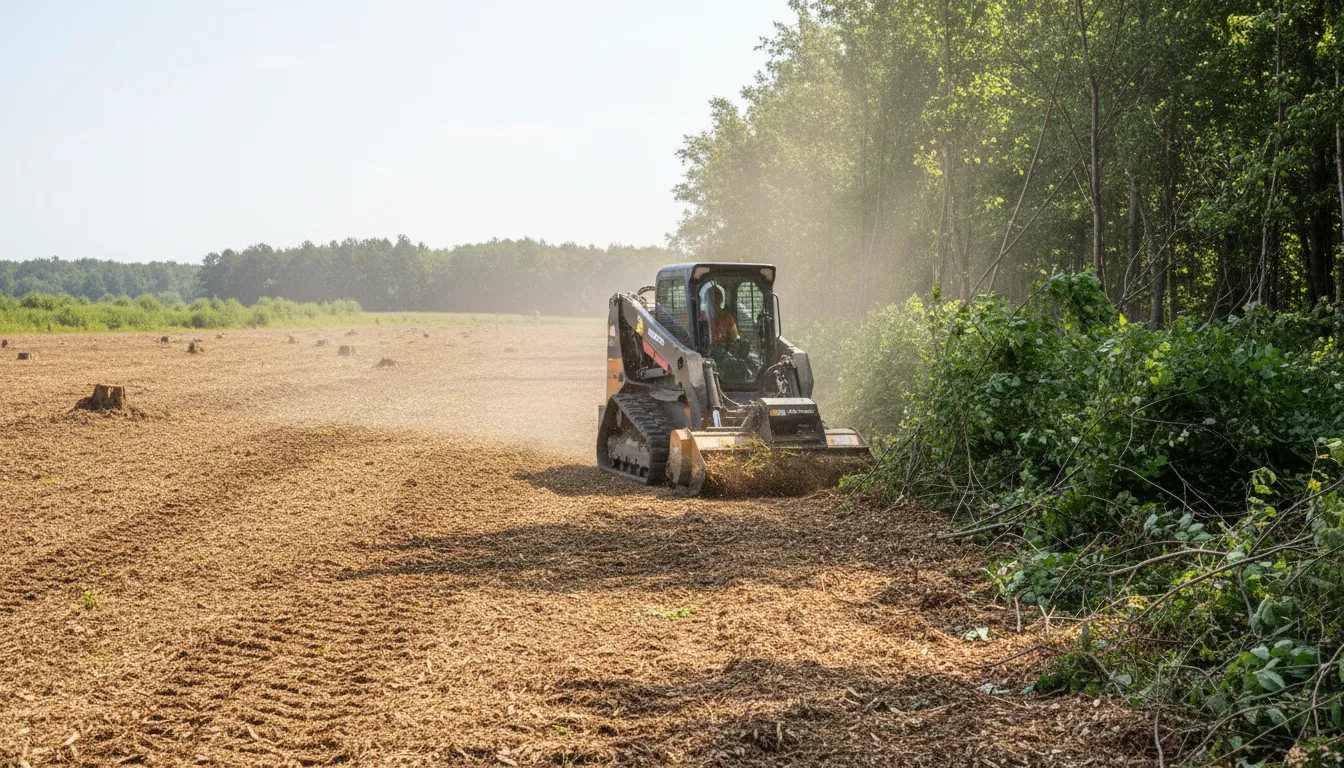
- Mobilization & Clearing: Heavy equipment like bulldozers, excavators, forestry mulchers, and stump grinders is brought in. Methods vary: whole-tree clearing removes everything, selective clearing removes specific trees/brush, and cut-and-grind processes vegetation on-site into mulch.
- Erosion Control Installation: As clearing progresses, silt fences, inlet protections, and other controls from the approved plan are installed.
- Debris Management: Removed trees and brush are either hauled away, chipped for mulch, burned (where permitted), or piled for future use.
- Final Grading & Stabilization: The land is graded to the desired contour, and all disturbed areas are immediately stabilized with seed, mulch, or other cover as per the plan.
Find the perfect land clearing contractors for your needs
Get personalized recommendations and expert advice
Factors Influencing Land Clearing Costs in Delaware
While Delaware-specific pricing examples are not detailed in public guides, costs are influenced by universal factors that apply within the state. Pricing is usually quoted per acre or as a total project price. Key cost drivers include:
- Vegetation Density and Type: This is the biggest factor. Clearing a field of light brush and grass is far less expensive per acre than clearing a dense, mixed forest with large hardwood trees and thick undergrowth.
- Terrain and Accessibility: Steep slopes, rocky ground, or wet, soft soil can slow down equipment and increase costs. Easy access for large machinery helps keep prices lower.
- Debris Disposal: Hauling away tons of logs and brush to a landfill or recycling center adds significant cost (tipping fees + transportation). On-site grinding or mulching may be a more economical option.
- Regulatory Compliance: The time and expertise required to obtain permits, create stormwater plans, and install/ maintain erosion controls are factored into the project cost. This is a non-negotiable expense for compliant work.
- Project Size: There are often economies of scale; clearing 50 acres typically has a lower cost per acre than clearing a single acre.
As a general reference from industry standards, costs can range widely: light brush clearing may range from $1,200 to $2,500 per acre, while clearing a dense forest with large trees can cost $6,000 to $12,000 or more per acre 7. Always get detailed, written estimates from local Delaware contractors that account for site-specific conditions and regulatory requirements.
Choosing a Qualified Land Clearing Professional in Delaware
Given the regulatory complexity, choosing the right contractor is critical. Look for these indicators of a reputable Delaware land clearing service:
- Local Experience & Knowledge: They should be intimately familiar with Delaware's Sediment and Stormwater regulations, SMZ rules, and county-specific requirements.
- Proper Licensing & Insurance: Verify they carry comprehensive liability insurance and workers' compensation. While Delaware may not have a specific "land clearing" license, they should be a registered business in good standing.
- Erosion Control Certification: Ask if their field personnel have the required Delaware-approved erosion and sediment control training 8.
- Portfolio & References: Request examples of past projects of similar scope and size, and contact references to ask about compliance, cleanup, and professionalism.
- Detailed, Written Estimates: A trustworthy quote will break down costs for clearing, debris removal, permitting assistance, and erosion control measures-not just a single bottom-line number.
Frequently asked questions
Sources
Footnotes
-
Delaware 5101 Sediment and Stormwater Regulations - https://regulations.delaware.gov/AdminCode/title7/5101 ↩
-
Construction Activity, Large Area: Agricultural, Residential ... - https://firststeps.delaware.gov/construction_activity_large_area/ ↩
-
Department of Natural Resources and Environmental Control - https://regulations.delaware.gov/register/april2013/proposed/16%20DE%20Reg%201047%2004-01-13.htm ↩
-
Erosion and Sediment Control Field Guide - https://deldot.gov/Business/drc/pdfs/construction/esc_field_guide.pdf ↩
-
401 Forest Service Erosion and Sedimentation Regulations - https://archive.regulations.delaware.gov/AdminCode/title3/400/401.shtml ↩ ↩2
-
DELAWARE SEDIMENT AND STORMWATER REGULATIONS - https://deldot.gov/Programs/stormwater/pdfs/regs.pdf ↩
-
Commercial Land Clearing Guide - https://strongholdtexas.com/a-complete-guide-to-commercial-land-clearing/ ↩
-
E&S Design Guide - Delaware DOT ES2M ... - https://es2mdesignguide.deldot.gov/index.php/E%26S_Design_Guide ↩