Find the Best Land Clearing Contractors for Your Business
No obligation • Fast responses • Nationwide coverage

Why you can trust Landscape Atlas
Landscape Atlas is a leading United States resource for evaluating landscaping, lawn care, and outdoor service providers. Our team researches each category in depth, focusing on service quality, safety, and customer experience. Listings and rankings are based on independent criteria and user feedback, and companies cannot pay to influence our assessments or recommendations.
Search providers near you
Best Land Clearing Contractors in Iowa Ranked
Land clearing is the process of removing trees, brush, stumps, and other obstacles from a piece of land to prepare it for construction, agriculture, or other uses. In Iowa, this work is more than just clearing vegetation; it's a regulated activity focused on protecting the state's valuable soil and waterways from erosion and sediment pollution. Understanding local rules and employing proper techniques is essential for a successful, environmentally responsible project. This guide provides the practical information you need to plan your project and connect with qualified local professionals who understand Iowa's specific requirements.
Understanding Iowa's Erosion Control Regulations
Land clearing in Iowa is governed by a framework designed to minimize soil loss and protect water quality. The primary goal is to prevent sediment-loose soil particles-from leaving your site and entering streams, rivers, and lakes.
- Iowa Department of Natural Resources (DNR): The DNR enforces state rules, including Iowa Code 161A.64, which may require an erosion and sediment control plan for certain land-disturbing activities. Their focus is on preventing pollution from sediment and other contaminants carried by stormwater 1.
- SUDAS Standards: For projects in urban or developing areas, the Statewide Urban Design and Specifications (SUDAS) manual provides detailed, legally recognized standards for erosion and sediment control. These standards align with federal Environmental Protection Agency guidelines and are often adopted by local municipalities.
- Local Permits: Always check with your city or county government. Many jurisdictions have their own permit requirements for land clearing, especially if it involves a certain acreage or is connected to a larger development project.
Failure to implement proper controls can result in fines, stop-work orders, and costly remediation efforts to repair damaged waterways or neighboring properties.
The Critical Role of Vegetation and Roots
A fundamental principle of responsible site work in Iowa is preserving existing vegetation wherever possible. Plants, grasses, and trees are nature's most effective erosion control system 2.
- Soil Binding: Root systems physically hold soil in place, creating a stable matrix that resists being washed away by rain or wind 3.
- Runoff Reduction: Canopies intercept rainfall, reducing the impact of droplets on bare soil. Vegetation also slows the flow of water across the land, allowing more time for it to soak into the ground 4.
- Infiltration Improvement: Organic matter from plants improves soil structure, increasing its ability to absorb and filter water 5.
When clearing is necessary, the strategy should shift to minimal disturbance. This means clearing only what is absolutely required and immediately stabilizing any exposed soil.
Approved Methods for Land Clearing and Stabilization
Professional land management companies in Iowa use a combination of clearing and stabilization techniques to meet regulatory and environmental goals.
Clearing Methods:
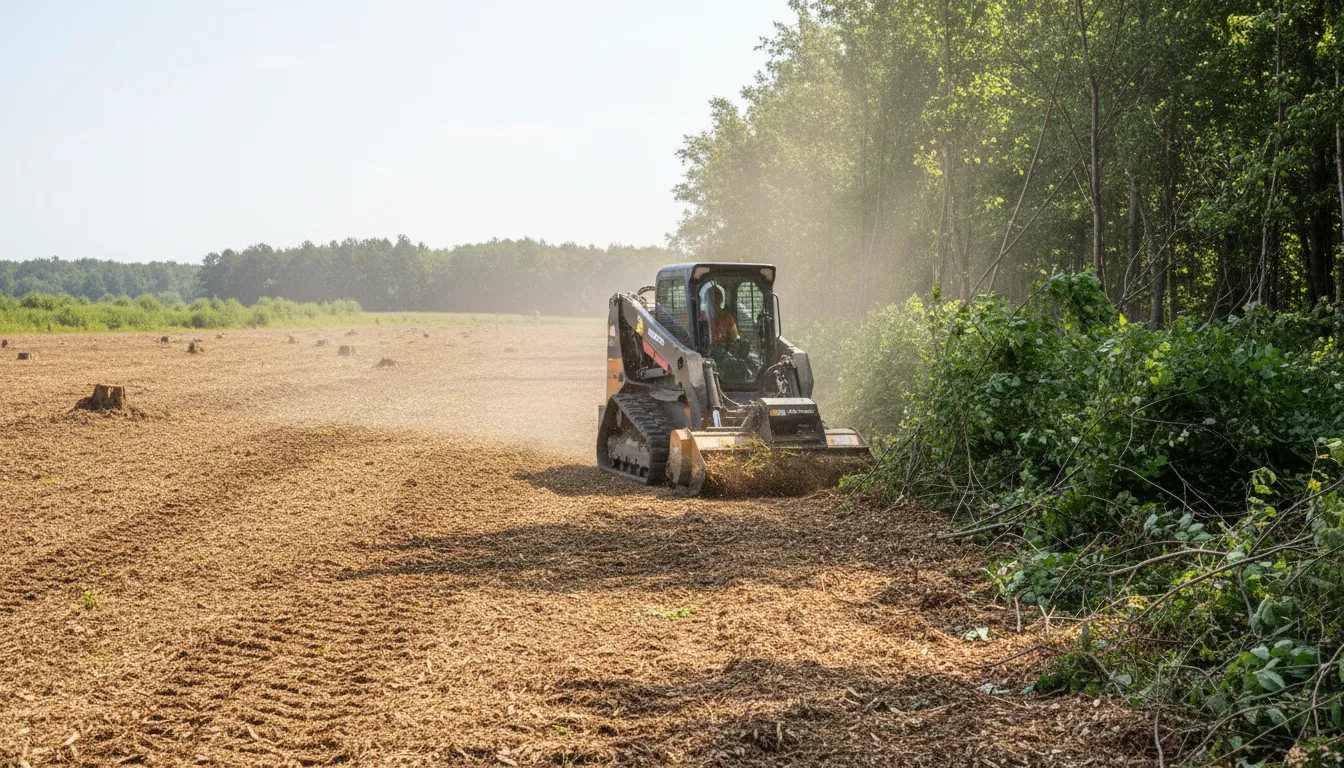
- Mulching: Using specialized equipment to grind trees and brush into wood chips on-site. This method is often preferred as it avoids hauling away organic material, leaving a protective layer of mulch that immediately helps suppress weeds and reduce erosion.
- Selective Clearing: Removing specific trees or brush while leaving desirable trees, groundcover, or vegetative buffers near waterways intact.
- Grading and Excavation: Using bulldozers and excavators to remove stumps, rocks, and level the land. This is often followed by the most critical step: stabilization.
Essential Erosion Control Practices (Best Management Practices - BMPs): After clearing, exposed soil must be protected. Common BMPs required in Iowa include 6:
- Silt Fences: Temporary sediment barriers made of geotextile fabric installed along the downhill perimeter of a site.
- Straw Wattles or Logs: Tubular devices placed on slopes or along contours to slow water flow and trap sediment.
- Seeding and Mulching: Applying a fast-growing temporary (e.g., annual ryegrass) or permanent grass seed mix, then covering with straw or mulch to hold soil and promote germination.
- Rolled Erosion Control Products (RECPs): Blankets or mats made of straw, coconut fiber, or synthetic materials that are rolled out over seeded areas to protect the soil from raindrop impact and hold moisture for growth.
- Sediment Basins: Small temporary ponds that collect runoff, allowing sediment to settle out before water is released from the site.
Find the perfect land clearing contractors for your needs
Get personalized recommendations and expert advice
What to Expect: Project Scope and Cost Factors
The cost and complexity of land clearing in Iowa are highly variable and depend entirely on your specific site conditions and the required level of erosion control.
Key Cost Drivers:
- Vegetation Density and Type: Clearing a thicket of small brush is less expensive than removing an acre of mature hardwood trees with large stumps.
- Terrain and Slope: Steep slopes are more challenging to work on and require more extensive (and costly) erosion controls like wattles, terraces, or RECPs 7.
- Disposal Needs: If debris must be hauled off-site (instead of being mulched), costs for transportation and tipping fees at a landfill or composting facility add up quickly.
- Erosion Control Measures: This is often a significant line item. Installing silt fencing, seeding, mulching, and other BMPs are not optional extras in Iowa-they are necessary project components, and their cost should be included in any quote 8 9.
- Project Size: While large acreage projects may have a lower per-acre rate, the total cost is substantial. Small residential lots are often priced as a complete project.
General Cost Ranges: These are broad estimates; obtaining local quotes is essential.
- Small Residential Properties: For basic clearing of brush and small trees on a lot, costs can range from $500 to $2,000+ per acre. The final price can increase significantly with stump removal, rocky soil, or stringent municipal requirements for stabilization 10.
- Large Rural or Commercial Properties: Projects spanning multiple acres are often priced per acre. Expect a range of $1,000 to $4,000+ per acre. The high end reflects dense timber, difficult terrain, and comprehensive stormwater management plans 11.
The Quote Process: When seeking estimates, provide contractors with as much detail as possible. Walk the site together and discuss:
- Your intended use for the land after clearing.
- Any specific trees or areas to preserve.
- Your local permit and erosion control plan requirements. A reputable Iowa contractor will assess these factors and provide a detailed quote that includes all necessary clearing, grubbing, and post-clearing stabilization work.
Planning for Success: A Step-by-Step Approach
- Define Your Goal: Be clear about why you are clearing the land (e.g., new home site, pasture expansion, wildlife habitat improvement). This determines the scope.
- Research Local Rules: Contact your city hall or county planning department to inquire about permit requirements for land disturbance.
- Consult Professionals: Seek multiple quotes from experienced Iowa land clearing and earthwork companies. Ask for references and examples of past projects where they implemented erosion controls.
- Develop a Plan: Work with your chosen contractor to ensure an erosion and sediment control plan is in place before work begins. This plan should detail the BMPs to be used and their maintenance schedule.
- Inspect and Maintain: Once controls are installed, they require maintenance. Silt fences need to be checked after rain, and seeded areas may require watering. Ensure this responsibility is clear in your contract.
By prioritizing soil stability and water protection from the start, your land clearing project in Iowa can achieve its purpose while safeguarding the state's natural resources for the future.
Frequently asked questions
Sources
Footnotes
-
SUMMARY GUIDANCE - Iowa DNR - https://www.iowadnr.gov/media/5843 ↩
-
The Effects of Forest Management on Erosion and Soil Productivity - https://forest.moscowfsl.wsu.edu/smp/docs/docs/Elliot_1-57444-100-0.html ↩
-
How do Plants Help Prevent Erosion? Key Benefits Explained - https://erosionmanagementservices.com/blog/how-do-plants-help-in-erosion-control-essential-insights-and-benefits/ ↩
-
Soak Up the Rain: Trees Help Reduce Runoff | US EPA - https://www.epa.gov/soakuptherain/soak-rain-trees-help-reduce-runoff ↩
-
The Role of Vegetation in Erosion Control and Sedimentation - Valor - https://www.valorenv.com/the-role-of-vegetation-in-erosion-control-and-sedimentation/ ↩
-
Chapter 7 - Erosion and Sediment Control - Iowa's SUDAS - https://www.iowasudas.org/wp-content/uploads/sites/15/2023/12/Chapter_07-2023.pdf ↩
-
Erosion Control Practices - Iowa Stormwater Education Partnership - https://iowastormwater.org/regulations/erosion-control-practices/ ↩
-
Erosion and Sediment Control Field Guide - https://iowadot.gov/media/421/download?inline ↩
-
Eco-Friendly Land Clearing Methods That Protect Your Property - https://pblandmgt.com/eco-friendly-land-clearing-methods-that-protect-your-property/ ↩
-
How Much Does It Cost to Clear Trees Off 1 Acre? - https://www.diamondtreeexperts.com/how-much-does-it-cost-to-clear-trees-off-1-acre/ ↩
-
Cost Estimation for Land Clearing - https://rrconstructioninc.com/2023/10/cost-estimation-for-land-clearing/ ↩