Find the Best Land Clearing Contractors for Your Business
No obligation • Fast responses • Nationwide coverage

Why you can trust Landscape Atlas
Landscape Atlas is a leading United States resource for evaluating landscaping, lawn care, and outdoor service providers. Our team researches each category in depth, focusing on service quality, safety, and customer experience. Listings and rankings are based on independent criteria and user feedback, and companies cannot pay to influence our assessments or recommendations.
Search providers near you
Best Land Clearing Contractors in Maine Ranked
Preparing land for construction, agriculture, or restoration in Maine requires careful planning and adherence to strict environmental regulations. Land clearing, the process of removing trees, brush, and other vegetation from a parcel, is governed by state and local rules designed to protect Maine's valuable natural resources, particularly its waterways. Understanding these regulations-especially Shoreland Zoning and erosion control laws-is essential for any property owner. This guide provides a clear overview of the rules, processes, and costs, helping you navigate your project and connect with experienced local professionals who can ensure compliance and proper execution.
Understanding Maine's Shoreland Zoning Rules
Maine's iconic lakes, rivers, and coastal areas are protected by Shoreland Zoning laws. These regulations apply within 250 feet of lakes and rivers, 75 feet of streams, and around wetlands. The primary goal is to preserve water quality, wildlife habitat, and the scenic character that defines the state.
If your project is within a protected shoreland area, you face significant restrictions on vegetation removal:
- Buffer Zones: The area closest to the water is a protected buffer. New structures are generally prohibited here, and existing vegetation should be maintained 1.
- Tree Removal Limits: Within the first 75 feet from the water, you are generally limited to removing only 40% of the total tree volume (for trees over 4 inches in diameter) over any 10-year period 2 3. This prevents clear-cutting and ensures a maintained forest canopy.
- Canopy Openings: To preserve the visual buffer from the water, openings in the tree canopy are restricted. You may create small openings (e.g., for a view or path), but they are typically limited to 250 square feet within 100 feet of the water 4.
Crucial First Step: Always check with your local municipal Code Enforcement Officer (CEO) before any clearing begins. Many towns have ordinances that are stricter than the state's baseline rules 5.
Erosion and Sedimentation Control: A Legal Requirement
Beyond zoning, Maine law requires that all land-disturbing activities, including clearing, prevent "unreasonable" soil erosion and sediment from entering water bodies 6 7. This isn't just a suggestion-it's a mandatory part of project planning.
You must implement Best Management Practices (BMPs) before starting work and maintain them until the site is permanently stabilized 8 9. Common and required BMPs include:
- Silt Fences: Placed downhill from the work area to trap sediment.
- Sediment Traps or Basins: Small ponds that capture runoff and allow sediment to settle.
- Diversion Ridges or Berms: To redirect clean water away from disturbed soil.
- Immediate Stabilization: Exposed soil must be covered as quickly as possible with seed, mulch, straw blankets, or other materials to prevent erosion 10.
Failure to properly control erosion can lead to fines, project delays, and damage to local ecosystems. Professional land clearing services are familiar with these requirements and will include necessary BMPs in their work plan and cost estimate.
The Land Clearing Process: Steps for Compliance
A successful, compliant land clearing project in Maine follows a logical sequence:
- Site Assessment & Planning: A professional will evaluate your property's topography, soil type, vegetation, and proximity to water. This assessment determines the best methods and equipment.
- Permitting and Approvals: Based on the assessment, you'll identify needed permits. This almost always involves a visit to your town office to consult the CEO and may require a permit from the Maine Department of Environmental Protection for sites near protected resources.
- Implementing Erosion Controls (BMPs): Before any trees are cut or ground is broken, install the planned silt fences, sediment traps, and diversions.
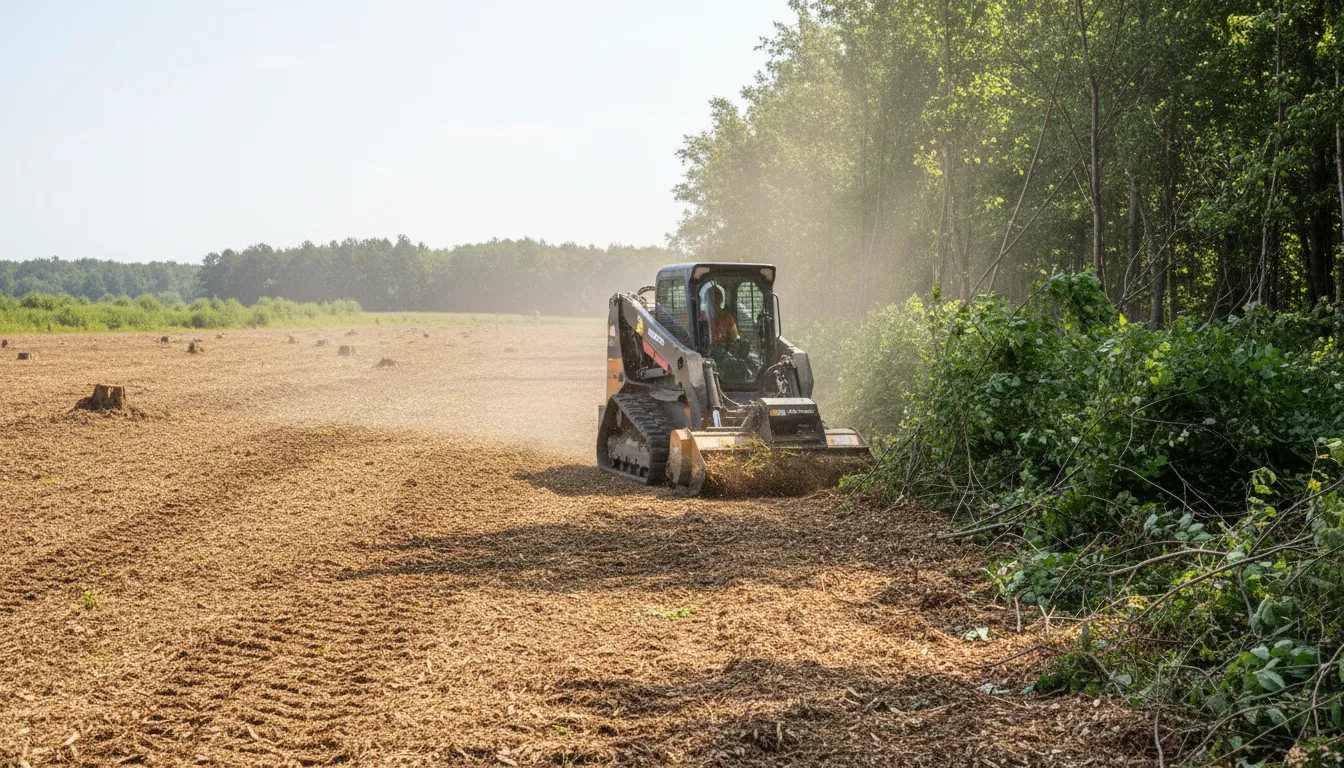
- Vegetation Removal: Using equipment like excavators with mulching heads, bulldozers with rakes, or traditional logging equipment, the clearing work begins. In sensitive areas, hand-cutting may be necessary.
- Stump Removal and Grinding: Stumps can be excavated or ground down below the surface.
- Debris Management: Brush may be chipped for mulch, timber may be harvested, and non-usable debris is often piled for controlled burning (with a permit) or hauled away.
- Final Grading and Stabilization: The land is graded to the desired contour and immediately seeded, mulched, or otherwise covered to prevent erosion.
Find the perfect land clearing contractors for your needs
Get personalized recommendations and expert advice
Cost Factors for Land Clearing in Maine
Costs in Maine vary dramatically based on your site's specific characteristics. While average price ranges provide a starting point, your final quote will depend on the following factors:
- Terrain and Slope: Steep, rocky, or wet land is more difficult and expensive to clear than flat, dry ground.
- Vegetation Density and Type: Clearing a field of light brush is far less costly than clearing a dense, mature forest with large hardwood trees.
- Site Access: Easy access for large equipment keeps costs down. Tight, restricted access may require smaller, less efficient machinery or manual labor.
- Erosion Control Requirements: The need for extensive silt fencing, sediment basins, and stabilization materials adds to the project cost.
- Debris Disposal: Hauling away debris is a significant cost factor. On-site chipping or burning (where permitted) can reduce expenses.
Estimated Cost Ranges
- Per Acre Estimates:
- Light Brush/Grass: $700 - $2,000
- Lightly Wooded: $2,000 - $3,500
- Heavily Wooded or Rocky Terrain: $3,500 - $8,000+
- Per Square Foot Estimates (often for smaller projects):
- Flat Land with Small Trees: $1 - $2
- Thick Forest or Hilly Land: $6 - $8+ 11
Remember: These are broad estimates. The only way to get an accurate cost is to have a qualified professional assess your specific property.
Why Professional Expertise is Essential
Given the complex regulatory environment in Maine, hiring a professional is strongly advised. Experienced contractors:
- Understand Local and State Regulations: They know how to navigate permits with town CEOs and the DEP.
- Implement Required BMPs: They will install and maintain proper erosion controls to keep your project legal and protect the environment.
- Have the Right Equipment: They use specialized machinery suited to Maine's terrain, which is safer and more efficient than DIY attempts.
- Provide Liability Insurance: Professional services carry insurance, protecting you from potential property damage or accident-related costs.
- Ensure Proper Disposal: They know the legal and efficient ways to handle cleared debris.
Frequently asked questions
Sources
Footnotes
-
MAINE SHORELAND ZONING - https://www.mainerealtors.com/wp-content/uploads/2019/02/citizenguide.pdf ↩
-
Maine Lakes Vegetative clearing standards - https://mainelakes.org/resources/landowners/vegetative-clearing-standards/ ↩
-
DEP ISSUE PROFILE - Clearing Vegetation in the Shoreland Zone - https://www.maine.gov/dep/land/slz/ip-szveg.pdf ↩
-
Vegetation Clearing - Consider the Impact - Harpswell, Maine - https://www.harpswell.maine.gov/vertical/sites/%7B3F690C92-5208-4D62-BAFB-2559293F6CAE%7D/uploads/Vegetation_Clearing_-_Consider_the_Impact.pdf ↩
-
Issue Profile Clearing Vegetation in the Shoreland Zone - Maine.gov - https://www.maine.gov/dep/land/slz/ip-szveg.html ↩
-
Title 38, §490-M: Erosion control requirements for clay, topsoil, or silt excavations of less than 5 acres - https://www.mainelegislature.org/legis/statutes/38/title38sec490-M.html ↩
-
Erosion & Sedimentation Control Law - Maine.gov - https://www.maine.gov/dep/land/stormwater/erosion.html ↩
-
Erosion & Sedimentation Control, Land Resources, Maine Department of Environmental Protection - https://www.maine.gov/dep/land/erosion/index.html ↩
-
MAINE EROSION AND SEDIMENT CONTROL BEST ... - https://www.maine.gov/dep/land/erosion/escbmps/esc_bmp_engineers.pdf ↩
-
Maine Erosion and Sediment Control Practices Field Guide for ... - https://www.maine.gov/dacf/lupc/laws_rules/materials_incorporated/MaineErosionSedimentationControlPracticesFieldGuideForContractors_2015.pdf ↩
-
Land Clearing Cost Per Square Foot: Why $1-$8 Only Tells Half the ... - https://www.bucktowngradingandconstruction.com/land-clearing-cost-per-square-foot-why-1-8-only-tells-half-the-story/ ↩