Find the Best Land Clearing Contractors for Your Business
No obligation • Fast responses • Nationwide coverage

Why you can trust Landscape Atlas
Landscape Atlas is a leading United States resource for evaluating landscaping, lawn care, and outdoor service providers. Our team researches each category in depth, focusing on service quality, safety, and customer experience. Listings and rankings are based on independent criteria and user feedback, and companies cannot pay to influence our assessments or recommendations.
Search providers near you
Best Land Clearing Contractors in Mississippi Ranked
Land clearing is the essential first step for many property development projects, from building a new home to creating agricultural fields or preparing commercial sites. In Mississippi, this process involves more than just removing trees and brush; it requires careful planning to comply with state environmental regulations, control erosion, and ensure the long-term health and stability of the land. This guide provides a clear, practical overview of what Mississippi property owners need to know about site clearing, including key regulations, best practices, and cost considerations, to help you connect with qualified local professionals for your project.
Understanding Mississippi's Land Clearing Regulations
Before any machinery arrives on-site, understanding the regulatory landscape is crucial. Mississippi has specific guidelines designed to protect its waterways, soil, and native ecosystems during development activities.
Permit Requirements: A permit is generally required for intensive clearing, especially in designated Primary Conservation Areas (PCAs) such as shore impact zones near lakes and rivers. Obtaining a permit often involves submitting a site plan that includes a restoration strategy to stabilize the soil after clearing. For projects near streams, the rules become even more stringent within Stream Management Zones (SMZs), which are buffers designed to protect water quality. 1
Key Restrictions in Sensitive Areas:
- Stream Protection: Within SMZs, using the stream channel itself for equipment access or as a sediment trap is prohibited. The number of stream crossings must be minimized, and any crossing must be designed to maintain bank stability and prevent silt from entering the water.
- Erosion Control Planning: A formal plan for erosion and sediment control is a fundamental part of the permitting process for any significant clearing project. 2 This plan must be implemented before clearing begins.
Best Practices for Sustainable Site Clearing
Following established best management practices (BMPs) isn't just about compliance; it's about responsible stewardship of your property and preventing costly problems like washouts or sedimentation fines.
Vegetation Selection & Preservation: The goal isn't to strip the land bare, but to clear selectively. The focus should be on preserving long-lived, structurally sound native trees that provide wildlife habitat, aesthetic value, and have strong root systems to hold soil. 3 4 Unhealthy, weak, or invasive species are typically prioritized for removal. A thoughtful approach to what stays and what goes lays the foundation for a stable and attractive property.
Erosion Control During Clearing: The most critical period for soil loss is during and immediately after clearing. Effective, on-the-ground measures are non-negotiable:
- Silt Fences: These temporary barriers are installed along the downhill perimeter of the work area to trap sediment runoff.
- Mulching: Applying a layer of mulch to exposed soil helps absorb the impact of rainfall, reduces surface runoff, and retains moisture for new grass seed.
- Prompt Re-Vegetation: The single most important practice is to grade and establish new ground cover (grass, native plants, or mulch) on cleared areas as soon as possible. Leaving soil bare for extended periods invites erosion. 5
Post-Clearing Land Management: The work doesn't end when the trees are removed. New vegetation needs to be maintained for several years to ensure it becomes fully established. Ongoing vigilance is also required to control invasive plant species that might colonize the disturbed soil.
Find the perfect land clearing contractors for your needs
Get personalized recommendations and expert advice
Cost Factors for Land Clearing in Mississippi
The cost to clear land in Mississippi is highly variable and depends on several site-specific factors. While averages provide a starting point, getting detailed quotes from local contractors is essential.
Primary Cost Drivers:
- Tree Density and Size: This is the biggest factor. A lightly wooded acre with small trees and brush will cost significantly less than an acre of dense, mature hardwood forest.
- Terrain and Accessibility: Steep slopes, rocky ground, and poor access for heavy equipment will increase labor time and complexity, raising costs.
- Project Scale: Larger projects (multiple acres) may benefit from a lower per-acre rate, but the total cost will be higher. Small residential lots (under an acre) often have a higher effective cost per acre due to fixed mobilization and equipment setup fees.
- Disposal Method: Costs change if debris is hauled away, chipped on-site for mulch, or piled for burning (where permitted).
Estimated Cost Ranges: General costs for professional land clearing in Mississippi can range from $1,500 to $5,000+ per acre. 6 More specific breakdowns include:
- Lightly Wooded Land: Approximately $700 - $2,300 per acre.
- Heavily Wooded Land: Approximately $3,400 - $6,100+ per acre.
- Small Lot Clearing (under 1 acre): Total project costs can range from $800 to $6,000, depending on conditions. 7
- Large Multi-Acre Projects: Total costs frequently exceed $10,000. 8
These figures typically cover basic clearing, grubbing (removing stumps and roots), and rough grading. They may not include permits, specialized erosion control installations, final fine grading, or seeding.
Choosing the Right Land Clearing Method
Different projects call for different techniques. The most common methods used in Mississippi include:
- Bulldozing and Grubbing: The traditional method using a bulldozer with a rake or blade to push over trees and vegetation, followed by a machine to dig out stumps and roots. It's efficient for large, open areas but can cause significant soil disturbance.
- Excavator-Based Clearing: Using an excavator provides more precision for selective tree removal, stump pulling, and grading in tighter spaces or on uneven terrain.
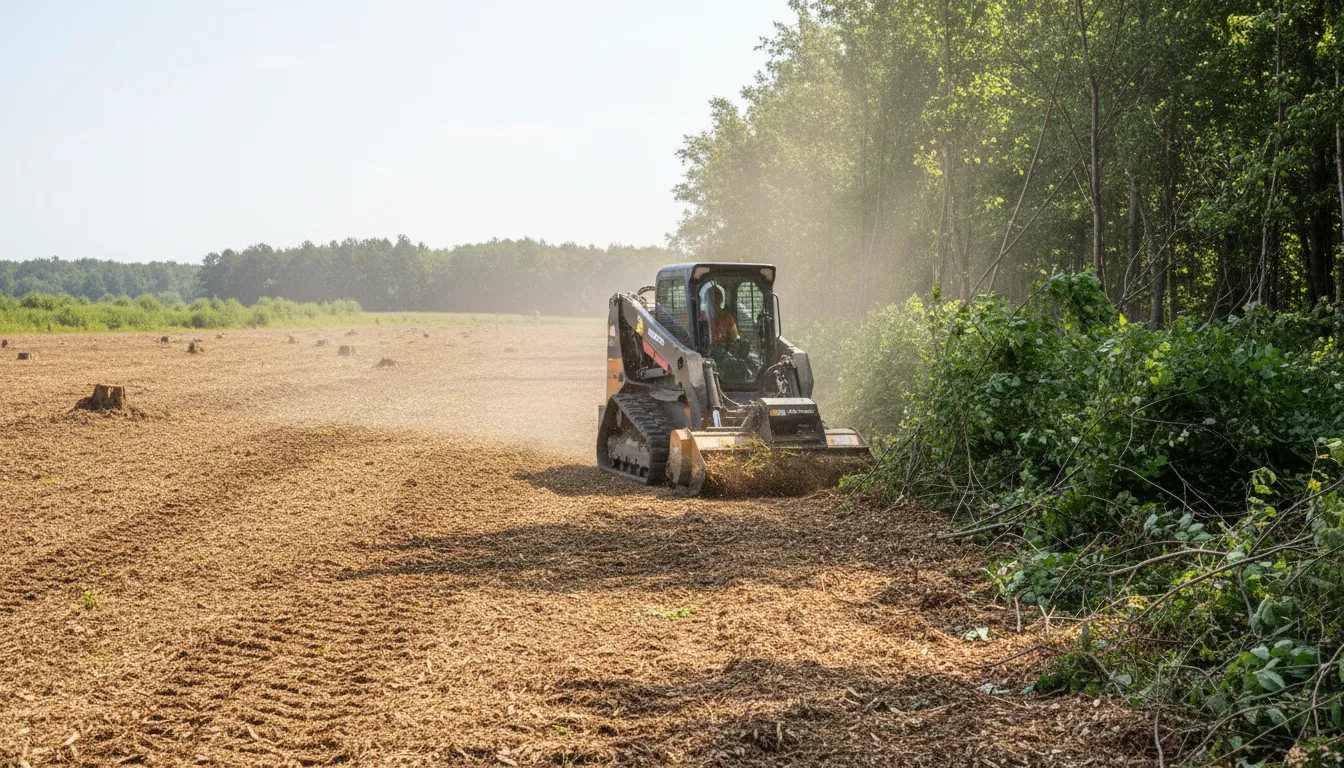
- Forestry Mulching: A versatile method that uses a single machine to cut, grind, and mulch trees and brush into small wood chips, which are left on-site as erosion-controlling ground cover. This is excellent for selective clearing, wetland margins, and slopes where minimal soil disturbance is desired. 9
- Cut and Haul: Involves manually or mechanically cutting trees, processing them, and hauling the debris away. This is often used when wood has value or when on-site mulch is not desired.
The choice depends on your final land use, the need to preserve topsoil, budget, and the contractor's assessment of the most efficient approach for your specific site conditions.
Planning Your Project: A Step-by-Step Overview
- Define Your Goal: Clearly identify the end use of the land (e.g., home site, pasture, commercial lot). This drives the extent of clearing needed.
- Conduct a Site Assessment: Walk the property with a professional to identify sensitive areas (streams, wetlands, slopes), desirable trees to save, and the general density of vegetation.
- Check Local Regulations: Contact your local county or city planning office and the Mississippi Department of Environmental Quality (MDEQ) to determine permit requirements for your location and project scope. 10
- Develop a Preliminary Plan: Create a sketch marking areas for clearing, areas for preservation, and the location for necessary erosion controls like silt fences.
- Obtain Multiple Quotes: Get detailed written estimates from several licensed and insured contractors. Ensure quotes specify the scope of work, cleanup level, disposal method, and timeline.
- Secure Permits: Finalize and submit your site plan and erosion control plan for any required permits before work begins.
- Execute with Oversight: Once clearing starts, monitor the work to ensure it adheres to the agreed plan and that erosion controls are properly maintained throughout the process.
- Final Stabilization: Ensure the contractor completes the job by properly grading the site and establishing permanent vegetation or mulch on all disturbed areas.
By taking a planned, informed approach to land clearing in Mississippi, you can transform your property responsibly, protect its environmental value, and create a stable foundation for whatever comes next.
Frequently asked questions
Sources
Footnotes
-
Property Owner Guidance for Vegetation Clearing Permits in ... - https://www.hastingsmn.gov/media/dc1fdstg/property-owner-guide-mrcca-vegetation-clearing-permiting.pdf ↩
-
General Planning Concepts for Erosion Control, Sediment ... - https://opcgis.deq.state.ms.us/Erosion_Stormwater_Manual_2ndEd/Volume1/V1_Chap2_Gen_Plan_Concep_Eros_Ctrl.pdf ↩
-
BMPs - Mississippi Forestry Commission - https://www.mfc.ms.gov/wp-content/uploads/2020/03/Entire_bmp_2008-7-24_2.pdf ↩
-
Property Owner Guidance for Vegetation Clearing Permits in the ... - https://www.cityoframsey.com/DocumentCenter/View/4468/Vegetation-Permit-Property-Owner-Guide ↩
-
Property Owner Guidance for Vegetation Clearing Permits in the ... - https://www.southstpaul.org/DocumentCenter/View/9450/Vegetation-Permit-Property-Owner-Guide ↩
-
Dirt Work & Land Clearing Costs in Brandon, MS - https://msdirt.com/uncategorized/dirt-work-land-clearing-cost-mississippi/ ↩
-
How Much Does it Cost to Clear Land in 2026? - Lawn Love - https://lawnlove.com/blog/land-clearing-cost/ ↩
-
How Much Does Land Clearing in Mississippi Cost? - https://heckservices.com/blog/how-much-does-land-clearing-in-mississippi-cost/ ↩
-
Land Clearing Method is Most Effective for Construction? - https://mississippilandclearing.net/2025/02/27/which-land-clearing-method-is-most-effective-for-commercial-construction-in-mississippi-2/ ↩
-
FIELD MANUAL - Mississippi Department of Environmental Quality - https://www.mdeq.ms.gov/wp-content/uploads/2009/08/NPS_FieldManualV2.pdf ↩