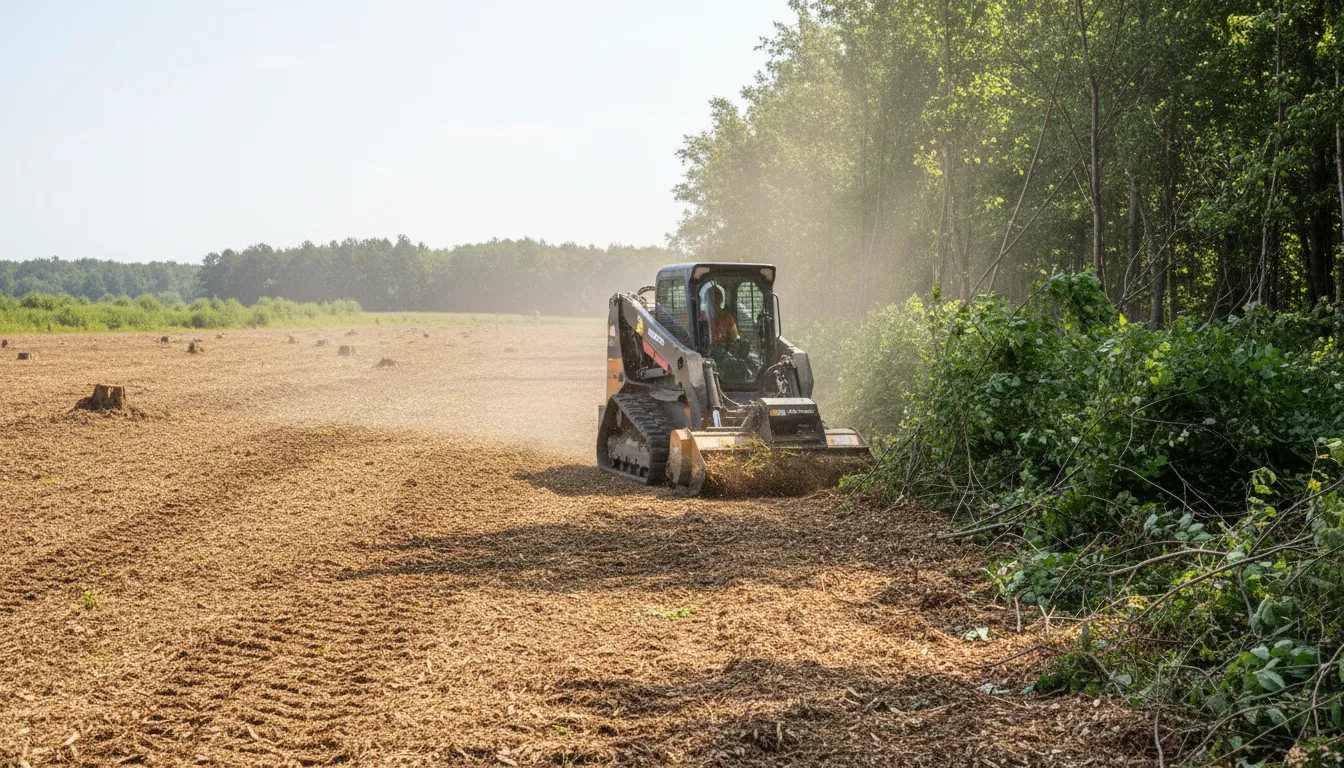
Find the Best Land Clearing Contractors for Your Business
No obligation • Fast responses • Nationwide coverage

Why you can trust Landscape Atlas
Landscape Atlas is a leading United States resource for evaluating landscaping, lawn care, and outdoor service providers. Our team researches each category in depth, focusing on service quality, safety, and customer experience. Listings and rankings are based on independent criteria and user feedback, and companies cannot pay to influence our assessments or recommendations.
Search providers near you
Best Land Clearing Contractors in North Carolina Ranked
Land clearing is a critical first step for many property development, agricultural, and construction projects in North Carolina. It involves the removal of trees, stumps, brush, and other obstacles to prepare a site for its intended use. In a state with diverse terrain and significant environmental regulations, proper site clearing is not just about removing vegetation-it's about managing soil, controlling erosion, and complying with state laws to protect waterways and neighboring properties. This resource connects you with essential information and local professionals who understand the specific requirements for clearing land across North Carolina's coastal plains, Piedmont, and mountain regions.
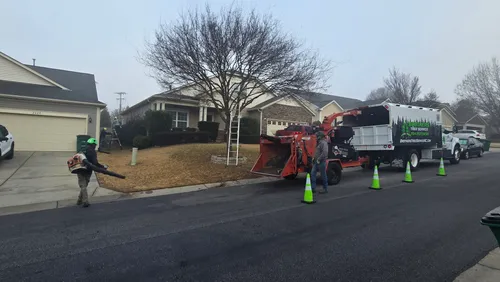
Brothers Tree Service NC , LLC
1005 Dataw Ln, Indian Trail, NC 28079
Brothers Tree Service NC, LLC is a family-run tree service and land clearing company based near Charlotte, NC. They offer tree removal, stump grinding, pruning, and lot clearing services. The company emphasizes skill and safety in tree removal and provides thorough cleanup after work. Founded by two brothers, Omar and Uriel, the team is composed of family members dedicated to honest and respectful customer service. They provide service Monday through Friday around the clock, with limited weekend availability by appointment.

Fredin Tree Service LLC
6103 Hushpuppy Ct, Raleigh, NC 27616
Fredin Tree Service LLC is a family-owned tree care company based in Raleigh, NC. They provide a range of services including tree removal, pruning, stump grinding, lot clearing, and emergency tree service. With 16 years of experience, their skilled team uses modern equipment and local tree knowledge to deliver safe and efficient solutions. They also offer professional stump grinding and site clearing to prepare properties for future use.

Green Bear Tree Service LLC
1801 Larkhill Ct, Kernersville, NC 27284
Green Bear Tree Service LLC offers a range of tree care and land clearing services in Winston Salem, NC. Their expertise includes tree removal, trimming, pruning, stump grinding, brush removal, and emergency storm damage cleanup. With over a decade of experience, they serve residential and commercial clients in the area, providing skilled and safe solutions for both routine and urgent tree care needs. The company has been recognized for its work in Forsyth, Guilford, and Davidson Counties and is known for handling emergency tree removal efficiently.
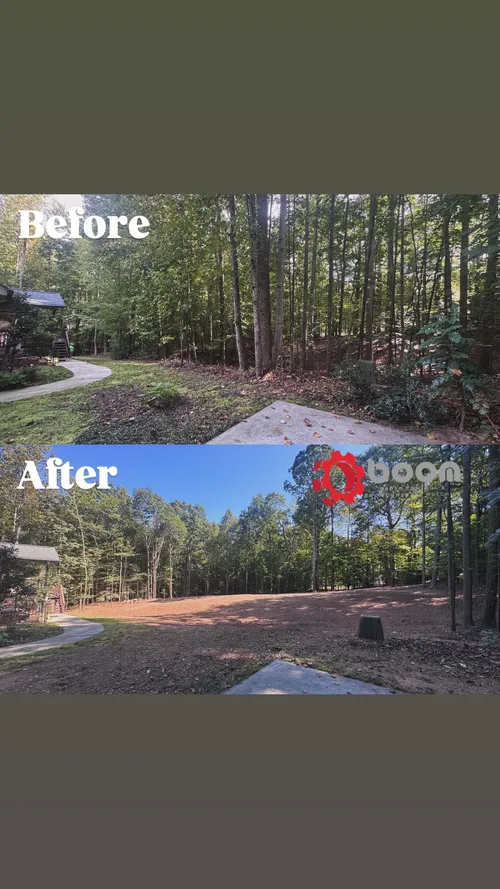
Boom Brush Control Land Management
912 Rising Rd, Waxhaw, NC 28173
Boom Brush Control Land Management is a veteran-owned small business based near Charlotte, NC, specializing in land clearing and forestry mulching. They offer services such as tree removal, brush clearing, and sustainable land management practices like silvopasture. Their forestry mulching technique uses specialized machinery to clear vegetation while preserving soil health by leaving mulch on-site. With over 20 years of experience in customer service, the owner Chris Roussell leads the company with a focus on environmentally friendly and efficient land management solutions. Boom Brush Control serves a range of clients including farms, commercial properties, and government contracts across Charlotte and surrounding areas.

Edgar's Tree Service
Raleigh, NC
Edgar's Tree Service provides comprehensive tree care and land clearing services in Raleigh, NC. Their skilled arborists handle tree pruning, removal, stump grinding, brush removal, and chipping with a focus on safety and customer-specific solutions. The company is fully insured and offers 24/7 emergency tree removal, specializing in storm damage cleanup for properties affected by severe weather. Serving multiple nearby communities, Edgar's Tree Service combines professional expertise with tailored service to maintain safe and attractive outdoor spaces.
Understanding North Carolina's Land Clearing Regulations
Before any machinery arrives on your property, it's crucial to understand the regulatory landscape. North Carolina takes soil erosion and sediment control seriously to protect its extensive network of rivers, streams, and lakes. The primary governing rule is the Sedimentation Pollution Control Act (SPCA).
The most important regulatory threshold is the one-acre rule. Any land-disturbing activity that will disturb more than one acre of land requires the submission and approval of an Erosion and Sediment Control Plan (ESCP) to the North Carolina Department of Environmental Quality (NCDEQ) at least 30 days before work begins. This formal plan details exactly how runoff and displaced soil will be managed throughout the project.
For projects disturbing less than one acre, a formal ESCP submission is not required. However, this does not mean "no rules apply." Property owners and contractors are still legally obligated to implement effective erosion and sediment control measures to prevent pollution from leaving the site. Common-sense practices like silt fencing and stabilized construction entrances are still mandatory.
Certain activities are exempt from the formal plan submission requirement, even on larger tracts. These generally include ongoing agricultural operations and forestry activities, provided they follow approved Best Management Practices (BMPs). It's always wise to confirm the specific requirements for your project with local authorities or a qualified professional.
The Critical Role of Vegetation in Erosion Control
Clearing land inherently removes the natural defense system against erosion: vegetation. Trees, shrubs, grasses, and their root networks perform several vital functions:
- Soil Binding: Root systems physically hold soil particles together, creating a stable matrix that resists being washed away by water 1.
- Rainfall Interception: Canopies break the force of raindrops, preventing soil compaction and the dislodging of particles that leads to sheet erosion.
- Runoff Reduction: Vegetation absorbs water and slows its flow across the land surface, allowing more time for infiltration into the soil 2.
- Organic Matter: Decaying plant material improves soil structure, increasing its ability to absorb and retain water.
When this vegetation is removed, especially on steep slopes common in the Piedmont and Western NC, the risk of severe erosion and even slope failure increases dramatically 3. Therefore, a responsible clearing plan doesn't just remove vegetation; it includes a strategy for either preserving key areas (like stream buffers) or immediately replacing lost ground cover with temporary or permanent stabilization methods.
Standard Erosion and Sediment Control Methods
Professional land clearing contractors employ a suite of techniques to manage soil during and after clearing. These methods are often required components of an ESCP.
- Silt Fences: Temporary sediment barriers made of geotextile fabric, installed downhill of disturbed areas to pond sediment-laden water and allow soil particles to settle out.
- Erosion Control Blankets (ECBs): Rolled blankets made of straw, coconut fiber, or other biodegradable materials laid on bare soil slopes or drainage channels. They protect the soil from raindrop impact and slow runoff until new vegetation establishes 4.
- Mulching: Applying a layer of wood chips or shredded vegetation (often produced on-site via forestry mulching) protects bare soil, retains moisture, and adds organic matter.
- Sediment Basins and Traps: Small temporary ponds constructed to capture runoff from a site, allowing sediment to settle before the water is discharged 5.
- Stabilized Construction Exit: A pad of stone at all vehicle exits to clean tires and prevent tracking mud onto public roads.
Find the perfect land clearing contractors for your needs
Get personalized recommendations and expert advice
Land Clearing Techniques and Cost Considerations
The method chosen for clearing your North Carolina land significantly impacts the project's cost, timeline, and environmental footprint. Common techniques include:
- Bulldozing and Grubbing: Traditional method using heavy equipment to push over trees, remove stumps and roots. Effective for large, open areas but can cause significant soil disturbance.
- Forestry Mulching: An efficient, single-step method using a specialized machine that cuts, grinds, and mulches vegetation in place. This leaves a protective layer of mulch on the ground, which drastically reduces erosion, suppresses regrowth, and improves soil health. It's ideal for sensitive areas and slopes.
- Excavator Clearing: Using hydraulic excavators with shear or grapple attachments for selective clearing or working in tight, wooded areas.
- Hand Clearing: Labor-intensive but precise, used for small areas, sensitive environmental zones, or selective removal.
Costs for land clearing in North Carolina are highly variable and depend on numerous factors 6:
- Vegetation Density: This is the primary cost driver.
- Lightly Wooded/Pasture: $500 - $2,000 per acre.
- Heavily Wooded/Dense Forest: $2,000 - $6,000+ per acre.
- Terrain and Accessibility: Steep slopes, rocky ground, and poor access increase difficulty and cost.
- Stump Removal: Grinding or excavation adds to the project price.
- Debris Disposal: Hauling away logs and brush incurs tipping fees and transportation costs.
- Grading: Final smoothing and contouring of the cleared land is often a separate but related cost.
- Project Size: Smaller projects are often priced by the square foot, typically ranging from $1.50 to $3.00 per square foot 7.
For forestry mulching, a popular choice, costs can range from $1,500 to $4,000 per acre depending on the same factors of density and terrain 8. Always obtain detailed, written estimates that specify the scope of work, cleanup level, and any necessary erosion control measures.
Planning Your Project: From Start to Finish
A successful land clearing project requires careful planning:
- Define Your Goal: Be clear on the final use of the land (home site, pasture, commercial lot, etc.).
- Check Regulations: Determine if your project is over one acre and requires a formal ESCP. Contact your local NCDEQ office or county planning department.
- Hire Qualified Professionals: Seek experienced, licensed, and insured contractors familiar with North Carolina's erosion control laws. They can often help navigate the permit process.
- Develop a Site Plan: Mark property lines, protected areas (wetlands, streams), trees to save, and the intended clearing boundary.
- Implement Controls First: Install perimeter silt fencing and other controls before clearing begins.
- Schedule Stabilization: Plan for immediate seeding, mulching, or sodding after grading to establish permanent erosion control as soon as possible.
Balancing development goals with environmental stewardship is the hallmark of responsible land clearing in North Carolina. By understanding the regulations, respecting the role of vegetation, and employing proper techniques, landowners can prepare their property for the future while protecting the state's valuable soil and water resources 9 10 11.
Frequently asked questions
Sources
Footnotes
-
How do Plants Help Prevent Erosion? Key Benefits Explained - https://erosionmanagementservices.com/blog/how-do-plants-help-in-erosion-control-essential-insights-and-benefits/ ↩
-
Soak Up the Rain: Trees Help Reduce Runoff | US EPA - https://www.epa.gov/soakuptherain/soak-rain-trees-help-reduce-runoff ↩
-
VEGETATION MANAGEMENT ON STEEP SLOPES - https://lowermnriverwd.org/application/files/9716/9575/2790/Steep_SlopesV2.pdf ↩
-
5 Effective Erosion Control Solutions in North Carolina - https://kentservicesnc.com/protect-your-land-effective-erosion-control-techniques-in-north-carolina/ ↩
-
9 Best Practices for Sediment Control on Worksites - Path Light Pro - https://www.pathlightpro.com/9-best-practices-for-sediment-control-on-worksites/ ↩
-
Complete guide about land clearing in NC - Bright LLC - https://brightllc.us/the-complete-guide-to-land-clearing-before-new-construction/ ↩
-
How Much Does It Cost To Clear Land In Johnston County? - https://southernstatelandscape.com/how-much-does-it-cost-to-clear-land-in-johnston-county/ ↩
-
How Much Does Forestry Mulching Cost in North Carolina? - https://boombrushcontrol.com/blog/how-much-does-forestry-mulching-cost-in-north-carolina/ ↩
-
Erosion & Sediment Control Planner Packet - https://www.deq.nc.gov/energy-mineral-and-land-resources/erosion-and-sediment-control/esc-education/planner-packet/download ↩
-
Erosion and Sedimentation Control in North Carolina - https://p2infohouse.org/ref/01/00055.htm ↩
-
The Role of Vegetation in Erosion Control and Sedimentation - Valor - https://www.valorenv.com/the-role-of-vegetation-in-erosion-control-and-sedimentation/ ↩