Find the Best Land Clearing Contractors for Your Business
No obligation • Fast responses • Nationwide coverage

Why you can trust Landscape Atlas
Landscape Atlas is a leading United States resource for evaluating landscaping, lawn care, and outdoor service providers. Our team researches each category in depth, focusing on service quality, safety, and customer experience. Listings and rankings are based on independent criteria and user feedback, and companies cannot pay to influence our assessments or recommendations.
Search providers near you
Best Land Clearing Contractors in North Dakota Ranked
Land clearing is the process of removing trees, brush, stumps, and other obstacles from a piece of land to prepare it for construction, agriculture, or other uses. In North Dakota, this work is governed by specific regulations designed to protect the state's sensitive ecosystems, prevent soil erosion, and preserve wildlife habitats. Finding a qualified local professional is crucial, as they understand the regional rules, seasonal restrictions, and best practices for managing your project efficiently and legally. This guide will help you understand the key considerations, costs, and steps for site preparation in North Dakota.
Understanding North Dakota's Regulatory Landscape
Before any equipment touches the ground, it's essential to understand the regulatory framework. North Dakota has rules to minimize environmental impact, particularly concerning wetlands, waterways, and wildlife.
Key Permit Triggers: A permit is typically required if your project will disturb more than 5,000 square feet of land or involve moving more than 50 cubic yards of earth. These permits are often managed at the local level by city or county authorities, and critically, by your local Watershed District (e.g., the Red River Basin Watershed District). For projects near state highways or involving larger-scale earthwork, you may also need to coordinate with the North Dakota Department of Transportation (NDDOT).
Protected Areas and Wildlife: Special care must be taken around streams, wetlands, and native prairie. The U.S. Army Corps of Engineers (USACE) has jurisdiction over waters of the United States, including near projects like the Garrison Dam 1. Furthermore, to protect ground-nesting birds and deer fawning, the recommended window to avoid major clearing activities is April 15 through August 1. Always verify property boundaries and obtain written permission; clearing without it on public or protected land is prohibited 2.
Best Management Practices (BMPs) for Erosion Control
Erosion and sediment control is not just a good idea-it's often a permit condition. North Dakota's climate and topography make soil stabilization a primary concern.
Standard Controls: Best Management Practices (BMPs) mandate the use of temporary sediment barriers like silt fences, straw bale barriers, and sediment basins to prevent soil from leaving your site. Maintaining existing grass buffers around water bodies is also a critical requirement.
Site Planning: Scheduling clearing during seasons with low runoff potential (typically late summer to fall) and following land contours when mowing or disking can significantly reduce erosion. The goal is to leave the soil protected and stable as quickly as possible after disturbance.
Technical Specifications: Clearing Depths and Methods
Proper site clearing involves more than just cutting down visible vegetation. Specifications ensure the land is truly prepared for its next use.
Clearing Depths: For trees, the standard is to remove stumps and roots to a depth of at least 18 inches below the finished grade. Brush should be cut flush to the ground. All organic material like stumps and large roots must be removed from areas intended for construction to prevent future settling and decay.
Common Clearing Methods:
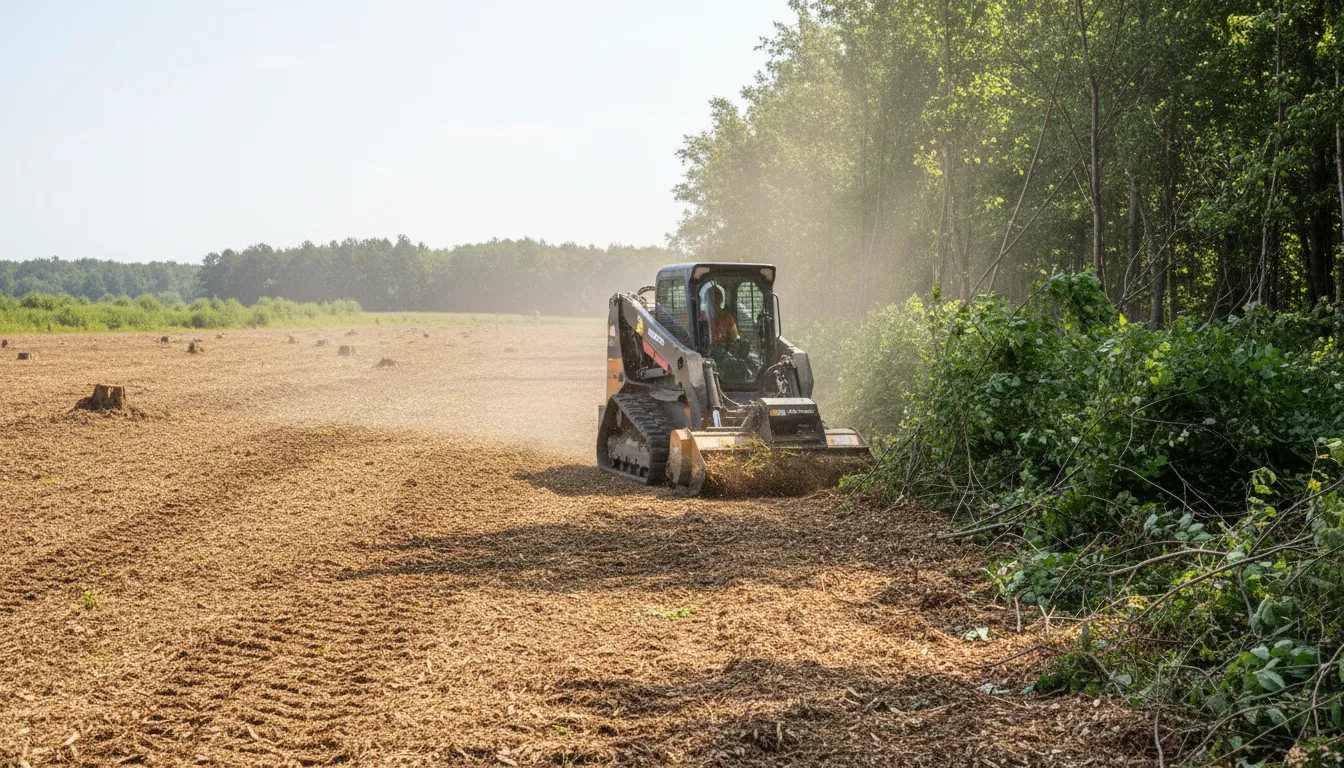
- Mulching: Ideal for small trees and dense brush, a mulching head attached to a skid steer or excavator grinds vegetation into mulch on-site.
- Bulldozing and Excavation: For larger trees and heavy clearing, bulldozers push material into piles. Excavators are then used to dig out stumps and roots.
- Skid Steers: These versatile machines are excellent for smaller projects, debris removal, and working in tighter spaces.
The chosen method depends on vegetation density, terrain, and your end goal for the cleared land.
Soil Protection and Site Rehabilitation
The job isn't done when the trees are gone. Protecting and rehabilitating the soil is a final, vital step.
Soil Management: Exposed soil is highly vulnerable. Beyond temporary controls, permanent stabilization is required. This often means promptly seeding with grass or applying mulch to re-establish vegetation 3. All depressions created during clearing and grubbing must be properly backfilled and compacted to prevent water pooling 4.
Long-Term Buffers: Permanent vegetative buffers should be established and maintained around any water bodies on or adjacent to the property. These buffers act as a final filter for any runoff, protecting water quality 5.
Find the perfect land clearing contractors for your needs
Get personalized recommendations and expert advice
Cost Factors for Land Clearing in North Dakota
Costs can vary widely based on the scope and difficulty of the project. While online averages provide a starting point, local conditions are the true determinant.
Pricing Models:
- Per Square Foot: Costs typically range from $1 to $2 per square foot for relatively flat land with light brush, to $8 or more per square foot for densely forested or rocky terrain.
- Per Acre: For larger parcels, costs can range from approximately $800 per acre for light clearing (e.g., mowing) to well over $5,800 per acre for heavy forest clearing with stump removal 6.
- Small Projects: For a half-acre to one-acre lot, total project costs can range from $400 to $6,000 or more, heavily dependent on the factors below 7.
Primary Cost Drivers:
- Vegetation Density: Light brush is far less expensive to clear than thick forest or areas with large trees.
- Terrain and Accessibility: Steep slopes, wetlands, and poor access for equipment increase time and complexity.
- Disposal Requirements: Hauling away debris (trees, stumps) adds significant cost compared to on-site mulching or burning (where permitted).
- Stump Removal: Grinding or excavating stumps is a separate, often costly, line item.
- Permits and Regulations: The need for erosion control plans, special wildlife surveys, or wetland delineations adds to pre-work costs.
A Step-by-Step Guide for North Dakota Landowners
- Define Your Goal: Clearly identify what you want to use the land for (building, pasture, etc.).
- Consult Local Authorities: Contact your city/county planning office and local Watershed District to discuss your project and identify required permits 8.
- Hire a Professional: Obtain multiple quotes from licensed and insured local contractors. Ensure they are familiar with North Dakota's BMPs and seasonal restrictions.
- Develop a Plan: Work with your contractor to create a site plan that includes erosion control measures and adheres to clearing depth specifications 9.
- Schedule Wisely: Plan the work outside of the primary wildlife nesting and fawning season (April-August) if possible 10.
- Supervise and Inspect: Ensure the work follows the agreed plan, that erosion controls are maintained, and that the site is left properly graded and stabilized.
Frequently asked questions
Sources
Footnotes
-
USACE Garrison Project Office SOP #14 - V - https://www.dot.nd.gov/sites/www/files/documents/References%20And%20Forms/Appendix%20E7%20USACE%20SOP%20%2314%20-%20Vegetation%20Mitigation%20Policy%20%28Signed%2012-13-23%29.pdf?cb=e74beab0 ↩
-
N.D. Admin Code 58-02-08-10 - Destruction of property - https://www.law.cornell.edu/regulations/north-dakota/N-D-A-C-58-02-08-10 ↩
-
GUIDE TO EROSION AND SEDIMENT CONTROL PRACTICES - https://download.fargond.gov/0/esc_guide.pdf ↩
-
Conservation Practice Standard Land Clearing (Code 460) - https://www.nrcs.usda.gov/sites/default/files/2022-09/Land_Clearing_460_CPS_9_2020.pdf ↩
-
Erosion and Sediment Control - NDDOT - https://www.dot.nd.gov/construction-and-planning/construction-planning/environmental/erosion-and-sediment-control ↩
-
Land Clearing Cost Per Square Foot: Why $1-$8 Only Tells Half the ... - https://www.bucktowngradingandconstruction.com/land-clearing-cost-per-square-foot-why-1-8-only-tells-half-the-story/ ↩
-
How Much Does it Cost to Clear Land in 2026? - Lawn Love - https://lawnlove.com/blog/land-clearing-cost/ ↩
-
Rule C - Erosion Prevention and Sediment Control 1 Policy - https://www.rpbcwd.org/files/c541bf963/2021-09-23_13-16_344.pdf ↩
-
Section 1600 - Project Site Clearing | Minot, ND - https://minotnd.gov/DocumentCenter/View/5856/Section-1600---Project-Site-Clearing ↩
-
Habitat Management Practices for the Northern Great Plains - https://gf.nd.gov/private-lands/landowner-resources/habitat-development/farm-ranch-guide/habitat-management-practices ↩