Find the Best Land Clearing Contractors for Your Business
No obligation • Fast responses • Nationwide coverage

Why you can trust Landscape Atlas
Landscape Atlas is a leading United States resource for evaluating landscaping, lawn care, and outdoor service providers. Our team researches each category in depth, focusing on service quality, safety, and customer experience. Listings and rankings are based on independent criteria and user feedback, and companies cannot pay to influence our assessments or recommendations.
Search providers near you
Top Land Clearing Contractors in Pawtucket, Rhode Island Ranked
Land clearing is the essential first step in preparing a property for new construction, landscaping, or agricultural use. This process involves the removal of trees, brush, stumps, and other obstacles to create a clean, workable site. In Pawtucket, this work is crucial for urban redevelopment, lot expansion, and managing overgrown properties, but it requires careful planning to navigate local regulations and environmental considerations. This guide will help you understand the methods, costs, and key steps involved in site preparation, empowering you to connect with qualified local professionals for your project.

Dependable Tree Service
837 Randolph St, Abington, MA 02351
Dependable Tree Service is a family-owned business with over 15 years of experience, serving Boston, MA, and surrounding areas. They specialize in tree removal, pruning, stump grinding, lot clearing, and brush removal. The company uses equipment such as bucket trucks, cranes, and climbers to safely remove trees, including those in delicate or hard-to-reach locations. Dependable Tree Service is fully licensed and insured, offering written proposals and free estimates to clients.
EP Landscape Demo & Services LLC - Boston
Boston, MA
EP Landscape Demo & Services LLC - Boston is a landscaping company serving Boston, MA, and surrounding communities. They offer a wide range of services including lawn mowing, fertilization, weed control, landscape design, tree and stump removal, yard drainage, grading, land clearing, and brush removal. Their expertise covers residential, commercial, and industrial landscaping needs, with capabilities such as large-scale land clearing, site preparation, and storm damage cleanup. The company understands Boston's unique climate and terrain, adapting their services to local conditions including coastal weather and seasonal changes. They provide ongoing maintenance and specialized services like bi-weekly weeding and mulch installation to support healthy landscapes throughout the year.
Understanding the Land Clearing Process
Effective site preparation in Pawtucket is not simply about removing vegetation; it's a multi-phase project that ensures safety, compliance, and a solid foundation for future work. The process typically begins with a professional evaluation and ends with a graded lot ready for its next purpose.
Initial Site Assessment and Planning
Every successful land clearing project starts with a thorough site assessment. A professional will visit your property to evaluate the scope of work, identify the types and density of vegetation, and note any potential challenges like slopes, wetlands, or existing structures. This assessment determines the best clearing methods, necessary equipment, and helps in creating an accurate project timeline and estimate. It's also the stage where critical planning for stormwater management and erosion control begins, which are heavily regulated in Rhode Island.
Securing Necessary Permits
Before any equipment arrives, securing the proper permits is often mandatory. In Pawtucket, land clearing typically requires approval from the City of Pawtucket Planning and Redevelopment Department. The permitting process usually involves submitting detailed site plans that address stormwater runoff, erosion control, topography, and any flood zone considerations. Working with a provider familiar with local codes can streamline this step and prevent costly delays or fines. Compliance with Rhode Island Department of Environmental Management (RIDEM) regulations is also a key factor that influences project methods and costs.
Common Land Clearing Methods and Equipment
The technique used for your lot clearing depends on the vegetation, terrain, and your goals for the cleared land. Here are the primary methods employed by professionals in the Pawtucket area.
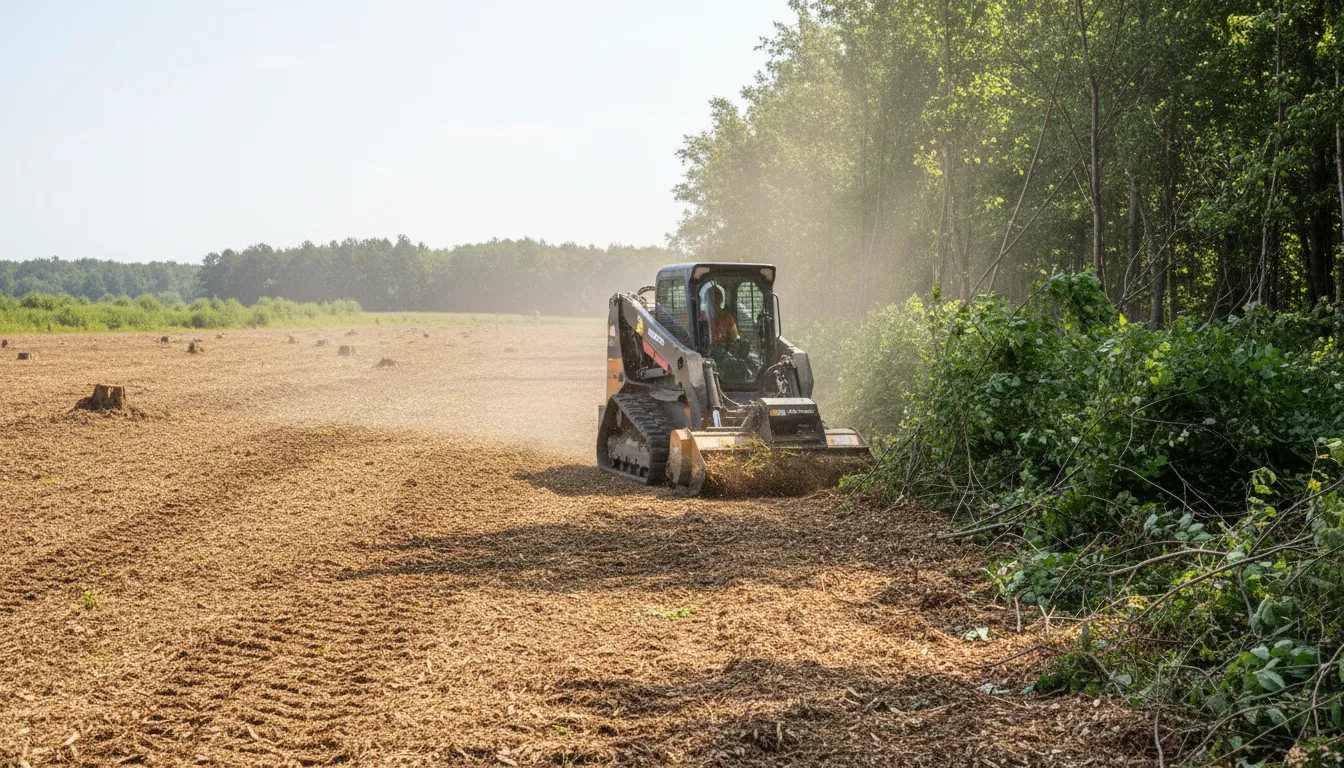
Mulching or Forestry Mowing This method uses a heavy-duty mulching machine to grind trees, brush, and undergrowth into fine wood chips on-site. It's ideal for clearing smaller trees and dense brush without the need for hauling away large debris. The resulting mulch can be left to decompose, helping with erosion control and soil amendment.
Dozing and Grubbing For larger-scale clearing involving big trees and extensive root systems, bulldozers equipped with root rakes or brush rakes are used. This method, known as dozing or grubbing, efficiently pushes over trees and extracts stumps and roots from the ground. It's a fast way to clear large, open areas but typically requires follow-up work to collect and dispose of the piled debris 1.
Selective Hand-Cutting and Clearing For smaller projects, sensitive areas, or when only specific trees need removal, crews may use chainsaws and hand tools. This selective cutting allows for precise control over what is removed and is often used in conjunction with other methods for final cleanup or in areas inaccessible to large machinery.
Stump and Root Removal Clearing the land isn't complete until stumps and major roots are addressed. The most common solution is stump grinding, which uses a specialized machine to chew the stump down below ground level. For full root removal, an excavator with a grapple attachment may be used to dig out the entire root ball. This step is vital for preventing regrowth and preparing the site for grading or construction.
Final Site Grading and Preparation
After vegetation and stumps are removed, the final phase is site grading. Using bulldozers or graders, the land is leveled, contoured, and compacted to create a stable base for its intended use, whether for building a foundation, installing a lawn, or creating agricultural fields. Proper grading ensures proper drainage away from future structures and completes the transformation from a wooded or overgrown lot to a usable parcel of land.
Find the perfect land clearing contractors for your needs
Get personalized recommendations and expert advice
Managing Debris and Disposal
What happens to all the removed trees, brush, and stumps? Disposal is a significant part of the project logistics and cost. Professionals typically manage this in several ways:
- On-Site Mulching: As mentioned, mulching machines process debris into usable mulch that can be spread on the property to suppress weeds and enrich the soil, reducing haul-away costs 2 3.
- Hauling and Landfills: For non-mulched debris like large logs, stumps, and root balls, hauling companies transport the material to licensed landfills, transfer stations, or biomass processing facilities.
- Dumpsters and Roll-Offs: For smaller-scale clearing projects, a dumpster or roll-off container is often placed on-site. Crews fill it by hand or with small machinery, and it is hauled away when full.
Understanding Land Clearing Costs in Pawtucket
The cost to clear land in Pawtucket varies widely based on the lot size, vegetation density, terrain, and disposal needs. Local regulations on stormwater and erosion control can also influence the final price 4. Here are the common pricing structures:
- Hourly Rates: For smaller or complex projects, work may be billed at an hourly rate, typically ranging from $100 to $250 or more per hour for the equipment and operator.
- Per Acre Pricing: This is common for larger parcels. Clearing a lightly wooded or brushy acre may cost between $1,000 and $5,000, while an acre with heavy timber and numerous stumps can range from $10,000 to $15,000 or more 5.
- By-Item or Project Quotes: Many providers give a flat project quote. Itemized costs might include things like $100 to $500+ for large tree removal and $200 to $500+ for stump grinding 6 7. The most accurate way to budget is to obtain detailed estimates from local professionals who can assess your specific site.
Choosing the right method and provider requires balancing efficiency, cost, and environmental impact. A reputable site clearing expert in Pawtucket will help you navigate these choices, ensuring your property is prepared correctly and in compliance with all city and state guidelines.
Frequently asked questions
Sources
Footnotes
-
Best Equipment for Efficient Land and Brush Clearing - DOZR - https://dozr.com/blog/best-equipment-for-efficient-land-and-brush-clearing ↩
-
Land Clearing Services | J.W. Studley & Sons | Rhode Island - https://www.jwstudleyandsons.net/land-clearing ↩
-
Top 5 Methods of Land Clearing | Which Is Right for You? - Valor - https://www.valorenv.com/top-5-methods-of-land-clearing-which-is-right-for-you/ ↩
-
Land Clearing - City of Pawtucket, RI - eCode360 - https://ecode360.com/8133190 ↩
-
Cheapest Way to Clear Land - Woodland Mills - https://woodlandmills.com/cheapest-way-to-clear-land ↩
-
How Much Does It Cost to Clear Land? [2025 Data] | Angi - https://www.angi.com/articles/how-much-does-it-cost-clear-land.htm ↩
-
How Much Does It Cost To Clear Land In Johnston County? - https://southernstatelandscape.com/how-much-does-it-cost-to-clear-land-in-johnston-county/ ↩