Find the Best Land Clearing Contractors for Your Business
No obligation • Fast responses • Nationwide coverage

Why you can trust Landscape Atlas
Landscape Atlas is a leading United States resource for evaluating landscaping, lawn care, and outdoor service providers. Our team researches each category in depth, focusing on service quality, safety, and customer experience. Listings and rankings are based on independent criteria and user feedback, and companies cannot pay to influence our assessments or recommendations.
Search providers near you
Best Land Clearing Contractors in South Carolina Ranked
Land clearing is a crucial first step for many property projects, from new construction and agricultural expansion to wildfire prevention and habitat restoration. In South Carolina, this process involves more than just removing trees and brush; it requires careful navigation of state and local environmental regulations to protect soil, water, and native ecosystems. This guide provides a clear overview of what to expect, from permit requirements and environmental best practices to cost considerations, helping you connect with experienced local professionals who can ensure your project is both effective and compliant.
Understanding Land Clearing Regulations in South Carolina
Before any machinery arrives on your property, understanding the regulatory landscape is essential. South Carolina has specific rules designed to minimize the environmental impact of land disturbance, primarily focusing on stormwater management and habitat protection.
State-Level Permitting: The DHEC Construction General Permit
The South Carolina Department of Health and Environmental Control (DHEC) oversees the primary state-level regulation. A Construction General Permit (CGP) is required for any project that will disturb one acre or more of land. This threshold is critical for homeowners and developers to note. Furthermore, smaller sites that are part of a larger "common plan of development or sale" may also fall under this permitting umbrella, meaning multiple smaller projects in a single area could collectively trigger the requirement.
The CGP focuses on creating and implementing a Stormwater Pollution Prevention Plan (SWPPP). This plan details how you will control erosion and sediment runoff during and after clearing to protect local waterways from pollution.
Local and Municipal Requirements
In addition to state rules, local city and county governments often have their own, sometimes stricter, ordinances. For example:
- In Charleston, a land disturbance permit is required for projects disturbing 5,000 square feet or more, and special permits are needed for removing designated "heritage" trees.
- Coastal zones, generally within a half-mile of tidally influenced waters, are subject to more stringent regulations to protect sensitive marine environments.
- Many municipalities have landscape and tree protection ordinances that mandate the preservation of certain native species or require replanting.
Always check with your local planning or zoning department before starting any site preparation work to ensure full compliance with all applicable codes.
Environmental Protections and Best Practices
Responsible land clearing in South Carolina isn't just about following the law-it's about stewardship. The state's regulations are built around protecting its diverse ecosystems.
Protecting Native Vegetation and Sensitive Areas
Regulations strongly encourage the preservation of native plants and drought-tolerant species, which are better adapted to the local climate and require less maintenance 1. Special permits are almost always required for clearing in designated wetlands, river corridors, or habitats for protected species. The goal is to minimize habitat fragmentation and loss.
Erosion and Sediment Control: A Mandatory Priority
Preventing topsoil loss and keeping sediment out of storm drains and streams is the cornerstone of South Carolina's land disturbance rules. For any permitted project, you can expect to implement control measures such as:
- Silt Fences: Temporary barriers that filter sediment from runoff water.
- Vegetative Buffers: Leaving or planting strips of vegetation along waterways to stabilize banks and filter pollutants.
- Stabilized Construction Entrances: Using stone pads to reduce mud tracked onto public roads.
- Prompt Seeding and Mulching: Revegetating disturbed areas as quickly as possible to hold soil in place.
These practices are not optional for regulated projects; they are enforceable components of your approved SWPPP 2 3.
Land Clearing Methods Used in South Carolina
The chosen method depends on your project's goal, the terrain, and the type of vegetation. Professional contractors will recommend the most efficient and appropriate technique.
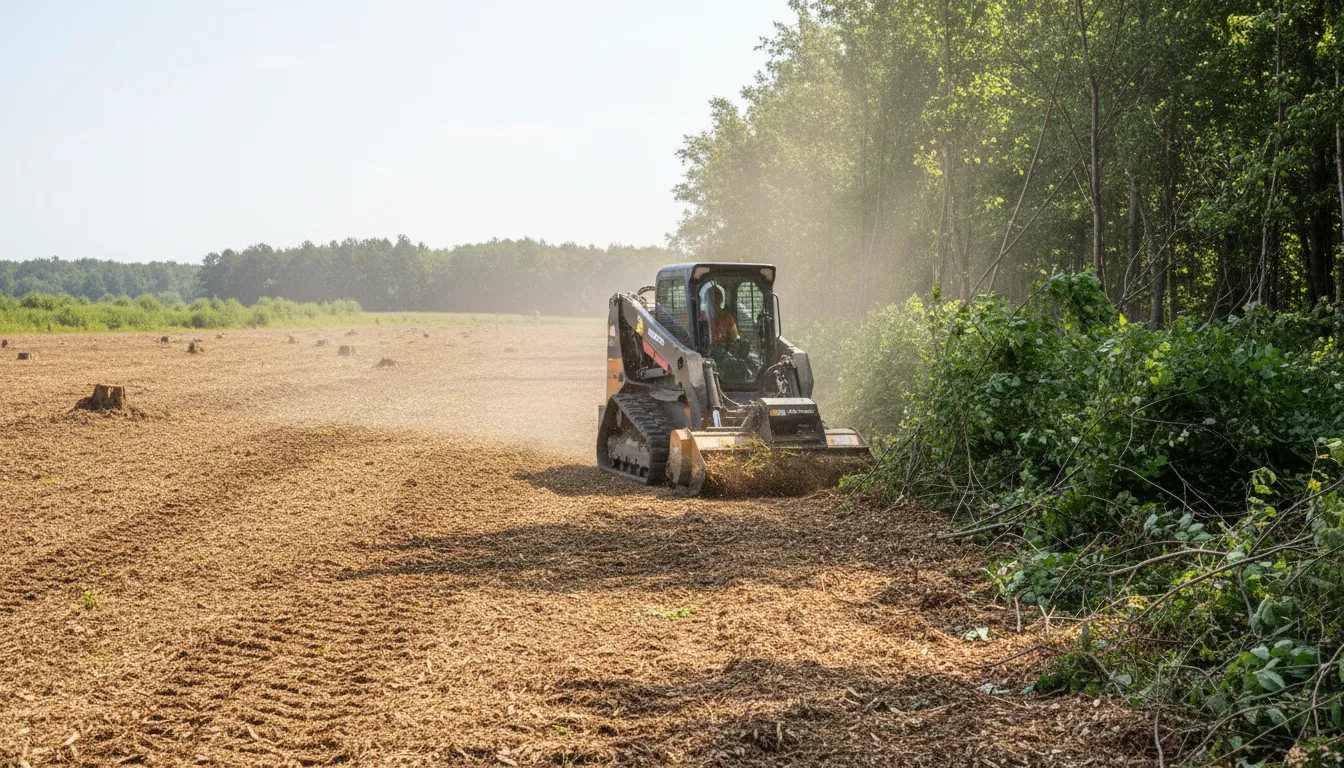
- Forestry Mulching: This versatile method uses a single machine to cut, grind, and shred vegetation into a layer of nutrient-rich mulch on the ground. It's excellent for brush clearing, invasive species control, and creating walking paths, as it prevents erosion, enriches the soil, and requires no burning or hauling away of debris.
- Excavator and Bulldozer Clearing: For larger-scale development projects, such as preparing a site for home construction or commercial use, tracked excavators and bulldozers are used to remove trees, stumps, and rocks. This method typically involves piling debris for later burning or hauling off-site.
- Selective Clearing: Instead of clearing an entire parcel, specific trees and underbrush are removed to achieve a desired aesthetic, create views, or improve forest health while preserving the overall canopy and ecosystem.
Find the perfect land clearing contractors for your needs
Get personalized recommendations and expert advice
Cost Factors for Land Clearing in South Carolina
Pricing for land clearing services is highly variable and is typically quoted per acre after a professional site assessment. The final cost hinges on several key factors:
- Vegetation Density and Type: Clearing a field of light brush is far less expensive than clearing a densely wooded tract with large hardwood trees.
- Terrain and Accessibility: Steep slopes, rocky ground, and poor access for heavy equipment will increase the time and complexity of the job, raising costs.
- Debris Disposal: The method for handling cleared material-whether it's left as mulch, burned on-site (where permitted), or hauled to a disposal facility-significantly impacts the price.
- Permitting and Compliance: The time and expertise required to secure necessary permits and implement mandated erosion controls are factored into professional quotes.
As a general reference, costs can range widely:
- Light to Medium Brush / Small Trees: $2,500 - $4,000 per acre 4.
- Heavy Brush / Mixed Forest: $4,000 - $6,000 per acre 5.
- Dense Forest with Large Trees: $6,000 - $12,000+ per acre 6 7.
These are estimates, and obtaining multiple site-specific quotes from licensed and insured contractors is crucial for accurate budgeting.
The Value of Professional Expertise
Given the complex interplay of regulations, environmental concerns, and heavy equipment operation, hiring a professional land clearing service in South Carolina is a wise investment. A reputable contractor will:
- Navigate Permitting: They understand the requirements of DHEC and local jurisdictions and can often manage the permit application process on your behalf 8 9.
- Implement Compliant Practices: Professionals know how to properly install and maintain erosion controls to avoid costly fines for non-compliance 10 11.
- Employ the Right Equipment: They have access to the specialized machinery needed for different tasks, from forestry mulchers for sensitive areas to large excavators for major development sites 12.
- Provide Site-Specific Advice: An experienced eye can assess your property's unique challenges and opportunities, recommending the most efficient clearing strategy to meet your long-term goals for the land.
Frequently asked questions
Sources
Footnotes
-
Sec. 17-5.3 Landscaping - https://planninganddevelopment.columbiasc.gov/wp-content/uploads/2022/01/Landscape-Tree-GreenBuildingStnds-Definitions-as-of-12-7-2021.pdf ↩
-
Stormwater - Construction Activities | South Carolina Department of ... - https://des.sc.gov/programs/bureau-water/stormwater/stormwater-construction-activities ↩
-
1 to 2 Acres of Land Disturbance - https://des.sc.gov/programs/bureau-water/stormwater/stormwater-construction-activities/1-2-acres-land-disturbance ↩
-
South Carolina Land Clearing | Forestry Mulching Pros - https://forestrymulchingpros.com/south-carolina-land-clearing-forestry/ ↩
-
Efficient Ways to Clear Land for Development Lexington, SC - https://southcarolinalandclearing.com/efficient-ways-to-clear-land-for-development-in-lexington-south-carolina/ ↩
-
How Much Does It Cost to Clear Land in 2025? - Daniel Dean - https://www.danieldean.com/how-much-does-it-cost-to-clear-land/ ↩
-
Environmental Considerations And Best Practices In Land Clearing - https://kinglandclearingsc.com/blog/environmental-considerations-and-best-practices/ ↩
-
What Property Owners Must Know About Land Clearing Permits - https://southcarolinalandclearing.com/what-property-owners-must-know-about-land-clearing-permits/ ↩
-
Permitting Requirements for Land Clearing in Charleston, SC - https://oltc.com/permitting-requirements-for-land-clearing-in-charleston-sc/ ↩
-
Essential Land Clearing Services: Preparing Your Site for Success - https://southcarolinalandclearing.com/essential-land-clearing-services-preparing-your-site-for-success/ ↩
-
Regulation 72-300 through 72-316 Standards for Stormwater ... - https://des.sc.gov/sites/des/files/Library/Regulations/R.72-300_72-316.pdf ↩
-
Comprehensive Guides To Land Clearing - https://kinglandclearingsc.com/blog/comprehensive-guides-to-land-clearing/ ↩