Find the Best Land Clearing Contractors for Your Business
No obligation • Fast responses • Nationwide coverage

Why you can trust Landscape Atlas
Landscape Atlas is a leading United States resource for evaluating landscaping, lawn care, and outdoor service providers. Our team researches each category in depth, focusing on service quality, safety, and customer experience. Listings and rankings are based on independent criteria and user feedback, and companies cannot pay to influence our assessments or recommendations.
Search providers near you
Best Land Clearing Contractors in South Dakota Ranked
Land clearing is the process of removing trees, brush, stumps, and other obstacles from a piece of land to prepare it for construction, agriculture, or other uses. In South Dakota, this work is more than just moving dirt; it's a regulated activity that balances development needs with the critical protection of the state's soil and water resources. Proper planning ensures your project proceeds smoothly, avoids costly fines, and protects your property from erosion. This guide outlines the key rules, best practices, and considerations for land clearing in South Dakota, helping you understand what to expect and how to connect with qualified local professionals who can navigate these requirements.
Understanding South Dakota's Regulatory Landscape
Before any equipment arrives on-site, understanding the regulatory framework is essential. Land clearing in South Dakota is governed by a combination of state and local rules designed to minimize environmental impact, particularly concerning erosion and sediment control.
State-Level Guidance: The South Dakota Department of Transportation (SDDOT) sets a strong precedent with its detailed Erosion & Sediment Control Manual, which is a valuable resource for any land-disturbing activity, not just road projects. Their guidelines emphasize the importance of vegetation and proactive erosion prevention.
Local Ordinances: City and county regulations are often the most directly applicable. Municipalities like Sioux Falls and Watertown have specific ordinances tied to federal Clean Water Act requirements. A critical threshold is the disturbance of one acre or more of land. Projects of this scale typically require a Stormwater Pollution Prevention Plan (SWPPP), which details how you will control runoff and prevent soil from leaving the site.
Waterway Protections: Special, stricter rules apply to clearing near streams, rivers, lakes, or wetlands. These areas are highly sensitive, and activities nearby often require additional permits and more robust protective measures to safeguard water quality.
Protected Vegetation and Slope Stability
Clearing isn't just about what you remove, but also about what you protect. South Dakota's landscape requires careful consideration of existing vegetation.
Native Species for Stability: Native grasses, shrubs, and trees are not just part of the natural scenery; their root systems are incredibly effective at holding soil in place. Preserving native vegetation, especially on slopes, is one of the best and most cost-effective erosion control methods available 1 2.
Threatened and Endangered Species: While specific protected species vary by location, it's important to check state and local lists. Removing certain plants may require permits or necessitate designing your clearing plan to avoid them altogether.
The Critical Role of Slope Stability: This cannot be overstated. Vegetation roots act as a natural reinforcement for soil. Removing trees and plants from steep slopes or bluffs significantly increases the risk of erosion and even landslides. Any clearing plan on sloped terrain must include a strategy for immediate and permanent stabilization to prevent slope failure.
Erosion Control: Best Management Practices (BMPs)
Expect any permitted clearing project in South Dakota to require the implementation of erosion and sediment control BMPs. These are temporary and permanent measures that keep soil on your property and out of storm drains and waterways.
Common BMPs for Land Clearing:
- Mulching: Applying a layer of wood chips or straw to achieve 80-90% ground coverage is highly effective at protecting bare soil from raindrop impact and slowing runoff 3 4.
- Erosion Control Blankets & Wattles: Blankets made of straw or coconut fiber protect seeded areas, while fiber rolls (wattles) placed along slopes contour lines slow water and trap sediment.
- Silt Fences: Temporary sediment barriers made of filter fabric, installed downhill of disturbed areas.
- Riprap: Layers of stone used to armor and stabilize drainage channels or steep slopes where vegetation cannot be established immediately.
Smart Site Management: A key principle is to limit the amount of land disturbed at any one time. Using phased clearing-working on one section, stabilizing it, then moving to the next-dramatically reduces erosion risk. The goal is to never leave bare soil exposed to the elements for longer than necessary 5.
Find the perfect land clearing contractors for your needs
Get personalized recommendations and expert advice
Land Clearing Methods and Cost Considerations
The method chosen for clearing directly impacts the project's cost, timeline, and environmental footprint. In South Dakota, common techniques include forestry mulching, mechanical grubbing and hauling, and hand clearing.
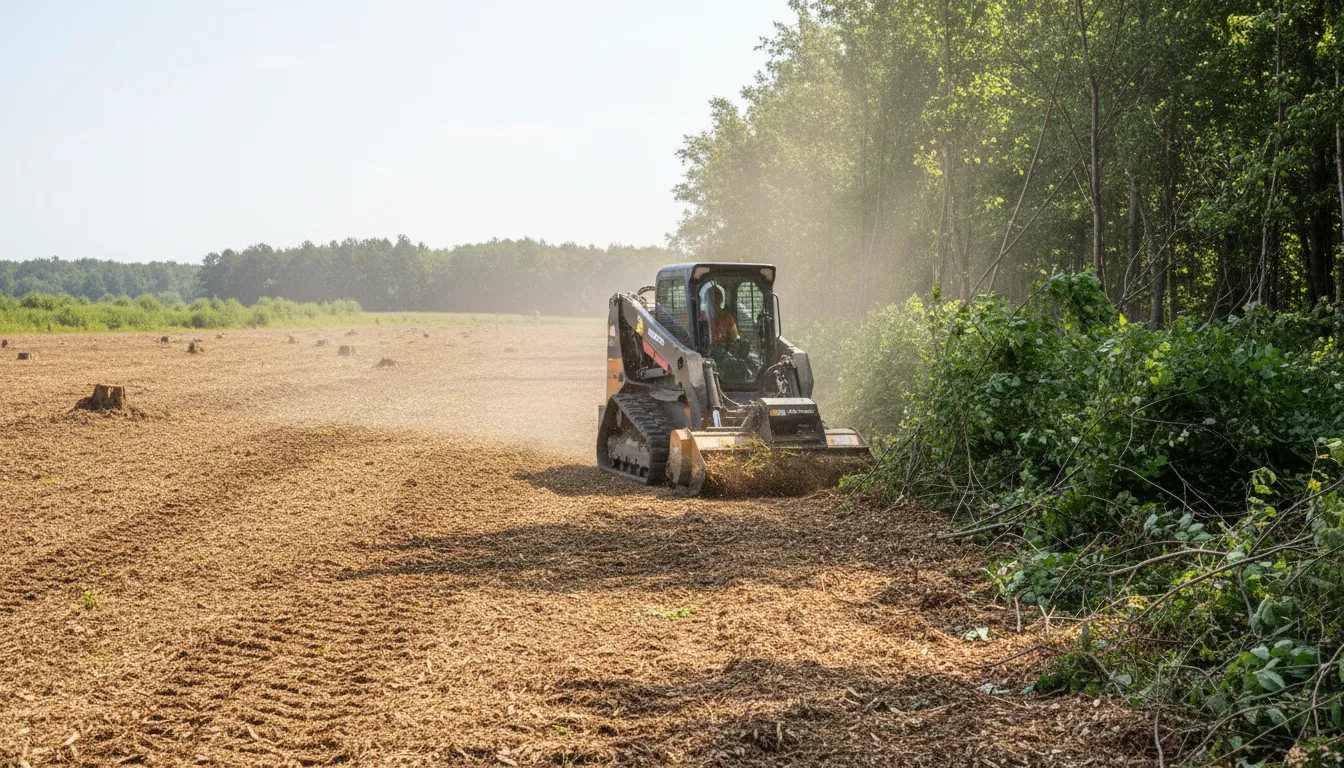
Forestry Mulching: This efficient method uses a single machine to cut, grind, and mulch vegetation in place, leaving a protective layer of wood chips on the ground. It's excellent for dense brush management, promotes soil health, and is often a cost-effective choice for larger properties as it eliminates hauling costs.
Traditional Grubbing and Hauling: This involves using excavators or bulldozers to remove vegetation and stumps, which are then piled and hauled away. It results in a "cleaner" site but is typically more expensive due to equipment and disposal costs and leaves bare soil vulnerable unless immediately addressed.
Pricing Factors: Land clearing costs in South Dakota are highly variable and are typically quoted per acre or by the hour. Key factors include:
- Acreage and Density: Clearing a lightly brushed acre costs far less than a densely wooded one.
- Terrain: Steep slopes, rocky ground, or poor access increase difficulty and cost.
- Method: Mulching is often more efficient per acre for brush, while large tree removal and grubbing are premium services.
- Location: Project site remoteness can affect mobilization costs.
For small properties, work may be billed hourly (often ranging from $150 to $300+ per hour for equipment and operator). For larger tracts, per-acre quotes are common, which can range from a few hundred dollars for light clearing to over $2,000 per acre for dense, complex work 6 7. Always obtain multiple detailed bids that specify the clearing method, cleanup, disposal, and erosion control measures included.
Planning Your South Dakota Land Clearing Project
A successful project starts with a solid plan. Begin by contacting your local city or county planning office to determine permit requirements, especially if your site is near water or over an acre in size. When consulting with contractors, discuss not just the clearing itself, but their approach to erosion control and site stabilization from day one. A reputable professional will be familiar with local BMP requirements and should factor them into their proposal.
Remember, the goal is to achieve your land use objectives while being a good steward of South Dakota's environment. By prioritizing soil stability, protecting waterways, and using native vegetation for long-term stabilization, you protect your investment and contribute to the health of the local ecosystem 8.
Frequently asked questions
Sources
Footnotes
-
VEGETATION MANAGEMENT ON STEEP SLOPES - https://lowermnriverwd.org/application/files/9716/9575/2790/Steep_SlopesV2.pdf ↩
-
Using Vegetation for Erosion Control on Construction Sites - https://extension.okstate.edu/fact-sheets/using-vegetation-for-erosion-control-on-construction-sites.html ↩
-
Erosion and Sediment Control Best Management Practices - https://www.watertownsd.us/DocumentCenter/View/399 ↩
-
Protecting Soils with Mulch and Erosion Control Materials - https://eec.ky.gov/Environmental-Protection/Water/Protection/DocsEPSC/EPSC-ProtectSoilsWithMulch.pdf ↩
-
What Causes Soil Erosion? How Do You Control It? - Path Light Pro - https://www.pathlightpro.com/what-causes-soil-erosion-how-do-you-control-it/ ↩
-
Eco-Friendly Land Clearing Methods That Protect Your Property - https://pblandmgt.com/eco-friendly-land-clearing-methods-that-protect-your-property/ ↩
-
Land Clearing Techniques: How to Choose the Best Method for ... - https://hurstlandworks.com/land-clearing-techniques-how-to-choose-the-best-method-for-your-property/ ↩
-
EROSION & SEDIMENT CONTROL - DOT.SD.gov. - https://dot.sd.gov/media/684e1776/ESControlSW.pdf ↩