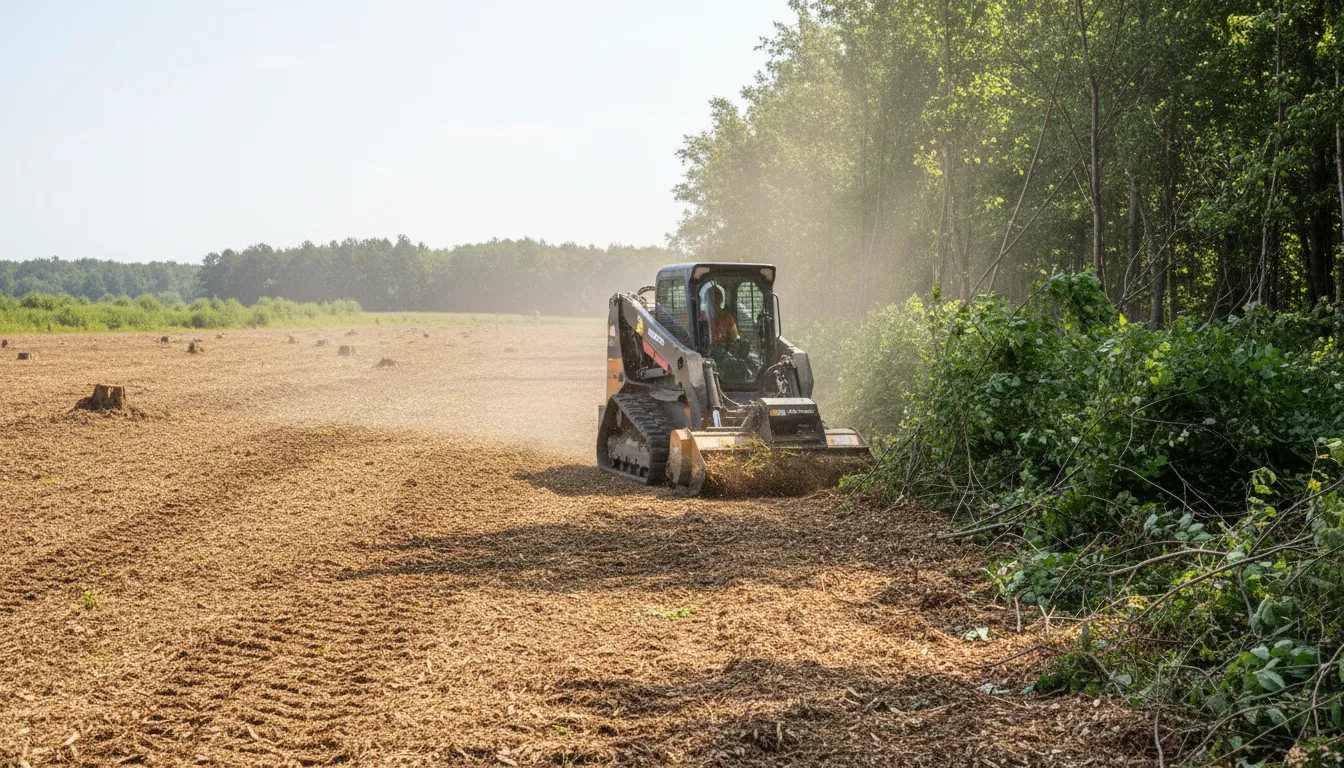
Find the Best Land Clearing Contractors for Your Business
No obligation • Fast responses • Nationwide coverage

Why you can trust Landscape Atlas
Landscape Atlas is a leading United States resource for evaluating landscaping, lawn care, and outdoor service providers. Our team researches each category in depth, focusing on service quality, safety, and customer experience. Listings and rankings are based on independent criteria and user feedback, and companies cannot pay to influence our assessments or recommendations.
Search providers near you
Top Land Clearing Contractors in Bryan, Texas Ranked
Land clearing is the essential first step in transforming a raw, overgrown piece of property into a usable space for building, farming, or landscaping. This process involves the systematic removal of trees, brush, stumps, and other obstacles to create a clean, stable foundation. For property owners in Bryan, navigating site preparation, local regulations, and equipment choices can be complex. This guide explains the process, methods, and considerations for site clearing in the Brazos Valley, helping you connect with experienced local professionals who can assess your land and execute a safe, efficient project.
Graham Land Services
2949 FM 2819, Anderson, TX 77830
Graham Land Services is a land clearing and landscaping contractor based near Houston, TX, serving East and South Texas with a roughly 70-mile radius. They specialize in land clearing, grading, pond and site work, driveway and parking lot construction, and drainage solutions. The company uses well-maintained, top-tier equipment operated by experienced professionals to prepare build-ready sites while preserving healthy, non-invasive trees and minimizing ground disturbance. Founded by Tod Graham, who brings over 30 years of experience and extensive OSHA training, the company emphasizes careful planning, soil and drainage analysis, and clear communication throughout each project.
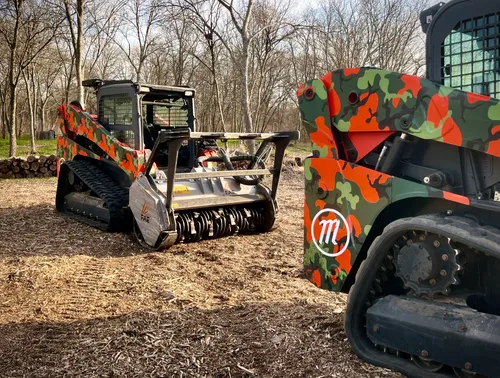
Mallard & Sons Land Service
Austin, TX
Mallard & Sons Land Service is based in Austin, TX, providing tree services including tree removal and stump grinding, as well as land clearing and brush removal. They serve clients in Austin and surrounding areas, handling dense and overgrown land with professional care. Their capabilities include thorough land clearing and mulching, which helps prepare properties for sale or recreational use. The company is known for detailed project planning and clear communication throughout the process.
Understanding the Land Clearing Process
A successful land clearing project in Bryan is more than just removing trees; it's a multi-phase operation that requires careful planning and execution to ensure safety, regulatory compliance, and a quality final result.
Initial Site Assessment and Planning
Every professional site clearing project begins with a thorough evaluation. Experts will survey the terrain, identify soil types, and note drainage patterns. A critical part of this phase is identifying any protected tree species or environmentally sensitive areas, as Bryan and Brazos County have regulations governing tree removal and soil disturbance. This assessment determines the scope of work, the necessary equipment, and helps create a detailed plan that designates clearing zones and preservation areas.
Securing Necessary Permits
Before any machinery arrives, securing the proper permits is crucial. Depending on the project's size, location, and the types of vegetation present, you may need approvals from the City of Bryan or Brazos County 1. A reputable land clearing service will often handle this permitting process, ensuring your project complies with local ordinances regarding tree removal, erosion control, and land development. Skipping this step can lead to significant fines and project delays.
Vegetation and Brush Removal
This is the core physical work of clearing land. The method depends on the vegetation's size and density. For dense underbrush and small trees, forestry mulching is a popular, efficient choice. A mulching machine grinds vegetation on-site, turning it into a layer of nutrient-rich mulch that suppresses regrowth and controls erosion. For larger trees, crews may use chainsaws and heavy machinery to fell, limb, and section the timber. The debris then needs to be processed, either through on-site grinding, haul-off, or controlled burning (where local ordinances allow).
Stump and Root Removal
After trees are removed, stumps and roots remain. Simply cutting a tree down leaves a stump that can hinder construction and attract pests. Stump grinding is a common solution, using a machine to chew the stump and major surface roots into wood chips 2. For complete removal, especially for future digging or grading, stumps may be excavated entirely. The cost for stump removal in Bryan typically ranges from $100 to $400 per stump, often calculated by the diameter of the tree.
Final Grading and Erosion Control
Once the land is cleared of vegetation and debris, the final shaping begins. Using bulldozers and graders, professionals will level the ground, create proper slopes for drainage, and compact the soil to form a solid base for construction or other uses 3 4. Immediately following grading, erosion control measures are vital. This often involves seeding the bare soil with a fast-growing cover crop, like Fescue, to stabilize the ground and prevent valuable topsoil from washing away during Texas rains 5.
Find the perfect land clearing contractors for your needs
Get personalized recommendations and expert advice
Common Land Clearing Methods Used in Bryan
Choosing the right technique for your property depends on your goals, budget, and the end use of the land. Here are the primary methods employed by Bryan land clearing companies.
Forestry Mulching
This is a highly efficient and environmentally friendly method for brush clearing. A single machine, called a forestry mulcher or masticator, cuts, grinds, and spreads vegetation in one pass. The key advantage is that it leaves behind a protective layer of mulch, which enriches the soil, retains moisture, and prevents erosion without the need to haul away debris 6. It's ideal for clearing overgrown fields, creating walking trails, or preparing land for pasture.
Traditional Cut, Pile, and Haul
In this conventional method, vegetation is cut down, gathered into large piles, and then removed from the site. The debris is often processed through an industrial tub grinder before being transported to a recycling center or landfill 7 8. This method is sometimes necessary for very large timber or when the cleared material has commercial value as firewood or lumber. It requires more handling and disposal logistics than mulching.
Controlled Burning
For certain agricultural or large-scale land management projects, controlled burning of piled debris may be an option after obtaining a burn permit from local authorities. This method reduces debris volume significantly but requires strict safety protocols, favorable weather conditions, and adherence to local air quality regulations. It is less common for smaller residential or commercial lots within Bryan city limits.
What Influences Land Clearing Costs in Bryan?
The cost to clear an acre in Bryan can vary widely based on several key factors. While averages provide a benchmark, getting a site-specific quote from a local professional is essential.
Project Size and Scope: Larger projects (10+ acres) often have a lower cost per acre due to economies of scale, while small lots under 2 acres may be priced as a flat daily rate. A small lot might cost around $2,500 for a day of work with a compact mulcher, which can clear between half an acre to two acres per day.
Vegetation Density and Type: A lightly wooded lot with small brush is far less expensive to clear than a densely forested area with large, mature trees. The presence of invasive species like cedar can also affect the approach and price.
Terrain and Accessibility: Steep slopes, rocky ground, or wet, muddy conditions make the work more challenging and time-consuming, increasing costs. Easy access for large equipment keeps prices down.
Debris Disposal Method: Forestry mulching typically has no separate disposal fee, as debris stays on-site. The traditional haul-off method includes costs for labor, hauling, and dump fees, which can add significantly to the total bill.
Additional Services: Costs for essential follow-on services like stump removal (typically $100-$400 per stump), final grading, soil compaction, and erosion control seeding are usually quoted separately but are critical for a finished project 9 10.
Equipment Costs: If you were to consider managing the project yourself, heavy equipment rentals are a major expense. Forestry mulchers can rent for $1,000 to $1,800 per day, and bulldozers for $800 to $1,200 per day, not including operator costs or transportation 11.
Key Considerations Before You Begin
- Define Your End Goal: Are you clearing for a new home, a barn, agricultural use, or simply to reclaim an overgrown yard? The final use dictates the level of clearing and site prep needed.
- Check Property Lines: Always have your property lines clearly marked by a surveyor before work begins to avoid accidentally clearing a neighbor's land.
- Utility Location: Contact Texas 811 to have all underground utilities (gas, water, electric, cable) marked. This is a free and legally required step for any digging or deep clearing.
- Hire Insured Professionals: Land clearing involves inherent risks. Always verify that any service you hire carries adequate liability and workers' compensation insurance.
- Plan for the Future: Discuss with your contractor what you want to do with the cleared land immediately afterward. Proper grading and erosion control are not optional in Bryan's climate; they are necessary to protect your investment.
Frequently asked questions
Sources
Footnotes
-
Commercial Land Clearing Guide - https://strongholdtexas.com/a-complete-guide-to-commercial-land-clearing/ ↩
-
Clearing Land in Texas: What You Need to Know - Coastal Spray - https://www.coastalspray.com/texas-clearing-land/ ↩
-
Land Clearing for Construction Projects: What to Expect and How ... - https://homertree.com/blog/land-clearing-for-construction-projects-what-to-expect-and-how-to-prepare/ ↩
-
What Is The Process Of Clearing Land? - American Paving - https://www.americanpavingtx.com/what-is-the-process-of-clearing-land/ ↩
-
Understanding the Process of Land Clearing - Tidd Tree - https://tiddtree.com/process-of-land-clearing/ ↩
-
Land Clearing Bryan TX - https://www.shuffieldservices.com/Land-Clearing-Bryan-TX ↩
-
Bryan Texas Land Clearing and Brush Removal - https://lonestarclearing.com/bryan-texas-land-clearing-and-brush-removal/ ↩
-
Land clearing is the removal of brush, trees and stumps. For ... - https://www.danieldean.com/land-clearing/ ↩
-
How Much Does It Cost to Clear Land in 2025? - https://www.danieldean.com/how-much-does-it-cost-to-clear-land-in-2025/ ↩
-
Complete Guide to Land Clearing Pricing and Project Planning - https://www.skidsteers.com/blog/brush-clearing-cost/ ↩
-
Cost Texas Land Clearing and Brush Removal - https://pierceheavyequipment.com/cost-texas-land-clearing-and-brush-removal/ ↩