Find the Best Land Clearing Contractors for Your Business
No obligation • Fast responses • Nationwide coverage

Why you can trust Landscape Atlas
Landscape Atlas is a leading United States resource for evaluating landscaping, lawn care, and outdoor service providers. Our team researches each category in depth, focusing on service quality, safety, and customer experience. Listings and rankings are based on independent criteria and user feedback, and companies cannot pay to influence our assessments or recommendations.
Search providers near you
Best Land Clearing Contractors in Vermont Ranked
Land clearing in Vermont is a carefully regulated process focused on balancing property development with the state's strong environmental values. It involves the removal of trees, stumps, brush, and other vegetation to prepare land for construction, agriculture, or restoration. This work is critical for creating usable space, managing forest health, and reducing wildfire risk, but it must be done in a way that protects Vermont's waterways, prevents erosion, and preserves natural beauty. Understanding the specific rules and best practices for your project is essential. This guide provides practical information to help you plan your land clearing project and connect with experienced local professionals who understand Vermont's unique requirements.
Understanding Vermont's Environmental Priorities
Vermont's approach to land clearing is rooted in a deep commitment to conservation. The state's regulations are designed to minimize the impact of development on its lakes, streams, wetlands, and forests. The primary goal is to preserve natural ground cover-the layer of soil, roots, leaves, and low-growing plants that holds the earth in place. This "duff" layer is crucial for preventing runoff and sediment pollution, which is the top cause of water quality degradation in the state.
Before any significant clearing begins, it's vital to recognize that Vermont is not a "clear-cut" state. The regulations encourage selective clearing and mandate that disturbed soil be stabilized quickly, often within 21 days of being exposed. This philosophy means that planning for erosion control is not an afterthought; it is an integral, upfront part of any responsible land clearing project in Vermont.
Key Regulations and Permit Requirements
Navigating the regulatory landscape is a fundamental step. Failure to comply can result in significant fines and project delays.
The Shoreland Protection Act: This is one of the most important regulations for properties near lakes and ponds. It establishes a protected zone extending 250 feet from the mean water level. Within this area, clearing is strictly limited to protect water quality and wildlife habitat 1. The law uses a points-based system to regulate vegetation removal; you can only clear a certain amount based on the points assigned to existing trees and saplings. Generally, only small openings (e.g., for a footpath) or very limited clearing (up to 250 square feet) is allowed without a more complex permit 1.
Erosion Prevention and Sediment Control (EPSC) Permits: Any land disturbance activity, including clearing, that exposes more than one acre of soil requires coverage under the Vermont Construction General Permit. For smaller sites, a "Low Risk Site Handbook" provides standards that must be followed. Key rules include:
- Winter Restriction: No clearing or grading is permitted between October 15 and April 15 without an approved, site-specific EPSC plan that includes special stabilization measures.
- Stabilization Deadline: All disturbed soil areas must be permanently stabilized (e.g., seeded and mulched) within 21 days of the last disturbance 2.
- Runoff Controls: Silt fences, sediment basins, and stabilized construction entrances are required to prevent sediment from leaving the site.
Local Permits: Always check with your local Town Clerk or Zoning Office. Many towns have their own bylaws regarding tree removal (often involving a Town Tree Warden), wetland buffers, and steep slope ordinances that are more restrictive than state rules 3.
Best Practices for Responsible Land Clearing
Following best practices isn't just about compliance; it's about being a good steward of the land and ensuring the long-term stability of your property.
1. Preserve Vegetation Strategically:
- Ground Cover: Maintain native ground cover under 3 feet tall wherever possible. This includes ferns, moss, and leaf litter.
- Tree Protection Zones: Establish a "no-dig, no-compact" zone around trees you wish to keep. A good rule is to protect an area with a radius twice the width of the tree's canopy to safeguard its critical root zone 4.
- Lakeshore Buffers: Within the shoreland zone, preserve as much existing vegetation as possible. Create narrow, winding paths rather than wide, straight cleared corridors to the water 5.
2. Implement Erosion Controls from Day One:
- Sequencing: Clear land in phases so you are never exposing more area than you can stabilize within the 21-day window.
- Mulching and Matting: Apply a thick layer of mulch (at least 6 inches deep) or install rolled erosion control mats (staked down securely) on any slopes or areas that cannot be immediately seeded 6.
- Perimeter Protection: Install silt fencing or fiber rolls (filter logs) along the downslope perimeter of the work area before clearing begins.
3. Plan for Site Stabilization:
- Timing is Everything: For permanent seeding, aim to complete seeding by September 15 to allow grass to establish before winter dormancy. If clearing occurs later, you must use heavy mulch or erosion control blankets as temporary cover 7.
- Sediment Tracking: Clean mud and debris from tires and equipment before they leave the site and track onto public roads. This may need to be done daily 8.
Find the perfect land clearing contractors for your needs
Get personalized recommendations and expert advice
Equipment and Methods Used in Vermont
The right equipment depends on the scale, terrain, and goals of your project. Vermont's often rocky and uneven landscape requires skilled operators.
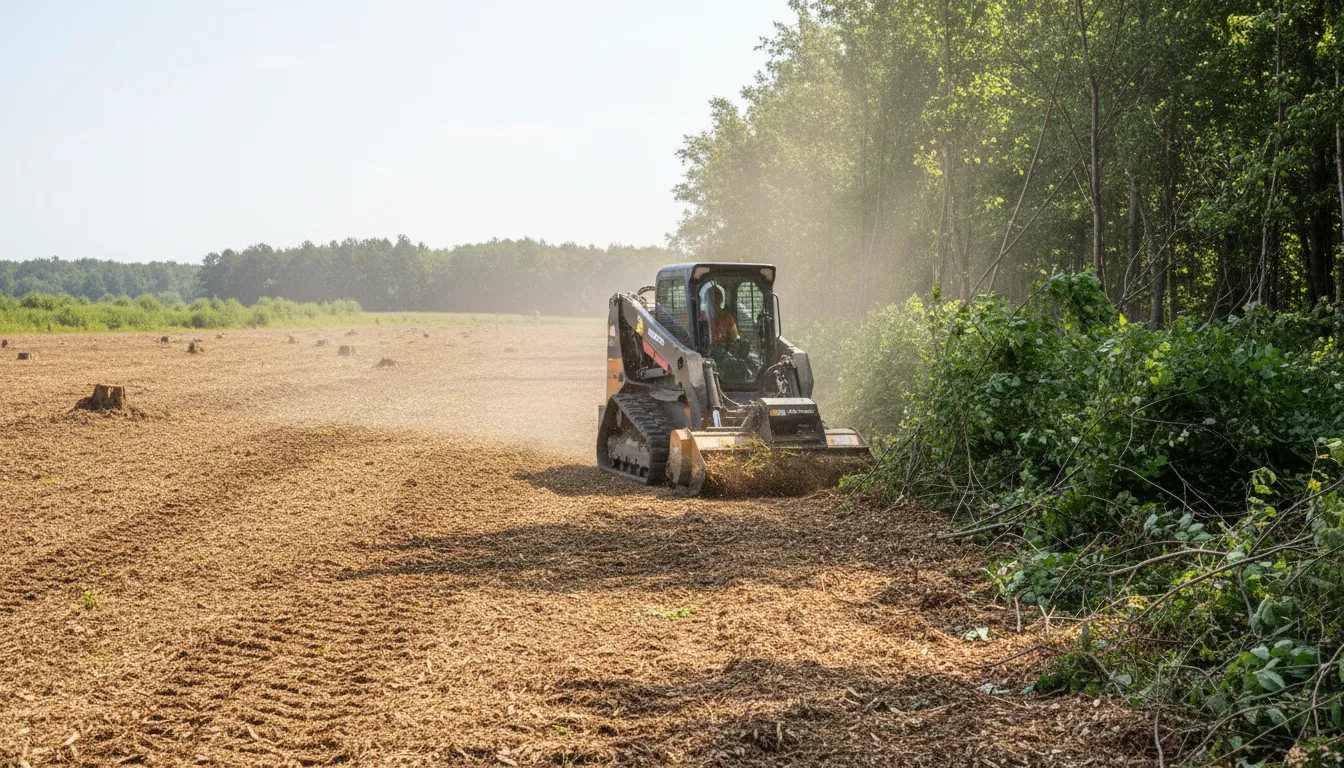
- Skid-Steer Loaders with Mulching Heads: Ideal for clearing dense brush and small trees while simultaneously mulching the material in place. This method leaves a protective layer of wood chips on the ground, which helps with erosion control.
- Excavators and Bulldozers: Used for larger-scale clearing, stump removal, and rough grading. Dozers are effective on flatter, larger parcels for pushing over trees and piling debris.
- Chippers and Tub Grinders: Process felled trees and brush into usable mulch or manageable debris for removal or composting.
- Hand Crews: Essential for selective clearing, working in sensitive areas near water or protected trees, and for fine-tuning areas after heavy machinery has done the bulk of the work.
Understanding Costs and Pricing Factors
The cost of land clearing in Vermont varies dramatically based on site-specific conditions. There is no standard "per-acre" price that applies to all projects.
Primary Cost Factors:
- Terrain: Steep, rocky, or wet sites are more difficult and time-consuming to clear than flat, dry land.
- Vegetation Density: A thickly wooded lot with large hardwood trees and dense underbrush costs significantly more to clear than a lot with scattered small trees.
- Debris Disposal: Costs rise if trees and stumps must be hauled away versus being mulched on-site or burned (where permitted).
- Permitting and Planning: The cost of developing and implementing a detailed EPSC plan, especially for shoreland or winter work, adds to the project total.
- Equipment Needed: Larger projects requiring dozers and excavators have higher daily equipment rates than those manageable with a skid-steer.
General Cost Ranges:
- Small-Scale / DIY: For very small areas, renting a mini-skid steer might cost $300-$500 per day, not including operator labor or hauling.
- Professional Clearing: For full, professional clearing, costs are often estimated per acre or per square foot. You might see ranges from $1,500 to $4,000+ per acre for lighter clearing, but heavily wooded or complex sites can cost $5,000 to $10,000 per acre or more 9 10. Some contractors may quote a project rate based on the specific scope of work. Always get detailed, written estimates that outline what is included (e.g., grubbing stumps, grading, seeding).
Hiring a Professional in Vermont
Given the regulatory complexity, hiring a professional with local experience is highly recommended. Look for providers who:
- Are familiar with the Vermont Low Risk Site Handbook and EPSC Field Guide.
- Can discuss the Shoreland Protection Act and local permit requirements knowledgeably.
- Provide references for similar projects in your region of Vermont.
- Include a clear plan for erosion control and site stabilization in their proposal.
- Carry adequate insurance, including liability and workers' compensation.
A reputable professional will view land clearing as the first step in a process that ends with a stable, vegetated, and compliant site, protecting your investment and Vermont's environment.
Frequently asked questions
Sources
Footnotes
-
The Vermont Shoreland Protection Act - https://dec.vermont.gov/sites/dec/files/wsm/lakes/docs/Shoreland/lp_ShorelandHandbook.pdf ↩ ↩2
-
erosion control general notes - Vermont.gov - https://anrweb.vt.gov/PubDocs/DEC/ENB/STORM/1001-C-14%20-%20Erosion%20Details%201.pdf ↩
-
Tree Law Roles and Responsibilities | Vermont League of Cities and ... - https://www.vlct.org/resource/tree-law-roles-and-responsibilities ↩
-
Vermont Erosion Prevention and Sediment Control Field Guide - https://dec.vermont.gov/sites/dec/files/wsm/wetlands/docs/wl_vermont_EPSC_field_guide-1.pdf ↩
-
Best Management Practices for Lakeshore Vegetation - https://anrweb.vt.gov/PubDocs/DEC/WSMD/Lakes/Docs/LP_BMPManaginglakeshorevegetation.pdf ↩
-
The Low Risk Site Handbook - https://dec.vermont.gov/sites/dec/files/wsm/stormwater/docs/StormwaterConstructionDischargePermits/sw_low_risk_site_handbook.pdf ↩
-
Low Risk Site Handbook - https://dec.vermont.gov/sites/dec/files/wsm/stormwater/docs/StormwaterConstructionDischargePermits/LowRiskSiteHandbookForErosionPreventionAndSedimentControl_Large-Booklet_February_2020.pdf ↩
-
16 CONSTRUCTION AND EROSION CONTROL STANDARDS - https://www.southburlingtonvt.gov/DocumentCenter/View/3002 ↩
-
Cost to Clear a Wooded Lot - https://canyoncutters.com/cost-to-clear-a-wooded-lot-a-comprehensive-guide/ ↩
-
Cost of Clearing Land to Build | Land Clearing Prices - https://www.fixr.com/costs/land-clearing-and-building-site-preparation ↩