Find the Best Landscape Design Companies for Your Business
No obligation • Fast responses • Nationwide coverage

Why you can trust Landscape Atlas
Landscape Atlas is a leading United States resource for evaluating landscaping, lawn care, and outdoor service providers. Our team researches each category in depth, focusing on service quality, safety, and customer experience. Listings and rankings are based on independent criteria and user feedback, and companies cannot pay to influence our assessments or recommendations.
Search providers near you
Top Landscape Design Companies in Wellington, Florida Ranked
Creating a beautiful and functional outdoor space in Wellington requires a thoughtful approach that embraces the unique South Florida environment. Landscape design is the art and science of planning and arranging living plants, hard structures, and outdoor features to create an aesthetically pleasing, sustainable, and usable extension of your home. In Wellington's subtropical climate, a well-executed design is not just about curb appeal-it's about building a resilient oasis that conserves water, supports local ecology, and enhances your lifestyle. This guide will help you understand the key principles, styles, and considerations for outdoor planning in Wellington, empowering you to connect with local professionals who can bring your vision to life.
Understanding Wellington's Landscape Design Environment
Successful outdoor planning in Wellington starts with a deep understanding of the local conditions. The village experiences a classic subtropical climate characterized by high heat, intense humidity, distinct wet and dry seasons, and the potential for heavy rainfall and periodic drought 1. This climate directly challenges plant selection and layout. Furthermore, the native sandy soil, while offering excellent drainage, struggles to retain moisture and nutrients, often requiring strategic amendment with organic matter 2.
This is why the core philosophy for any residential landscape design here should be Florida-Friendly Landscaping™ (FFL). This University of Florida-backed approach isn't just a trend; it's a necessary framework for creating sustainable, low-maintenance, and beautiful yards. The principles focus on right plant, right place, water efficiency, fertilizing appropriately, managing yard pests responsibly, recycling yard waste, reducing stormwater runoff, protecting the waterfront, and attracting wildlife. Adopting these principles from the start of your design process leads to a landscape that thrives with less work, water, and chemical intervention.
Core Principles for Wellington Yard Design
When conceptualizing your outdoor space, several foundational design principles guide a cohesive and effective plan. These principles work hand-in-hand with Florida-Friendly practices to ensure beauty and functionality.
- Unity and Balance: This principle creates a sense of harmony and order. Unity is achieved by repeating elements like specific plants, colors, or materials throughout the yard. Balance can be symmetrical (mirrored on either side of a central point) or asymmetrical (achieved through visual weight). In Wellington, grouping plants with similar water and light needs not only creates visual unity but also simplifies maintenance and irrigation.
- Right Plant, Right Place: Perhaps the most critical principle for Florida landscaping. It involves selecting plants that are naturally adapted to the specific conditions of your yard-considering sun exposure, soil type, space for mature size, and salt tolerance. Using native and adapted plants, like many palms, bromeliads, and coontie fern, ensures they will thrive with minimal supplemental water and fertilizer, forming the backbone of a resilient design.
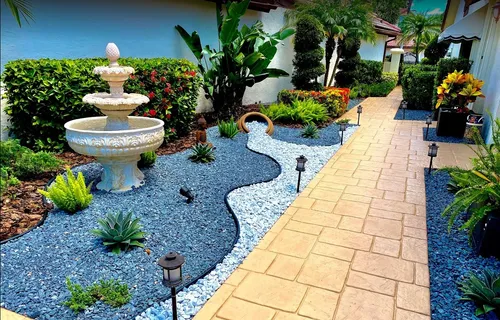
- Focalization and Line: A focal point, such as a specimen tree, a sculpture, or a water feature, draws the eye and gives the landscape interest. Lines, created by bed edges, walkways, or the arrangement of plants, guide movement and attention through the space. Clean, geometric lines often define modern landscape design, while flowing, curved beds lend a more informal, traditional feel.
- Proportion and Transition: The size of plants and landscape features should be in proportion to your home and to each other. Transition refers to the gradual change in element size, texture, or color, which creates depth and a natural flow. A well-proportioned design with thoughtful transitions makes a space feel intentional and comfortable 3.
Popular Layouts and Planting Strategies
Wellington homes often benefit from layouts that blend structured living areas with lush, tropical planting beds. Common configurations include a mix of foundation planting around the home's perimeter, defined turf or groundcover areas for recreation, and strategically placed specimen trees for shade and vertical interest.
Plant selection is where your design comes alive with local character. A palette built for Wellington typically features:
- Architectural Plants: Palms (Sabal, Queen, Pygmy Date), yucca, and agave provide strong vertical lines and silhouettes.
- Tropical Foliage: Bromeliads, philodendrons, ferns, and crotons offer dramatic leaf shapes, textures, and vibrant colors.
- Seasonal Color: Incorporate Florida-friendly flowering plants like pentas, blanket flower, firebush, and plumbago to attract pollinators and provide year-round interest 4.
Grouping plants in layered beds-with taller specimens in back, mid-size shrubs in the middle, and groundcovers in front-creates a lush, full appearance and helps suppress weeds. Mulching these beds is essential in Wellington; it conserves soil moisture, moderates soil temperature, and adds to the finished look.
Find the perfect landscape design companies for your needs
Get personalized recommendations and expert advice
Incorporating Hardscape and Functional Features
Hardscaping refers to the non-living elements of your landscape design. These features define spaces, add functionality, and create structure. In Wellington, popular hardscape elements must withstand humidity and occasional heavy rain.
- Patios, Decks, and Walkways: These create the "rooms" of your outdoor living area. Materials like paver stones, travertine, and composite decking are durable choices for the climate. A well-designed patio extends your entertaining space and serves as a foundation for outdoor furniture.
- Water Features: From serene fountains and ponds to full swimming pools, water elements are a natural fit for Florida living. They provide visual and auditory interest, a cooling effect, and a habitat for wildlife.
- Outdoor Kitchens and Fire Features: For those who love to entertain, an outdoor kitchen with a grill, counter space, and storage transforms the backyard. Fire pits or fireplaces extend usability into cooler evenings and create a cozy gathering spot.
- Lighting and Privacy: Strategic landscape lighting enhances safety, highlights architectural plants or features, and allows you to enjoy your yard after dark. Privacy can be achieved through thoughtful planting of dense hedges (like clusia or Simpson's stopper), or through structures like decorative fences or trellises 5.
Understanding Investment and Project Scope
The cost of a landscape design project in Wellington varies immensely based on its scale, complexity, and the materials chosen. It's helpful to think in terms of project tiers:
- Basic Design & Planting: This tier focuses on foundational beds, simple lawn reshaping, and a curated selection of low-cost, high-impact plants. It's an excellent starting point for enhancing curb appeal and establishing a Florida-Friendly framework 6 7.
- Mid-Range Comprehensive Design: This often includes more extensive planting beds, a greater variety of specimen plants, and the introduction of some hardscaping elements, such as a small patio, walkway, or basic drainage solutions.
- High-End Master Planning: This tier involves a fully customized design for the entire property. It typically integrates extensive hardscaping (large patios, outdoor kitchens, retaining walls), water features, sophisticated lighting systems, and mature, specimen plantings. This represents a significant, long-term investment in your property's value and livability.
Pro Tip: Before finalizing any plans, consult the resources from your local UF/IFAS Extension office. They offer invaluable, science-based guidance tailored specifically to the Palm Beach County area, including plant lists, watering guides, and fertilizer recommendations that align perfectly with Florida-Friendly Landscaping™ goals 8 9.
Frequently asked questions
Sources
Footnotes
-
5 Tips for Designing a Thriving Landscape in Florida's Humid Climate - https://anglerlawn.com/2025/02/20/how-to-design-landscape-florida-humid-climate/ ↩
-
Residential 3D Landscape Design Florida by ShrubHub - https://www.shrubhub.com/florida-3d-landscape-design ↩
-
What are the 7 Principles of Landscape Design? - https://hearnlandscape.com/what-are-the-7-principles-of-landscape-design/ ↩
-
Florida-Friendly Landscaping™ - Handbook for Home ... - https://www.capecoral.gov/Documents/Departments/Public%20Works/Environmental%20Resources/FFL-Handbook_03172022_web.pdf ↩
-
Learn how modern landscape design can harness the beauty of nature. - https://www.mymodernhome.com/blog/modern-landscape-design-ideas-for-your-dream-home/ ↩
-
landscape design definition - https://www.toddhaimanlandscapedesign.com/blog/what-is-landscape-design ↩
-
Residential Landscape Design Pattern Book - Planting Plans ... - https://hort.ifas.ufl.edu/media/hortifasufledu/landscape-design-studio/lds-pdfs/TBW-landscape-pattern-book_02242021-.pdf ↩
-
Plant Selection & Landscape Design - https://www.swfwmd.state.fl.us/sites/default/files/store_products/fynplantguide-web.pdf ↩
-
9 Principles - Florida-Friendly Landscaping™ Program - https://ffl.ifas.ufl.edu/about-ffl/9-principles/ ↩