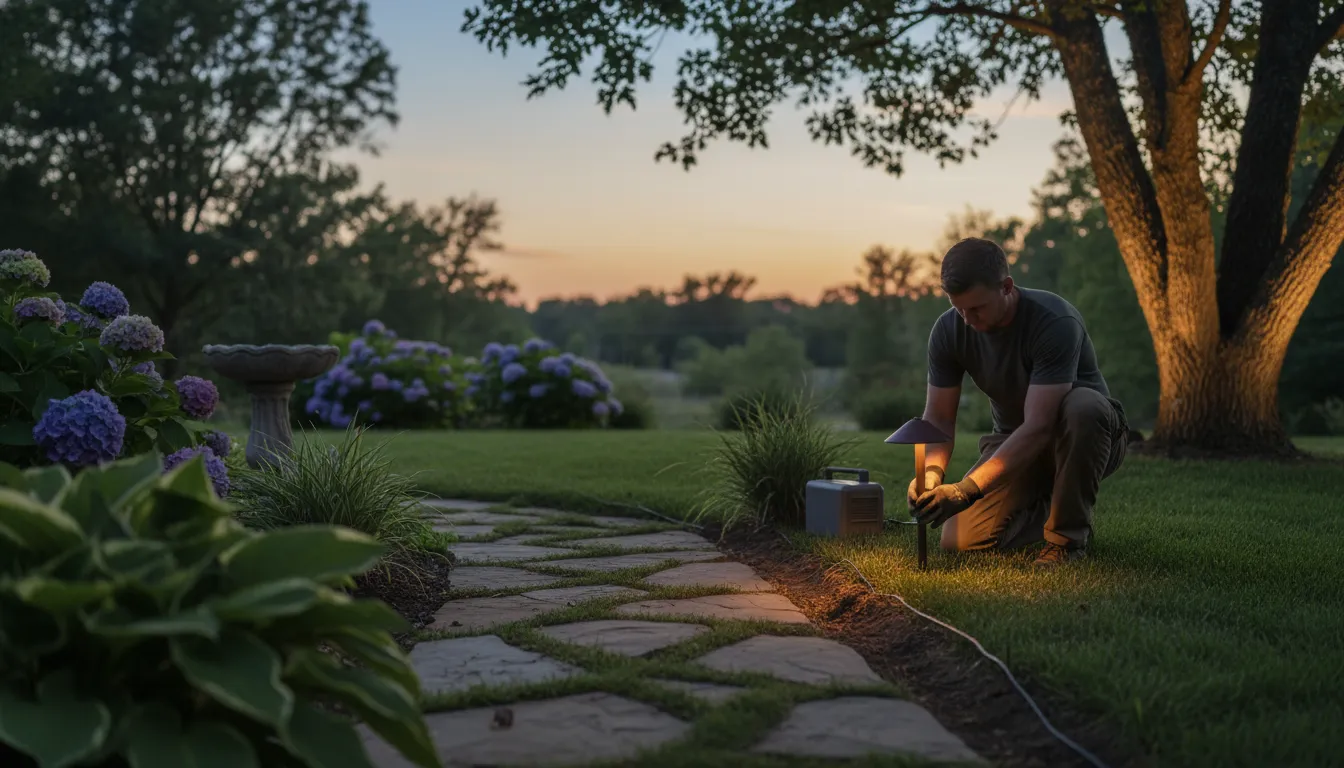
Find the Best Landscape Lighting Installers for Your Business
No obligation • Fast responses • Nationwide coverage

Why you can trust Landscape Atlas
Landscape Atlas is a leading United States resource for evaluating landscaping, lawn care, and outdoor service providers. Our team researches each category in depth, focusing on service quality, safety, and customer experience. Listings and rankings are based on independent criteria and user feedback, and companies cannot pay to influence our assessments or recommendations.
Search providers near you
Best Landscape Lighting Installers in West Virginia Ranked
Enhancing your West Virginia property with outdoor lighting adds beauty, safety, and value. A well-designed landscape lighting system can highlight your home's architecture, illuminate pathways for safe navigation, and extend the enjoyment of your outdoor spaces into the evening. This guide will help you understand the key considerations, from system types and costs to installation specifics, so you can make informed decisions and find the right local expertise for your project.
Understanding Your System Options: Low-Voltage vs. Line-Voltage
The first and most critical decision in planning your landscape lighting is choosing between low-voltage and line-voltage systems. Each has distinct advantages, safety implications, and installation requirements that are important for West Virginia homeowners to understand.
Low-Voltage (12V) Systems are the most popular choice for residential properties. These systems use a transformer to convert your home's standard 120V electricity down to a safer 12 volts. The lower voltage means the wiring carries less shock hazard, making the system safer for families and pets and often simpler to install 1. In many cases, a licensed electrician is not required for installation, though you must always check with your local West Virginia municipality for specific licensing and permit rules before starting any project. Low-voltage systems offer a wide variety of fixture styles and are generally more cost-effective for typical yard lighting projects.
Line-Voltage (120V) Systems use your home's standard electrical current. They are significantly brighter and more powerful, making them suitable for illuminating large areas, commercial properties, or for security applications where maximum visibility is needed 2 3. However, this comes with important requirements: installation must be performed by a licensed electrician, and the wiring must be buried at least 18 inches deep or run through protective conduit, adhering to strict electrical codes 4 2. The fixture selection for line-voltage is often more limited and the overall project cost is typically higher.
Key Components of a Landscape Lighting System
A functional and reliable outdoor lighting setup is more than just fixtures. Understanding the core components will help you plan effectively and communicate with installers.
- Transformer: The heart of any low-voltage system. This box plugs into a standard outdoor GFCI outlet and steps down the voltage from 120V to 12V. It's crucial to select a transformer with a wattage capacity that exceeds the total wattage of all your planned fixtures to allow for future expansion.
- Fixtures: This is the visible hardware. Common types include:
- Path Lights: Short stakes that cast light downward, ideal for lining walkways and driveways.
- Spotlights & Floodlights: Used to highlight architectural features, trees, or signage.
- Well Lights: Installed flush with the ground to uplight trees or walls discreetly.
- Deck & Step Lights: Provide safety lighting on stairs and railings.
- Wire: Low-voltage systems typically use direct-burial cable in gauges like 14, 12, or 10 AWG. The thicker the wire (lower gauge number), the less voltage is lost over long distances, which is key for maintaining brightness in larger West Virginia yards 5.
- Connections: All wire splices and fixture connections must be made with waterproof connectors to ensure the system withstands the state's weather, from humid summers to snowy winters.
Planning Your West Virginia Lighting Design
A thoughtful plan is the foundation of a beautiful result. Start by identifying your goals: is it safety, aesthetics, security, or a combination? Walk your property at dusk to note areas that are dark or features you'd like to accentuate.
Sketch a simple layout of your yard, marking the house, trees, pathways, and other key elements. Decide on fixture placement, remembering that less is often more-strategic lighting creates drama and interest. Consider "layering" light by using a mix of techniques: uplighting trees, washing walls with light, and downlighting paths. Also, factor in light pollution; use shielded fixtures and aim lights carefully to respect your neighbors and the natural nighttime environment.
Find the perfect landscape lighting installers for your needs
Get personalized recommendations and expert advice
Installation Process and Local Considerations
The installation process varies based on your system choice. For a professional low-voltage installation in West Virginia, the crew will typically map out the design, locate the power source, and dig narrow, shallow trenches (often just a few inches deep) for the wiring. Fixtures are then positioned and connected, the transformer is mounted and connected to power, and the entire system is tested. For line-voltage systems, the trenching is deeper, and all electrical work must be completed by a licensed professional.
A crucial local consideration is permitting. Regulations can vary by city or county in West Virginia. Some areas may require a permit for any electrical work, including low-voltage lighting, while others may not. Always verify requirements with your local building department to ensure your project is compliant. Furthermore, working with a professional familiar with West Virginia's terrain-from rocky soil in some regions to softer earth in others-can prevent installation headaches.
Cost Guide for Landscape Lighting in West Virginia
Costs can vary widely based on the system's complexity, quality of materials, property size, and labor. The figures below are estimates to help you budget.
- Per Fixture Cost (Installed): For a standard low-voltage fixture, including the fixture itself and professional installation, homeowners can expect to pay roughly $100 to $150 each.
- Total Project Ranges:
- Entry-Level/Small Property: A basic setup for a modest home with warm white path lighting and a few accent lights typically ranges from $2,500 to $3,500.
- Mid-Size Property: A more comprehensive design with multiple lighting techniques and higher-quality fixtures often falls between $4,000 and $7,000.
- Large/Complex Property: Extensive systems for large yards, with advanced features like multiple lighting zones or color-changing capabilities, can range from $7,000 to $12,000 or more.
- Add-Ons: Incorporating smart controls (Wi-Fi/app-based) or RGB (color-changing) LED fixtures can add approximately 30% or more to the overall project cost 6 7.
Maintenance and Long-Term Value
Modern LED landscape lighting fixtures are built to last for years, but some maintenance ensures optimal performance. Periodically clean lenses and housings of dirt, pollen, and debris. Trim back plant growth that may be blocking light or encroaching on fixtures. After severe storms, check for any fixtures that may have been shifted or buried. In winter, while LED lights are efficient and can handle the cold, heavy snow accumulation should be gently cleared from fixtures.
Investing in quality landscape lighting offers a strong return. It significantly enhances your home's curb appeal and can be a attractive feature for potential buyers. More importantly, it increases the safety and security of your property by eliminating dark shadows and deterring unwanted activity, while transforming your outdoor living area into a nightly retreat.
Frequently asked questions
Sources
Footnotes
-
120V vs. 12V: Which is the Safer Landscape Lighting Option? - https://utahlights.com/120v-vs-12v-which-is-the-safer-landscape-lighting-option/ ↩
-
Landscape Lighting: Low-Voltage (12V) vs Line-Voltage (120V) - https://www.voltlighting.com/learn/low-voltage-vs-line-voltage-landscape-lighting ↩ ↩2
-
Understanding Low Voltage vs. Line Voltage - Spectrum Electric - https://www.spectrumelectricinc.com/blog/2023/understanding-low-voltage-vs-line-voltage.html ↩
-
Do I Need to Be an Electrician to Install Landscape Lighting ... - https://www.youtube.com/watch?v=yra_PP4Qkso&t=3 ↩
-
A Beginner's Guide to Low Voltage Landscape Lighting Wire Lengths - https://www.gardenreet.com/blogs/landscape-lighting-articles/a-beginners-guide-to-low-voltage-landscape-lighting-wire-lengths ↩
-
How Much Does Landscape Lighting Cost In Virginia? - https://dominionlightworks.com/how-much-does-landscape-lighting-cost-in-virginia/ ↩
-
How Much Does Landscape Lighting Cost in 2026? - LawnStarter - https://www.lawnstarter.com/blog/cost/landscape-lighting-price/ ↩