Find the Best Land Clearing Contractors for Your Business
No obligation • Fast responses • Nationwide coverage

Why you can trust Landscape Atlas
Landscape Atlas is a leading United States resource for evaluating landscaping, lawn care, and outdoor service providers. Our team researches each category in depth, focusing on service quality, safety, and customer experience. Listings and rankings are based on independent criteria and user feedback, and companies cannot pay to influence our assessments or recommendations.
Search providers near you
Top Land Clearing Contractors in Minnetonka, Minnesota Ranked
Land clearing is the essential first step in transforming a wooded or overgrown property into a usable space for building, farming, or landscaping. This process involves the systematic removal of trees, brush, stumps, and debris to prepare a site for its next purpose. For homeowners and developers in Minnetonka, understanding the local requirements, methods, and costs for lot clearing is crucial for a successful project. This guide will help you navigate the process, from initial assessment to final grading, and connect you with experienced professionals who can manage the job safely and efficiently.
NWI Tree Service & Landscaping
St Paul, MN
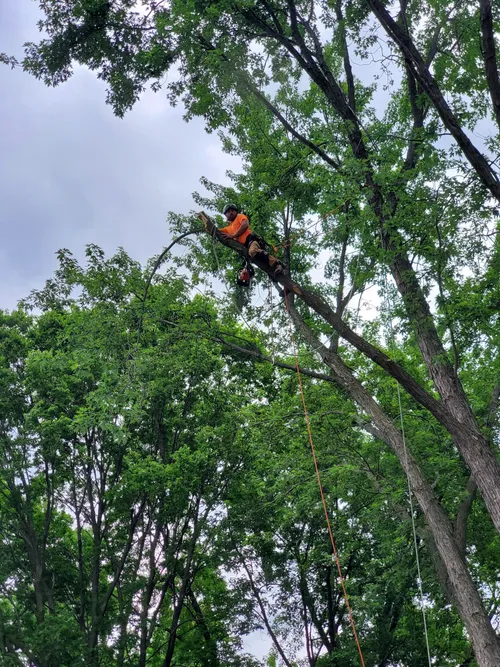
NWI Tree Service & Landscaping is a family-owned company serving St Paul, MN, and the surrounding St. Croix Valley and Western Wisconsin areas. Since 2013, they have provided comprehensive tree care, landscaping, land clearing, and property maintenance services to residential and commercial clients. Their certified arborists offer tree removal, trimming, planting, stump grinding, and plant health care, along with commercial property assessments and emergency tree services. NWI emphasizes safety and thorough cleanup, ensuring each project is completed efficiently and with attention to detail.

Scott Lorenz Tree Service
4741 Gettysburg Ave N, Minneapolis, MN 55428
Scott Lorenz Tree Service is a family-owned business based in Minneapolis, MN, offering tree trimming, removal, stump grinding, and land clearing services. With over 35 years of experience, they serve Central Minnesota and the Twin Cities area, focusing on careful property protection and thorough cleanup. Their team uses proven techniques to ensure safety and efficiency while treating each project with respect and precision.
Twisted Limb Tree Works LLC
Minneapolis, MN
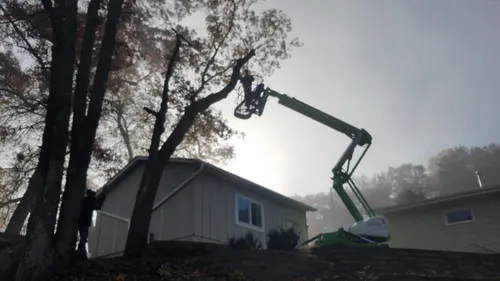
Twisted Limb Tree Works LLC is a tree service company based in Minneapolis, MN, specializing in tree removal, trimming, stump grinding, and land clearing. They serve several nearby communities including Maplewood, Oakdale, White Bear Lake, Roseville, North St. Paul, and Woodbury. With over 20 years of experience in the tree care industry, the company focuses on quality workmanship and customer satisfaction. Their services include technical tree removals and lot clearing, with an emphasis on careful site cleanup after each job.
Mancini Tree Service
St Paul, MN
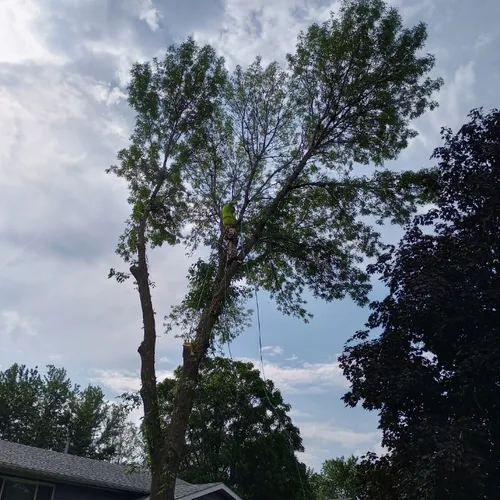
Mancini Tree Service provides professional tree care and land clearing services in St Paul, MN. Their skilled arborists offer tree trimming, removal, stump grinding, brush removal, and specialized ash tree removal to maintain the health and safety of landscapes. They also handle land clearing for construction or agricultural projects and offer rapid storm damage removal to restore properties efficiently. With years of experience, Mancini Tree Service focuses on delivering quality solutions tailored to each client's needs.

Randal Tree Service LLC
St Paul, MN
Randal Tree Service LLC is a professional tree trimming and removal company based in St Paul, MN. They serve residential, commercial, and municipal clients throughout eastern Minnesota and western Wisconsin. Their services include tree removal, tree pruning, land clearing, stump grinding, and storm damage cleanup. The company uses advanced, turf-friendly equipment and is licensed, insured, and certified. They also handle insurance claims for their customers.
What is Land Clearing and Site Preparation?
Land clearing, often referred to as lot clearing or site clearing, is more than just cutting down trees. It's a comprehensive service that prepares raw land for construction, agriculture, or recreational use. In Minnetonka, this typically involves a multi-step process: a thorough site assessment, the removal of vegetation and obstacles, debris disposal, and final grading to create a stable, level surface. Professional site preparation ensures that the land is not only clear but also properly configured for drainage and future development, adhering to local environmental and building codes.
The Land Clearing Process in Minnetonka
A professional land clearing project follows a logical sequence to ensure efficiency, safety, and regulatory compliance. Here's a breakdown of the typical steps involved for properties in the Minnetonka area.
1. Initial Site Assessment and Permitting
Before any equipment arrives, a reputable contractor will conduct a detailed site evaluation. This assessment identifies the types and density of vegetation, soil conditions, topography, and any potential obstacles like wetlands, waterways, or rock outcroppings. Crucially, this stage involves checking with the City of Minnetonka for required permits. Projects near wetlands, shoreland areas, or involving significant tree removal often need local approval to protect Minnesota's natural resources and ensure the work aligns with municipal ordinances.
2. Vegetation Removal: Trees, Brush, and Undergrowth
This is the core of the clearing work. The approach varies based on what's on the land:
- Tree Removal: Large trees are professionally felled using chainsaws and heavy machinery. The focus is on safety and controlling the direction of the fall to protect existing structures or desired trees.
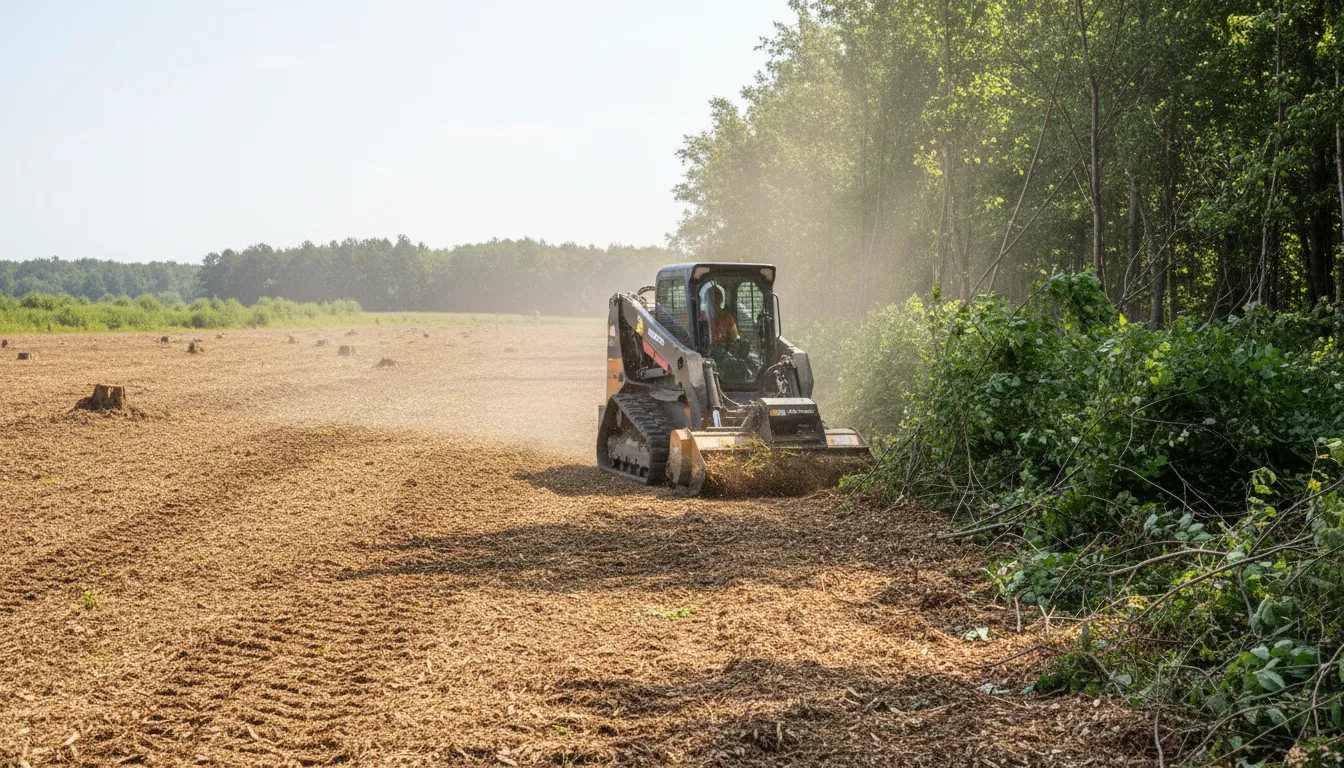
- Brush Clearing: Dense thickets of shrubs, saplings, and undergrowth are cleared using specialized equipment like forestry mulchers, brush mowers, or excavators with grapple attachments.
- Stump Grinding or Removal: After trees are cut, stumps remain. Most projects use stump grinders to chew stumps into wood chips below ground level. For certain sites, stumps may be entirely excavated or "grubbed" out 1.
3. Debris Processing and Disposal
What happens to all the removed material? Professional crews manage disposal efficiently, which is a major component of the project's cost and planning.
- On-Site Chipping: Wood from trees and brush is often fed through industrial chippers. The resulting wood chips can be spread on-site as mulch for erosion control or used in landscaping, reducing haul-away costs 2.
- Hauling and Off-Site Disposal: Remaining debris is loaded onto trucks and taken to local landfills, recycling centers, or biomass facilities. This service includes all associated tipping fees 3.
- Controlled Burning: While sometimes used in rural areas, open burning is highly regulated within Minnetonka and often not permitted due to air quality and safety ordinances. Always verify local rules before considering this method 4.
4. Final Grading and Site Preparation
Once the land is cleared of organic material, the final step is to prepare the sub-surface. Using bulldozers and excavators, crews remove rocks, level the ground, and shape the land to ensure proper drainage away from future building sites. This grading creates a stable, blank canvas ready for the next phase of your project, whether it's laying a foundation, seeding a lawn, or installing a landscape.
Equipment Used for Professional Lot Clearing
The right equipment makes land clearing faster, safer, and more cost-effective. DIY attempts often underestimate the power and specialization needed. Professionals utilize a fleet of machinery, including:
- Excavators and Bulldozers: For moving soil, pushing over large stumps, and final grading.
- Forestry Mulchers: Attached to skid-steers or excavators, these machines grind trees and brush into mulch in a single pass, dramatically reducing cleanup 5.
- Stump Grinders: Dedicated machines for reducing stumps to a pile of chips.
- Chippers and Wood Chippers: For processing felled trees and limbs.
- Chainsaws and Brush Saws: For manual cutting and precision work.
- Dump Trucks and Trailers: For hauling away debris that cannot be repurposed on-site.
Find the perfect land clearing contractors for your needs
Get personalized recommendations and expert advice
Understanding Land Clearing Costs in Minnetonka
The cost to clear land is highly variable and is typically quoted per acre. It depends primarily on the density and type of vegetation, the complexity of the terrain, and the chosen disposal methods. Based on regional data, here are general cost ranges for lot clearing in the Minnetonka area 6 7:
- Light to Medium Brush / Small Trees: For parcels with mostly brush, shrubs, and small-diameter trees, costs can range from $2,500 to $4,000 per acre.
- Heavy Brush / Mixed Forest: Land with a mix of mature trees and dense underbrush typically falls between $4,000 and $6,000 per acre.
- Dense Forest / Large Timber: Properties covered in thick, mature forest with large trees represent the most complex and expensive projects, often costing $6,000 to $12,000 or more per acre.
These estimates include labor, equipment, and standard disposal. Factors that can increase the price include difficult access, rocky soil, the presence of wetlands requiring special care, and higher local landfill fees. The most reliable way to budget is to obtain multiple detailed, written quotes from licensed and insured local contractors 8.
Professional Services vs. DIY Land Clearing
While tackling a small brush pile yourself is feasible, large-scale land clearing is a job for professionals.
Advantages of Hiring a Professional Crew:
- Efficiency and Speed: Industrial equipment completes in days what might take weeks of manual labor.
- Expertise and Safety: Professionals are trained in safe equipment operation and tree felling techniques, mitigating risks of property damage or personal injury.
- Regulatory Knowledge: They handle permit applications and ensure work complies with Minnetonka's environmental and land-use regulations 9.
- Proper Disposal: They have the resources and partnerships to dispose of or recycle debris legally and efficiently.
- Site Preparation: They provide the final grading necessary for your project's success.
Challenges of DIY Clearing:
- Equipment Costs: Renting necessary machinery like excavators, stump grinders, and large chippers is expensive and requires operational skill 10.
- Labor Intensity: Clearing land by hand is extremely physically demanding and time-consuming.
- Disposal Logistics: Hauling loads to a landfill without commercial access can be slow and costly.
- Safety Risks: Operating heavy machinery and chainsaws without experience is dangerous.
- Regulatory Pitfalls: Unknowingly violating local ordinances can lead to fines and project delays.
Key Considerations for Your Minnetonka Project
- Verify Property Lines: Always have your property surveyed or clearly marked before work begins to avoid clearing a neighbor's land.
- Check for Utilities: Contact Gopher State One Call (811) at least a few days before digging to have underground utility lines marked.
- Plan for Erosion Control: Freshly cleared land is vulnerable to erosion. Discuss with your contractor about using silt fencing, straw wattles, or leaving a layer of mulch to protect the soil.
- Consider Future Use: Communicate your end goal (e.g., home construction, horse pasture, new lawn) to your contractor so they can tailor the site prep accordingly.
- Review Contracts Carefully: Ensure your quote details all services: permits, clearing, grinding, hauling, disposal, grading, and cleanup.
Frequently asked questions
Sources
Footnotes
-
Methods of Wooded Land Clearing You Should Know - Day Logging - https://daylogging.com/2022/09/15/methods-of-wooded-land-clearing-you-should-know/ ↩
-
How to Clear Land Easily on Your Own - Woodland Mills - https://woodlandmills.com/how-to-clear-land-easily-on-your-own ↩
-
Brush Clearing Cost: Complete Guide to Land Clearing Pricing and Project Planning - https://www.skidsteers.com/blog/brush-clearing-cost/ ↩
-
Detailed breakdown of site clearing expenses - https://hellolandmark.com/detailed-breakdown-of-site-clearing-expenses/ ↩
-
Best Equipment for Efficient Land and Brush Clearing - DOZR - https://dozr.com/blog/best-equipment-for-efficient-land-and-brush-clearing ↩
-
How Much Does It Cost to Clear Land in 2025? - Daniel Dean - https://www.danieldean.com/how-much-does-it-cost-to-clear-land/ ↩
-
How Much Does It Cost to Clear Land? [2026 Data] | Angi - https://www.angi.com/articles/how-much-does-it-cost-clear-land.htm ↩
-
Lot Clearing Minneapolis & St. Paul - Oak and Iron Tree Experts - https://ironandoakmn.com/tree-services/lot-clearing/ ↩
-
Land & Brush Clearing Service Company In Minnetonka MN ... - https://www.jllandworx.com/land-clearing-minnetonka ↩
-
Cheapest Way to Clear Land - Woodland Mills - https://woodlandmills.com/cheapest-way-to-clear-land ↩