Find the Best Land Clearing Contractors for Your Business
No obligation • Fast responses • Nationwide coverage

Why you can trust Landscape Atlas
Landscape Atlas is a leading United States resource for evaluating landscaping, lawn care, and outdoor service providers. Our team researches each category in depth, focusing on service quality, safety, and customer experience. Listings and rankings are based on independent criteria and user feedback, and companies cannot pay to influence our assessments or recommendations.
Search providers near you
Top Land Clearing Contractors in Chapel Hill, North Carolina Ranked
Preparing a piece of land for a new home, agricultural use, or a commercial project in Chapel Hill often begins with land clearing. This essential process removes trees, brush, stumps, and other obstacles to create a safe, level, and buildable site. Given Chapel Hill's mix of dense woodlands, protected areas, and local regulations, proper site preparation requires careful planning and expertise. This guide will help you understand the steps, methods, costs, and key considerations for lot clearing and vegetation removal in the area, so you can effectively evaluate and connect with experienced local professionals.
Fredin Tree Service LLC
6103 Hushpuppy Ct, Raleigh, NC 27616
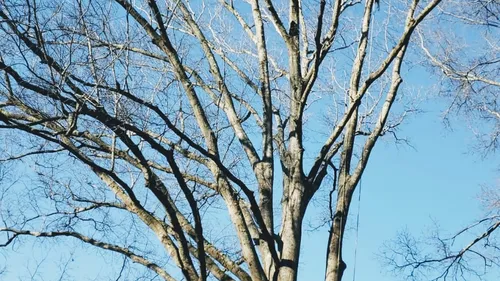
Fredin Tree Service LLC is a family-owned tree care company based in Raleigh, NC. They provide a range of services including tree removal, pruning, stump grinding, lot clearing, and emergency tree service. With 16 years of experience, their skilled team uses modern equipment and local tree knowledge to deliver safe and efficient solutions. They also offer professional stump grinding and site clearing to prepare properties for future use.

Edgar's Tree Service
Raleigh, NC
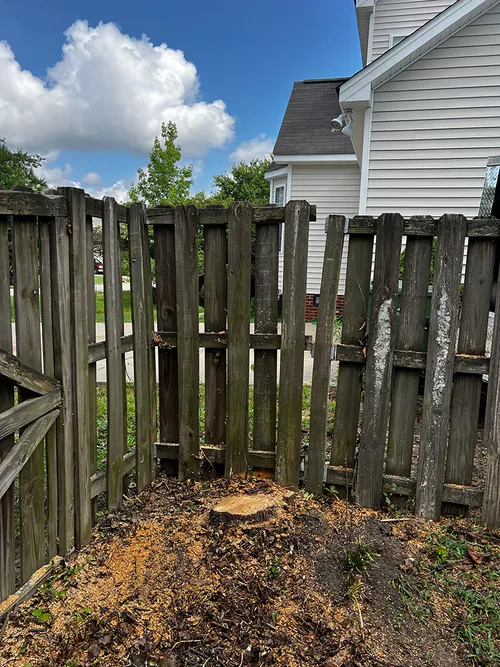
Edgar's Tree Service provides comprehensive tree care and land clearing services in Raleigh, NC. Their skilled arborists handle tree pruning, removal, stump grinding, brush removal, and chipping with a focus on safety and customer-specific solutions. The company is fully insured and offers 24/7 emergency tree removal, specializing in storm damage cleanup for properties affected by severe weather. Serving multiple nearby communities, Edgar's Tree Service combines professional expertise with tailored service to maintain safe and attractive outdoor spaces.
JayBird Tree Service, LLC
Raleigh, NC
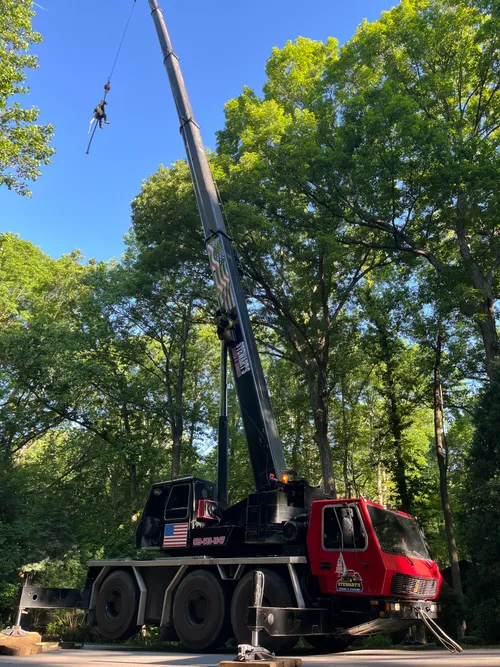
JayBird Tree Service, LLC is a tree care and landscaping company serving Raleigh, NC, and surrounding areas including Knightdale and Cary. With nine years of industry experience, they provide a range of services such as tree removal, trimming, stump grinding, land clearing, and landscaping. They also offer crane-assisted tree removal for large or hard-to-reach trees and provide 24/7 emergency tree services to address urgent situations. Their approach emphasizes clear communication and attention to detail throughout each project.

Wood Brothers Landscaping
316A Woodhaven Rd, Chapel Hill, NC 27514
Wood Brothers Landscaping is a full-service landscaping and hardscaping company based in Chapel Hill, serving Durham, NC, and nearby areas. They provide residential and commercial landscaping, including sod installation, grading, gravel driveway construction and repair, custom hardscapes like flagstone pathways and retaining walls, tree and shrub installations, and land clearing. Their expertise includes gravel driveway grading and drainage solutions such as piping and culverts. The company serves both homes and businesses, maintaining commercial properties including hotels in the region. Wood Brothers Landscaping works closely with clients to design and execute outdoor projects that enhance curb appeal and property value.
Fonville Tree Service
9721 1/2 Fonville Rd, Wake Forest, NC 27587
Fonville Tree Service is a family-owned tree care company serving Raleigh, NC, and the surrounding Wake Forest area. With over 25 years of experience, they provide a wide range of tree services including tree removal, stump grinding, brush removal, and land clearing. The company uses advanced equipment to handle projects of any size safely and efficiently, from small pruning jobs to large lot clearing. Fonville Tree Service is known for its comprehensive approach and commitment to safety and cleanliness on every job.
Understanding the Land Clearing Process
Land clearing, or site clearing, is more than just cutting down trees. It's a systematic project that transforms overgrown or wooded land into a usable parcel. In Chapel Hill, this typically follows a multi-stage process designed to ensure safety, regulatory compliance, and a solid foundation for whatever comes next.
The first and most critical step is planning and permitting. Before any machinery arrives, a reputable contractor will help you identify property lines, survey the land for protected trees or sensitive areas, and secure any necessary permits from local authorities. Chapel Hill and Orange County have specific rules regarding tree removal, erosion control, and stormwater management that must be addressed upfront to avoid costly fines or project delays 1.
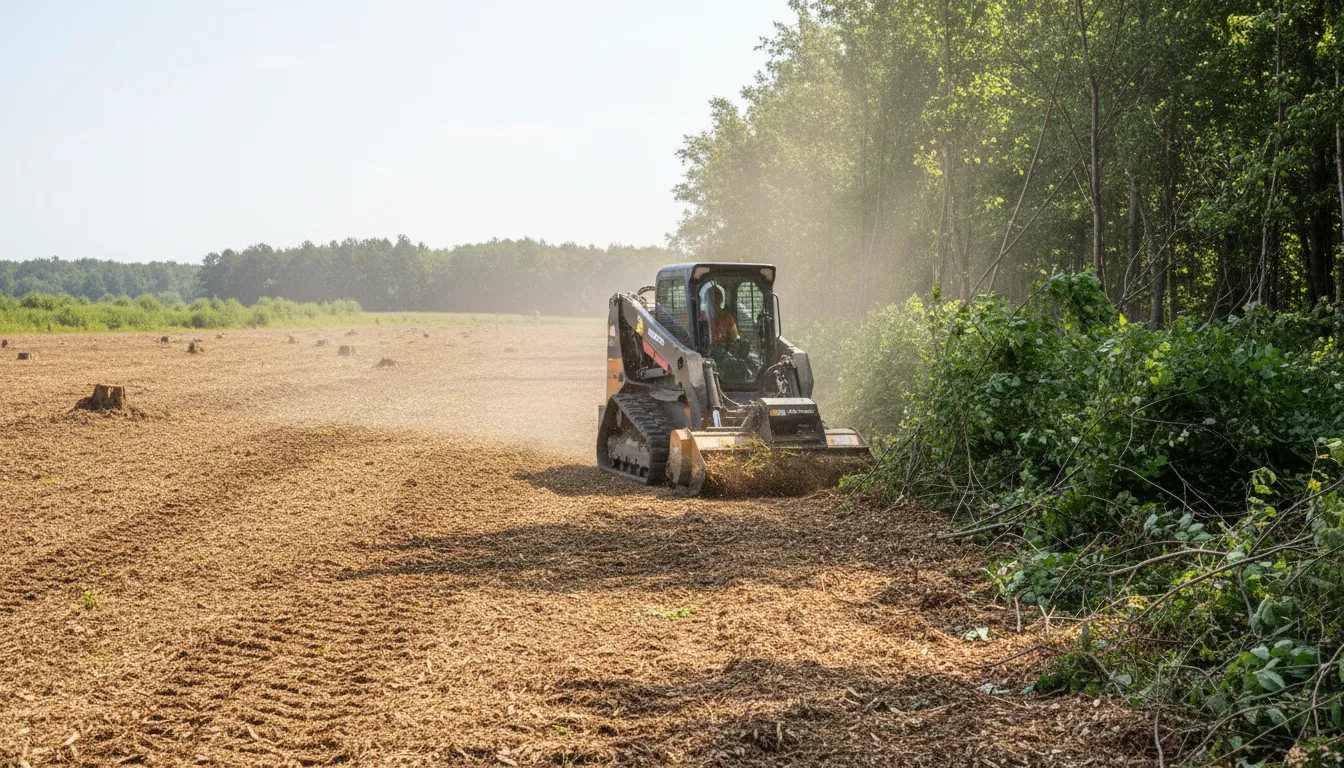
Once plans are approved, the physical vegetation removal begins. For light undergrowth and brush, operators may use specialized mulchers or brush cutters. Larger trees are carefully felled using chainsaws and heavy equipment like excavators, which can safely handle trees and move large debris. The goal is to clear the designated area efficiently while minimizing impact on the surrounding landscape that is to remain undisturbed.
Key Steps in a Chapel Hill Clearing Project
A successful land development project hinges on executing each phase of clearing correctly. Here's a closer look at the standard workflow.
1. Stump Removal and Grinding
After trees are felled, stumps remain. You generally have two options: stump grinding or stump pulling. Stump grinding uses a machine with a rotating cutting wheel to chew the stump and its major roots into small wood chips below ground level. This is often the faster and more cost-effective method, leaving the area ready for grading. Stump pulling involves using an excavator to physically yank the entire stump and root ball from the ground, which creates a larger hole but ensures complete removal. For most residential projects in Chapel Hill, grinding is the preferred choice.
2. Debris Hauling and Disposal
What happens to all the logs, branches, and brush? Disposal is a major component of the total cost and effort. Common methods include:
- Haul-Off: Debris is loaded onto trucks and transported to a local landfill or recycling center. This method adds significant cost due to transportation and tipping fees but results in a completely clean site.
- On-Site Mulching (Forestry Mulching): A growingly popular technique uses a single machine to cut, grind, and spread vegetation as mulch directly onto the soil. This eliminates hauling costs, suppresses weed growth, and helps prevent soil erosion 2 3.
- Burning: In some rural parts of the region, obtaining a burn permit may allow for open burning of brush piles. This is highly regulated, often seasonal, and not typically an option within Chapel Hill city limits due to air quality and safety ordinances.
3. Final Grading and Erosion Control
With the land cleared and stumps removed, the final shaping begins. Grading and leveling uses bulldozers or graders to create a smooth, stable surface with proper drainage away from future construction areas. This is immediately followed by implementing erosion and sediment controls, such as silt fences, sediment basins, or stabilized construction entrances. These measures are not just good practice-they are legally required in North Carolina to prevent runoff from polluting nearby streams and are a key part of the permitting process 4.
Find the perfect land clearing contractors for your needs
Get personalized recommendations and expert advice
Popular Land Clearing Methods in the Triangle Area
The topography and vegetation in Chapel Hill lend themselves to specific clearing techniques. Understanding these options helps in discussing the best approach for your property.
- Forestry Mulching: This is an excellent choice for projects where soil conservation is a priority. A forestry mulcher can quickly process small to medium trees and dense brush, turning them into a protective layer of mulch. It's efficient, reduces the need for multiple machines, and leaves the soil structure intact, which is ideal for future planting or pasture development.
- Traditional Mechanical Clearing: For larger-scale projects or land with many big trees, a traditional approach using excavators, bulldozers, and chippers is standard. Trees are felled, processed into logs (which can sometimes be sold), and the remaining brush is chipped or hauled away. This method provides maximum clearance and is often necessary for full construction site preparation 5.
- Selective Clearing: Not every project requires a clean slate. Selective clearing, or thinning, involves removing specific trees, invasive species, or underbrush while preserving mature, healthy trees and the natural canopy. This is common for creating building sites, driveways, or views within an otherwise wooded lot.
Cost Factors for Land Clearing in Chapel Hill
The price for lot clearing in Chapel Hill is highly variable, as it depends on numerous project-specific factors. However, understanding the primary cost drivers can help you interpret estimates.
Primary Cost Influencers:
- Vegetation Density and Type: A lightly brushed acre costs significantly less to clear than a densely forested one. The size, number, and species of trees are the biggest determinants.
- Terrain and Accessibility: Steep slopes, rocky ground, wetlands, or poor access for heavy equipment will increase the time, complexity, and cost of the job.
- Disposal Method: As mentioned, hauling debris to a landfill is a major expense. Methods that process debris on-site, like forestry mulching, can offer substantial savings 6.
- Scope of Work: Are you doing a full clear, a selective thin, or just clearing a building pad? The size of the area and the desired finished condition directly impact the price.
- Stump Removal: Stump grinding or pulling is typically an additional cost beyond basic clearing.
General Price Ranges: While every project is unique, average costs in the region often fall within these brackets 7 8 9 10 11:
- Light Brush Clearing: $500 - $2,500 per acre.
- Moderate to Fully Wooded Land: $2,000 - $6,000+ per acre.
- Average Comprehensive Clearing: Often ranges between $1,000 - $3,900 per acre.
- Stump Grinding: Can add an additional $200-$500 or more per acre, or be priced per stump.
Always get detailed, written estimates from several contractors that break down costs for each phase (permitting, clearing, stump removal, hauling, grading) to ensure you are comparing equivalent services.
Planning Your Project Timeline
A realistic timeline manages expectations. From initial consultation to a fully graded lot, a standard land clearing project in Chapel Hill can take anywhere from a few days to several weeks. The permitting phase with local authorities can take time, so starting early is crucial. The physical clearing itself for a typical residential lot often takes 1-3 days, with additional time for stump removal, debris hauling, and final grading. Weather, permit approval speed, and the project's complexity are the main variables that affect the schedule.
Frequently asked questions
Sources
Footnotes
-
Guide on land clearing timeline - Bright LLC - https://brightllc.us/how-long-does-land-clearing-usually-take-a-complete-timeline-from-estimate-to-finished-site/ ↩
-
Understanding Land Clearing Near Me: The Real Cost ... - https://www.mountainfolklandclearing.com/post/land-clearing-near-me-how-forestry-mulching-saves-time-and-money-1 ↩
-
What Is Land Clearing? How It Prepares Land for Development - https://www.danieldean.com/what-is-land-clearing/ ↩
-
Practice Standards and Specifications - https://www.deq.nc.gov/energy-mineral-and-land-resources/land-quality/erosion-and-sediment-control-planning-and-design-manual/chapter-6/i-site-preparation/download ↩
-
Land Clearing for Construction Projects: What to Expect and How ... - https://homertree.com/blog/land-clearing-for-construction-projects-what-to-expect-and-how-to-prepare/ ↩
-
Complete Guide to Land Clearing Pricing and Project Planning - https://www.skidsteers.com/blog/brush-clearing-cost/ ↩
-
The Ultimate Guide to Land Clearing | DC Hauling Makes It Easy - https://www.dcmakesiteasy.com/the-ultimate-guide-to-land-clearing/ ↩
-
How Much Does Forestry Mulching Cost in North Carolina? - https://boombrushcontrol.com/blog/how-much-does-forestry-mulching-cost-in-north-carolina/ ↩
-
Complete guide about land clearing in NC - Bright LLC - https://brightllc.us/the-complete-guide-to-land-clearing-before-new-construction/ ↩
-
How Much Does It Cost To Clear Land In Johnston County? - https://southernstatelandscape.com/how-much-does-it-cost-to-clear-land-in-johnston-county/ ↩
-
How Much Does It Cost to Clear Land in 2025? - Daniel Dean - https://www.danieldean.com/how-much-does-it-cost-to-clear-land/ ↩