Find the Best Land Clearing Contractors for Your Business
No obligation • Fast responses • Nationwide coverage

Why you can trust Landscape Atlas
Landscape Atlas is a leading United States resource for evaluating landscaping, lawn care, and outdoor service providers. Our team researches each category in depth, focusing on service quality, safety, and customer experience. Listings and rankings are based on independent criteria and user feedback, and companies cannot pay to influence our assessments or recommendations.
Search providers near you
Top Land Clearing Contractors in Wake Forest, North Carolina Ranked
Preparing a piece of land for a new home, agricultural use, or a commercial project is a significant first step. Land clearing is the essential process of removing trees, brush, stumps, and debris to create a clean, workable site. In Wake Forest, this work must balance efficiency with environmental stewardship, especially given the area's mix of dense woodlands and rolling terrain. This guide will help you understand the methods, costs, and local considerations for site clearing and land preparation in our community, connecting you with the expertise needed to start your project on solid ground.

Fredin Tree Service LLC
6103 Hushpuppy Ct, Raleigh, NC 27616
Fredin Tree Service LLC is a family-owned tree care company based in Raleigh, NC. They provide a range of services including tree removal, pruning, stump grinding, lot clearing, and emergency tree service. With 16 years of experience, their skilled team uses modern equipment and local tree knowledge to deliver safe and efficient solutions. They also offer professional stump grinding and site clearing to prepare properties for future use.
JayBird Tree Service, LLC
Raleigh, NC
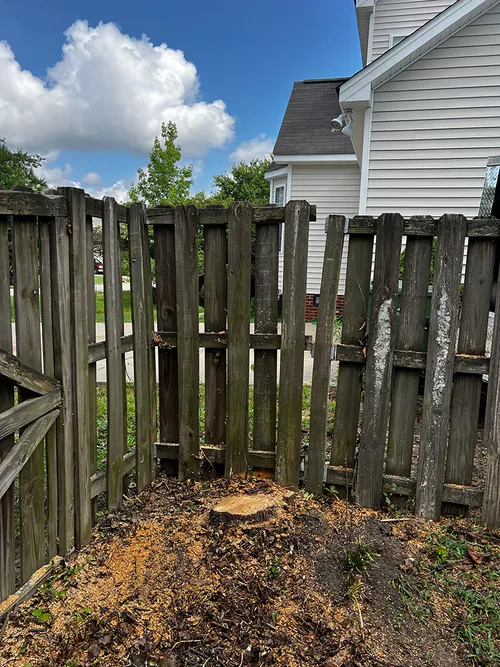
JayBird Tree Service, LLC is a tree care and landscaping company serving Raleigh, NC, and surrounding areas including Knightdale and Cary. With nine years of industry experience, they provide a range of services such as tree removal, trimming, stump grinding, land clearing, and landscaping. They also offer crane-assisted tree removal for large or hard-to-reach trees and provide 24/7 emergency tree services to address urgent situations. Their approach emphasizes clear communication and attention to detail throughout each project.

Wood Brothers Landscaping
316A Woodhaven Rd, Chapel Hill, NC 27514
Wood Brothers Landscaping is a full-service landscaping and hardscaping company based in Chapel Hill, serving Durham, NC, and nearby areas. They provide residential and commercial landscaping, including sod installation, grading, gravel driveway construction and repair, custom hardscapes like flagstone pathways and retaining walls, tree and shrub installations, and land clearing. Their expertise includes gravel driveway grading and drainage solutions such as piping and culverts. The company serves both homes and businesses, maintaining commercial properties including hotels in the region. Wood Brothers Landscaping works closely with clients to design and execute outdoor projects that enhance curb appeal and property value.
Fonville Tree Service
9721 1/2 Fonville Rd, Wake Forest, NC 27587
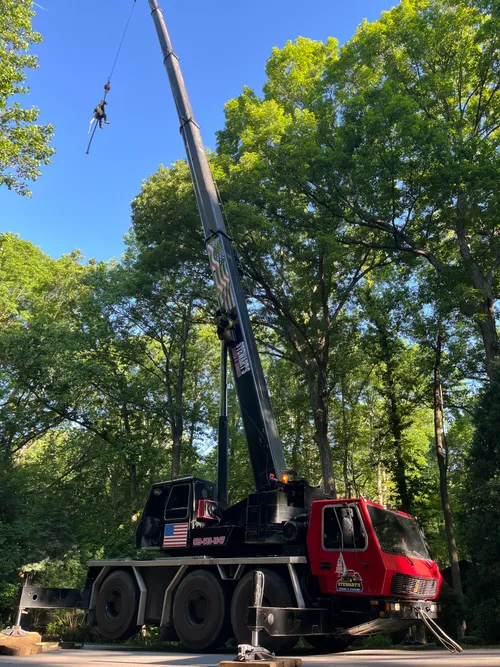
Fonville Tree Service is a family-owned tree care company serving Raleigh, NC, and the surrounding Wake Forest area. With over 25 years of experience, they provide a wide range of tree services including tree removal, stump grinding, brush removal, and land clearing. The company uses advanced equipment to handle projects of any size safely and efficiently, from small pruning jobs to large lot clearing. Fonville Tree Service is known for its comprehensive approach and commitment to safety and cleanliness on every job.

Bobcat Vinnie
224 N Raleigh Farms Rd, Youngsville, NC 27596
Bobcat Vinnie is a contractor based in Durham, NC, specializing in yard drainage, grading, land clearing, and brush removal. With over 30 years of experience, the company serves Raleigh and surrounding areas, offering services such as pool and spa demolition, gravel driveway installation, and residential demolition. Bobcat Vinnie is equipped to handle drainage solutions to address water pooling issues and provides comprehensive land clearing and grading services to prepare properties for landscaping or construction.
Understanding the Land Clearing Process
A successful lot clearing project in Wake Forest begins long before equipment arrives on-site. It involves a systematic approach to transform overgrown or wooded land into a usable parcel.
Initial Assessment and Planning
The first step is a thorough site evaluation by a professional. They will assess the density and type of vegetation (from light brush to mature hardwood forest), the terrain (including slopes and wet areas), and the presence of any protected species or wetlands. This assessment also determines if local permits are required from Wake County or the Town of Wake Forest; it's important to note that agricultural clearing is often exempt from certain regulations, but residential and commercial projects typically require approval. A clear plan outlines the boundaries of work, the chosen clearing method, and the strategy for debris disposal.
Common Clearing Methods Used in Wake Forest
The topography and vegetation in our area dictate which land clearing techniques are most effective. Here's a look at the primary methods used by local contractors:
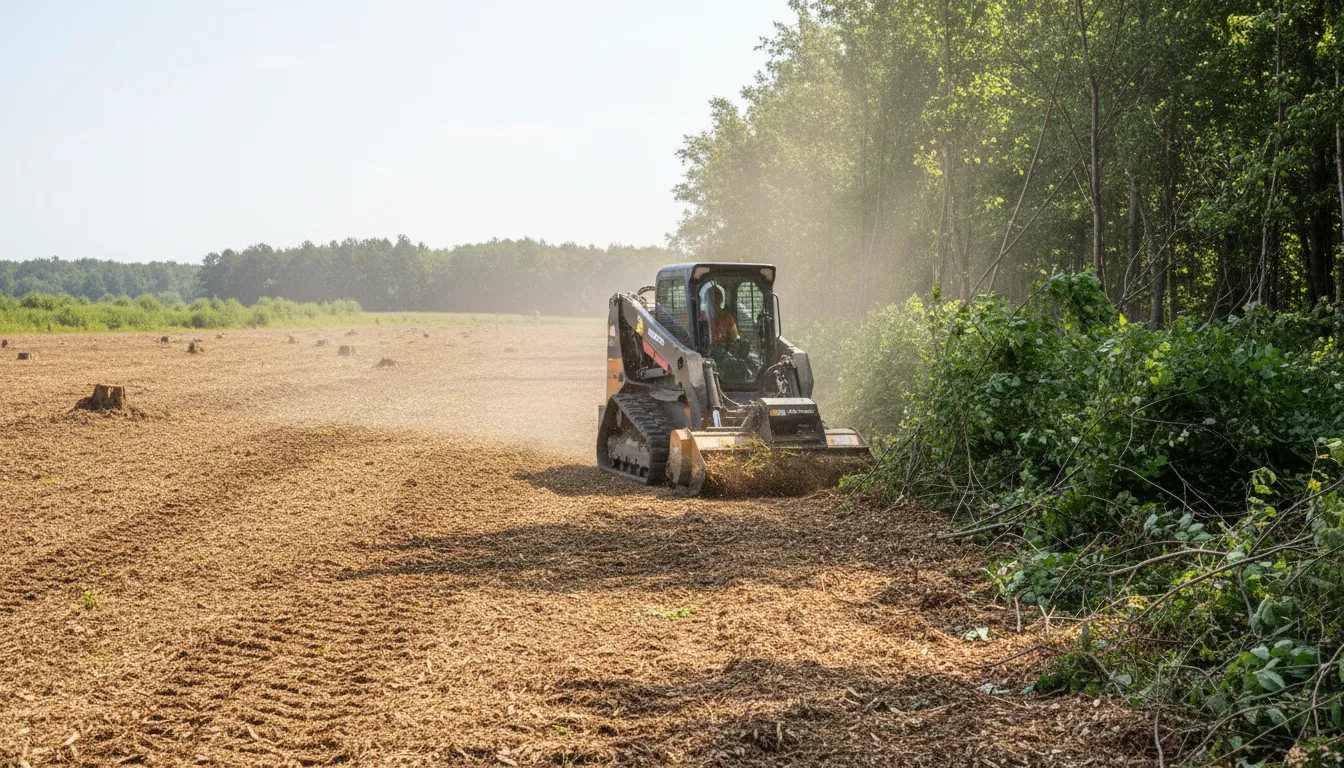
- Forestry Mulching (Mowing): This is an increasingly popular method for vegetation management in Wake Forest. A single machine with a rotary mulching head grinds trees, brush, and stumps into a layer of nutrient-rich mulch that is left on the ground. This technique preserves the topsoil, prevents erosion, and naturally suppresses weed regrowth, making it ideal for creating walking trails, firebreaks, or preparing land where soil health is a priority.
- Grubbing (Dozing): For projects requiring a completely clean slate, such as new construction pads, grubbing is the standard. It involves using heavy equipment like bulldozers fitted with root rakes to push over trees, extract stumps, and remove the root mass from the ground. This method is more invasive than mulching but is necessary for full site development and grading.
- Hand Clearing: In situations where heavy machinery cannot access the site or for selective tree removal, hand clearing with chainsaws and brush cutters is employed. This labor-intensive method offers precision and is often used in conjunction with other techniques for finishing work or clearing sensitive areas.
Stump Removal and Site Preparation
Clearing the vegetation is only part of the job. For a site to be truly ready for construction or landscaping, stump removal and grading are critical.
- Stump Removal: Leftover stumps can hinder construction and landscaping. They are typically removed via grinding (which chips the stump into mulch) or through the grubbing process, which pulls the entire root system 1. The choice impacts both cost and the final condition of the soil.
- Grading and Final Site Prep: After clearing and stump removal, the land must be shaped. Grading involves leveling the ground, creating proper slope for drainage, and often spreading and compacting topsoil 2. This step ensures a stable, well-draining base for whatever comes next, whether it's a foundation, a driveway, or a new pasture.
Find the perfect land clearing contractors for your needs
Get personalized recommendations and expert advice
Debris Disposal Options
What happens to all the removed trees and brush? In Wake Forest, you generally have three disposal avenues, each with different implications for cost and site ecology:
- On-Site Mulching: As described in the forestry mulching method, debris is processed and left in place. This is the most efficient and eco-friendly option, as it returns organic matter to the soil and eliminates hauling costs 3 4.
- Hauling Away: For grubbing and hand-clearing projects, debris is often piled and then hauled off-site by truck to a recycling center or landfill. This results in a cleaner-looking site initially but incurs additional disposal fees.
- Controlled Burning: In some cases, particularly for agricultural land clearing, contractors may obtain a permit for a controlled burn to dispose of piled woody debris 5. This is highly regulated in Wake Forest due to air quality and safety concerns, so it's not always a viable option.
Cost Factors for Land Clearing in Wake Forest
The price for lot clearing services here can vary dramatically based on the project's scope and complexity. Understanding these factors will help you budget effectively.
Primary Cost Drivers
- Acreage and Tree Density: This is the most significant factor. Clearing a lightly brushed one-acre lot costs far less than clearing an acre of dense, mature forest. Heavy clearing in wooded areas is the most expensive scenario.
- Terrain and Accessibility: Steep slopes, rocky ground, or wet, soft soil can complicate equipment operation, increasing time and labor costs. Easy access for large machinery helps keep prices lower.
- Clearing Method Selected: Forestry mulching tends to have a different cost structure than full grubbing and hauling. Mulching is often priced per acre, while grubbing projects may be priced by the hour for equipment and labor or as a total project bid 6.
- Scope of Services: Does the quote include only tree and brush removal, or does it also encompass stump grinding, root removal, final grading, and debris hauling? A "full-service" clear and grade will naturally cost more than basic clearing.
Estimated Price Ranges
Based on regional data for areas like Wake Forest, you can expect the following general price ranges 7 8 9 10:
- Light Clearing (Brush, Small Trees): $500 - $2,000 per acre.
- Heavy Clearing (Dense Forest): $2,000 - $6,000+ per acre. Extremely dense areas with large timber can reach $12,000 per acre.
- Forestry Mulching: $350 - $1,200 per acre.
- Stump Removal: This is typically an additional cost. Stump grinding is less expensive than full grubbing, which removes the roots.
Always get detailed, written estimates from several licensed and insured local contractors. A reputable provider will visit your site to provide a quote that accounts for its unique challenges.
Local Considerations for Wake Forest Property Owners
Beyond the basic process and costs, several local factors are crucial for a smooth project.
- Erosion and Sediment Control: Wake County has strict regulations to prevent soil runoff into waterways. Your clearing plan may need to include silt fences, sediment basins, or seeding to stabilize exposed soil immediately after grading 11.
- Protected Areas: Be aware of any streams, wetlands, or jurisdictional buffers on your property. Clearing in these areas is heavily restricted and requires separate permits, if allowed at all.
- Utility Location: Before any digging or grubbing begins, it is mandatory to have all underground utilities (gas, water, electric, cable) marked by calling 811. This free service prevents dangerous and costly accidents.
- Neighbor Considerations: For larger projects, it's courteous to inform adjacent property owners of your plans, especially regarding noise, dust, and equipment access.
Frequently asked questions
Sources
Footnotes
-
What is Land Clearing? - Tidd Tree - https://tiddtree.com/what-is-land-clearing/ ↩
-
What Is The Process Of Clearing Land? | Houston Concrete And ... - https://www.americanpavingtx.com/what-is-the-process-of-clearing-land/ ↩
-
Land Clearing by RYEX Services - https://www.ryexservices.com/services/land-clearing ↩
-
Forestry Mulching in Tipton & Shelby County - https://www.outdoorservicesgroup.com/forestry-mulching ↩
-
Lot Clearing | Asheville, NC - https://www.united-tree-service-nc.com/land-clearing/lot-clearing ↩
-
Top 5 Methods of Land Clearing | Which Is Right for You? - Valor - https://www.valorenv.com/top-5-methods-of-land-clearing-which-is-right-for-you/ ↩
-
Average Cost Of Forestry Mulching & Farm Mulcher 2025 - Farmonaut - https://farmonaut.com/blogs/average-cost-of-forestry-mulching-farm-mulcher-2025 ↩
-
How Much Does It Cost to Clear Land in 2025? - Daniel Dean - https://www.danieldean.com/how-much-does-it-cost-to-clear-land/ ↩
-
Complete guide about land clearing in NC - Bright LLC - https://brightllc.us/the-complete-guide-to-land-clearing-before-new-construction/ ↩
-
What Does it Cost to Clear Land in NC? - Eric Andrews Realtor - https://www.ericandrewsrealtor.com/cost-to-clear-land/ ↩
-
Land and Water | NC State Extension - Farm Planning Resources - https://farmplanning.ces.ncsu.edu/land-and-water/ ↩