Find the Best Land Clearing Contractors for Your Business
No obligation • Fast responses • Nationwide coverage

Why you can trust Landscape Atlas
Landscape Atlas is a leading United States resource for evaluating landscaping, lawn care, and outdoor service providers. Our team researches each category in depth, focusing on service quality, safety, and customer experience. Listings and rankings are based on independent criteria and user feedback, and companies cannot pay to influence our assessments or recommendations.
Search providers near you
Top Land Clearing Contractors in Wauwatosa, Wisconsin Ranked
Preparing a property for a new home, a landscaping project, or agricultural use often begins with land clearing. This essential service involves the systematic removal of trees, brush, stumps, and other vegetation to create a clean, workable site. In Wauwatosa, proper lot clearing is crucial not only for development but also for managing invasive species, improving safety, and enhancing the usability of your outdoor space. This guide outlines the process, costs, and local considerations to help you connect with experienced professionals who can assess your specific needs and execute a safe, efficient site preparation project.

Husky Tree Services
S74w16860 Janesville Rd #292, Muskego, WI 53150
Husky Tree Services is a tree service and land clearing contractor based near Milwaukee, WI. They provide tree removal, stump grinding, and brush removal services for homeowners and businesses throughout Wisconsin. Their certified arborists use specialized equipment such as spider lifts and grapple saw trucks to ensure safe and efficient work while protecting the surrounding landscape. Husky Tree Services is fully insured and has received positive customer feedback. They focus on improving property safety and appearance through expert tree and stump removal.
J.W. Kolp Tree Service LLC
Milwaukee, WI
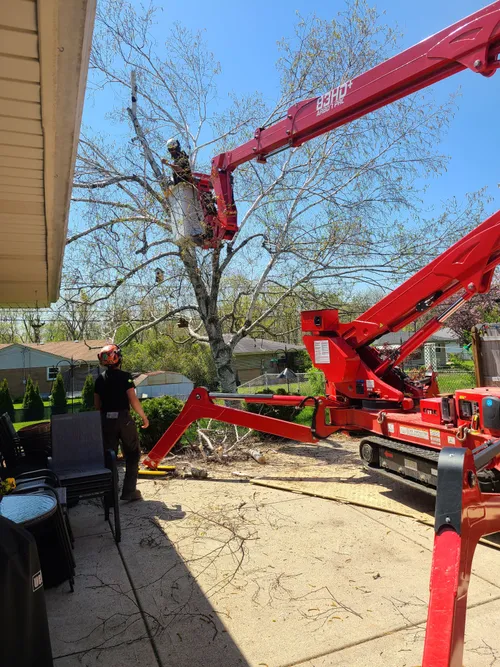
J.W. Kolp Tree Service LLC provides tree removal, pruning, emergency storm and insurance tree work, and lot clearing in Milwaukee, WI. They serve residential, commercial, and municipal clients, offering services such as brush removal and stump grinding. The team emphasizes client communication and safety, guiding customers on tree health and property protection. They are fully insured and committed to maintaining a clean and safe worksite.
Palasz Tree Service LLC
Milwaukee, WI
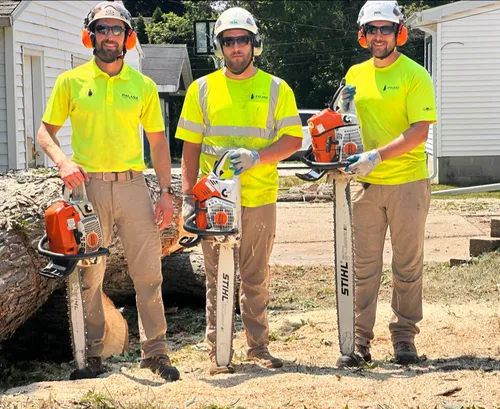
Palasz Tree Service LLC is a local tree care company based in Milwaukee, WI, offering a full range of tree services. They provide tree removals, trimming, pruning, stump grinding, land clearing, and brush removal for residential and commercial properties. Serving Southeastern Wisconsin, they handle everything from routine tree maintenance to the removal of diseased trees to help maintain property safety and aesthetics.
Waukesha Lawn Service
675 N Brookfield Rd #107, Brookfield, WI 53045
Waukesha Lawn Service is a family-owned lawn care and landscaping company based in Milwaukee, WI. They provide full-season yard care services including lawn maintenance, landscape design, sod installation, yard drainage solutions, and snow removal. Serving the Waukesha County area and surrounding communities, they focus on creating healthy, well-maintained lawns and custom landscape renovations. Their team has over 30 years of experience and uses premium products to ensure lasting results. Waukesha Lawn Service offers year-round availability, including snow removal during winter months.
His Workmanship - Milwaukee
Milwaukee, WI
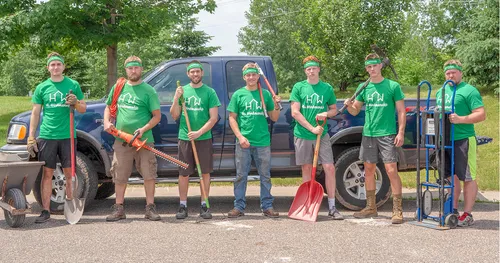
His Workmanship - Milwaukee is a landscaping and labor service provider based in Milwaukee, WI. They offer a range of services including lawn fertilization, weed control, tree removal, stump grinding, sprinkler installation and repair, land clearing, brush removal, and general landscaping. The company connects homeowners with skilled laborers, primarily Christian college students, to complete projects efficiently across the Milwaukee area, including Greenfield, Racine, Menomonee Falls, and Waukesha. Their crews handle tasks such as heavy yard cleanup, removal of invasive plants, and stump grinding, leaving sites tidy and well-prepared for future landscaping. His Workmanship emphasizes clear communication and quick scheduling to facilitate smooth project completion.
Understanding the Land Clearing Process
A successful land clearing project in Wauwatosa is more than just removing trees; it's a multi-phase operation that requires careful planning and execution. The goal is to transform an overgrown or wooded parcel into a ready-to-use space while adhering to local regulations and preserving the health of the surrounding ecosystem.
Initial Site Assessment and Planning
Every effective project starts with a thorough evaluation. A professional will survey your property to identify key elements: the density and type of vegetation, the terrain and slope, soil conditions, and the location of any utilities or property boundaries. A critical step is marking which trees are to be preserved, especially valuable or mature specimens. This planning phase also involves determining the best access routes for heavy machinery and establishing a clear sequence of operations to minimize disruption and cost.
Permitting and Local Regulations
Before any work begins, it's essential to secure the necessary permits. Wauwatosa and Milwaukee County have specific regulations governing land clearing, particularly concerning erosion control, tree preservation, and proper debris disposal 1. For example, if you're clearing land for construction, you'll need to comply with local site clearing standards designed to protect water quality and soil stability 1. A reputable clearing service will be familiar with these requirements and can often handle the permitting process on your behalf.
Common Land Clearing Methods Used in Wauwatosa
The technique chosen for your property depends on the size of the area, the type of vegetation, and your plans for the cleared land. Local contractors typically employ a combination of the following methods.
Manual Clearing
For smaller residential lots, areas near structures, or projects requiring high precision, manual clearing with chainsaws, brush cutters, and hand tools is often the best approach. This method allows for selective clearing, carefully removing specific trees and underbrush while protecting desirable plants. It's particularly important for treating certain species; for instance, oak trees cut between April and September should have their stumps painted immediately to prevent the spread of oak wilt, a serious fungal disease.
Mechanical Clearing
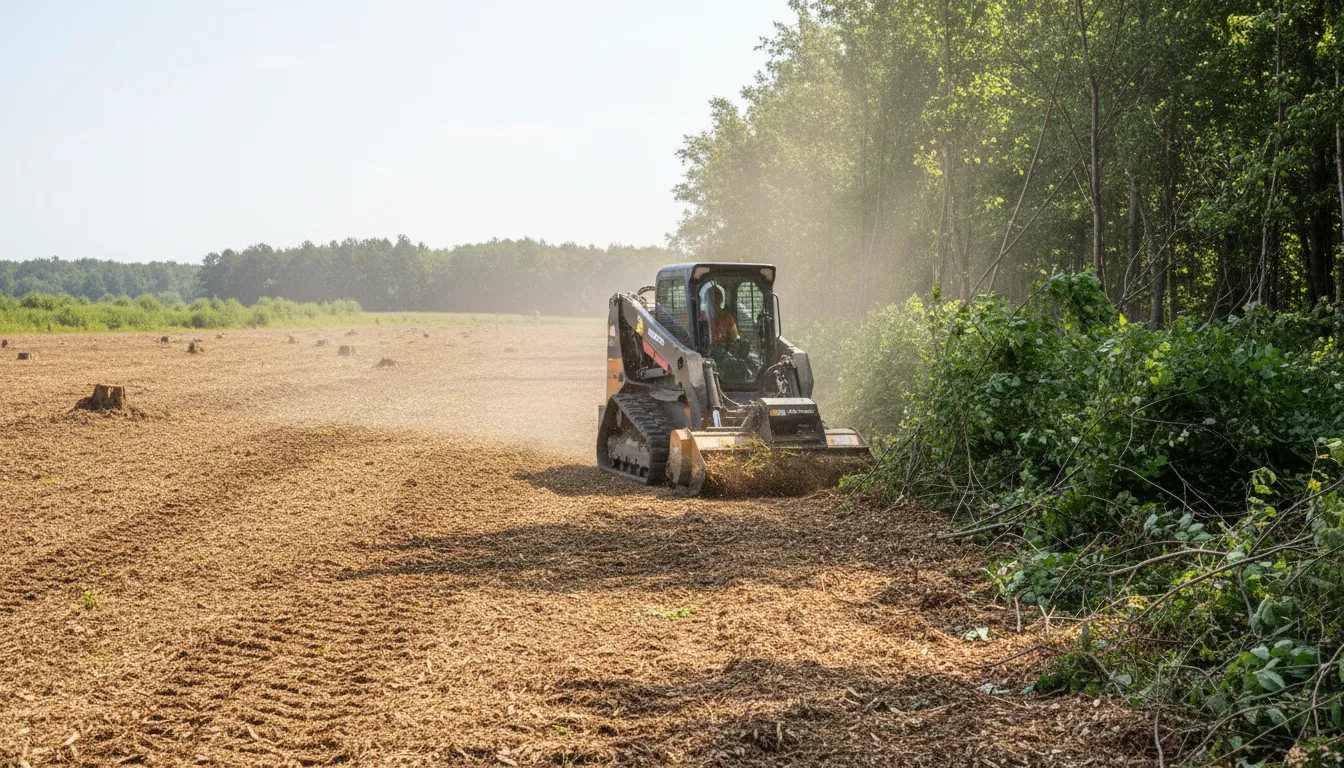
For larger acreage or heavily wooded plots, mechanical clearing is the most efficient option. This involves using heavy equipment like bulldozers, excavators, and skid-steers with specialized attachments. A highly efficient mechanical method is mulching, where a forestry mulcher grinds trees and brush into small wood chips on-site. This eliminates the need for separate hauling in many cases and leaves a layer of nutrient-rich mulch that can help with erosion control.
Stump and Root Removal
After trees are felled, stumps and roots remain. The standard solution is stump grinding, which uses a rotary cutter to grind the stump below grade level, leaving behind wood chips. For complete removal, especially if new construction is planned, stump extraction may be necessary to pull out the entire root ball, ensuring a stable and obstruction-free subgrade.
Chemical Clearing
This method is primarily used for controlling invasive plant species or preventing regrowth in areas where vegetation is not desired. Targeted herbicide applications can manage invasive brush like buckthorn without the disturbance of mechanical methods 2. Chemical treatments are often used in conjunction with other clearing techniques for long-term management.
Find the perfect land clearing contractors for your needs
Get personalized recommendations and expert advice
Debris Management and Disposal Options
What happens to all the removed material is a key part of the project planning. In Wauwatosa, you have several options for debris management, each with different cost and environmental implications.
- On-Site Mulching: As mentioned, forestry mulchers process debris into mulch that can be spread over the cleared area. This is cost-effective and beneficial for soil health but may not be suitable if the site needs to be graded immediately for construction.
- Chipping and Recycling: Brush and limbs can be fed through a wood chipper. The resulting chips can be removed for use as biomass fuel or landscaping mulch elsewhere.
- Hauling and Landfill Disposal: For mixed debris, non-organic waste, or when on-site processing isn't possible, material is loaded onto trucks and hauled away. It may be taken to a recycling center, a composting facility, or, as a last resort, a landfill 3. Disposal fees are a significant component of the overall project cost.
Grading and Final Site Preparation
Clearing the vegetation is only part of the job. The final phase involves preparing the land for its intended use. Grading uses equipment to level the ground, create proper drainage slopes, and establish a stable base 4. This step is crucial for building foundations, installing lawns, or creating agricultural fields. A final inspection ensures the site meets all planned specifications and regulatory requirements before the project is considered complete.
Cost Factors for Land Clearing in Wauwatosa
The price for lot clearing services can vary dramatically based on your property's specific characteristics. Understanding these factors will help you interpret quotes from local providers.
- Vegetation Density and Type: A lightly brushed acre costs far less to clear than a densely forested one. The presence of large trees, thick undergrowth, or invasive species increases labor and time.
- Terrain and Accessibility: Steep slopes, wet ground, or limited access for equipment can complicate the work and raise costs.
- Project Size: Economies of scale often apply. Clearing a small residential lot may have a higher cost per square foot than clearing several acres of open land.
- Disposal Method: On-site mulching is typically less expensive than hauling debris away, which involves trucking fees and landfill tipping costs 5.
- Permits and Regulations: The cost and time required to obtain necessary permits are factored into the project total.
To provide a general range based on common project scales: clearing an acre of medium brush might cost between $2,500 and $4,000, while clearing an acre of heavy forest can range from $6,000 to over $12,000 6 7 8. For standard residential lots, total costs often range from a few hundred to several thousand dollars, depending on the density 9 10.
Tip: The best way to understand your specific cost is to obtain detailed, written quotes from several local Wauwatosa land clearing companies. Reputable firms will provide a free site assessment and a breakdown of costs for labor, equipment, disposal, and permits 11 12.
Frequently asked questions
Sources
Footnotes
-
Waukesha County Land Conservation: Site Clearing Standards - https://midwesttreeandlandscape.com/waukesha-site-clearing-standards/ ↩ ↩2
-
Land Clearing Techniques - https://www.midwestlandsolutionswi.com/post/land-clearing-techniques ↩
-
Yard Debris Removal Wauwatosa, WI | Pickup & Disposal Services - https://goloadup.com/wauwatosa-wi/yard-debris-removal/ ↩
-
Land clearing is the removal of brush, trees and stumps. For ... - https://www.danieldean.com/land-clearing/ ↩
-
Plan Your Land Clearing Project: A Step-by-Step Guide - https://www.midwestlandsolutionswi.com/post/plan-your-land-clearing-project-a-step-by-step-guide ↩
-
The Ultimate Guide to Land Clearing | DC Hauling Makes It Easy - https://www.dcmakesiteasy.com/the-ultimate-guide-to-land-clearing/ ↩
-
Pricing Guide: How Much Does It Cost to Clear Land? - LawnStarter - https://www.lawnstarter.com/blog/cost/clear-land-price/ ↩
-
How Much Does It Cost to Clear Land in 2025? - Daniel Dean - https://www.danieldean.com/how-much-does-it-cost-to-clear-land/ ↩
-
Land Clearing 101: Costs, Permits, and Timeline Explained - https://www.gibbsexcavating.net/blog-land-clearing-101--costs-permits-and-timeline-explained.php ↩
-
Complete Guide to Land Clearing Pricing and Project Planning - https://www.skidsteers.com/blog/brush-clearing-cost/ ↩
-
Logging & Debris Removal: Land & Lot Clearing Wauwatosa (888 ... - https://land-lot-clearing-wauwatosa-wi.a3treeservice.com/ ↩
-
What To Know About Land Clearing For Construction - https://www.darrylstreeservicewi.com/what-homeowners-builders-should-know-about-land-clearing-for-construction/ ↩