Find the Best Lawn Treatment Companies for Your Business
No obligation • Fast responses • Nationwide coverage

Why you can trust Landscape Atlas
Landscape Atlas is a leading United States resource for evaluating landscaping, lawn care, and outdoor service providers. Our team researches each category in depth, focusing on service quality, safety, and customer experience. Listings and rankings are based on independent criteria and user feedback, and companies cannot pay to influence our assessments or recommendations.
Search providers near you
Best Lawn Treatment Companies in Alabama Ranked
Maintaining a healthy, vibrant lawn in Alabama requires a strategic approach tailored to the state's unique climate and common grass types. Effective lawn fertilization and weed control are essential services that provide your turf with the nutrients it needs to thrive while suppressing invasive plants that compete for resources. This guide explains the core principles of a successful lawn care program for Alabama homeowners, helping you understand the seasonal schedule, product options, and professional services available to achieve a resilient and beautiful yard.
Understanding Alabama's Lawn Environment
Alabama's humid subtropical climate presents both opportunities and challenges for lawn care. Long, hot summers and mild winters create an extended growing season for desirable warm-season grasses, but also for a wide array of weeds and pests. The state's common soil types, particularly clay, can affect nutrient availability and water drainage, making soil management a critical first step.
The most prevalent turfgrasses in Alabama are warm-season varieties, each with specific needs:
- Bermudagrass: Thrives in full sun, tolerates heat and drought, and recovers quickly from damage. It requires more frequent mowing and fertilization.
- Zoysiagrass: Known for its dense, carpet-like growth and good shade tolerance. It establishes slowly but forms a very resilient turf.
- Centipedegrass: Often called the "lazy man's grass," it requires less fertilizer and mowing but is less tolerant of heavy foot traffic and certain herbicides.
- St. Augustinegrass: Prefers coastal areas, has good shade tolerance, but is susceptible to several fungal diseases and insect pests.
A one-size-fits-all approach does not work. Your fertilization and weed control strategy must be built around your specific grass type and the local conditions in your yard.
The Essential Lawn Care Calendar for Alabama
A proactive, calendar-based approach is the foundation of effective lawn management. Following a schedule aligns your actions with the grass's natural growth cycles and the life cycles of common weeds.
Late Winter to Early Spring (February - March)
This period is critical for setting up a weed-free summer. The primary task is applying a pre-emergent herbicide before soil temperatures consistently reach 55°F, which prevents crabgrass and other summer annual weeds from germinating 1. A light fertilization can be applied once the threat of frost has passed and grass begins to green up, but the major feeding should wait for stronger growth.
Late Spring (April - May)
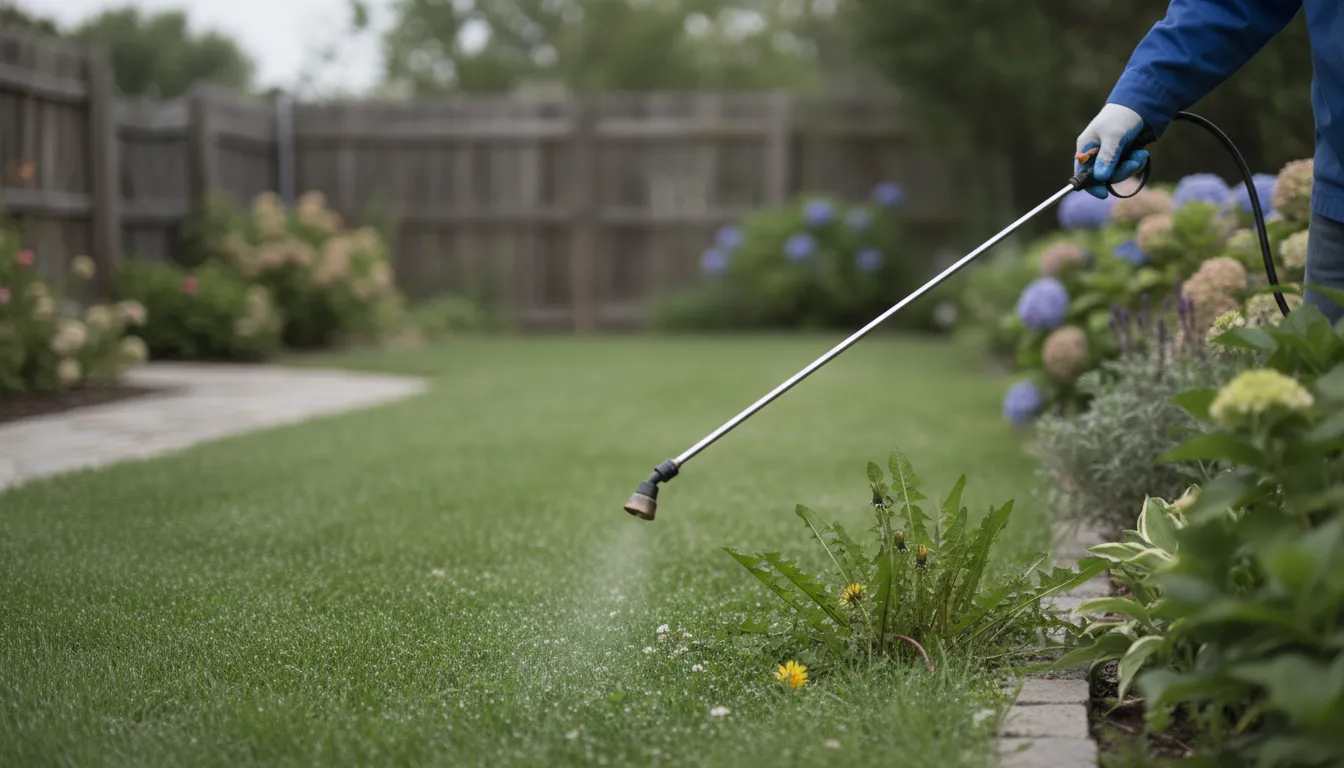
As temperatures rise, apply post-emergent herbicides to tackle existing broadleaf weeds like dandelions and clover. The first major fertilizer application of the year should occur in late May or early June. Use a slow-release nitrogen fertilizer (such as a 16-2-8 or similar ratio) to feed the lawn steadily as it enters its peak growing season without causing a damaging surge of growth 2.
Summer (June - July)
Focus shifts to maintenance and problem-solving. Monitor for heat stress, water deeply and infrequently (about 1-1.5 inches per week), and mow at the recommended height for your grass type. Spot-treat for stubborn summer weeds like nutsedge with a targeted product. Be vigilant for insect pests such as grubs and armyworms, which can cause significant damage quickly.
Late Summer to Early Fall (August - September)
Apply a final high-nitrogen, slow-release fertilizer to help the lawn recover from summer stress and build strength before dormancy. This feeding promotes root development and nutrient storage. Continue to monitor and spot-treat weeds as necessary.
Fall (September - November)
This is the second most critical weed prevention window. Apply a fall pre-emergent herbicide in September or October to prevent winter weeds like chickweed, henbit, and annual bluegrass (poa annua) 3 4. In October or November, a "winterizer" fertilizer application-high in potassium-helps improve cold tolerance and root health for the dormant period. This is also an excellent time to aerate compacted soil and apply lime if a soil test indicates the pH is too low.
Key Products for Fertilization and Weed Control
Choosing the right products is crucial for safety and effectiveness. Always read and follow all label directions.
Fertilizers: Look for blends formulated for Southern lawns. A balanced, slow-release fertilizer with a ratio like 16-4-8 or 15-0-15 is often recommended. Slow-release formulas provide nutrients over time, reducing the risk of burn and leaching.
Pre-Emergent Herbicides: These form a barrier in the soil to stop weed seeds from sprouting. Common active ingredients for lawns include Prodiamine and Dithiopyr. Products like Hi-Yield Crabgrass Control (Benefin + Trifluralin) are widely available 5.
Post-Emergent Herbicides: For weeds you can see. For broadleaf weeds, look for products containing 2,4-D, Dicamba, or MCPP. For tough grassy weeds like nutsedge, SedgeHammer (halosulfuron-methyl) is effective. Atrazine is a common choice for use in Centipede and St. Augustine lawns, but it must be used with caution 6 7.
Combination "Weed & Feed" Products: These combine fertilizer and weed control in one application. Examples include BioAdvanced 3-in-1 Weed & Feed for Southern Lawns and Scotts Turf Builder Southern Triple Action. Important Note: Avoid applying weed and feed products during the heat of summer when temperatures exceed 90°F, as this can damage the lawn.
Find the perfect lawn treatment companies for your needs
Get personalized recommendations and expert advice
Professional Services vs. DIY Lawn Care
Many Alabama homeowners choose between managing their lawn themselves or hiring a professional service. Each path has its merits.
The DIY Approach offers maximum control and can be more cost-effective for smaller lawns. It requires an investment in time, equipment (spreader, sprayer), and product knowledge. The initial cost for quality DIY products can be significant; for example, a 20 lb bag of a premium weed & feed product can cost $45-$55 and cover up to 8,000 sq. ft. 8. Success depends on your ability to correctly diagnose problems, apply products at the right time and rate, and adhere to the seasonal schedule.
Professional Lawn Care Services provide expertise, convenience, and consistent results. A typical comprehensive program in Alabama includes 6-8 visits per year, covering pre-emergent and post-emergent weed control, slow-release fertilization, and insect monitoring 9. Professionals have access to commercial-grade products and the training to apply them safely and effectively. They can also identify and address issues like disease or soil compaction that a homeowner might miss.
Understanding Service Costs
Professional lawn care costs in Alabama vary based on lawn size, service frequency, and program scope.
- Basic Fertilization & Weed Control Program: A full-year, multi-visit program typically ranges from $300 to $600 per year for an average-sized residential lawn 10 11.
- À La Carte Services: Single applications like post-emergent weed control may cost $50-$100 per visit. Specialized treatments like core aeration can range from $150 to $750 depending on lawn size 12 13.
- Insect/Pest Control: Targeted treatments for grubs or fire ants generally cost between $75 and $150 per application 14.
Foundational Best Practices for Success
Beyond products and schedules, these core practices determine long-term lawn health.
- Conduct a Soil Test First: This is the most important step often overlooked. A soil test (available through your local county Extension office) will reveal your soil's pH and exact nutrient levels. It takes the guesswork out of fertilization and can save you money by preventing unnecessary applications 15 16.
- Mow Correctly: Mow at the proper height for your grass type. For example, Bermuda should be kept at 1.5-2.5 inches, while Zoysia and Centipede do best at 1-2 inches 17. Never remove more than one-third of the grass blade in a single mowing, and keep mower blades sharp.
- Water Wisely: Deep, infrequent watering encourages deep root growth. Aim for about 1 to 1.5 inches of water per week, including rainfall. Watering in the early morning reduces evaporation and fungal disease risk 18.
- Address Problems Early: Regularly inspect your lawn for signs of weeds, insects, or disease. Early intervention is always easier and more effective than trying to correct a widespread problem.
Frequently asked questions
Sources
Footnotes
-
The Best Lawn Care Schedule for Alabama - Lawn Love - https://lawnlove.com/blog/lawn-care-schedule-alabama/ ↩
-
Lawn Fertilization | Mountain Brook, Liberty Park & Greystone, AL - https://qcscapes.com/services/lawn-care/lawn-fertilization/ ↩
-
The Best Lawn Care Schedule for Alabama - Lawn Love - https://lawnlove.com/blog/lawn-care-schedule-alabama/ ↩
-
St. Augustine, Zoysia & Bermuda Maintenance - https://www.aces.edu/wp-content/uploads/2024/11/ANR-3107_SouthAlaGardening-GeneralMaintenanceSchedule_110724L-G.pdf ↩
-
Lawn Care Schedule For Warm Season Grasses - DoMyOwn - https://www.domyown.com/lawn-care-schedule-for-warm-season-grasses-a-538.html ↩
-
Home Lawns: Chemical Weed Control - https://www.aces.edu/wp-content/uploads/2020/02/IPM-0590-Home-Lawns-Chemical-Control_021821L-G.pdf ↩
-
St. Augustine, Zoysia & Bermuda Maintenance - https://www.aces.edu/blog/topics/lawn-garden/south-alabama-gardening-st-augustine-zoysia-bermuda-maintenance/ ↩
-
Google's Shopping Data - https://blog.google/products/shopping/shopping-graph-explained/ ↩
-
Year-Round Lawn Care Schedule - Waynes Pest Control - https://callwaynes.com/blog/year-round-lawn-care-schedule/ ↩
-
How much does lawn care service cost? - Green Lawn Fertilizing - https://www.greenlawnfertilizing.com/blog/how-much-does-lawn-care-service-cost ↩
-
Lawn Treatment in Birmingham, AL - Fairway Lawns - https://fairwaylawns.com/location/birmingham-al/lawn-treatment-in-birmingham-al/ ↩
-
Birmingham Lawn Care Schedule: 2024 Complete Guide - https://mightygreen.com/lawn-care-blog/birmingham-lawn-care-schedule-2024-complete-guide/ ↩
-
How much does lawn care service cost? - https://www.greenlawnfertilizing.com/blog/how-much-does-lawn-care-service-cost ↩
-
Lawn Care Fertilizer Service In Plano TX | Lawn Fertilization - https://www.collegefundlandscaping.com/lawn-fertilization ↩
-
The Best Lawn Care Schedule for Alabama - Lawn Love - https://lawnlove.com/blog/lawn-care-schedule-alabama/ ↩
-
Fertilize with Care - Smart Yards Recipe Series - https://www.aces.edu/blog/topics/landscaping/fertilize-with-care-smart-yards-recipe-series/ ↩
-
Alabama Lawn Maintenance: Essential Year-Round Guide for ... - https://pcsolutionllc.com/blog/alabama-lawn-maintenance-essential-year-round-guide-for-homeowners/ ↩
-
Alabama Lawn Care Schedule - LawnStarter - https://www.lawnstarter.com/blog/al/alabama-lawn-care-schedule/ ↩