Find the Best Lawn Treatment Companies for Your Business
No obligation • Fast responses • Nationwide coverage

Why you can trust Landscape Atlas
Landscape Atlas is a leading United States resource for evaluating landscaping, lawn care, and outdoor service providers. Our team researches each category in depth, focusing on service quality, safety, and customer experience. Listings and rankings are based on independent criteria and user feedback, and companies cannot pay to influence our assessments or recommendations.
Search providers near you
Best Lawn Treatment Companies in Delaware Ranked
A healthy, vibrant lawn requires a consistent and well-timed approach to feeding and weed management. In Delaware, this means understanding the specific needs of cool-season grasses and the local climate. Professional lawn fertilization and weed control services provide the expertise and scheduled care necessary to build a resilient, green turf that can outcompete weeds and withstand seasonal stress. This guide explains the key principles and schedules for Delaware lawns, helping you understand what to look for when seeking a local provider to maintain your outdoor space.
Understanding Delaware's Lawn Grasses
The foundation of any effective lawn care program is knowing what type of grass you have. In Delaware, the vast majority of lawns are composed of cool-season grasses 1. These grasses, which include tall fescue, Kentucky bluegrass, and perennial ryegrass, thrive in the cooler temperatures of spring and fall. They grow most actively when air temperatures are between 60°F and 75°F and can become stressed or semi-dormant during the hot, humid Delaware summers 2.
This growth cycle is crucial for planning your fertilization and weed control strategy. Treatments should support the grass during its peak growth periods and protect it during times of stress. A one-size-fits-all approach rarely works, which is why tailoring your plan to the cool-season grass calendar is essential for success.
The Ideal Fertilization Schedule for Delaware
Fertilizing at the right time is more important than simply fertilizing often. For cool-season grasses, the fall is the most critical feeding period, as it promotes deep root development and energy storage for the winter and following spring.
Here is a season-by-season breakdown of a typical professional fertilization schedule:
- Early Spring (March/April): The primary goal is weed prevention. A light application of slow-release fertilizer may be used for a quick "green-up," but the main feeding should be saved for later. The key action is applying a pre-emergent herbicide to prevent summer weeds like crabgrass. This must be done before soil temperatures consistently reach 55°F 3 4.
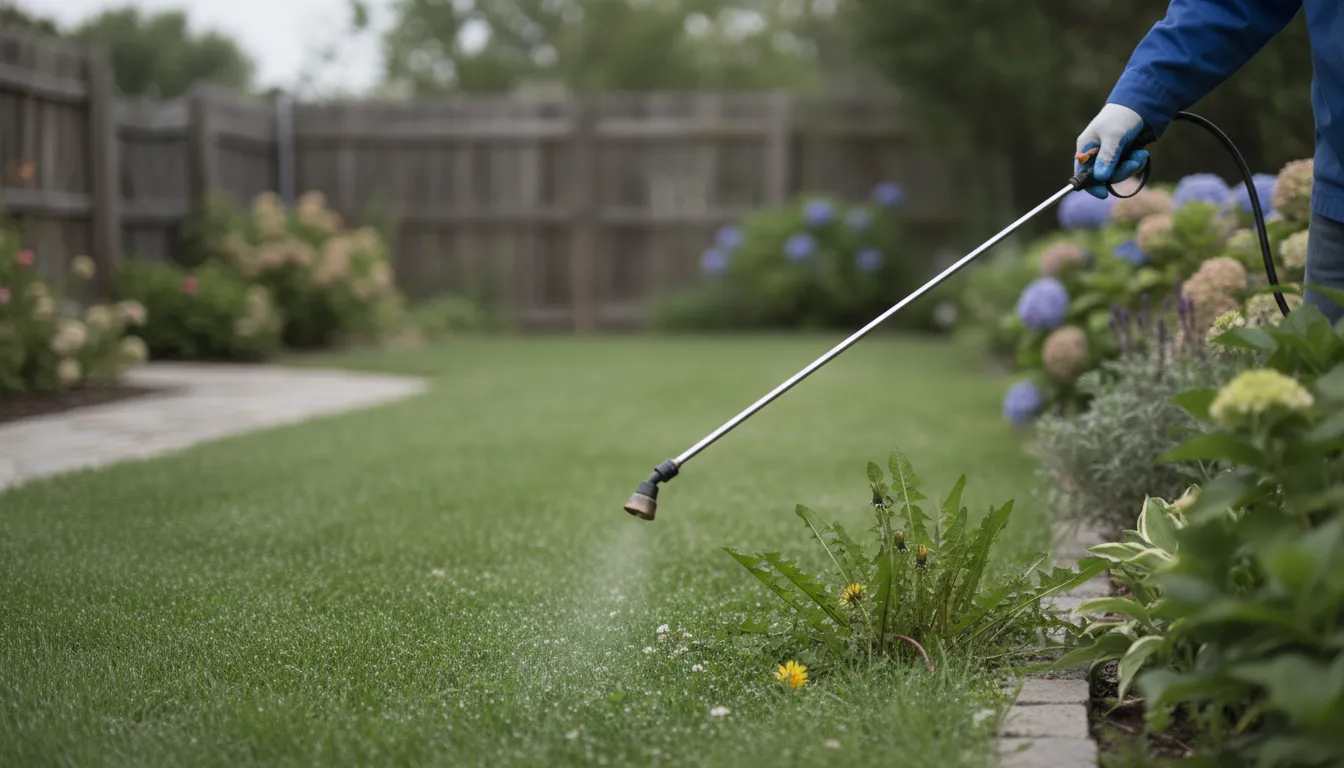
- Late Spring (May/June): A second application of pre-emergent may be necessary, depending on the product's longevity. This is also the time for spot-treating any broadleaf weeds (like dandelions or clover) that have emerged with a post-emergent herbicide.
- Summer (June-August): Fertilization should be minimized or avoided. Cool-season grasses are under heat stress and focusing on survival, not top growth. Applying heavy nitrogen can burn the lawn and promote disease. The focus remains on spot-treatment of weeds as they appear 5.
- Early Fall (Late August/September): This is the most important fertilization of the year. Applying fertilizer now fuels root growth and recovery from summer stress. It's also the perfect time for core aeration and overseeding to thicken the lawn.
- Late Fall (October/November): The final application, often called a "winterizer," is applied. This slow-release, high-nitrogen fertilizer helps the grass store nutrients for a strong, early green-up the next spring. A fall pre-emergent can also be applied to target winter annual weeds like henbit 6 7.
Find the perfect lawn treatment companies for your needs
Get personalized recommendations and expert advice
Selecting the Right Fertilizers and Herbicides
Choosing products is not just about picking a bag off the shelf. It involves understanding soil needs and legal requirements.
Soil Testing First: Always start with a soil test. This simple analysis, available through the University of Delaware Cooperative Extension, will tell you exactly which nutrients your soil lacks, preventing wasteful and potentially harmful over-application.
Fertilizer Guidelines: Look for slow-release nitrogen formulas, which feed the lawn gradually over time. A common ratio for cool-season grasses is 3-1-2 (Nitrogen-Phosphorus-Potassium), such as a 30-10-20 blend. Importantly, Delaware law prohibits the application of phosphorus (P) to established turf unless a soil test confirms a deficiency 8 9. Therefore, many suitable fertilizers will have a "0" in the middle number (e.g., 10-0-20).
- Synthetic Examples: Products like Scotts Turf Builder WinterGuard Fall Lawn Food are formulated for the fall feeding.
- Organic Options: Milorganite is a popular, non-burning organic fertilizer that is widely used. Espoma Organic Lawn Food is another excellent choice for those seeking an organic program 10 11.
Weed Control Products:
- Pre-emergent Herbicides: These create a barrier in the soil that prevents weed seeds from germinating. Effective active ingredients for crabgrass include Prodiamine and Pendimethalin 12.
- Post-emergent Herbicides: For weeds that are already visible, a selective herbicide is used. A "three-way" mixture containing 2,4-D, dicamba, and mecoprop is highly effective against a broad spectrum of common broadleaf weeds 13. Always follow label directions carefully regarding temperature and application rates.
The Value of Professional Lawn Care Programs
Many homeowners in Delaware opt for professional annual programs. These typically involve 5 to 6 scheduled visits that align with the optimal seasonal schedule outlined above 14. The benefits include:
- Expert Timing: Professionals know precisely when to apply pre-emergents based on soil temperature, not just the calendar.
- Correct Product Selection: They choose the right fertilizer analysis and herbicide for each specific season and problem.
- Proper Application: Commercial-grade equipment ensures even coverage and correct application rates.
- Consistency: A scheduled program ensures no critical step is missed, providing continuous care and prevention.
- Diagnosis: Trained technicians can identify early signs of disease, insect issues, or soil problems that may be affecting lawn health.
Understanding Service Costs
Professional lawn care services in Delaware generally price their programs based on the size (square footage) of your lawn and the number of treatments included in the annual plan 15 16.
- Per-Treatment Cost: If purchased individually, a weed control application can range from approximately $50 to $210 per visit, depending on lawn size and the methods used 17.
- Annual Program Cost: A comprehensive annual program that includes multiple fertilization and weed control applications will typically represent a better value. For a standard residential property, total annual costs can range from several hundred dollars to over a thousand dollars, varying significantly with the level of service, property size, and the specific company 18 19 20. The most accurate way to determine cost is to obtain quotes from local providers who can assess your specific lawn.
Frequently asked questions
Sources
Footnotes
-
Year-Round Lawn Care Tips for Delaware - LawnStarter - https://www.lawnstarter.com/blog/delaware/lawn-care-tips-delaware/ ↩
-
Year-Round Lawn Care Tips for Delaware - LawnStarter - https://www.lawnstarter.com/blog/delaware/lawn-care-tips-delaware/ ↩
-
Year-Round Lawn Care Tips for Delaware - LawnStarter - https://www.lawnstarter.com/blog/delaware/lawn-care-tips-delaware/ ↩
-
When to Apply Spring Pre-Emergent - Sod Solutions - https://sodsolutions.com/lawn-care/spring-weed-control-the-effective-use-of-a-pre-emergent-herbicide/ ↩
-
When to Apply Weed Control | Sod Solutions - https://sodsolutions.com/lawn-care/the-best-and-worst-times-for-herbicide-applications/ ↩
-
Plan To Fertilize In The Fall - Delaware Livable Lawns - https://www.delawarelivablelawns.org/make-your-lawn-livable/fertilize-in-the-fall/ ↩
-
The Ideal Lawn Fertilization Schedule for Delaware County ... - https://www.shevlinlawncare.com/lawn-care-tips/ideal-lawn-fertilization-schedule-delaware-county-homeowners ↩
-
When to Fertilize Your Lawn in Delaware | Wikilawn - https://www.wikilawn.com/lawn-care/de/when-to-fertilize-your-lawn-in-delaware/ ↩
-
Delaware Gardener's Guide to Lawn and Landscape Fertilizers - https://www.udel.edu/academics/colleges/canr/cooperative-extension/fact-sheets/delaware-gardeners-guide-to-lawn-and-landscape-fertilizers/ ↩
-
Green Envy: Best Lawn Fertilizers to Use in Delaware - https://www.thenavigationist.com/fitness-and-outdoors/best-lawn-fertilizer-delaware ↩
-
Google's Shopping Data - https://blog.google/products/shopping/shopping-graph-explained/ ↩
-
Managing Weeds in Warm Season Lawns - Clemson HGIC - https://hgic.clemson.edu/factsheet/managing-weeds-in-warm-season-lawns/ ↩
-
Weed Control in Turf - University of Delaware - https://www.udel.edu/academics/colleges/canr/cooperative-extension/fact-sheets/weed-control-in-turf/ ↩
-
Local Lawn Care in Delaware | Quality Cut Lawn Service LLC - https://qualitycutlawnservice.com/services/lawn-care ↩
-
Greenville DE Lawn Care Service | DTL Total Turf Care - https://dtltotalturf.com/greenville-de-lawn-care-service/ ↩
-
How Much Does Lawn Aeration Cost? - https://www.thisoldhouse.com/lawns/lawn-aeration-cost ↩
-
How Much Does Weed Control Cost in 2026? - LawnStarter - https://www.lawnstarter.com/blog/cost/weed-control-price/ ↩
-
Lawn Fertilization Cost | Lawn Treatment Prices - https://www.fixr.com/costs/lawn-fertilization ↩
-
Weed Control Service in Longmont, Niwot & Frederick, CO - https://totalturflawncare.com/services/lawn-care/weed-control/ ↩
-
What Services Do Lawn Care Companies Provide: Best Benefits - https://bostonlandscapeco.com/what-services-do-lawn-care-companies-provide/ ↩