Find the Best Lawn Treatment Companies for Your Business
No obligation • Fast responses • Nationwide coverage

Why you can trust Landscape Atlas
Landscape Atlas is a leading United States resource for evaluating landscaping, lawn care, and outdoor service providers. Our team researches each category in depth, focusing on service quality, safety, and customer experience. Listings and rankings are based on independent criteria and user feedback, and companies cannot pay to influence our assessments or recommendations.
Search providers near you
Best Lawn Treatment Companies in Iowa Ranked
A healthy, vibrant lawn in Iowa requires a consistent, science-backed approach to feeding and protecting your grass. Lawn fertilization provides essential nutrients for growth and resilience, while targeted weed control prevents invasive plants from competing for resources and spoiling your lawn's appearance. This guide explains the seasonal schedule, product choices, and professional options for effective lawn nutrition and weed management across the state, helping you connect with the right expertise for your property.
Understanding Iowa's Lawn Environment
Most lawns in Iowa are composed of cool-season grasses like Kentucky bluegrass, perennial ryegrass, and tall fescue. These grasses thrive in the cooler temperatures of spring and fall and can go dormant or become stressed during Iowa's hot, often dry summers. A successful lawn care strategy works with these natural growth cycles, providing nutrients when the grass can best use them and applying weed control at the most effective times.
The foundation of any good program is understanding your soil. A simple soil test, available through Iowa State University Extension, can reveal your lawn's pH and nutrient levels, allowing you to choose fertilizers that address specific deficiencies 1. This targeted approach is more effective and environmentally sound than guesswork.
The Essential Seasonal Schedule
A professional-grade lawn care program in Iowa typically involves 4 to 5 treatments annually, timed to match grass growth cycles and weed life stages. Here's a breakdown of the optimal schedule.
Early Spring (Mid-March to Mid-April)
This first application is critical for setting up your lawn for success. The focus is on a moderate application of slow-release fertilizer to gently kickstart green-up without causing excessive, weak growth. Equally important is the application of a pre-emergent herbicide when soil temperatures consistently reach 50-55°F. This creates a barrier in the soil to prevent annual weeds like crabgrass from germinating 2. Spot treatments with post-emergent herbicides can address any overwintered weeds.
Late Spring (Mid-April to Mid-June)
A second application of slow-release fertilizer replenishes nutrients used during the spring growth surge. This treatment is often paired with post-emergent broadleaf weed control to tackle visible weeds like dandelions, clover, and plantain. Targeting weeds in late spring, when they are actively growing but before they set seed, is highly effective.
Summer (Optional)
Fertilizing cool-season grasses during the peak summer heat (June, July, August) is generally discouraged, as it can force growth when the grass is stressed and increase disease susceptibility 3. The primary summer focus is on proper mowing and watering. However, a targeted post-emergent weed control application in late summer can be beneficial for controlling persistent weeds.
Early Fall (September)
Early fall is arguably the best time to strengthen your lawn. As temperatures cool, grass redirects energy from leaf production to root development. A fall fertilizer application helps the lawn recover from summer stress, promotes deep root growth, and thickens the turf density, which naturally helps crowd out future weeds 4.
Late Fall / Winterizer (October to November)
The final "winterizer" application is one of the most important of the year. This treatment uses a specific fertilizer formulation to promote root growth and nutrient storage, helping the lawn endure winter conditions and green up faster in spring 5 6. Fall is also the most effective time to apply broadleaf herbicides, as weeds are actively moving nutrients to their roots, carrying the herbicide down for a more complete kill 7 8.
Find the perfect lawn treatment companies for your needs
Get personalized recommendations and expert advice
Choosing the Right Products
Whether you tackle lawn care yourself or want to understand what a professional might use, knowing about common products is helpful.
Fertilizers: Look for products labeled as slow-release or controlled-release. These provide a steady supply of nitrogen over time, preventing nutrient runoff and giving a longer-lasting feed without the "flush and fade" growth of quick-release formulas. The N-P-K ratio (Nitrogen-Phosphorus-Potassium) should be chosen based on soil test results. A typical fall winterizer fertilizer, for example, might have a formulation higher in potassium to promote hardiness 9 10.
Weed Control:
- Pre-emergent Herbicides: Products containing Prodiamine or Dithiopyr are common. Timing is everything-they must be applied before weed seeds germinate in spring.
- Post-emergent Herbicides: For broadleaf weeds, look for products containing a mix of active ingredients like 2,4-D, MCPP, MCPA, and dicamba. This combination is effective against a wide spectrum of weeds 11 12. Always follow label directions meticulously regarding application rates, safety gear, and restrictions for pets and children.
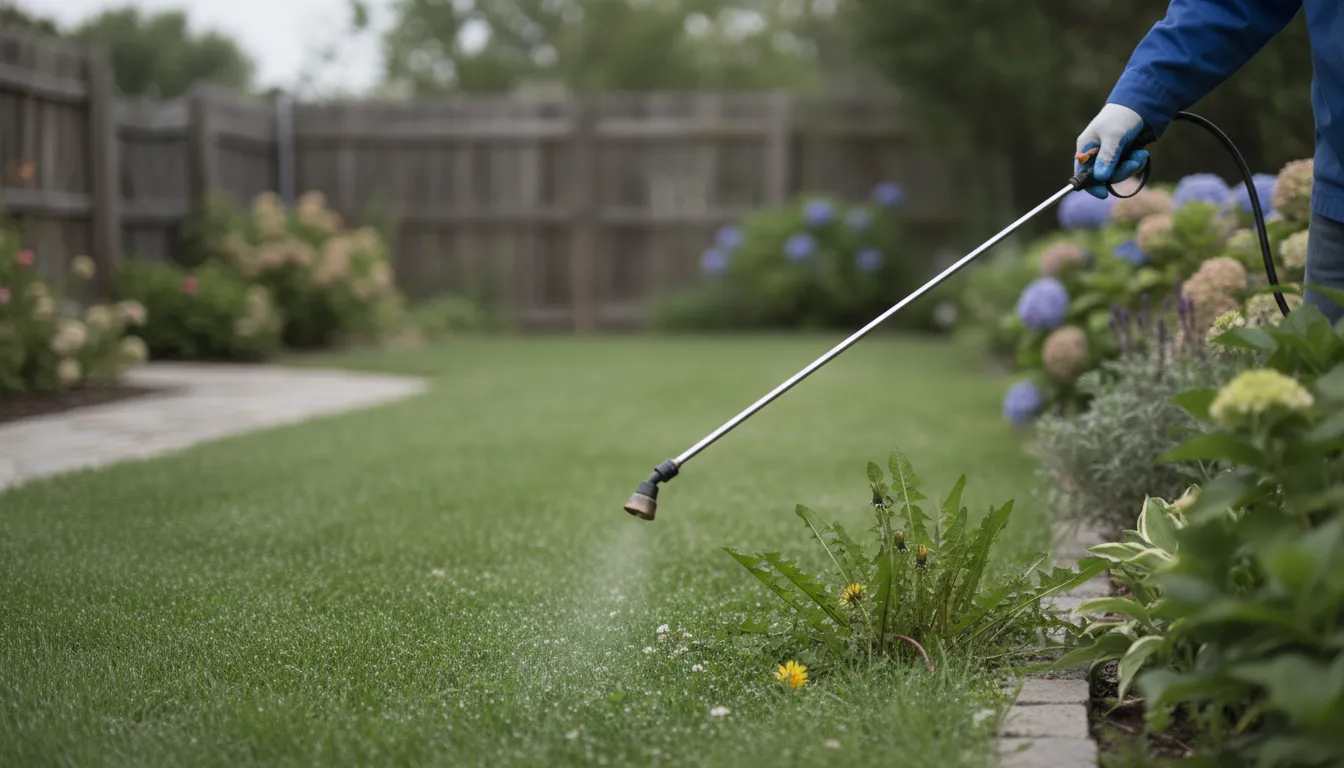
Application Methods: Granular products (like many "weed and feed" combinations) are applied with a broadcast or drop spreader. Liquid concentrates are mixed with water and applied with a tank sprayer, allowing for more precise spot treatment. Professionals often use liquid applications for more uniform coverage and faster absorption.
Professional Services vs. DIY
The choice between hiring a pro and doing it yourself depends on your time, budget, and desired outcome.
Professional Lawn Care Services: Hiring a professional lawn care company offers convenience, expertise, and consistent results. They handle the timing, product selection, and application with commercial-grade equipment. Most companies offer annual programs that bundle multiple fertilization and weed control visits.
Pricing for professional services in Iowa typically ranges from $45 to $125 per application, with annual package prices ranging from $250 to $875 or more, depending heavily on lawn size and service scope 13. For a full-service annual plan:
- Small Lawn (up to 1/8 acre): $350-$600 per year
- Medium Lawn (1/4 to 1/3 acre): $450-$800 per year
- Large Lawn (1/2 to 1 acre+): $700-$1,500+ per year 14
The DIY Approach: DIY lawn care requires an investment in time and equipment (spreader, sprayer, etc.) but can be more cost-effective for materials. The cost for fertilizer and weed control products per application can range from $40 to $80 for fertilizer and $15 to $40 for weed killer, depending on product quality and lawn size 15. Success depends on your ability to correctly identify weeds, calibrate equipment, apply products at the right time, and follow all safety and environmental precautions on product labels.
Key Practices for a Healthier Lawn
Beyond fertilization and chemicals, cultural practices are your first defense against weeds.
- Mow High: Keep your cool-season grass at a height of 3 to 3.5 inches. Taller grass shades the soil, cooling roots and making it harder for weed seeds to germinate.
- Water Deeply and Infrequently: Provide about 1 inch of water per week, ideally in one or two deep watering sessions. This encourages deep root growth.
- Core Aeration: Aerating your lawn in the fall relieves soil compaction, improves water and nutrient uptake, and reduces thatch.
- Overseed: Thicken your lawn in the fall by overseeding with a recommended grass variety. A dense lawn is the best natural weed deterrent.
Frequently asked questions
Sources
Footnotes
-
Spring Lawn Care | Yard and Garden - Iowa State University - https://yardandgarden.extension.iastate.edu/how-to/spring-lawn-care ↩
-
Weed Control Timing and Application Schedule for Lawn - https://sutterlawns.com/blog/weed-control-timing-application-schedule/ ↩
-
When should I fertilize my lawn? - Yard and Garden - https://yardandgarden.extension.iastate.edu/faq/when-should-i-fertilize-my-lawn ↩
-
How Often Does Your Lawn in Iowa Need a Boost of Fertilizer? - https://www.frontlinelawns.com/blog/how-often-does-your-lawn-in-iowa-need-a-boost-of-fertilizer ↩
-
Your Lawn in Iowa Should Be Routinely Fertilized During the ... - https://brilliantborders.com/blog/your-lawn-in-iowa-should-be-routinely-fertilized-during-the-growing-season/ ↩
-
Yard and Garden: Fall Lawn Care | News - https://www.extension.iastate.edu/news/yard-and-garden-fall-lawn-care ↩
-
Controlling Weeds in the Home Lawn and Garden - https://www.extension.iastate.edu/smallfarms/controlling-weeds-home-lawn-and-garden ↩
-
This Spring Fertilization Schedule Will Get Your Lawn in Great ... - https://apluslawn.com/blog/this-spring-fertilization-schedule-will-get-your-lawn-in-great-shape-/ ↩
-
Year Round Lawn Care Schedule and Tips For Maintaining ... - https://scottsmiraclegro.com/en-us/learn/lawn-care/your-seasonal-guide-to-a-lush-lawn.html ↩
-
Year Round Lawn Care Schedule and Tips For Maintaining Your Lawn - https://scottsmiraclegro.com/en-us/learn/lawn-care/your-seasonal-guide-to-a-lush-lawn.html ↩
-
Controlling Weeds in the Home Lawn and Garden - https://www.extension.iastate.edu/smallfarms/controlling-weeds-home-lawn-and-garden ↩
-
All DIY lawn weed control sucks. Change my mind. - https://www.bogleheads.org/forum/viewtopic.php?t=432775 ↩
-
how much does lawn care cost - https://niceandprecise.com/how-much-does-lawn-care-cost/ ↩
-
Lawn Care Pricing Chart: Your Guide to Fair Lawn Service Costs - https://invoicefly.com/academy/lawn-care-pricing-chart/ ↩
-
How Much Does Lawn Care Cost? (2026) - HomeGuide - https://homeguide.com/costs/lawn-care-prices ↩