Find the Best Lawn Treatment Companies for Your Business
No obligation • Fast responses • Nationwide coverage

Why you can trust Landscape Atlas
Landscape Atlas is a leading United States resource for evaluating landscaping, lawn care, and outdoor service providers. Our team researches each category in depth, focusing on service quality, safety, and customer experience. Listings and rankings are based on independent criteria and user feedback, and companies cannot pay to influence our assessments or recommendations.
Search providers near you
Best Lawn Treatment Companies in Mississippi Ranked
A healthy, vibrant lawn in Mississippi requires a consistent, science-backed approach to feeding your grass and managing weeds. This specialized service combines targeted nutrient applications with strategic herbicide treatments to promote thick turf that naturally resists pests and weeds. For homeowners, finding a local expert who understands the unique challenges of Mississippi's climate and soil can transform lawn care from a constant battle into a manageable routine. This guide explains the core principles of effective lawn nutrition and weed management, helping you understand the process and evaluate professional services in your area.
Understanding Mississippi's Lawn Environment
Success in lawn care starts with understanding your local environment. Mississippi's humid subtropical climate, with its long, hot summers and mild winters, is ideal for warm-season turfgrasses. The most common grasses found in Mississippi lawns include Bermudagrass, St. Augustinegrass, Zoysiagrass, and Centipedegrass 1. Each has specific strengths and sensitivities, but they all share a growth cycle that peaks in the heat of summer and goes dormant (turns brown) after the first hard frost in winter.
This climate also creates a perfect environment for a wide range of weeds. Effective management hinges on timing treatments to your grass's active growth period and attacking weeds at their most vulnerable life cycle stages. A one-size-fits-all approach rarely works; the most effective plans are tailored to your specific grass type, soil condition, and the prevalent weeds in your region.
The Annual Lawn Care Schedule: A Seasonal Guide
A proactive, scheduled approach is far more effective-and often less costly-than reacting to problems as they appear. Following a calendar-based plan ensures your lawn gets what it needs, when it needs it.
| Season | Timing | Treatment Focus |
|---|---|---|
| Early Spring | February to April | Apply pre-emergent herbicides to stop annual weeds like crabgrass before they sprout (when soil temps reach 55°F). A light, balanced fertilizer can also be applied. |
| Late Spring/Summer | May to August | Main fertilization period during active growth. Use post-emergent herbicides for any existing broadleaf weeds such as dandelions, clover, or spurge. |
| Fall | September to November | A crucial time for winterizing fertilization to build strong roots and prepare for dormancy. Apply another round of pre-emergent herbicides to prevent winter annuals. |
| Winter | December to January | The lawn is dormant. Focus on soil testing and amendments like lime or sulfur to correct pH levels if necessary. |
This schedule forms the backbone of a professional lawn care program, ensuring consistent protection and nourishment throughout the year 2.
The Critical Role of Soil Testing
Before applying any product, a soil test is the single most important step. It removes the guesswork from lawn care by revealing your soil's precise pH level and nutrient profile. Mississippi soils can vary from acidic to alkaline, and applying fertilizer without knowing what's lacking (or already abundant) is inefficient and can harm your lawn and the environment. A test typically costs between $20-$40 for a DIY kit, and many professional services include it in their annual plan. The results will guide all your fertilization decisions, telling you exactly which nutrients to apply and in what amounts.
Selecting the Right Fertilizer
Fertilizers are labeled with three numbers representing the ratio of primary nutrients: Nitrogen (N), Phosphorus (P), and Potassium (K). Nitrogen promotes lush, green blade growth. Phosphorus supports strong root development. Potassium enhances overall plant health and stress tolerance.
For Mississippi's warm-season grasses, a general-purpose fertilizer with a 3-1-2 or 4-1-2 N-P-K ratio, such as 12-4-8, is often a good starting point in the absence of a soil test 3 4 5. However, the ideal blend should be based on your soil test results.
Key Fertilizer Tips:
- Slow-Release Nitrogen: Opt for fertilizers containing slow-release or controlled-release nitrogen. This provides a steady supply of nutrients over several weeks, promoting even growth and drastically reducing the risk of burning the lawn.
- Follow Label Instructions: More is not better. Over-fertilizing can burn grass, pollute waterways, and encourage fungal diseases.
- Water It In: Always water your lawn thoroughly after applying fertilizer to move the nutrients into the soil where roots can absorb them.
Find the perfect lawn treatment companies for your needs
Get personalized recommendations and expert advice
Effective Weed Control Strategies
Weed control is a two-pronged strategy: stopping weeds before they start and eliminating those that have already taken hold.
1. Pre-Emergent Herbicides
Pre-emergent herbicides create a chemical barrier at the soil surface that prevents weed seeds from germinating. Timing is absolutely critical-they must be applied before seeds sprout.
- For Summer Annuals (like crabgrass): Apply in early spring when soil temperatures consistently reach 55°F, typically late February through March in Mississippi.
- For Winter Annuals (like annual bluegrass/Poa annua): Apply in early fall, around September to October, to prevent winter weeds 6.
- Common Ingredients: Look for products containing active ingredients like Dimension (dithiopyr) or Atrazine. Atrazine is noted as a common and safe choice for sensitive southern grasses like St. Augustine and Centipede 7.
2. Post-Emergent Herbicides
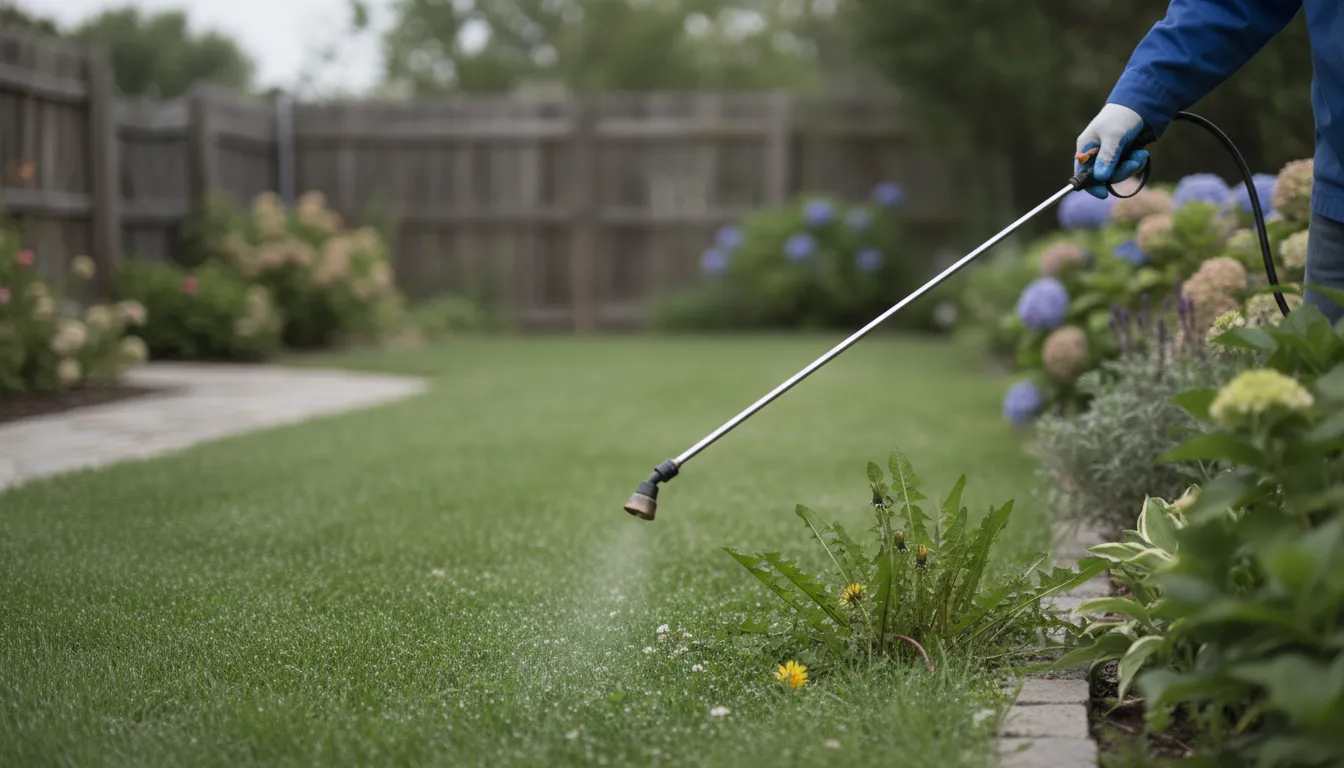
Post-emergent herbicides are used to kill weeds that are already visible in your lawn. They are most effective when applied to young, actively growing weeds.
- Selective vs. Non-Selective: For lawn use, you almost always want a selective herbicide that targets broadleaf weeds or specific grassy weeds without harming your turfgrass. Non-selective herbicides (like glyphosate) will kill any plant they touch, including your grass.
- For Broadleaf Weeds: Effective selective herbicides often contain a mix of ingredients like 2,4-D, dicamba, and clopyralid to control common invaders like dandelion, clover, and spurge 8.
- Professional-Grade Options: Products like Celsius WG Herbicide offer broad-spectrum, professional-grade control that is safe for various warm-season grasses, even during high summer heat 9.
Always identify your weed and your grass type before applying any herbicide. Applying the wrong product can be ineffective or damage your lawn.
The Value of Professional Lawn Care Services
While DIY lawn care is possible, many homeowners opt for professional services for convenience, expertise, and consistent results. Professional lawn care companies offer recurring plans that seamlessly integrate fertilization and weed control based on the seasonal schedule.
Benefits include:
- Expert Knowledge: Professionals can accurately identify grass types, weeds, and pest issues.
- Proper Equipment: They have commercial-grade spreaders and sprayers for even, precise application.
- Time Savings: They handle product purchase, storage, and application.
- Guaranteed Programs: Many companies offer satisfaction guarantees on their multi-visit plans.
Understanding Service Costs
Professional lawn care costs in Mississippi vary based on lawn size, condition, grass type, and location. Here's a general overview of what you might expect:
| Service | Estimated Cost Range | Notes |
|---|---|---|
| Basic Annual Fertilization & Weed Control Program | $300 - $600 per year | Typically includes 4-6 visits combining fertilization and basic weed prevention 10 11 12. |
| Targeted Weed Control (Per Visit) | $50 - $100 per visit | Spot treatments for persistent or difficult-to-control weed outbreaks. |
| Core Aeration | $150 - $750 per year | An add-on service to relieve soil compaction, improve fertilizer uptake, and enhance turf density. |
It's always wise to get multiple estimates and clearly understand what is included in a proposed plan, such as the number of visits, types of treatments, and any guarantees offered.
Maintaining a Healthy Lawn Between Treatments
Professional services provide the foundation, but your daily and weekly practices play a huge role in long-term success.
- Mowing Correctly: Never cut more than one-third of the grass blade at a time. Keep your mower blades sharp. For warm-season grasses in Mississippi, a mowing height of 1.5 to 2.5 inches for Bermudagrass and 2.5 to 4 inches for St. Augustine and Zoysia is recommended during the growing season.
- Watering Deeply and Infrequently: Water your lawn deeply (about 1 inch per watering) to encourage deep root growth. This is better than frequent, shallow watering. Early morning is the best time to water.
- Addressing Thatch and Compaction: Annual core aeration helps alleviate soil compaction, allowing water, air, and nutrients to reach the root zone. Excessive thatch (a layer of dead organic matter) over ½ inch thick should be dethatched.
Frequently asked questions
Sources
Footnotes
-
How to Keep Your Neighbor's Weeds Out of Your Mississippi Lawn - https://www.lawnandpest.net/blog/how-to-keep-neighbors-weeds-out-of-your-mississippi-lawn ↩
-
Lawn Care Schedule For Warm Season Grasses - DoMyOwn - https://www.domyown.com/lawn-care-schedule-for-warm-season-grasses-a-538.html ↩
-
Selecting a lawn fertilizer (03-27-2006) - https://extension.msstate.edu/newsletters/turf-tips-newsletter/2006/selecting-lawn-fertilizer-03-27-2006 ↩
-
Best Fertilizer for Your Grass Type - Lawn Ace - https://lawnace.com/how-to-choose-the-best-lawn-fertilizer-for-different-grass-types/ ↩
-
Best Lawn Fertilizer N-P-K Numbers - https://www.superjuicefertilizer.com/best-lawn-fertilizer-n-p-k-numbers/ ↩
-
Managing Winter Annual Weeds in the Lawn Now (3-7-11) - http://www.ext.msstate.edu/newsletters/turf-tips-newsletter/2011/managing-winter-annual-weeds-the-lawn-now-3-7-11 ↩
-
Best Weed Killers Safe for St. Augustine Grass - Sod Solutions - https://sodsolutions.com/lawn-care/weed-control-in-your-st-augustine-lawn/ ↩
-
Controlling the 11 Most Common Lawn Weeds in North ... - https://www.lawnandpest.net/blog/common-lawn-weeds-north-ms ↩
-
Google's Shopping Data - https://blog.google/products/shopping/shopping-graph-explained/ ↩
-
Affordable Lawn Care Plans & Pricing Options - TruGreen - https://www.trugreen.com/products-and-services ↩
-
How Often Should You Fertilize Your Lawn for Optimal Growth? - https://www.percyslawncare.com/blog-posts/best-time-fertilize-lawn ↩
-
How much does lawn care service cost? - Green Lawn Fertilizing - https://www.greenlawnfertilizing.com/blog/how-much-does-lawn-care-service-cost ↩