Find the Best Lawn Treatment Companies for Your Business
No obligation • Fast responses • Nationwide coverage

Why you can trust Landscape Atlas
Landscape Atlas is a leading United States resource for evaluating landscaping, lawn care, and outdoor service providers. Our team researches each category in depth, focusing on service quality, safety, and customer experience. Listings and rankings are based on independent criteria and user feedback, and companies cannot pay to influence our assessments or recommendations.
Search providers near you
Best Lawn Treatment Companies in North Dakota Ranked
Maintaining a healthy, green lawn in North Dakota requires a tailored approach that works with the state's climate and cool-season grasses. Effective lawn care is about more than just aesthetics; it's about building a resilient turf that can withstand drought, cold winters, and outcompete weeds. This involves a strategic schedule of fertilization and targeted weed control, often best handled as separate tasks. The following guide provides a science-backed, practical framework for North Dakota homeowners, whether you plan to manage your lawn yourself or seek professional help.
Understanding North Dakota's Lawn Environment
North Dakota lawns are predominantly composed of cool-season grasses like Kentucky bluegrass, perennial ryegrass, and fine fescues. These grasses thrive in cooler temperatures and have two main growth peaks: one in the spring and a more vigorous one in the fall. This growth cycle dictates the entire schedule for feeding and weed management. The state's harsh winters, hot summers, and variable precipitation mean your lawn care strategy must be both robust and adaptable.
A foundational step before any treatment is understanding your soil. The North Dakota State University (NDSU) Extension recommends testing your soil every 3-4 years to determine its pH and nutrient levels 1. Many soils in the region can be alkaline, which can lock up essential nutrients like iron, leading to yellowing grass. Amending soil based on a test is a critical first step for long-term lawn health 1.
The Core Principle: Separate Fertilization and Weed Control
A key recommendation from NDSU experts is to avoid all-in-one "weed and feed" products. While convenient, these combination products are inefficient and potentially harmful because the optimal timing for applying fertilizer and herbicides rarely aligns.
- Fertilization aims to feed the grass roots and blades.
- Herbicides are designed to kill plants (weeds).
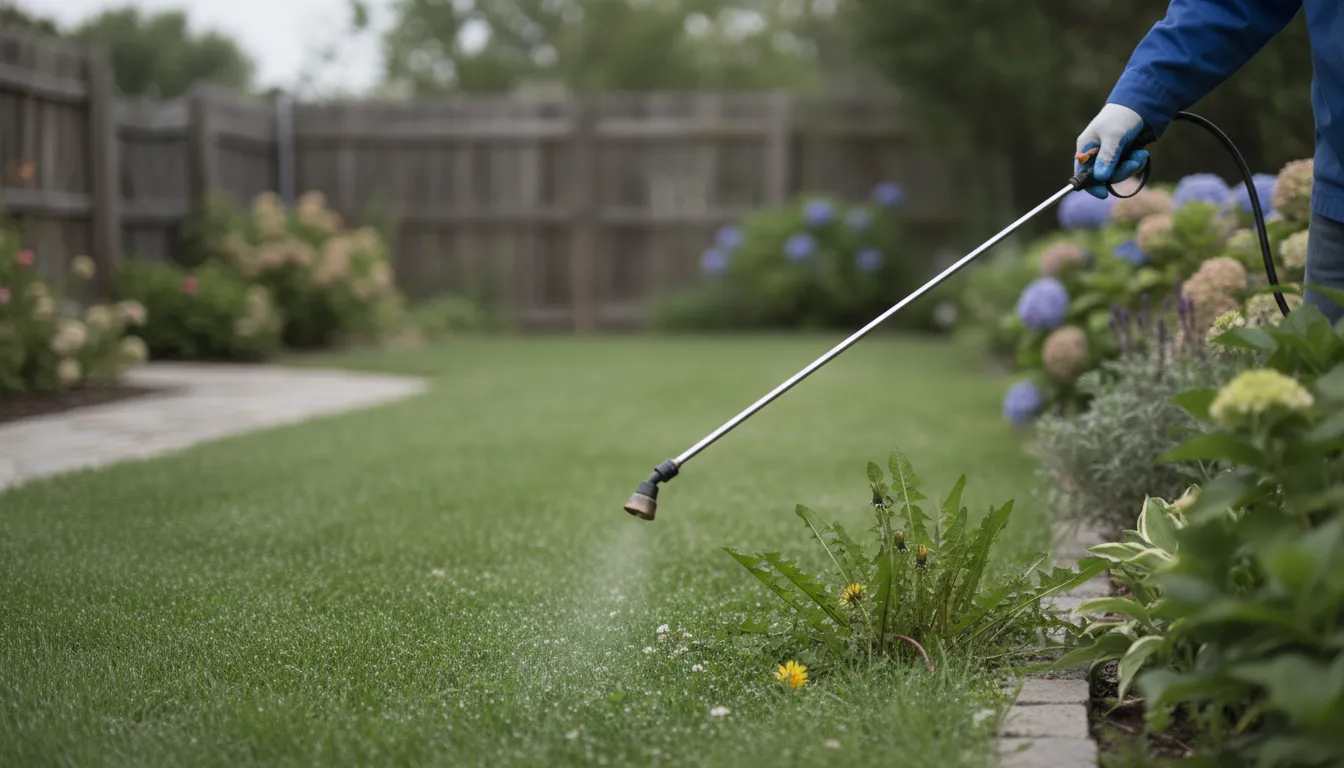
Applying herbicide over your entire lawn, including weed-free areas, is unnecessary and introduces chemicals where they aren't needed. The most effective and environmentally conscious strategy is to use fertilizer broadly and apply liquid herbicides only as spot treatments to visible weed patches.
The North Dakota Lawn Care Calendar
Following a seasonal schedule aligned with grass growth cycles is the secret to success. This calendar synthesizes recommendations from NDSU Extension for a typical lawn 2.
Late Spring (Late May)
- Goal: Provide a nitrogen boost for spring green-up and growth.
- Action: Apply a slow-release nitrogen-only fertilizer. Look for a product where at least one-third of the nitrogen is listed as "water-insoluble nitrogen" (WIN) for a steady feed. A standard rate is 1 pound of actual nitrogen per 1,000 square feet. Timing is crucial: Wait until you have mowed the lawn at least three times in the spring. This ensures the grass is actively growing and can utilize the nutrients.
Early Summer (Early to Mid-June)
- Goal: Prevent crabgrass and other summer annual weeds.
- Action: If crabgrass has been a problem, apply a pre-emergent herbicide. These products create a barrier in the soil that stops weed seeds from sprouting. Effective active ingredients include pendimethalin, prodiamine, or dithiopyr. This application is separate from fertilization. For other emerging annual weeds, a liquid spot treatment is preferable.
Late Summer (July - Optional)
- Goal: Maintain nutrient levels during summer stress.
- Action: This is an optional application for those seeking a high-quality lawn. Use a maintenance fertilizer to help the grass recover from summer heat and drought stress.
Early Fall (Early September)
- Goal: This is the most important fertilization of the year. It promotes deep root development, energy storage for winter, and a thicker lawn for the following spring.
- Action: Apply a high-nitrogen, low-phosphorus fertilizer. A formulation like 25-0-10 is often recommended. The strong fall growth spurt allows grass to absorb these nutrients efficiently, leading to a healthier turf.
Late Fall (Mid- to Late September)
- Goal: Control perennial broadleaf weeds like dandelion and clover.
- Action: Apply a liquid broadleaf herbicide as a spot treatment. It is critical to wait 4-6 weeks after the early September fertilizer application to avoid damaging the grass 3. Fall is ideal because weeds are actively moving nutrients to their roots, carrying the herbicide down for more effective kill. Be cautious with herbicides containing dicamba near sensitive trees and shrubs, as it can cause root damage 3.
Find the perfect lawn treatment companies for your needs
Get personalized recommendations and expert advice
DIY Product Selection Guide
Choosing the right products is essential for DIY success. Here's what to look for:
For Fertilization:
- Slow-Release Nitrogen: Seek out fertilizers with a portion of WIN, often listed on the bag. Brands like Scotts Turf Builder or GreenView offer suitable formulations for cool-season grasses 4.
- NPK Ratio: The three numbers represent Nitrogen (N), Phosphorus (P), and Potassium (K). For the vital fall feeding, a high first number (Nitrogen) and a low middle number (Phosphorus) is ideal, such as 25-0-10 5.
For Weed Control:
- Crabgrass Prevention: Use a pre-emergent with prodiamine, pendimethalin, or dithiopyr 6.
- Broadleaf Weeds: Use a liquid concentrate (like those containing 2,4-D, dicamba, and mecoprop) that you mix in a sprayer for precise spot treatment. This method minimizes chemical use and is more cost-effective than ready-to-spray bottles for larger lawns.
Cost Considerations: DIY vs. Professional Service
The investment in your lawn varies significantly based on the approach you choose.
Do-It-Yourself Costs: The DIY route requires an investment in equipment (spreader, sprayer) and products. Annual costs are primarily for materials:
- Single Bag of Fertilizer: $15 - $45 (typically covering 2,000 - 5,000 sq ft) 7.
- Annual Product Cost: For a full season of fertilizer and targeted herbicides, homeowners can expect to spend $100 - $320 on products alone, depending on lawn size and product quality.
Professional Lawn Care Services: Hiring a professional service offers convenience, expertise, and commercial-grade products. Costs are typically quoted per application or as an annual program.
- Per Application Cost: Ranges from $50 to $200 per visit, with the final price heavily dependent on the size of your lawn 8.
- Small Lawn (under 5,000 sq ft): $50 - $150 per application
- Medium Lawn (5,000 - 10,000 sq ft): $65 - $200 per application
- Annual Program: Most companies offer bundled plans (usually 4-6 seasonal treatments), with annual costs ranging from $260 to over $1,000 9 10.
Building a Resilient Lawn Beyond Chemicals
The best defense against weeds is a thick, healthy lawn. Integrate these practices into your routine:
- Mow High: Keep your mower blade set at 3 to 3.5 inches. Taller grass shades the soil, cooling roots and preventing weed seeds from germinating.
- Water Deeply and Infrequently: Aim for about 1 inch of water per week, including rainfall. Watering deeply encourages roots to grow downward, making your lawn more drought-tolerant.
- Core Aeration: Aerating your lawn in the fall relieves soil compaction, improves water and nutrient absorption, and enhances root growth.
- Overseed in Fall: Spread grass seed over existing turf in early fall to fill in thin areas and introduce newer, more robust grass varieties.
Frequently asked questions
Sources
Footnotes
-
Evaluating, Preparing and Amending Lawn and Garden Soil - NDSU - https://www.ndsu.edu/agriculture/extension/publications/evaluating-preparing-and-amending-lawn-and-garden-soil ↩ ↩2
-
Dakota Gardener: It's a great time to fertilize your lawn - https://www.ag.ndsu.edu/news/columns/dakota-gardener/dakota-gardener-it2019s-a-great-time-to-fertilize-your-lawn ↩
-
Fall Lawn Weed Control - Carrington REC - NDSU Agriculture - https://www.ag.ndsu.edu/greenhouse/carringtonrec/center-points/2015/fall-lawn-weed-control ↩ ↩2
-
Feed All Year Long with Our Custom Lawn Fertilizer Schedule - https://scottsmiraclegro.com/en-us/learn/lawn-care/Feed-all-year-long-with-our-custom-lawn-fertilizer-schedule.html ↩
-
Managing Your Lawn | NDSU Agriculture - https://www.ndsu.edu/agriculture/extension/impact-stories/managing-your-lawn ↩
-
Crabgrass Management in North Dakota Lawns | NDSU Agriculture - https://www.ndsu.edu/agriculture/extension/publications/crabgrass-management-north-dakota-lawns ↩
-
How Much Does It Cost to Fertilize a Lawn? (2026) - HomeGuide - https://homeguide.com/costs/lawn-fertilizer-service-cost ↩
-
How Much Does Lawn Fertilization Cost in 2026? - https://lawnlove.com/blog/lawn-fertilization-cost/ ↩
-
average cost of lawn fertilization service: 7 Best 2025 Wins - https://ajmgrounds.com/average-cost-of-lawn-fertilization-service/ ↩
-
Understanding Lawn Care Costs [2024 Update] - https://www.ergeon.com/blog/post/lawncare-cost ↩