Find the Best Lawn Treatment Companies for Your Business
No obligation • Fast responses • Nationwide coverage

Why you can trust Landscape Atlas
Landscape Atlas is a leading United States resource for evaluating landscaping, lawn care, and outdoor service providers. Our team researches each category in depth, focusing on service quality, safety, and customer experience. Listings and rankings are based on independent criteria and user feedback, and companies cannot pay to influence our assessments or recommendations.
Search providers near you
Best Lawn Treatment Companies in Vermont Ranked
A healthy, vibrant lawn in Vermont requires a strategic approach to feeding your grass and managing weeds. This specialized service focuses on providing the right nutrients at the right time while preventing and eliminating invasive plants that compete for resources. For homeowners, understanding the seasonal schedule and product options is key to success. This guide outlines the essential practices for Vermont's climate and helps you connect with local professionals who can tailor a plan for your property.
Understanding Vermont's Lawn Care Climate
Vermont's climate, with its cold winters and warm summers, is ideal for cool-season grasses like Kentucky Bluegrass, Perennial Ryegrass, and various Fescues 1 2. These grasses thrive in cooler temperatures and have two primary growth periods: spring and fall. This cycle dictates the entire fertilization and weed control strategy. Summer heat can stress the turf, making it more susceptible to drought and disease, which is why timing applications correctly is not just beneficial-it's critical for lawn survival 3.
The state's weather patterns mean your lawn care efforts must be proactive. Applying fertilizer or herbicide at the wrong time can be ineffective or even harmful, wasting both product and money. Furthermore, Vermont has specific regulations to protect its waterways; for instance, fertilizer can only be applied to lawns between April 1 and October 15, and must be kept at least 25 feet from surface water. A professional service is well-versed in these local rules and the microclimates across the state, from the Champlain Valley to the Green Mountains.
The Essential Seasonal Schedule for Vermont Lawns
Following a calendar-based plan is the most effective way to achieve a thick, weed-resistant lawn. Here's a breakdown of what to focus on each season.
Early Spring (Late March - April)
As the snow melts and soil temperatures begin to rise, your lawn wakes from dormancy. This is a crucial window for crabgrass prevention. Apply a pre-emergent herbicide, often combined with a light fertilizer, to stop crabgrass seeds from germinating 4 5. This "weed and feed" approach helps the grass recover from winter while creating a barrier against one of the most common lawn weeds. It's also an excellent time to rake away any winter debris and assess thin or bare spots for possible overseeding in the fall.
Late Spring (May - June)
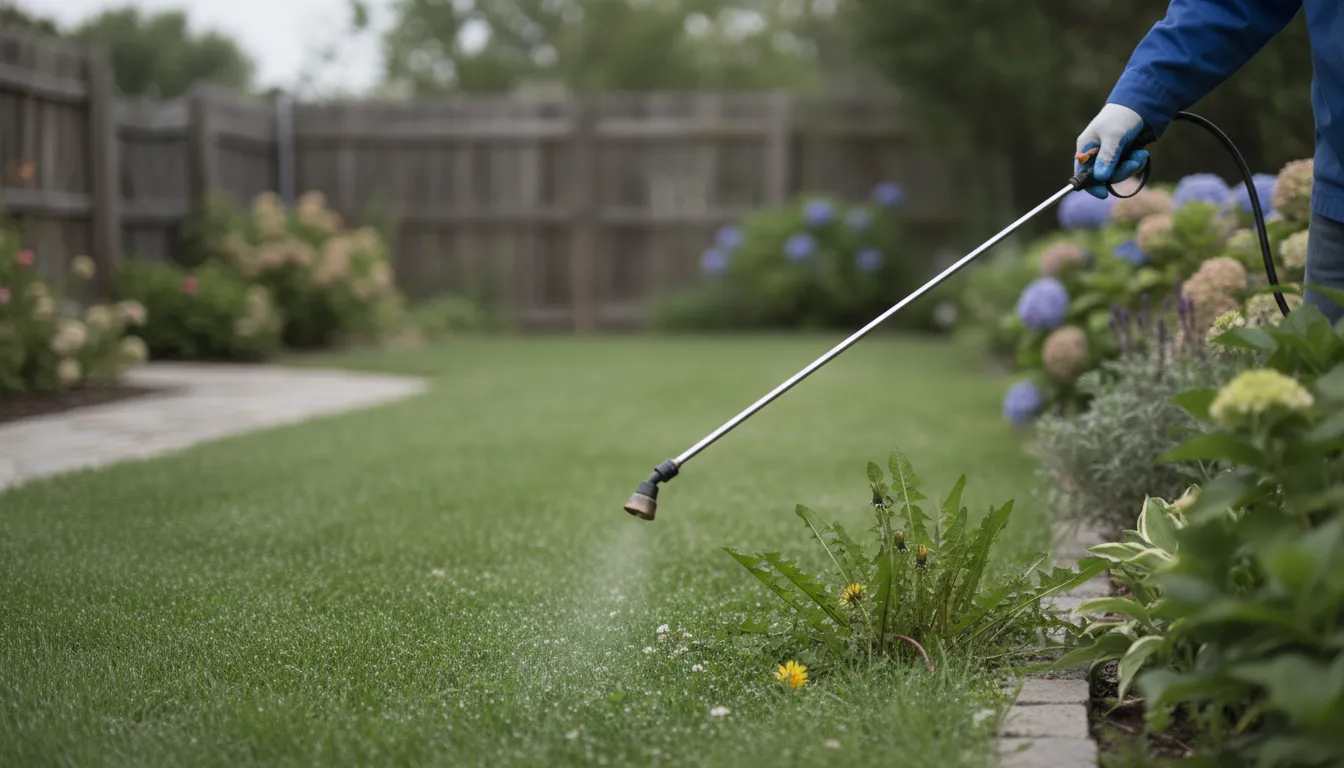
Focus shifts to nurturing growth and spot-treating weeds. Broadleaf weeds like dandelions, clover, and plantain become highly visible as they flower. Use a post-emergent herbicide to target these specific weeds 6. For fertilization, a balanced, slow-release formula can support steady growth without causing a surge that requires excessive mowing. Mowing height should be maintained at around 3 to 3.5 inches; taller grass shades the soil, helping to prevent new weed seeds from sprouting.
Summer (July - August)
The goal in summer is lawn preservation, not aggressive growth. Avoid fertilizing during peak heat, as it can burn the grass and promote disease 7 8. Your primary tools are your mower and hose. Continue mowing high and practice deep, infrequent watering (about 1 inch per week, including rainfall) to encourage deep root systems that can withstand drought 9. If weeds appear, spot-treat them carefully, preferably during cooler morning hours to minimize stress on the turf.
Fall (September - October)
Fall is the most important season for lawn care in Vermont. This is the time for major feeding and effective weed control. Apply a nitrogen-rich "winterizer" fertilizer to promote robust root growth and nutrient storage, which ensures a healthier green-up the following spring 10. Fall is also the best time for post-emergent weed control, as perennial weeds are moving nutrients down to their roots, carrying systemic herbicides with them for a more complete kill. Core aeration and overseeding are highly recommended fall practices to relieve soil compaction and introduce new grass plants, naturally crowding out future weeds.
Winter (November - February)
The lawn is dormant. No chemical treatments are needed. This is a time for planning, equipment maintenance, and reviewing the previous year's results to prepare for the next cycle.
Find the perfect lawn treatment companies for your needs
Get personalized recommendations and expert advice
Key Products for Fertilization and Weed Control
Choosing the right products is easier when you understand their purpose. Always start with a soil test to determine your lawn's specific pH and nutrient deficiencies; this prevents over-application and saves money 11.
Fertilizers
Look for fertilizers with a high percentage of slow-release nitrogen (40-70%), which feeds the grass gradually over several weeks.
- Milorganite Organic Nitrogen Fertilizer (6-4-0): A popular organic, non-burning option that is safe for use around children and pets.
- GreenView Fairway Formula Lawn Fertilizer (27-0-5): A professional-grade synthetic option with polymer-coated slow-release nitrogen.
- Jonathan Green Winter Survival Fall Lawn Fertilizer: Formulated with extra potassium to strengthen grass roots for winter hardiness 12 13.
Weed Control
- Pre-emergent Herbicides: Applied in early spring to form a barrier in the soil. Products containing Dimension (dithiopyr) or Barricade (prodiamine) are effective against crabgrass. Some, like Ferti-Lome Crabgrass Preventer Plus Lawn Food, combine pre-emergent with fertilizer 14 15.
- Post-emergent Herbicides: Used to kill existing weeds. Products with Trimec (a blend of 2,4-D, dicamba, and MCPP) are excellent for broadleaf weeds. Options include Ferti-lome Weed-Out Plus Lawn Fertilizer or Hi-Yield Weed & Feed. For a broader spectrum, BioAdvanced All-in-One Lawn Weed & Crabgrass Killer targets both weeds and crabgrass 16 17.
Professional Services vs. DIY Approach
Homeowners in Vermont can choose between managing their lawn themselves or hiring a professional service. Each has its merits.
The DIY Route offers full control and can be more cost-effective for smaller lawns. It requires an investment in time, equipment (spreader, sprayer), product knowledge, and adherence to the seasonal schedule. DIY product costs are approximately $20-$40 per bag of fertilizer (covering 5,000-10,000 sq. ft.) and $25-$70 for weed control concentrates 18.
Professional lawn care services provide expertise, convenience, and consistent results. A professional company will conduct a property analysis, develop a customized multi-step annual program, and handle all applications with commercial-grade products and precise timing 19 20. They assume liability for proper application and are updated on local regulations. Professional programs for fertilization and weed control in Vermont typically range from $300 to $600 annually, with individual weed control visits costing around $50 to $100 21 22. Many also offer integrated services like aeration, seeding, and pest control, which can be bundled for better lawn health and value.
Building a Healthy Lawn Foundation
Beyond just fertilizer and weed killer, long-term success depends on core cultural practices.
- Mowing: Keep blades sharp and never cut more than one-third of the grass blade at a time. Maintain a height of 3-3.5 inches.
- Watering: Water deeply (about 1 inch) and infrequently to encourage drought-tolerant roots. Early morning is the best time to water.
- Aeration: Annual core aeration in the fall alleviates soil compaction, allowing air, water, and nutrients to reach the root zone more effectively 23.
- Overseeding: Introducing new grass seed, especially after aeration, fills in thin areas and improves the lawn's density and genetic diversity, which is its best defense against weeds and disease.
By combining a smart seasonal strategy with these fundamental practices, you can cultivate a resilient, beautiful lawn that enhances your Vermont property.
Frequently asked questions
Sources
Footnotes
-
Seasonal Lawn Care Maintenance and Treatment Schedule - https://www.trugreen.com/lawn-care-101/blog/trugreen-lawn-care-services/lawn-maintenance-checklist ↩
-
The Best Grass Seed For Vermont - https://naturesseed.com/resources/lawn-turf/vermont/ ↩
-
Williston, VT Lawn Care | 6,000+ 5-Star Reviews - https://www.getsunday.com/local-guide/lawn-care-in-williston-vt ↩
-
Your New England Lawn Care Schedule for The Perfect Lawn - https://seacoastturfcare.com/blog/new-england-lawn-care-schedule-perfect-lawn ↩
-
Lawn Fertilizer Schedule - Jonathan Green - https://www.jonathangreen.com/resources/lawn-fertilizer-schedule/ ↩
-
How Often Should I Treat For Weeds? - ABC Scapes Inc - https://www.abcscapes.com/how-often-should-i-treat-for-weeds/ ↩
-
Summer Lawn Care Schedule - Middlebury Agway - https://middleburyagway.com/blog/71339/summer-lawn-care-schedule ↩
-
Lawn Care Month by Month - Weston Nurseries - https://www.westonnurseries.com/lawn-care-month-by-month/ ↩
-
Watering the Vermont Lawn and Landscape - http://landscapevermont.com/watering-vermont-lawn-landscape/ ↩
-
Best Time to Apply Lawn Fertilizer: Complete Guide 2025 - https://www.getsunday.com/shed/lawn/best-time-to-apply-lawn-fertilizer ↩
-
Soil Fertility and Fertilization Guidelines for Lawn Turf in ... - https://www.uvm.edu/d10-files/documents/2024-10/UVMExt_Soil_Fertility_Recommendations_for_Vt_Lawns_7p.pdf ↩
-
Best Lawn Fertilizer for Grass - Jonathan Green - https://www.jonathangreen.com/resources/best-lawn-fertilizer-grass/ ↩
-
Best Lawn Fertilizers for Lush, Green Grass - DIY Pest Control - https://diypestcontrol.com/blog/best-lawn-fertilizers-for-lush-green-grass-7-types-of-the-best-lawn-fertilizer.html ↩
-
Herbicides - Weed Killer & Control for Lawn ... - DoMyOwn - https://www.domyown.com/herbicides-c-59_188.html?page=all ↩
-
Top 10 Best Weed Killers of 2025 for Homeowners in the CSRA | - https://lawnace.com/top-10-best-weed-killers-2025/ ↩
-
Lawn Care Schedule For Cool Season Grasses - https://www.domyown.com/lawn-care-schedule-for-cool-season-grasses-a-539.html ↩
-
Weed Control for Lawns - Scotts Miracle-Gro - https://scottsmiraclegro.com/en-us/brands/scotts/products/fertilizer/49801C.html ↩
-
Google's Shopping Data - https://blog.google/products/shopping/shopping-graph-explained/ ↩
-
Fertilization and Weed Plans for a Beautiful Lawn - https://www.lawndoctor.com/annual-programs/fertilization-and-weed-plans/ ↩
-
LAWN CARE - Turf Fashions - https://turffashions.com/lawn-care/ ↩
-
How much does lawn care service cost? - Green Lawn Fertilizing - https://www.greenlawnfertilizing.com/blog/how-much-does-lawn-care-service-cost ↩
-
How Much Does Lawn Weed Control Cost in 2026? - Lawn Love - https://lawnlove.com/blog/weed-control-cost/ ↩
-
Turf Aeration and Overseeding: Fall Work for the Vermont Lawn - http://landscapevermont.com/aeration_overseeding/ ↩