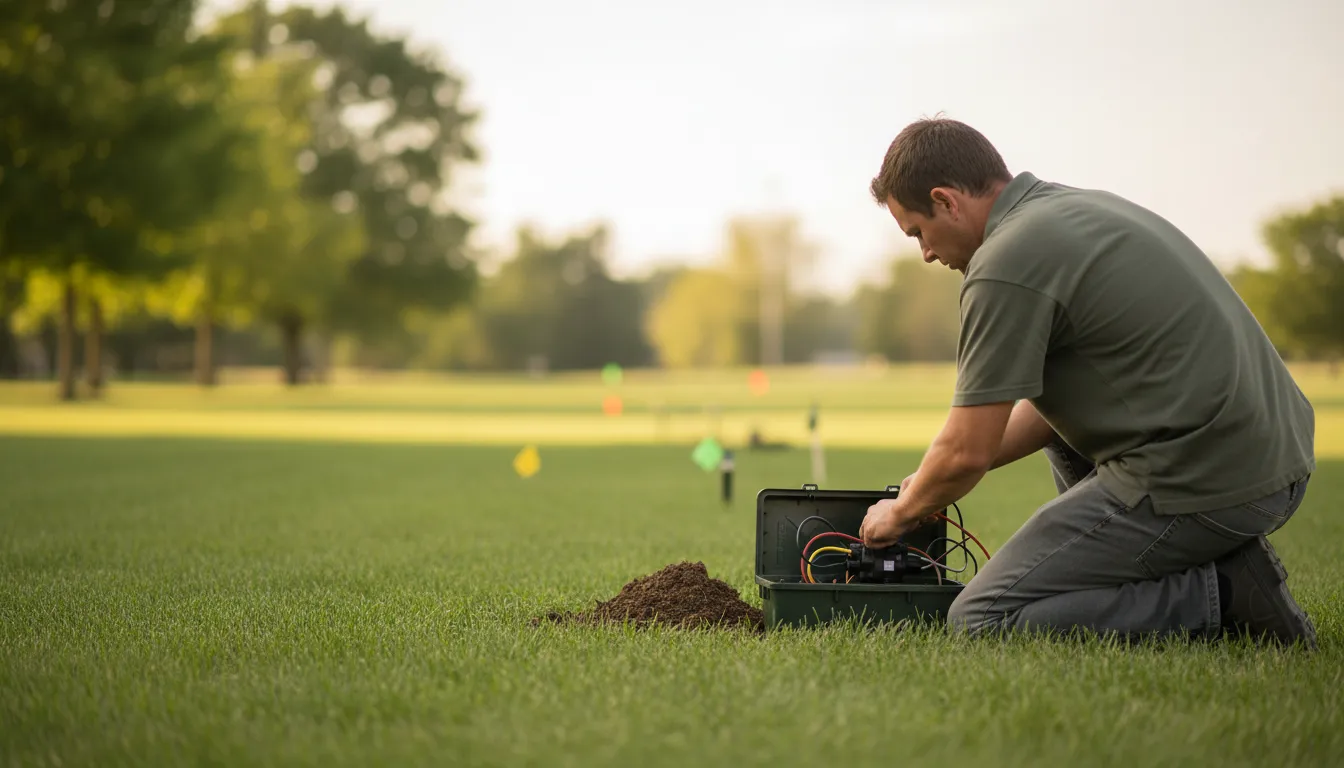
Find the Best Sprinkler & Irrigation Companies for Your Business
No obligation • Fast responses • Nationwide coverage

Why you can trust Landscape Atlas
Landscape Atlas is a leading United States resource for evaluating landscaping, lawn care, and outdoor service providers. Our team researches each category in depth, focusing on service quality, safety, and customer experience. Listings and rankings are based on independent criteria and user feedback, and companies cannot pay to influence our assessments or recommendations.
Search providers near you
Top Sprinkler & Irrigation Companies in Raleigh, North Carolina Ranked
An automated sprinkler or irrigation system is a smart investment for any Raleigh homeowner looking to maintain a healthy, vibrant landscape while conserving water. These systems deliver precise, scheduled watering directly to your lawn and garden beds, saving you time and ensuring your plants get the moisture they need, even during the hottest summer months. This guide will help you understand how these systems work, their key components, and how to find qualified local professionals for installation, maintenance, and repair.
DreamScapes
4913 Professional Ct, Raleigh, NC 27609
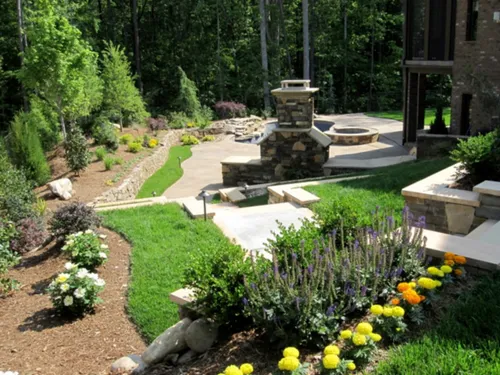
DreamScapes is a landscaping company based in Raleigh, NC, offering a wide range of residential and commercial landscaping services. Their expertise includes lawn mowing, fertilization, weed control, sod and artificial turf installation, landscape lighting, design, tree services, yard drainage, sprinkler installation and repair, as well as hardscaping such as pavers and retaining walls. With over fifteen years of experience, DreamScapes serves the greater Raleigh area including Cary, Wake Forest, Durham, and Chapel Hill. They provide customized landscape design and maintenance plans, combining hardscapes, planting, and lighting to meet client needs. DreamScapes sources materials from local high-quality suppliers and is known for attention to detail and comprehensive service. The company does not specify special availability hours.

Greenway Irrigation
2314 S Miami Blvd Suite 253, Durham, NC 27703
Greenway Irrigation is a landscaping and irrigation company based in Durham, NC, serving the Greater Triangle Area including Cary, Chapel Hill, and Raleigh. Since 1992, they have provided sprinkler and drip irrigation installation, repairs, startups, winterizations, and backflow testing. Their services also include outdoor lighting installation and repair, water features, drainage solutions, pool maintenance, and pressure washing. Greenway Irrigation holds an NC Irrigation Contractor License and employs a certified backflow inspector, reflecting their expertise in irrigation system care.

Pacific Lawn Sprinklers
Raleigh, NC
Pacific Lawn Sprinklers provides comprehensive irrigation, landscape lighting, and yard drainage services in Raleigh, NC. They specialize in new lawn sprinkler installations, repairs, and annual maintenance to ensure efficient watering and system longevity. The company also offers low-voltage outdoor lighting and holiday light installation using professional equipment and safety standards. With experience dating back to 1999, Pacific Lawn Sprinklers has completed numerous commercial and residential projects, including large-scale irrigation systems and landscape lighting. Their services include winterization to protect systems from freeze damage and smart WiFi controller installations for remote irrigation management.
Agape Lawn Company
2500 Regency Pkwy Suite 211, Cary, NC 27518
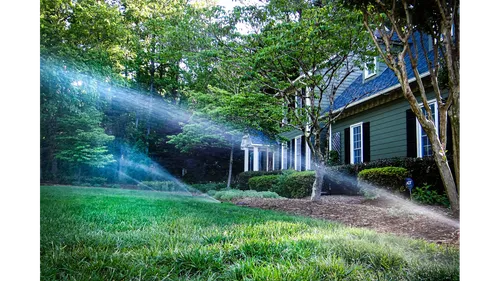
Agape Lawn Company provides comprehensive lawn care, landscaping, and outdoor living services to homeowners in Raleigh, NC. Their offerings include lawn fertilization, weed control, sod installation, irrigation system installation and repair, tree and shrub care, landscape design, and hardscaping features such as patios and retaining walls. Established in 2009, the company combines years of experience with a wide range of capabilities to maintain and enhance residential properties in the area.
Cary Sprinklers
503 Canon Gate Dr, Cary, NC 27518
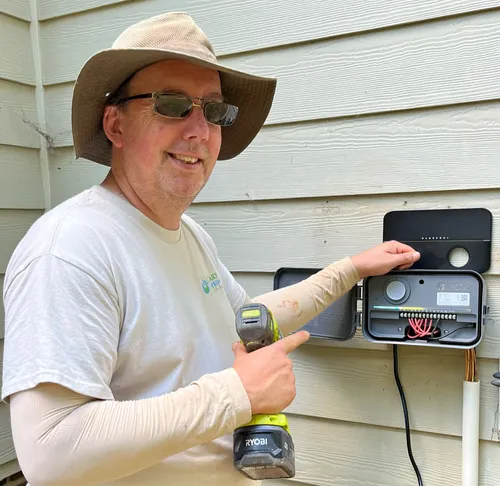
Cary Sprinklers is a full-service sprinkler and irrigation contractor serving Raleigh, NC, and surrounding Wake County communities. They provide comprehensive sprinkler system repairs, including fixing broken heads, clogged nozzles, valve and manifold repairs, controller troubleshooting, and backflow preventer services. The company also offers seasonal maintenance such as system startup, efficiency checks, fall optimization, and winterization to protect irrigation systems year-round. Cary Sprinklers installs new systems, smart controllers, drip irrigation, and performs expansions or upgrades tailored to local soil and climate conditions. They serve both residential and commercial clients across Cary, Apex, Raleigh, and nearby areas. Emergency repair services are available to address urgent sprinkler issues promptly.
How an Automated Watering System Works
At its core, a residential irrigation system is a network of underground pipes, valves, and sprinkler heads controlled by a central timer. The process begins at your water source, typically a connection to the city's main water supply. A backflow prevention device, which is required by Raleigh code, is installed here to protect the public water supply from contamination. From there, water travels through a mainline to a series of solenoid valves, each controlling a specific "zone" of your yard1.
The brain of the operation is the irrigation controller. This device, often mounted in your garage or on an exterior wall, sends an electrical signal to open the solenoid valves according to a pre-programmed schedule. When a valve opens, water pressure forces its way through the lateral pipes in that zone and out through the sprinkler heads or drip emitters, applying water exactly where it's needed2. After the set run time, the controller signals the valve to close, and the system waits for its next cycle.
Key Components of a Raleigh Irrigation System
Understanding the parts of your system is essential for effective maintenance and communication with service providers.
- Controller: The timer that automates your watering schedule. Modern "smart" controllers can adjust watering based on local weather data, improving efficiency.
- Solenoid Valves: These electrically operated valves act as gates, controlling water flow to individual zones. They are usually housed in valve boxes buried in the yard.
- Piping: Durable PVC or polyethylene pipes form the underground network that distributes water from the valves to the sprinkler heads.
- Sprinkler Heads: These are the endpoints that distribute water over an area. They come in several types:
- Spray Heads: Fixed nozzles that pop up and water a small, fan-shaped area (e.g., 15-foot radius). Ideal for small, rectangular lawn sections.
- Rotor Heads: Rotating streams that cover larger, circular areas (e.g., 25 to 50-foot radius). Better for bigger lawns and more water-efficient3.
- Drip Irrigation: A network of tubing with emitters that deliver water slowly and directly to the root zone of plants, shrubs, and garden beds. This is the most efficient method for non-turf areas.
- Backflow Preventer: A crucial safety device mandated by the City of Raleigh to ensure irrigation water cannot siphon back into the drinking water supply.
Designing for Efficiency: Zoning and Coverage
A well-designed system is not a one-size-fits-all setup. Proper zoning is critical. Your lawn, flower beds, shrubs, and vegetable garden all have different water requirements. An efficient design will group plants with similar needs on the same valve zone. For instance, turf grass on a sunny slope will be on a separate zone from shade-tolerant plants or a moisture-loving garden bed.
Another fundamental principle for lawn zones is achieving head-to-head coverage. This means the spray from one sprinkler head should reach the adjacent head4. This overlap ensures uniform watering without dry spots, preventing the temptation to over-water some areas to compensate for others. A professional installer will carefully map your property, accounting for water pressure, flow rate, and the specific precipitation rates of the selected heads to create an optimized, water-saving layout.
Smart Watering Practices for the Piedmont Climate
Raleigh's climate, with its hot, humid summers and cooler winters, demands a seasonal approach to irrigation. The general goal for established lawns is about 1 inch of water per week, including rainfall. However, this is a starting point; your soil type greatly influences your schedule. Sandy soil drains quickly and may require shorter, more frequent cycles, while clay soil holds water longer and needs slower application to prevent runoff5.
Timing is everything. The best time to water is between 4 AM and 10 AM6. Watering in the early morning minimizes loss to evaporation from sun and wind, allows foliage to dry before nightfall (reducing disease risk), and takes advantage of typically lower water pressure demands in the city.
A sample seasonal schedule might look like this 7:
- Summer (Hot & Dry): Water 3 times per week. Split the total weekly runtime into multiple cycles per watering day if runoff occurs.
- Spring/Fall: Water 1-2 times per week as temperatures moderate.
- Winter: Systems are typically winterized to prevent pipe damage from freezing. Watering is rarely needed.
Find the perfect sprinkler & irrigation companies for your needs
Get personalized recommendations and expert advice
Installation, Service, and Maintenance Costs
Investing in a new irrigation system or maintaining an existing one involves various cost factors specific to your Raleigh property.
For new installations, pricing varies widely based on lawn size, landscape complexity, water source, and the mix of sprinkler and drip components. A simple system for a small yard will cost significantly less than a complex, multi-zone system for a large property with gardens and slopes. Due to these variables, professional installers provide custom quotes after a site evaluation.
For repairs and maintenance, a common starting point is a service call fee, which can be around $110 for the first hour for diagnosis and minor fixes, with the cost of any replacement parts added on. Common repairs include fixing broken pipes, replacing clogged or damaged sprinkler heads, and repairing faulty valves.
Many companies offer annual maintenance plans, which typically include a spring start-up (activating the system, checking for winter damage, programming the controller) and a fall winterization (blowing compressed air through the lines to remove all water). These plans, which may also include a backflow prevention device test, often range from $235 to $260 per year8 9. Regular maintenance is key to preventing costly repairs and ensuring efficient operation.
Local Regulations and Water Conservation
Raleigh homeowners have a responsibility to install and operate their systems wisely. The city's Cross-Connection Control Program requires that all irrigation systems connected to the public water supply have an approved backflow prevention device installed and tested annually by a certified tester10. This is not just a recommendation-it's a code requirement for public health.
Furthermore, the state of North Carolina encourages water efficiency. Using WaterSense-labeled products, incorporating drip irrigation for beds, and employing smart controllers that adjust for rain are all excellent ways to create a beautiful landscape while being a good steward of local water resources11 12.
Frequently asked questions
Sources
Footnotes
-
How Does a Lawn Irrigation System Work: #1 Best Benefits - https://mcleodlandscaping.com/how-does-a-lawn-irrigation-system-work/ ↩
-
The Ultimate Guide to Sprinkler and Irrigation Systems for Your ... - https://heartlandsprinklers.com/green-tips/ultimate-guide-to-sprinkler-and-irrigation-systems/ ↩
-
Selecting an Irrigation System - https://www.nrcs.usda.gov/sites/default/files/2022-09/stelprdb1167474-selecting-irrigation-system.pdf ↩
-
Easy, step-by-step, underground sprinkler system layout guide - https://images.thdstatic.com/catalog/pdfImages/a9/a9564496-8fb7-4141-8758-5f660a7a9310.pdf ↩
-
Irrigation for Clay Soil vs Sandy Soil - Learning Center - https://blog.greenmeadowlawncare.com/irrigation-for-clay-soil-vs-sandy-soil ↩
-
Irrigation Help | Santa Clarita Valley Water - https://yourscvwater.com/irrigation-help ↩
-
How Long to Run a Sprinkler for 1 Inch of Water - Sod Solutions - https://sodsolutions.com/advanced-how-to/how-long-to-run-a-sprinkler-for-1-inch-of-water/ ↩
-
Cost Factors For Raleigh, NC Sprinkler System Installation - https://waterworksunltd.com/sprinkler-system-installation-cost-factors-raleigh-nc/ ↩
-
Raleigh Lawn Sprinkler Repair & Maintenance - https://systemizeirrigation.com/raleigh/ ↩
-
Irrigation Systems | Raleighnc.gov - https://raleighnc.gov/water-and-sewer/services/cross-connection-control-program/irrigation-systems ↩
-
Landscape Irrigation Watering Guide - https://northgeorgiawater.org/wp-content/uploads/2017/02/Landscape-Irrigation-Watering-Guide.pdf ↩
-
The 5 essential components for an efficient irrigation system - rain.it - https://www.rain.it/en/magazine/5-essential-components-for-an-efficient-irrigation-system/ ↩