Find the Best Yard Drainage Contractors for Your Business
No obligation • Fast responses • Nationwide coverage

Why you can trust Landscape Atlas
Landscape Atlas is a leading United States resource for evaluating landscaping, lawn care, and outdoor service providers. Our team researches each category in depth, focusing on service quality, safety, and customer experience. Listings and rankings are based on independent criteria and user feedback, and companies cannot pay to influence our assessments or recommendations.
Search providers near you
Best Yard Drainage Contractors in Alabama Ranked
Effective yard drainage and grading are essential for protecting your Alabama home from water damage. The state's heavy rainfall and clay-rich soils can quickly lead to saturated yards, foundation issues, and landscape erosion. This guide explains the principles of proper water management and the common solutions used by local professionals to keep your property dry and stable.
Why Alabama Homes Need Specialized Drainage
Alabama's humid subtropical climate presents unique challenges for property owners. The state experiences significant rainfall, particularly in the spring and fall, which can lead to rapid runoff and soil saturation. This is compounded by the prevalence of heavy clay soils, which drain very slowly. Without a well-planned drainage system, this persistent moisture can lead to serious problems, including foundation settling, basement or crawl space flooding, mold growth, and pest infestations. A proactive approach to water management is not just about puddle prevention; it's a critical investment in your home's structural integrity.
Core Principles: Grading for Foundation Protection
The first and most fundamental line of defense is proper grading-the slope of the land around your home.
- Create a Positive Slope: The ground should slope away from your foundation in all directions. A standard guideline is a minimum 6-inch drop over the first 10 feet from the foundation wall. This simple gradient is the most effective way to direct surface water away from your home's most vulnerable area.
- Manage Downspouts Effectively: Your gutter system is useless if it dumps water right next to your foundation. Downspout extensions should carry water at least 5 to 10 feet away from the house, ideally discharging into a splash block, a buried drain pipe, or a dedicated drainage channel.
- Minimize Soil Disturbance: Bare, compacted soil erodes easily and prevents water from soaking in. Maintaining vegetative cover (grass, ground cover, or mulch) helps stabilize the soil and allows for natural water infiltration, reducing overall runoff 1.
Common Drainage Solutions for Alabama Properties
When grading alone isn't enough, professionals employ a variety of systems tailored to the site's specific needs. These are often referred to as stormwater control measures or best management practices (BMPs) 2.
1. Swales and Regrading
A swale is a broad, shallow, vegetated channel designed to convey runoff. It's a more engineered form of grading that can be integrated seamlessly into your landscape. Regrading involves moving soil to correct improper slopes and is often the first step in solving chronic drainage issues 3.
2. French Drains
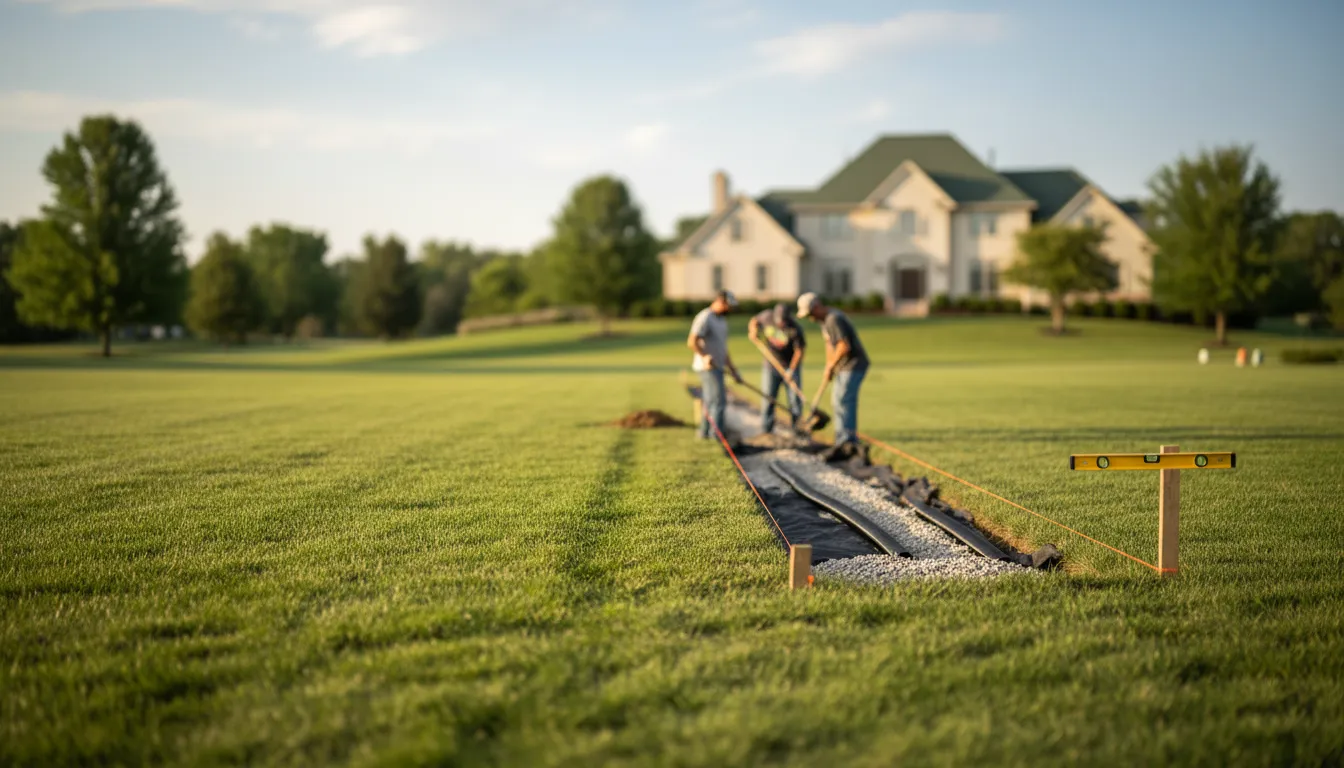
A French drain is a gravel-filled trench containing a perforated pipe. It's designed to intercept and redirect groundwater and surface water that has seeped below the surface. This system is highly effective for areas with persistent soggy spots or for channeling water from downspouts away from the property.
3. Catch Basins and Channel Drains
These are ideal for collecting water from paved surfaces, driveways, or low spots. A catch basin is a grated inlet that connects to an underground pipe system. A channel drain is a long, narrow grate (often seen across driveways) that performs a similar function. They are excellent for capturing large volumes of surface water quickly.
4. Rain Gardens and Bioretention
This approach uses landscaping to manage water. A rain garden is a depressed area planted with native, water-tolerant plants. It collects runoff from roofs or driveways, allowing it to slowly infiltrate the soil while being filtered by the plants. This method aligns with Low Impact Development (LID) principles encouraged for managing Alabama's heavy rains.
5. Dry Wells and Detention Basins
For properties with significant runoff, a dry well (an underground chamber that disperses water into the soil) or a detention basin (a landscaped depression that temporarily holds water and releases it slowly) may be appropriate solutions to prevent overwhelming municipal storm systems or causing erosion downstream 4.
Find the perfect yard drainage contractors for your needs
Get personalized recommendations and expert advice
Incorporating Low Impact Development (LID)
For Alabama homeowners, the state's Department of Environmental Management (ADEM) provides a valuable resource: the Low Impact Development Handbook. LID is a land planning and engineering design approach that mimics natural processes to manage stormwater. It emphasizes:
- Conserving natural areas where possible.
- Minimizing impervious surfaces like concrete.
- Using integrated, small-scale controls like rain gardens and permeable pavers.
- Treating stormwater as a resource rather than a waste product.
Consulting this handbook or working with a professional familiar with LID principles can lead to more sustainable, effective, and aesthetically pleasing drainage solutions for your yard.
Understanding Costs and Professional Design
The cost of a drainage solution varies dramatically based on the size of your property, the extent of the problem, and the complexity of the system installed.
- Basic regrading or creating a swale can be a lower-cost project if it involves mainly labor and soil movement.
- Installing a French drain is typically priced per linear foot, with costs influenced by depth, trenching difficulty, and materials.
- Rain garden installation costs are moderate and depend on size, plants, and soil amendments 5.
- Catch basins, channel drains, and extensive pipe networks involve higher material and installation costs 6.
While some simple grading or swale creation can be a DIY project, most effective drainage systems benefit from professional design. An expert can accurately assess water flow, soil composition, and the root cause of your drainage issue to recommend a system that will work long-term, preventing costly repairs to your home's foundation or landscape.