Find the Best Yard Drainage Contractors for Your Business
No obligation • Fast responses • Nationwide coverage

Why you can trust Landscape Atlas
Landscape Atlas is a leading United States resource for evaluating landscaping, lawn care, and outdoor service providers. Our team researches each category in depth, focusing on service quality, safety, and customer experience. Listings and rankings are based on independent criteria and user feedback, and companies cannot pay to influence our assessments or recommendations.
Search providers near you
Find Yard Drainage Contractors near you
A soggy lawn, standing water, or water pooling near your foundation are more than just nuisances-they can threaten your home's structural integrity, create mosquito breeding grounds, and ruin your landscape. Proper yard drainage and grading are the cornerstones of a healthy, stable, and usable outdoor space. This guide explains the core solutions for managing water flow on your property, from foundational grading to sophisticated drainage systems, helping you understand your options and connect with qualified professionals who can assess and solve your specific water management challenges.
Search providers near you
Why Proper Water Management is Critical for Your Home
Ignoring poor drainage can lead to costly and serious problems. Water that doesn't drain properly can seep into your basement or crawl space, causing mold, mildew, and foundation cracks. Saturated soil around your home's footing can shift and settle, leading to uneven floors and stuck doors. In your yard, persistent dampness kills grass, drowns plant roots, and creates slippery, muddy conditions. Effective surface drainage and subsurface drainage systems work to intercept water and channel it safely away, protecting your investment and enhancing your property's usability. 1 2
The Foundation: Understanding Yard Grading
Grading is the process of shaping the land's surface to control water runoff. It's often the first and most important step in solving drainage issues. The goal is to create a gentle, consistent slope that directs surface water away from your home's foundation and toward a suitable discharge point, like a street gutter, storm drain, or dry well.
- The Ideal Slope: Landscape professionals typically recommend a minimum slope of 2% away from your foundation. This means the ground should drop 2 inches for every 10 feet of horizontal distance. For the first 10 feet immediately surrounding your house, a steeper slope of 5% (6 inches over 10 feet) is often advised for optimal protection.
- The Process: Regrading a yard involves adding or removing soil (fill dirt), compacting it, and carefully sculpting the new grade to ensure positive drainage. It requires heavy equipment like skid-steers and a skilled eye to ensure water flows as intended without creating new problems elsewhere on the property.
- When It's Needed: If you notice water pooling against your home, or if your yard is flat or slopes toward the house, regrading is likely necessary. It's frequently done in conjunction with other drainage solutions to create a comprehensive water management plan.
Surface Drainage Solutions
These methods manage water that flows across the top of the ground. They are often more visible but can be integrated beautifully into your landscape.
- Swales: A swale is a wide, shallow, vegetated ditch designed to capture and slowly channel surface runoff. They are often lined with grass or other plants that help filter the water and prevent erosion. Swales are excellent for managing runoff from large, sloped areas and can be a natural-looking addition to your landscape. 3
- Dry Creek Beds: Combining function with aesthetics, a dry creek bed is a rock-lined channel that mimics a natural stream. It handles heavy water flow during storms while serving as an attractive landscape feature during dry periods. They are particularly effective for directing water from downspouts or through garden areas. 4
- Catch Basins: These are in-ground collection boxes with a grate on top, installed at low points where water pools. They act as intake points, collecting surface water which is then carried away through an underground pipe system to a safe outlet. They are crucial for solving specific, localized ponding issues in driveways, patios, or lawn depressions.
- Rain Gardens: A rain garden is a depressed, bowl-shaped garden bed filled with native, water-tolerant plants and amended soil. It's strategically placed to capture runoff from roofs or paved areas, allowing the water to pool and slowly infiltrate into the ground. This not only manages water but filters pollutants and provides habitat.
Subsurface Drainage Solutions
When water problems are below the surface or when above-ground solutions aren't feasible, these underground systems are employed.
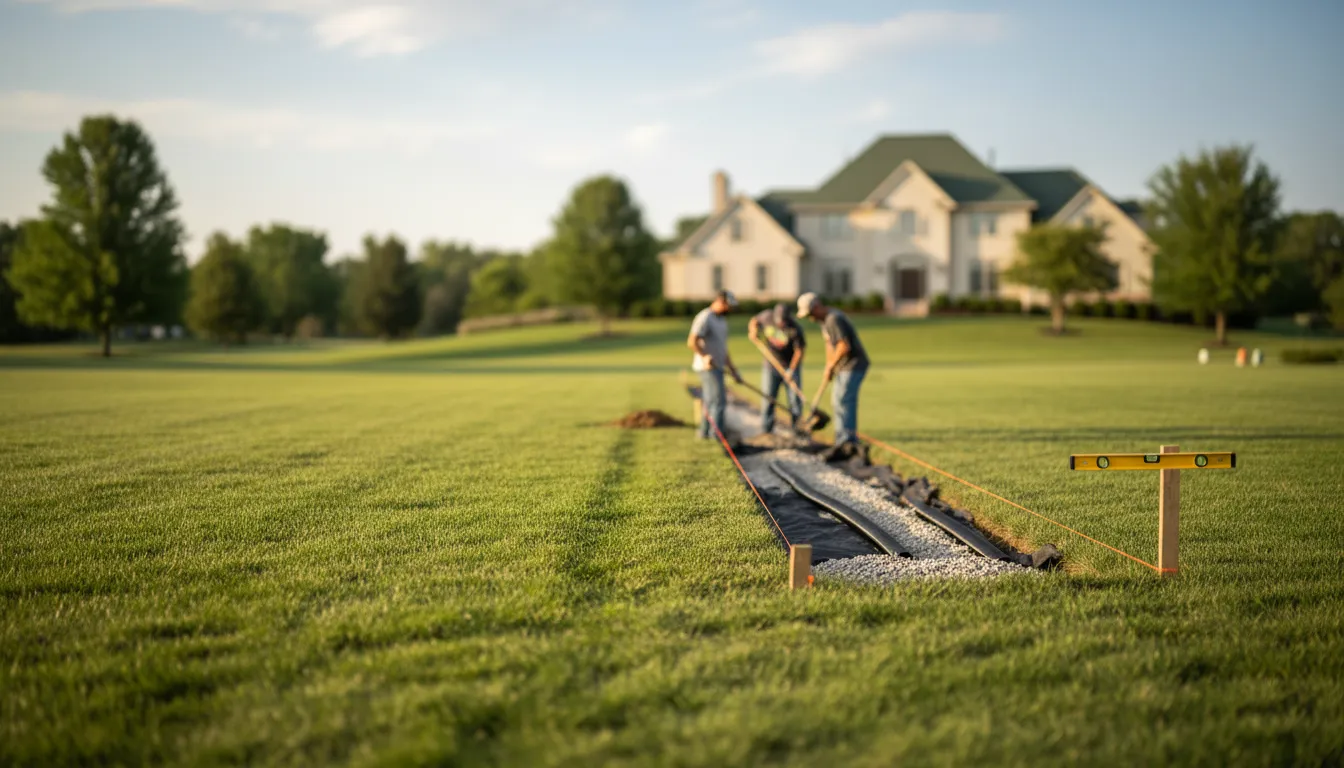
- French Drains: Arguably the most well-known yard drainage system, a French drain is a trench filled with gravel containing a perforated pipe. The pipe collects groundwater and surface water that seeps through the gravel, redirecting it away from problem areas. The "perf" pipe is typically installed with the holes facing downward to draw water up from saturated soil. 5 6
- Channel Drains: Similar to catch basins but linear, these are long, narrow drains with grates, often used across driveways, walkways, or patio entries to intercept surface water before it can spread.
- Dry Wells: A dry well is an underground structure, often a large pit filled with gravel or a pre-made chamber, that collects water from downspouts or drainage pipes. It stores the water temporarily, allowing it to slowly percolate (infiltrate) into the surrounding subsoil. They are ideal where there is no convenient downhill outlet. 7
Find the perfect yard drainage contractors for your needs
Get personalized recommendations and expert advice
The Professional Installation Process: What to Expect
While some minor solutions like downspout extensions can be DIY projects, most drainage and grading work benefits from professional expertise. Here's a general overview of the process a qualified contractor will follow:
- Site Assessment and Diagnosis: A professional will inspect your property during or after a rain event to identify the sources of water, the flow paths, and the areas of accumulation. They will also assess your soil type (clay, sand, loam), as it greatly affects drainage.
- System Design and Planning: Based on the assessment, they will design a solution. This involves determining the best type of system (or combination of systems), mapping the drainage route, and calculating the necessary slopes. A critical step here is calling 811 to have all public underground utility lines marked before any digging begins. 8 9
- Excavation: Using equipment like trenchers or mini-excavators, the crew will dig trenches for pipes, pits for catch basins or dry wells, or reshape the land for grading.
- Installation: Components are placed-gravel beds laid, pipes connected, basins set, and fabric installed to prevent soil from clogging the system. For grading, soil is moved, spread, and compacted in layers.
- Backfill and Restoration: The trenches are filled, typically with more gravel, then soil, and finally topped with sod or seed to restore the lawn. The area is cleaned up.
- Testing and Final Inspection: The contractor will run water through the new system to verify proper flow and function, ensuring it directs water to the intended discharge point. 10
Cost Considerations for Drainage and Grading Projects
The investment for a drainage solution varies dramatically based on the size of your yard, the complexity of the problem, the solutions chosen, and your geographic region. Professional labor is a significant component, with rates typically ranging from $50 to $150 per hour.
Here is a breakdown of typical cost ranges for professional installation of common systems:
| Method | Typical Cost Range (Professional Installation) |
|---|---|
| Yard Grading | $1.25-$4.00 per square foot, or $2,000-$8,000 for most projects 11 12 |
| French Drain | $10-$100 per linear foot, or $1,000-$10,000 total 13 |
| Catch Basin | $200-$500 per plastic unit; $2,000-$5,000 per concrete unit (plus pipe costs) 14 |
| Swale | $5-$15 per linear foot |
| Dry Well | $1,165-$4,420 total |
| Downspout Extension | $200-$2,000 each 15 |
| Rain Garden | $5-$25 per square foot 16 |
Simple DIY corrections may cost a few hundred dollars in materials, while extensive, whole-property systems involving multiple catch basins, long pipe runs, sump pumps, and complex grading can exceed $15,000. 17 18 It's important to get detailed quotes from several contractors that include a clear scope of work, materials, and warranty information.
Maintaining Your Drainage System
Once installed, most systems require minimal maintenance to function for decades. Key maintenance tasks include:
- Inspecting Grates and Inlets: Regularly clear leaves, grass clippings, and debris from catch basin grates and channel drains to prevent blockages.
- Checking the Outlet: Ensure the final discharge point (where the water exits your pipe) is clear of obstructions like soil, vegetation, or debris.
- Observing After Heavy Rain: Walk your property after a storm to ensure water is moving as designed and not creating new pooling areas.
- Avoiding Soil Compaction: Be mindful of driving or parking heavy vehicles over areas with subsurface drains, as this can compact the soil and crush pipes.
A well-designed and maintained water management solution is a long-term asset to your property, preventing damage and preserving the beauty and health of your landscape.
Frequently asked questions
Sources
Footnotes
-
Tailored Drainage Solutions for Sloped Yards - Rainscapes - https://rainscapes.com/tailored-drainage-solutions-for-sloped-yards/ ↩
-
7 Water Management Solutions for Proper Drainage - https://marshalllandscapingllc.com/blog/7-water-management-solutions-for-proper-drainage ↩
-
Swales, Drains, and Site Grading for Stormwater Control - https://basc.pnnl.gov/resource-guides/swales-drains-and-site-grading-stormwater-control ↩
-
Say Goodbye to Soggy Yards! 5 Drainage Solutions Every ... - https://www.classicgardens.com/landscaping-tips/say-goodbye-to-soggy-yards-5-drainage-solutions ↩
-
Sloped Yard Drainage: 12 Best DIY Solutions for 2024 - https://salcorplandscaping.com/sloped-yard-drainage/ ↩
-
5 Essential Yard Drainage Systems Homeowners Can't Ignore - https://www.bluecollarscholars.net/types-of-yard-drainage-systems/ ↩
-
5 Best Backyard Drainage Systems And Ideas: For a Healthy, Flood- ... - https://warelandscaping.com/5-best-backyard-drainage-systems-and-ideas/ ↩
-
Mastering Yard Drain System Installation - Ware Landscaping - https://warelandscaping.com/mastering-yard-drain-system-installation/ ↩
-
How To Design a Drainage System - Easy Digging - https://www.easydigging.com/digging/articles-d/drainage/design-drain.html ↩
-
15 DIY Yard Drainage Methods You Should Know - The Spruce - https://www.thespruce.com/diy-yard-drainage-methods-5080419 ↩
-
Grading Yard for Drainage: A Homeowner's Step-by-Step Guide - https://tamuradesigns.com/grading-yard-for-drainage/ ↩
-
Landscape Grading and Drainage Costs - https://www.whiteshovel.com/blog/landscape-grading-and-drainage-costs ↩
-
French Drain Costs in 2025: What Homeowners Need to Know - https://warelandscaping.com/french-drain-costs-in-2025 ↩
-
What is the Best Yard Drainage Solution? - https://drainagefirst.com/what-is-the-best-yard-drainage-solution/ ↩
-
How Much Does It Cost to Install a Drainage System in Your ... - https://www.homeadvisor.com/cost/landscape/install-drainage/ ↩
-
How Much Does Yard Drainage Cost? [2026 Data] | Angi - https://www.angi.com/articles/how-much-does-it-cost-install-landscape-drainage.htm ↩
-
How Much Does Yard Drainage Cost in 2025? Homeowner's ... - https://warelandscaping.com/how-much-does-yard-drainage-cost-in-2025 ↩
-
How Much Do Drainage Services Cost? - https://drainagefirst.com/how-much-do-drainage-services-cost/ ↩