Find the Best Yard Drainage Contractors for Your Business
No obligation • Fast responses • Nationwide coverage

Why you can trust Landscape Atlas
Landscape Atlas is a leading United States resource for evaluating landscaping, lawn care, and outdoor service providers. Our team researches each category in depth, focusing on service quality, safety, and customer experience. Listings and rankings are based on independent criteria and user feedback, and companies cannot pay to influence our assessments or recommendations.
Search providers near you
Best Yard Drainage Contractors in South Carolina Ranked
Effective yard drainage and grading are essential for protecting your South Carolina home from water damage. The state's heavy rainfall, high humidity, and prevalent clay soils create a perfect storm for standing water, foundation issues, and landscape erosion. A well-designed drainage system manages this runoff, directing it safely away from your home's foundation and into appropriate areas. This guide explains the common challenges, proven solutions, and local considerations for South Carolina homeowners, helping you understand your options for finding qualified professionals to assess and solve your property's unique water management needs.
Understanding South Carolina's Drainage Challenges
South Carolina's climate and geology present specific hurdles for property owners. Successfully managing water starts with recognizing these local factors.
- Heavy Rainfall Events: The Southeast, including South Carolina, is prone to intense downpours that can overwhelm poorly prepared landscapes. These events demand systems that can convey large volumes of water quickly or store it temporarily to prevent flooding 1.
- Clay Soils and High Humidity: Much of the state has clay-heavy soil, which drains very slowly. Combined with high humidity, this leads to prolonged soil saturation, increasing hydrostatic pressure against foundations and creating muddy, unusable yard spaces.
- Coastal Considerations: In coastal zones, higher water tables and sandy soils require specialized approaches. Techniques like bioretention (rain gardens) are encouraged to filter and infiltrate water rather than simply piping it away, aligning with Low Impact Development (LID) principles.
Core Solutions for Yard Drainage & Grading
A combination of techniques is often used to create a comprehensive water management plan. Here are the most common and effective systems installed across the Palmetto State.
Grading and Site Contouring
This is the fundamental first step. Proper grading involves shaping the land to create a "positive slope," ensuring water flows away from your home's foundation for at least 5-10 feet. Professionals use compacted fill dirt to reshape problem areas, correcting negative slopes that pool water. Swales (broad, shallow ditches) and berms (raised mounds) are used to guide surface runoff along a desired path, often toward a street, drainage ditch, or a designated infiltration area.
Subsurface Drainage Systems
When water pools below the surface or saturates the soil, subsurface solutions are necessary.
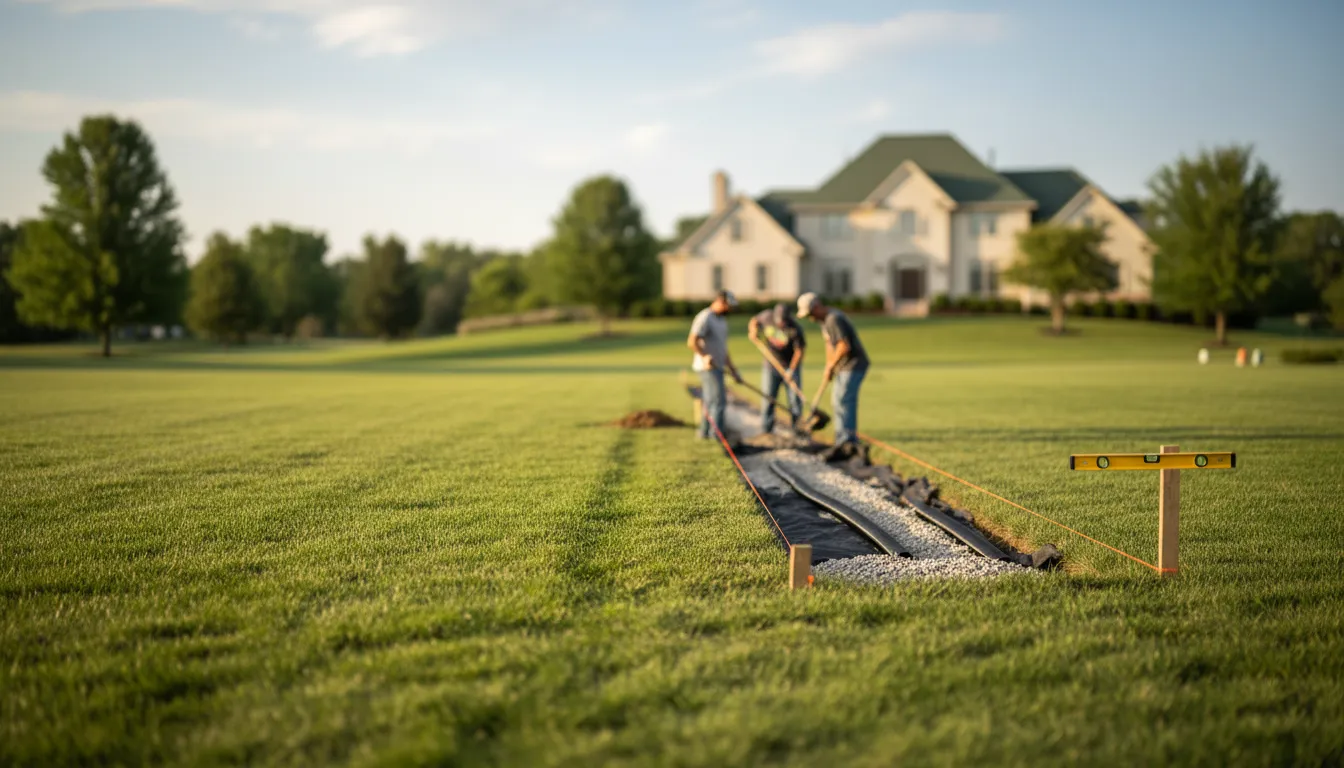
- French Drains: A trench is dug, filled with gravel, and contains a perforated pipe that collects and redirects groundwater. They are highly effective for relieving soggy lawns and foundation seepage.
- Foundation Drain Tile: Often installed during construction or major renovation, this is a perforated pipe placed at the footing of the foundation to intercept water before it can enter a basement or crawl space.
Surface Water Capture and Conveyance
These systems handle water running across hard surfaces like driveways, patios, and walkways.
- Catch Basins and Channel Drains: These are grates or linear drains set into the ground that capture surface runoff. The water is then piped underground to a safe discharge point, such as a storm sewer or dry well.
- Gutter and Downspout Management: A critical, often overlooked component. Downspouts should be extended well away from the foundation (at least 5 feet) or connected to underground drain pipes that lead to a proper outlet.
Low Impact Development (LID) and Infiltration
These "softer" techniques work with nature to manage stormwater, reduce runoff volume, and improve water quality. They are increasingly promoted in South Carolina, especially in coastal communities.
- Rain Gardens (Bioretention): A landscaped depression planted with native, water-tolerant plants. It collects runoff from roofs or driveways, allowing it to slowly filter into the ground while removing pollutants 2.
- Permeable Paving: Pavers, special concrete, or gravel systems designed to allow water to pass through the surface and soak into a stone reservoir below, reducing direct runoff 3.
- Rain Barrels and Cisterns: These capture roof runoff from downspouts for later use in irrigation, effectively reducing the total volume of water that hits the ground during a storm 4.
Find the perfect yard drainage contractors for your needs
Get personalized recommendations and expert advice
Protecting Your Home's Foundation
Foundation protection is the primary goal of most residential drainage projects. Water is the leading cause of foundation cracks, settling, and basement/crawl space moisture. A layered defense is best:
- Ensure Positive Slope: The ground should always fall away from the foundation.
- Manage Roof Runoff: Ensure gutters are clean and downspouts discharge far from the house.
- Install Subsurface Relief: A French drain or drain tile system intercepts water moving through the soil toward the foundation 5.
Cost Considerations in South Carolina
Costs vary widely based on property size, slope, soil conditions, and system complexity. Simple regrading of a small area might be a few thousand dollars, while a full-yard system with multiple drains and catch basins can be a significant investment.
- Professional Grading: Basic reshaping can range from $1,000 to $6,400, with extensive leveling projects exceeding $15,000.
- Drainage Installation: Installing drainage pipes like French drains typically costs $10 to $50 per linear foot, not including site preparation and excavation 6.
- Labor Rates: Professional labor for drainage work often falls between $50 and $150 per hour 7.
Legal and Regulatory Notes for Homeowners
Understanding local rules is important before starting a drainage project.
- South Carolina's "Common Enemy" Doctrine: This legal principle generally allows landowners to take reasonable actions on their own property to fend off surface water (the "common enemy"). However, you cannot divert water in a manner that creates a nuisance or causes harm to a neighboring property 8.
- Local Regulations: Many municipalities, especially growing cities and coastal counties, have stormwater management ordinances. For example, Charleston has a detailed Stormwater Design Standards Manual 9. Always check with your local building or public works department before installing significant drainage systems, as permits may be required, and certain best practices (like LID) may be encouraged or mandated 10 9.
Maintenance for Long-Term Performance
A drainage system is only as good as its upkeep. Regularly inspect and clean gutter systems and downspout extensions. Check the grates of catch basins and channel drains for debris like leaves and silt, clearing them to prevent clogs. Periodically flush French drain systems with a hose to ensure the pipes are clear. For rain gardens, maintain the plants and ensure the basin does not become overly silted.
Frequently asked questions
Sources
Footnotes
-
S.C. Code Regs. § 72-300 - Scope | State Regulations - https://www.law.cornell.edu/regulations/south-carolina/R-72-300 ↩
-
Stormwater Best Management Practices - https://spcwater.org/topics/stormwater-management/stormwater-best-management-practices-2/ ↩
-
Post-Construction Stormwater Control Measures - https://ehs.unc.edu/topics/stormwater/program/post-construction-stormwater-control-measures/ ↩
-
10 Things You Can Do to Prevent Stormwater Runoff Pollution - https://www.farmington-ct.org/departments/engineering/stormwater/10-things-to-prevent-stormwater-pollution ↩
-
BMP Handbook | South Carolina Department of ... - https://des.sc.gov/programs/bureau-water/stormwater/best-management-practices-bmps/bmp-handbook ↩
-
Landscape Grading and Drainage Costs - https://www.whiteshovel.com/blog/landscape-grading-and-drainage-costs ↩
-
How Much Does Yard Drainage Cost? [2026 Data] | Angi - https://www.angi.com/articles/how-much-does-it-cost-install-landscape-drainage.htm ↩
-
Your Right to be Free of Your Neighbor's Water | Turner Padget Law - https://www.turnerpadget.com/south-carolina-business-litigation-blog/your-right-to-be-free-of-your-neighbors-water ↩
-
Stormwater Design Standards Manual - Charleston-SC.gov - https://www.charleston-sc.gov/DocumentCenter/View/5972/Stormwater-Design-Standards-Manual-August-2014-Updates?bidId= ↩ ↩2
-
Chapter 4: Guide to Stormwater Best Management Practices - https://www.scseagrant.org/wp-content/uploads/LID-in-Coastal-SC-4.pdf ↩