Find the Best Yard Drainage Contractors for Your Business
No obligation • Fast responses • Nationwide coverage

Why you can trust Landscape Atlas
Landscape Atlas is a leading United States resource for evaluating landscaping, lawn care, and outdoor service providers. Our team researches each category in depth, focusing on service quality, safety, and customer experience. Listings and rankings are based on independent criteria and user feedback, and companies cannot pay to influence our assessments or recommendations.
Search providers near you
Best Yard Drainage Contractors in Illinois Ranked
Effective yard drainage and grading are essential for protecting your Illinois home from water damage. Proper systems manage heavy rainfall and snowmelt, directing water away from your foundation to prevent costly issues like basement flooding, soil erosion, and structural damage. This guide explains the key principles, common solutions, and best practices for managing water on your property, helping you understand your options and connect with qualified local professionals who can assess and solve your specific drainage challenges.
Ross & Jack's Landscaping Inc
Chicago, IL
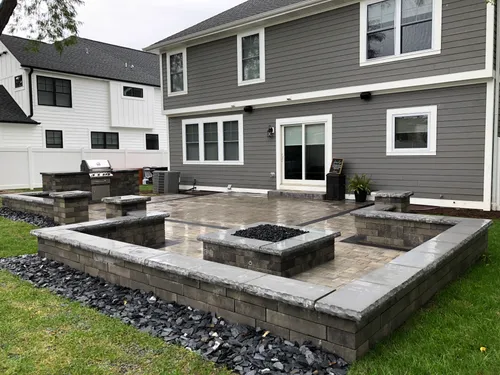
Ross & Jack's Landscaping Inc is a family-owned landscaping company based in Elmhurst, Illinois, serving Chicago and surrounding towns. Since 1975, they have offered comprehensive landscaping services including landscape design, installation, grounds maintenance, lawn care, sod installation, drainage solutions, and hardscaping such as retaining walls and brick paving. Their expertise includes digital landscape design layouts to help clients visualize projects before installation, as well as specialized drainage solutions like dry wells to manage water issues effectively. The company focuses on creating functional and aesthetically pleasing outdoor living spaces that enhance property value.
Ascend Irrigation, Inc
813 E Washington St, West Chicago, IL 60185
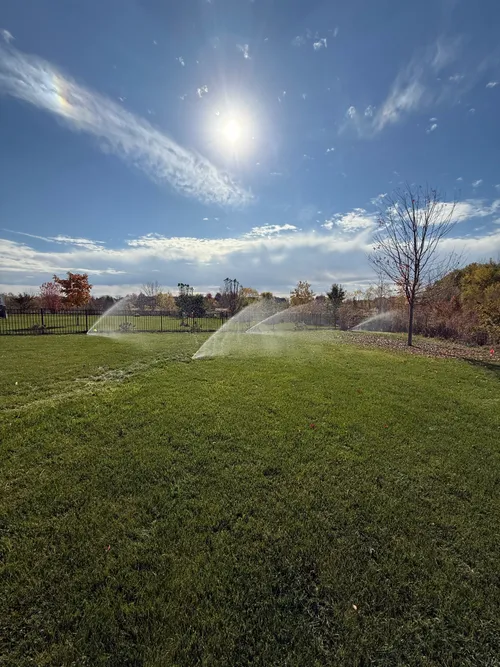
Ascend Irrigation, Inc is a Chicago, IL-based company specializing in landscape lighting installation, yard drainage, grading, and sprinkler system services. They design and install tailored irrigation and drainage solutions that promote efficient water use and help maintain healthy, vibrant outdoor spaces. Their expertise includes advanced irrigation technologies aimed at minimizing water waste and comprehensive drainage systems to prevent water buildup and erosion. With years of experience, Ascend Irrigation, Inc serves both residential and commercial properties, focusing on sustainable landscaping and outdoor lighting enhancements.
Allscape Services
452 Scotland Rd, Lakemoor, IL 60051
Allscape Services is an outdoor landscape and lawn sprinkler service provider based in Chicago, IL. They offer a full range of services including lawn irrigation, landscape lighting installation, yard drainage, grading, and holiday lighting. With over 25 years of experience, they serve customers throughout northern Illinois and specialize in design, installation, maintenance, and repairs to enhance outdoor spaces year-round. Their capabilities include lawn sprinkler system installation and comprehensive holiday lighting services.
Xpert Flood Control And Seepage Inc.
3544 W Montrose Ave, Chicago, IL 60618
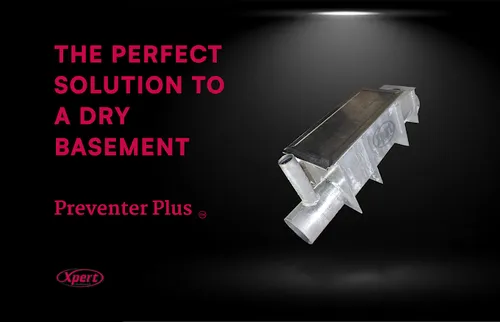
Xpert Flood Control And Seepage Inc. is a yard drainage and grading service provider located in Chicago, IL. They specialize in flood control, sump pump installation, and basement waterproofing, offering various flood prevention solutions for homes and yards. With over 63 locations serving Chicago and its suburbs, they provide local expertise in managing basement flooding and yard drainage issues. Their services include the installation of durable flood control products designed for long-term performance and backed by a warranty.
Arts Landscaping & Maintenance LLC
3146 W 59th St, Chicago, IL 60629
Arts Landscaping & Maintenance LLC is a locally owned landscaping and lawn care company based in Chicago, IL. They provide a wide range of outdoor services including lawn mowing, fertilization, weed control, sod installation, tree trimming and removal, stump grinding, yard drainage, grading, and hardscaping such as retaining walls and concrete pathways. The company serves both residential and commercial clients throughout Chicago, tailoring their services to the local climate and seasonal needs. Their capabilities include lawn aeration, overseeding, and comprehensive landscape maintenance to ensure healthy, vibrant outdoor spaces year-round.
Why Proper Drainage is Critical in Illinois
Illinois's climate presents unique challenges for homeowners. The state experiences intense seasonal thunderstorms, significant snow accumulation, and pronounced freeze-thaw cycles. When combined with the region's prevalent clay soils-which absorb water slowly-these conditions can quickly lead to standing water, saturated lawns, and water intrusion into basements and crawl spaces. Implementing effective drainage and grading isn't just about a dry yard; it's a fundamental part of home maintenance that safeguards your property's value and structural integrity by controlling stormwater runoff.
Core Principles of Effective Drainage
Successful water management revolves around a few fundamental concepts. The goal is to intercept, convey, and safely discharge water away from critical areas.
- Intercept Water: Stop water before it becomes a problem. This includes managing roof runoff with gutters and downspouts and capturing surface water from driveways or patios.
- Convey Water Safely: Move intercepted water through channels, pipes, or slopes to a designated discharge point without causing erosion.
- Discharge to a Suitable Outlet: Release water to a location where it will not cause damage, such as a municipal storm sewer, a dry well, a rain garden, or a lower point on your property where it can safely soak in.
- Promote Infiltration: Where possible, allow water to soak into the ground naturally, which replenishes groundwater and reduces runoff volume.
Essential Grading: Your First Line of Defense
Grading-shaping the soil's slope-is the most critical and often most overlooked aspect of drainage. The Illinois Extension emphasizes that soil should slope away from your home's foundation at a minimum of 2-4% (a 2 to 4-inch drop per 10 horizontal feet) 1. This "positive grade" ensures surface water flows away from your house, not toward it. Over time, soil can settle, or landscaping projects can inadvertently alter the grade. Regularly checking and maintaining this slope is a simple yet powerful preventive measure. For severe slope issues, professional regrading or the installation of terraces may be necessary to manage water on steep lots 2.
Common Drainage Solutions for Illinois Homes
Depending on your property's specific issues-whether it's surface pooling, soggy soil, or basement seepage-different solutions can be applied. Often, a combination of methods works best.
Surface Drainage Systems
These solutions manage water that flows across the ground.
- Swales and Berms: A swale is a broad, shallow, vegetated ditch designed to guide water along a desired path. A berm is a raised mound of soil used to redirect water flow. They are often used together to channel water around or away from structures.
- Channel Drains: Also known as trench drains, these are grated channels set into concrete or pavement (like a driveway apron or patio edge) to collect large volumes of surface runoff and pipe it away.
- Catch Basins: These are underground containers with a grate at ground level that collect surface water from a specific low spot. A pipe connected to the basin outlet then carries the water away.
Subsurface Drainage Systems
These address water that saturates the soil below the surface.
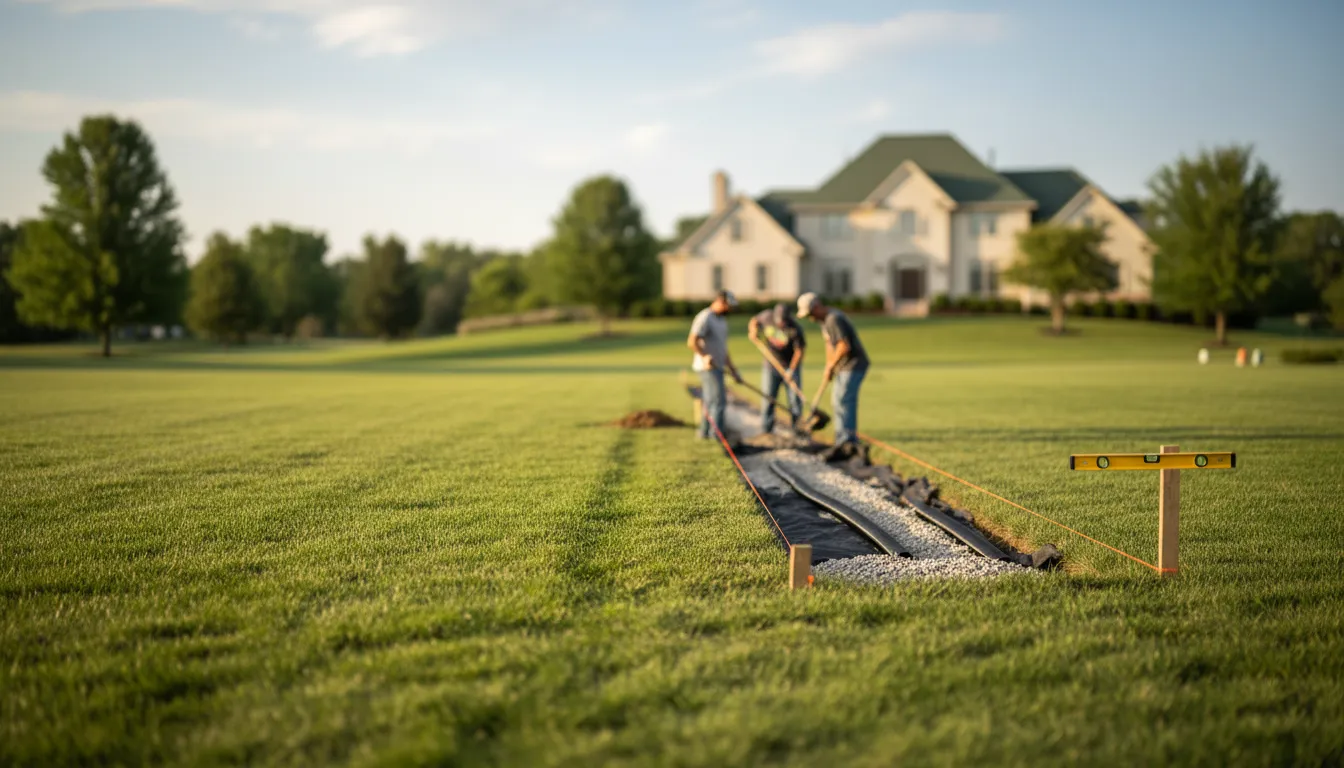
- French Drains: A perforated pipe buried in a gravel-filled trench. The pipe collects groundwater and excess sub-surface moisture, channeling it away from problem areas like a perpetually wet section of lawn or a foundation footer.
- Foundation Drains: Often installed during home construction, these are perforated pipes placed at the base of the foundation footing to collect water and direct it to a sump pump or daylight outlet.
Water Capture and Infiltration Systems
These eco-friendly solutions manage runoff by holding it and letting it soak into the ground.
- Rain Gardens: A depressed landscape area planted with native, water-tolerant plants. It collects runoff from roofs or driveways, allows it to pond temporarily, and filters it as it slowly infiltrates the soil. Rain gardens are a recommended Best Management Practice (BMP) that can reduce stormwater volume and improve water quality.
- Dry Wells: Underground chambers filled with gravel or rubble that collect downspout or surface water and allow it to percolate slowly into the surrounding soil.
- Rain Barrels: A simple way to intercept roof runoff at a downspout. Stored water can then be used for irrigation, reducing the volume of water discharged near your foundation.
Find the perfect yard drainage contractors for your needs
Get personalized recommendations and expert advice
Stormwater Best Management Practices (BMPs)
Illinois municipalities and environmental agencies promote BMPs, which are techniques to manage stormwater runoff in a more sustainable, natural way. Integrating these into your landscape plan can enhance your property's drainage and environmental health 3 4 5.
- Reduce Impervious Surfaces: Replace solid concrete or asphalt with permeable pavers, gravel, or other porous materials for walkways, patios, and driveways to allow water to infiltrate.
- Plant Native Vegetation: Native grasses, perennials, and shrubs typically have deeper root systems than turf grass. These roots create channels in the soil, improving its structure and ability to absorb water 6.
- Use Mulch and Organic Matter: Adding compost and mulch to garden beds increases soil organic matter, which improves water retention and infiltration rates.
- Create a "Conservation" Landscape: Design your yard to function more like a natural prairie, with diverse plantings that capture rainfall and reduce runoff volume and velocity.
Climate and Soil Considerations
Your drainage plan must account for local conditions. Northern Illinois experiences heavy lake-effect snow, while the entire state is prone to spring thunderstorms. The freeze-thaw cycle is particularly damaging; water that pools near foundations can freeze and expand, leading to cracks in concrete and masonry 7. Furthermore, much of Illinois has clay-heavy soil, which has very small pores and drains poorly compared to sandy or loamy soil. This means surface grading and channeling water away are often more effective than relying on quick absorption. A professional will evaluate your soil type and the flow path of water during a storm to recommend the right solution.
Understanding Project Costs
The cost of drainage and grading work varies significantly based on the solution's complexity, the size of your property, and the extent of the problem. Here is a general range for common projects in Illinois, though obtaining multiple local estimates is crucial 8 9 10.
- Basic Regrading & Downspout Management: Correcting slope and adding downspout extensions typically ranges from $500 to $2,000+.
- Rain Garden Installation: Creating a functional rain garden, including excavation, soil amendment, and plants, can cost between $500 and $3,000+.
- French Drain or Catch Basin System: Installing a subsurface drainage system involving trenching, pipe, and gravel usually falls in the range of $1,500 to $5,000+.
- Terracing or Major Earthwork: For properties with severe slope issues requiring retaining walls or significant reshaping, costs can range from $2,000 to $10,000 or more.