Find the Best Yard Drainage Contractors for Your Business
No obligation • Fast responses • Nationwide coverage

Why you can trust Landscape Atlas
Landscape Atlas is a leading United States resource for evaluating landscaping, lawn care, and outdoor service providers. Our team researches each category in depth, focusing on service quality, safety, and customer experience. Listings and rankings are based on independent criteria and user feedback, and companies cannot pay to influence our assessments or recommendations.
Search providers near you
Best Yard Drainage Contractors in South Dakota Ranked
Effective yard drainage and grading are essential for protecting your South Dakota home from water damage. The state's unique climate, with its intense summer storms, heavy snowmelt, and dramatic freeze-thaw cycles, makes managing surface and groundwater a critical part of property maintenance. This guide will help you understand the common water management challenges in South Dakota, explore proven solutions, and connect with local expertise to keep your foundation secure and your landscape healthy.
Why Drainage is Critical in South Dakota
South Dakota's weather patterns create specific and severe challenges for residential properties. Without a proper plan, homeowners risk significant damage to their home's structure and their landscape's integrity.
- Freeze-Thaw Cycles: When poor drainage allows water to saturate the soil near your foundation, it can freeze during the cold South Dakota winters. Water expands as it freezes, creating pressure that can lead to cracks in foundation walls and basement floors. Proper grading and drainage prevent this saturation in the first place.
- Heavy Rain and Snowmelt: Intense summer thunderstorms can drop large volumes of water in a short time. Similarly, the rapid spring melt of significant winter snowpack generates a massive, concentrated flow of water. Both scenarios require a robust system to move water away from your home quickly to prevent flooding and erosion.
- Soil Composition: Soil types vary across the state, from heavy clay to sandy loam. Clay soils absorb water slowly and drain poorly, often leading to standing water. Sandy soils drain quickly but can be prone to erosion during heavy flows. Any effective drainage solution must be tailored to your property's specific soil conditions 1.
Core Principles of Effective Yard Grading
Grading-shaping the slope of your land-is the first and most fundamental line of defense against water intrusion. It's often the most cost-effective solution when done correctly.
The gold standard is to slope the soil away from your foundation at a minimum grade of 2%. This means the ground should drop at least 2 feet for every 100 feet of horizontal distance. In many cases, this involves bringing in quality topsoil to build up the grade around your home's perimeter, ensuring water naturally flows away rather than pooling against the foundation.
For properties with more challenging topography, swales or diversion channels are highly effective. These are broad, shallow ditches lined with grass or other vegetation. They are designed to intercept surface runoff and gently guide it to a safe discharge point, such as a street gutter, a dry well, or a wooded area on your property, preventing it from ever reaching your home.
Common Drainage Solutions for South Dakota Homes
When grading alone isn't enough, or when dealing with persistent groundwater issues, installing a dedicated drainage system is the next step. Here are the most reliable methods used by professionals across the state.
French Drains (Subsurface Drainage)
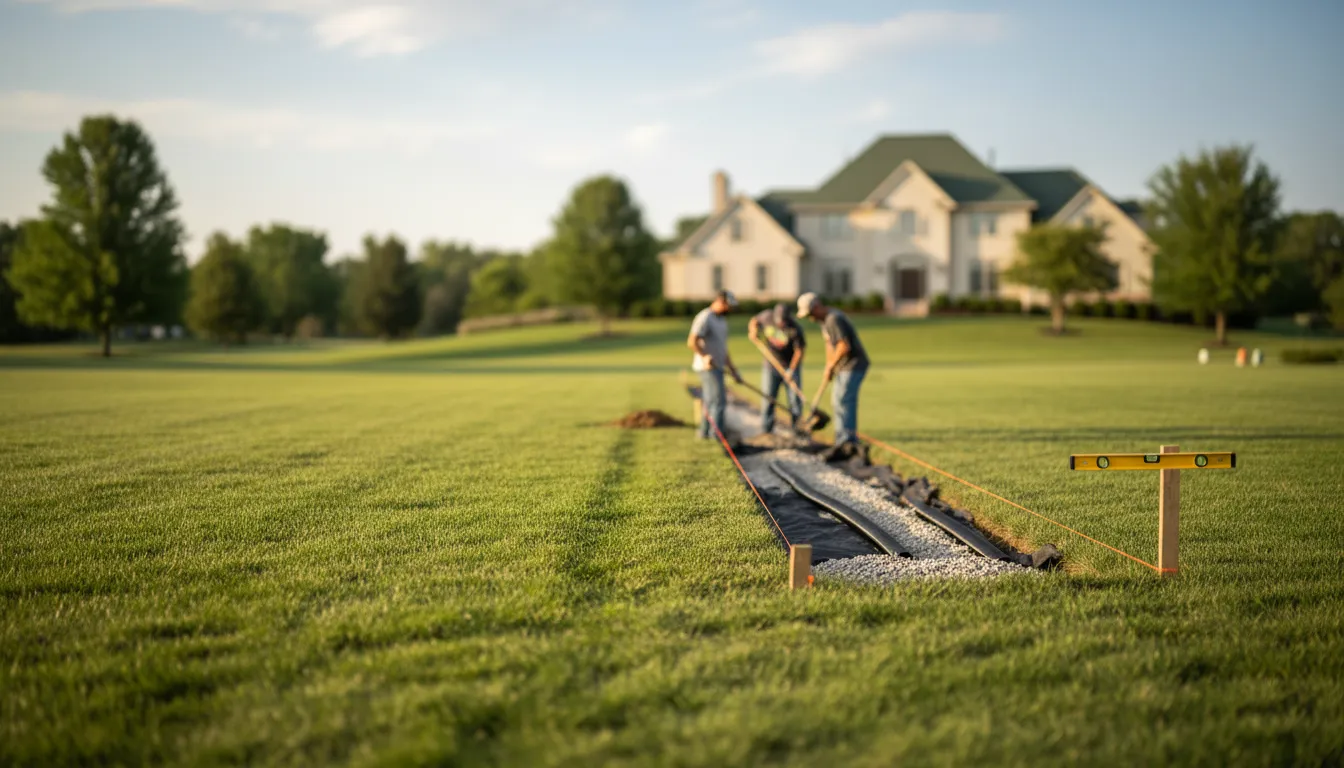
A French drain is a trench filled with gravel and containing a perforated pipe. It's designed to collect groundwater and subsurface water, channeling it away from problem areas. This is an excellent solution for yards with soggy low spots, persistent dampness near a foundation, or where the water table is high. The pipe is sloped to carry water to a daylight outlet or a dry well.
Catch Basins and Surface Drain Systems
For managing large volumes of surface water from driveways, patios, or low-lying lawns, catch basins are ideal. These are grates installed at the lowest point of an area, connected to a solid pipe that carries the water underground to a suitable discharge location. They are crucial for capturing stormwater before it can flood a basement walk-out or garage.
Rain Gardens and Bio-Swales
For an eco-friendly solution that also manages runoff, consider a rain garden. This is a landscaped depression planted with native, water-tolerant plants. It is designed to collect runoff from roofs or driveways, allowing it to slowly infiltrate the soil while being filtered by the plant roots. Rain gardens reduce the total volume of runoff, filter pollutants, and add beautiful landscaping to your yard 2. They are particularly encouraged in municipal guidelines as a best management practice.
Downspout Management and Dry Wells
Your roof collects a tremendous amount of water. Simply extending your downspouts at least 5 to 10 feet away from your foundation is a low-cost, high-impact upgrade. For even better management, downspouts can be connected to underground pipes that lead to a dry well-a buried pit filled with gravel that allows water to slowly percolate into the surrounding soil, eliminating surface discharge entirely.
Find the perfect yard drainage contractors for your needs
Get personalized recommendations and expert advice
Understanding Costs and Professional Installation
The cost of solving a drainage problem in South Dakota varies widely based on the solution's complexity, the size of your property, and the materials required.
- DIY Grading: Adding soil and re-grading a small area yourself might cost $50-$300 for materials.
- Professional Grading: Hiring a professional for regrading a typical residential yard can range from $400 to over $1,500, depending on the machinery needed and the amount of soil moved 3.
- French Drain Installation: As a more involved subsurface solution, a professionally installed French drain typically costs between $1,000 and $4,000+, factoring in labor, pipe, gravel, and excavation 4.
- Catch Basin System: Installing a catch basin with connecting pipe can cost $500 to $1,500 or more, based on depth and pipe run length 5.
- Rain Garden: Creating a rain garden is often less expensive for materials ($300 - $1,000+) but requires careful planning and planting. Professional design and installation ensure it functions correctly 6.
Crucial Note: These are estimated price ranges. The only way to get an accurate cost for your specific situation is to obtain a detailed quote from a qualified local professional. They can assess your property's unique slope, soil, and water flow patterns.
Navigating Local Regulations
Before beginning any significant drainage project, it's important to check with your local municipality. Cities like Brookings and Sturgis have specific stormwater management criteria and best practice manuals designed to protect the community's infrastructure and waterways 7 8. For example, you may need a permit to connect to a municipal storm sewer, or there may be rules about where you can discharge water onto adjacent properties or streets. The South Dakota Department of Transportation also provides guidelines on storm drainage systems that can inform residential projects near roadways 9. A local professional will be familiar with these codes and can ensure your project is compliant.
Maintaining Your Drainage System
A drainage system is an investment that requires occasional maintenance to function at its best. Regularly inspect and clear debris from catch basin grates, especially after fall leaf drop and spring storms. Ensure downspout extensions are securely attached and not blocked. Check the outlets of French drains or pipe systems to make sure they are not clogged with sediment or overgrown with vegetation. A simple annual check can prevent small problems from turning into major backups and costly repairs.
Frequently asked questions
Sources
Footnotes
-
The Crucial Role of Drainage in Protecting Your Home's Foundation - https://www.frontierbasementsystems.com/about-us/blogs/50275-the-crucial-role-of-drainage-in-protecting-your-homes-foundation.html ↩
-
Urbanization and Stormwater Runoff | US EPA - https://www.epa.gov/sourcewaterprotection/urbanization-and-stormwater-runoff ↩
-
Foundation Drainage - https://cms9files.revize.com/marshallmn/_Departments/Community%20Planning/Foundation%20Drainage%20-%208-9-21.pdf ↩
-
11 Tips to Handle Stormwater Drainage on Slopes - Valor - https://www.valorenv.com/11-tips-to-handle-stormwater-drainage-on-slopes/ ↩
-
Yard Drainage Solutions for Your Landscape Design • North Coral ... - https://northcorallandscaping.com/yard-drainage-solutions-for-your-landscape-design/ ↩
-
10 Things You Can Do to Prevent Stormwater Runoff Pollution - https://www.farmington-ct.org/departments/engineering/stormwater/10-things-to-prevent-stormwater-pollution ↩
-
Stormwater Best Management Practices (BMPs) for Sturgis, SD - https://www.sturgis-sd.gov/media/Engineering/Stormwater/Sturgis%20Stormwater%20BMP%20Manual.pdf ↩
-
Storm Drainage Design and Technical Criteria Manual City of ... - https://www.cityofbrookings-sd.gov/DocumentCenter/View/305/Storm-Drainage-Design-and-Technical-Criteria-Manu?bidId= ↩
-
Chapter 12 STORM DRAINAGE SYSTEMS | DOT.SD.gov. - https://dot.sd.gov/media/7f0dd601/Chapter%2012-Storm%20Drainage%20Systems.pdf ↩