Find the Best Yard Drainage Contractors for Your Business
No obligation • Fast responses • Nationwide coverage

Why you can trust Landscape Atlas
Landscape Atlas is a leading United States resource for evaluating landscaping, lawn care, and outdoor service providers. Our team researches each category in depth, focusing on service quality, safety, and customer experience. Listings and rankings are based on independent criteria and user feedback, and companies cannot pay to influence our assessments or recommendations.
Search providers near you
Best Yard Drainage Contractors in Iowa Ranked
Managing water on your property is a critical part of homeownership in Iowa. Heavy rains and intense storms can quickly lead to soggy lawns, flooded gardens, and, most concerningly, water damage to your home's foundation. Effective yard drainage and proper land grading are the first lines of defense, directing water away from your house and into areas where it can be safely absorbed or channeled. This guide explains the core principles of residential water management in Iowa, outlines the most effective solutions for local conditions, and helps you understand how to connect with skilled professionals who can assess your property and implement a lasting fix.
Why Iowa Properties Need Specialized Drainage Solutions
Iowa's climate presents unique challenges for property owners. The state experiences periods of intense rainfall and thunderstorms that can deposit large volumes of water in a short time. Without a proper plan, this water has nowhere to go, leading to pooling, erosion, and the risk of basement flooding. Furthermore, Iowa's soil types vary significantly in their ability to absorb water (infiltration rates). Some clay-heavy soils drain poorly, causing surface water to sit, while sandier soils may allow water to pass through more easily. A successful drainage strategy must account for both the volume of water from heavy precipitation and the specific absorption characteristics of your soil to protect your foundation.
Core Principles: Grading and Sloping
The most fundamental and critical aspect of any drainage plan is the grading of your land. Proper grading ensures the ground slopes away from your home's foundation, creating a natural path for water to follow.
- The Golden Rule: The standard recommendation is a slope of at least 6 inches of fall for every 10 feet of horizontal distance away from your foundation. This positive grade is your primary defense against water intrusion.
- Inspection: Regularly check the grade around your home, especially after heavy rains or seasonal ground settling. Look for areas where water pools or where the ground appears to be sloping back toward the house.
- Professional Grading: Correcting poor grading often involves bringing in fill dirt, compacting it, and carefully sculpting the landscape to achieve the correct slope. This work typically ranges from $500 to over $2,000, depending on the size of the area and the amount of earth that needs to be moved 1.
Effective Drainage Systems for Iowa Homes
When grading alone isn't enough, or to handle water from specific problem areas, integrating dedicated drainage systems is the next step. Here are the most effective options suited to Iowa's environment.
1. French Drains and Catch Basins
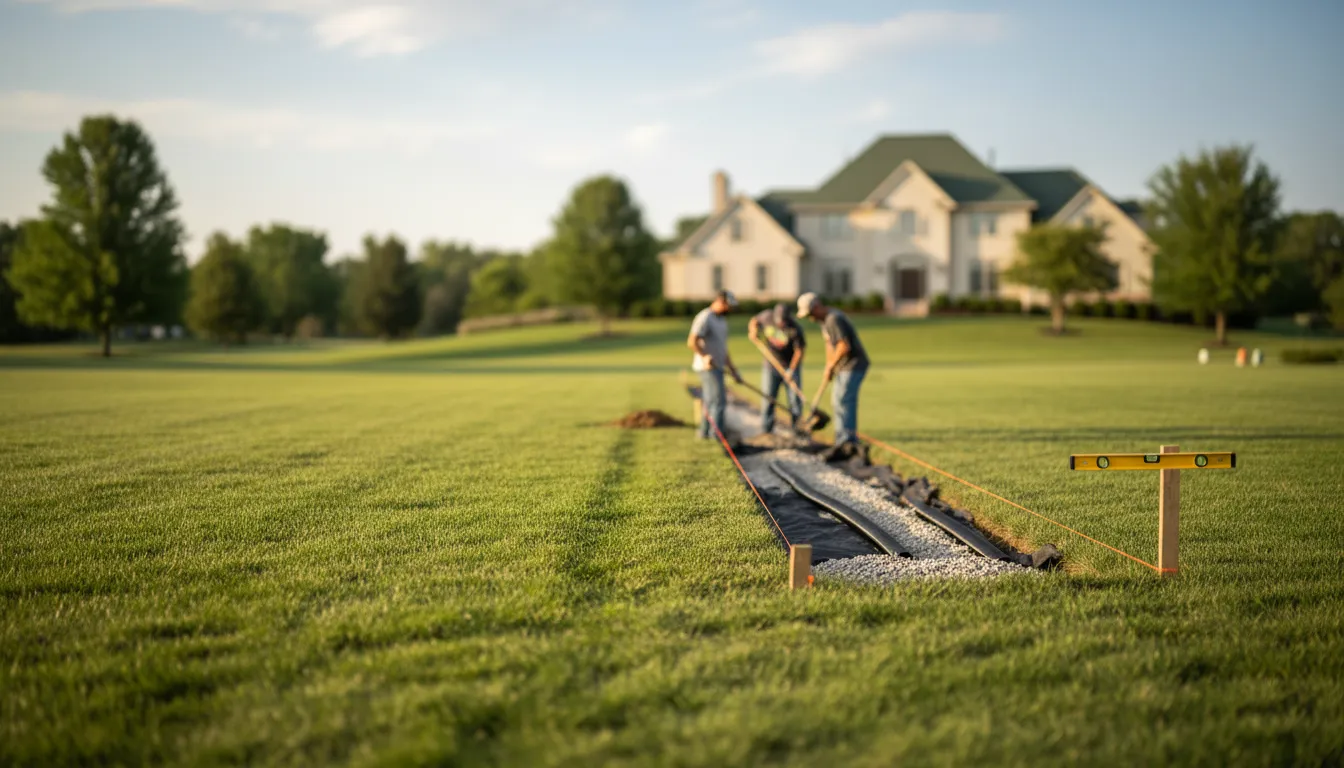
For persistent soggy spots or to manage subsurface water, a French drain is a reliable solution. It consists of a perforated pipe buried in a gravel-filled trench. The pipe collects water and redirects it to a safer discharge point, like a storm drain or a dry well 2. Catch basins are often used in conjunction, acting as an entry point to collect surface water from downspouts or low spots before it enters the pipe system 3. These piped solutions are particularly crucial for handling concentrated flow from heavy rains 4. Installation for a French drain or catch basin system is more involved, with costs typically ranging from $1,000 to $4,000 or more, depending on length and complexity 2 3.
2. Rain Gardens and Bioswales
These are "green infrastructure" solutions that manage water beautifully and ecologically. A rain garden is a shallow, planted depression designed to capture runoff from roofs or paved areas and allow it to soak into the ground over 24-48 hours 5. They are ideal for the end of a downspout. For Iowa, using deep-rooted native prairie plants is key, as they absorb significant water and are adapted to local weather extremes 6 7. A swale is a broader, vegetated channel that gently guides water across a property. Both methods reduce runoff volume and filter pollutants. A DIY rain garden can be a relatively inexpensive project (a few hundred dollars for plants and soil), but professional design ensures proper sizing and overflow routing away from structures 5.
3. Dry Wells and Permeable Pavement
A dry well is an underground structure that stores stormwater runoff and allows it to percolate slowly into the surrounding soil 8. It's often the endpoint for a French drain or downspout leader. Permeable pavement, such as porous pavers or gravel systems, is an excellent choice for patios, walkways, or driveways. It lets rainwater pass through the surface into a stone reservoir below, drastically reducing surface runoff from your property 8. While the upfront material cost is higher than traditional pavement, it provides a significant drainage benefit.
Find the perfect yard drainage contractors for your needs
Get personalized recommendations and expert advice
4. Downspout Management and Simple Tips
Never underestimate the power of managing your roof runoff. This is often the largest source of water hitting your property.
- Ensure downspouts extend at least 5-10 feet away from your foundation.
- Use splash blocks or buried downspout extensions to direct water onto vegetated areas or into a drain line.
- Consider installing rain barrels to capture water for later use in gardens, which also reduces the immediate volume of runoff.
Choosing the Right Solution for Your Property
There is no one-size-fits-all answer. The best approach often combines several methods. A professional assessment will consider:
- The Source: Where is the water coming from? (Roof, neighboring property, a natural spring?)
- The Problem Area: Where is it pooling or causing damage?
- The Exit Point: Where can the water be safely sent? (Municipal storm sewer, a dry well, a lower wooded area?)
- Soil and Landscape: What is your soil type, and what are the existing features of your yard?
A qualified contractor will evaluate these factors and design a system that may include regrading, a French drain to handle a wet corner, and a rain garden to beautify a downspout discharge area.
Maintaining Your Drainage System
Like any part of your home, drainage systems need occasional maintenance to function properly.
- Keep it Clear: Regularly remove leaves, silt, and debris from catch basin grates, gutter guards, and the openings of any drains.
- Inspect Grading: Check your slopes each season for erosion or settling.
- Check Downspouts: Ensure extensions are intact and not clogged.
- Rain Garden Care: Weed and occasionally replenish mulch in rain gardens to maintain their absorption capacity.
Investing in proper yard drainage and grading is an investment in the long-term health and value of your Iowa home. It prevents costly structural repairs, reduces mosquito breeding grounds, and can transform a unusable muddy yard into a beautiful, functional outdoor space.
Frequently asked questions
Sources
Footnotes
-
Land Grading Services | Des Moines, IA - https://www.supremelawnandlandscape.com/grading-services ↩
-
12 Residential Backyard Drainage Solutions - Protect Your Yard - https://wilsonslawncare.com/12-residential-backyard-drainage-solutions/2024/ ↩ ↩2
-
Surface Drainage Systems | Serving Iowa - WCI Basement Repair - https://www.wcibasementrepair.com/surface-drainage.html ↩ ↩2
-
STORMWATER - https://www.waukee.org/DocumentCenter/View/10345/Stormwater-Grant-Brochure- ↩
-
Iowa Rain Garden Design & Installation Guide - https://iowastormwater.org/wp-content/uploads/Iowa-Rain-Garden-Design-and-Installation-Guide-Third-Edition-Web-March-2021.pdf ↩ ↩2
-
Rainscaping Practices - The Rain Campaign - https://raincampaign.org/rainscaping-practices/ ↩
-
Stormwater Management Considerations - Brown Deer Golf Club - https://browndeergolf.org/DocumentCenter/View/5603 ↩
-
Stormwater Best Management Practices - https://spcwater.org/topics/stormwater-management/stormwater-best-management-practices-2/ ↩ ↩2