Find the Best Yard Drainage Contractors for Your Business
No obligation • Fast responses • Nationwide coverage

Why you can trust Landscape Atlas
Landscape Atlas is a leading United States resource for evaluating landscaping, lawn care, and outdoor service providers. Our team researches each category in depth, focusing on service quality, safety, and customer experience. Listings and rankings are based on independent criteria and user feedback, and companies cannot pay to influence our assessments or recommendations.
Search providers near you
Best Yard Drainage Contractors in Oregon Ranked
Proper yard drainage and grading are essential for protecting your home's foundation, preventing basement flooding, and managing Oregon's diverse rainfall. Effective systems direct water away from structures and use the landscape to absorb and filter stormwater, aligning with the state's emphasis on sustainable, low-impact development. This guide explains the key principles, common solutions, and climate-specific considerations to help you understand your options and connect with qualified local professionals for your project.
HD Landscape and Maintenance
Portland, OR
HD Landscape and Maintenance is a landscaping and maintenance company serving Portland, OR, and the surrounding metropolitan area. They offer a wide range of services including lawn care, sod and artificial turf installation, fence installation, landscape lighting, landscape design, tree services, yard drainage, hardscaping, and seasonal maintenance. Their work covers residential and commercial properties across Multnomah, Washington, and Clackamas counties. The company emphasizes sustainable landscaping practices using native plants and eco-friendly materials. They are fully licensed and insured, with experience handling projects from initial design to completion, including specialized capabilities like storm damage restoration and smart drainage systems.
Simple Lawns Landscape Design
9707 NE 54th St #C, Vancouver, WA 98662
Simple Lawns Landscape Design is a family-owned landscaping and lawn care company serving Portland, OR. They provide a full range of services including lawn mowing, fertilization, weed control, landscape design, yard drainage, sprinkler installation and repair, and hardscaping such as pavers and retaining walls. With over 20 years of experience, they focus on durable outdoor solutions backed by a 5-year warranty on hardscaping. Their team includes trained installers who stay current with landscaping techniques to ensure quality results.
Lawn & Irrigation Technologies NW
2900 SE Cornelius Pass Rd Ste 336, Hillsboro, OR 97123
Lawn & Irrigation Technologies NW is a landscaping and irrigation contractor based in Portland, OR, serving the Washington County area for over 30 years. They offer a wide range of services including irrigation system installation and repair, sod installation, landscape lighting, paver installation, yard drainage solutions, and lawn fertilization. Their team is known for using water-efficient irrigation products and providing NDS-certified drainage solutions to enhance outdoor spaces while promoting environmental stewardship.
Danshap Landscaping and Excavation inc.
7800 NE 103rd Ave, Vancouver, WA 98662
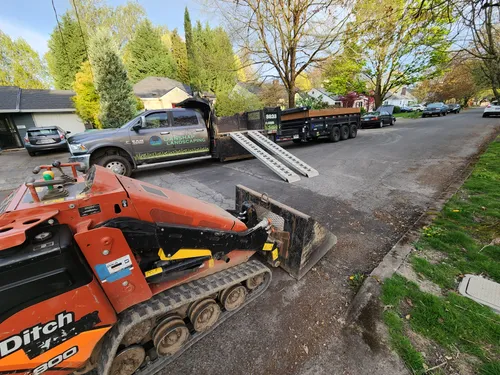
Danshap Landscaping and Excavation Inc. is a licensed, bonded, and insured landscaping company serving Portland, OR, and the surrounding areas. They offer a wide range of services including sod installation, landscape design, tree removal, stump grinding, yard drainage, grading, land clearing, brush removal, and general lawn care. The company is equipped to handle both residential and commercial projects, with capabilities such as grading and re-sloping yards to improve drainage and appearance. Danshap Landscaping is locally owned and operated, with a strong focus on customer satisfaction and quality workmanship.
Wyeast Gardens, LLC
23202 SE Hoffmeister Rd, Damascus, OR 97089
Wyeast Gardens, LLC is a full-service landscaping company based in Portland, OR, offering landscape design, irrigation installation and repair, yard drainage solutions, and hardscaping services. Serving commercial, residential, industrial, and governmental clients, they specialize in efficient irrigation systems and sustainable water management to enhance outdoor spaces. Established in 1994, Wyeast Gardens brings over 25 years of experience, including work with national cemeteries and VA hospitals, and provides skilled masonry and landscape construction services.
Why Drainage is Critical in Oregon
Water is the most common cause of foundation problems and basement moisture issues in homes. In Oregon, where precipitation patterns vary dramatically from the coast to the high desert, a one-size-fits-all approach doesn't work. A well-designed drainage plan manages water flow to prevent erosion, protect landscaping, and reduce the risk of soil saturation near your home's footings. Investing in proper grading and drainage safeguards your property's value and prevents costly structural repairs down the line.
The state, and particularly municipalities in the wetter Willamette Valley, strongly encourage Low-Impact Development (LID) strategies. The core idea is to manage rainwater where it falls, reducing runoff into municipal storm sewers, filtering pollutants, and recharging groundwater. This means solutions often integrate functional landscaping, like rain gardens, into the overall drainage plan.
Core Principles: Grading and Foundation Protection
The first and most fundamental rule of any drainage system is proper grading. This refers to the slope of the land around your home.
- The Gold Standard: Soil should be sloped away from your foundation at a minimum grade of 1/4 inch per foot for at least 10 feet. This simple measure is your primary defense against water pooling next to your basement or crawlspace walls.
- Gutter and Downspout Management: Your roof collects a massive amount of water. Gutters and downspouts must be clean and functional. Downspouts should extend at least 5 to 10 feet away from the foundation, discharging onto a splash block or, better yet, into a buried drain pipe that leads to a safe discharge point.
- Site Assessment: Before planning any system, observe your property during a heavy rain. Note where water pools, flows, or runs toward the house. Understanding the natural flow paths is key to an effective design.
Oregon's Climate and Regional Considerations
Your drainage solution should be tailored to your region's specific climate challenges.
Western Oregon (Coastal & Willamette Valley): This region experiences high annual rainfall, with intense, frequent storms common, especially from fall through spring. The focus here is on capacity and conveyance-moving large volumes of water away from structures-and infiltration-soaking it into the ground.
- Priorities: Robust gutter systems, French drains, curtain drains, and solid piping are crucial for moving water. To manage volume and meet LID goals, infiltration features like rain gardens, dry wells, and bioswales are highly recommended 1.
Eastern Oregon (High Desert & Drier Climates): While annual rainfall is lower, storms can be intense and cause significant erosion. The focus shifts toward water conservation and retention.
- Priorities: Rainwater harvesting is extremely valuable. Installing rain barrels or larger cisterns to capture roof runoff for summer irrigation is a smart dual-purpose solution. Grading and swales should be designed to slow water flow, prevent erosion, and allow maximum soil absorption to support landscaping.
Find the perfect yard drainage contractors for your needs
Get personalized recommendations and expert advice
Common Drainage and Grading Solutions
Here are the most frequently implemented systems and features for Oregon properties.
1. Grading and Swales
This is the art of shaping the earth. Regrading involves moving soil to create the proper slope away from foundations. A swale is a broad, shallow, vegetated channel designed to gently guide surface water across your yard to a safe area, like a rain garden or street gutter. It's a natural-looking, effective way to manage overland flow.
2. Subsurface Drains: French Drains and Trench Drains
These workhorses handle water you can't see-saturated soil and high groundwater.
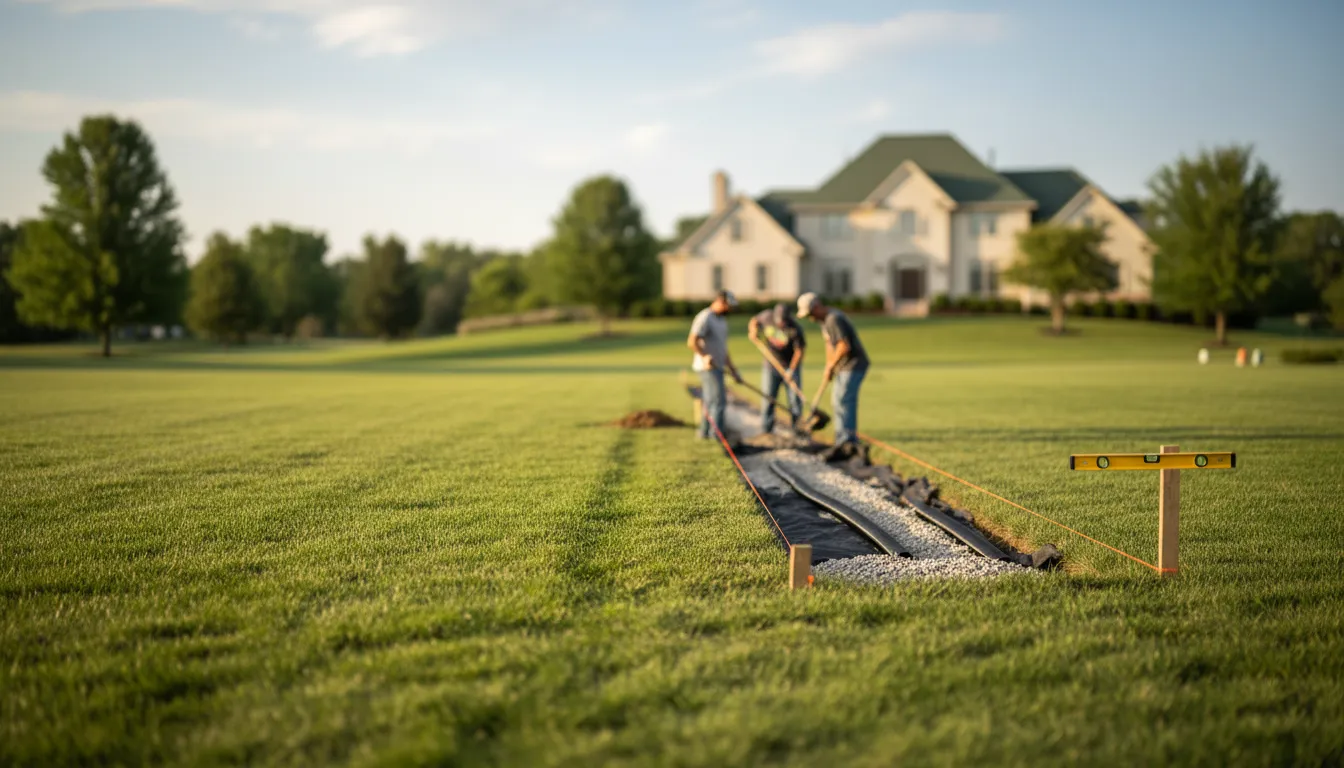
- French Drain: A perforated pipe laid in a gravel-filled trench. It collects subsurface water and redirects it to a daylight (open outlet), dry well, or storm sewer. It's ideal for soggy yards or where water seeps into basements.
- Trench Drain: Often used for surface water on driveways or patios, this is a narrow trench with a grate cover leading to a solid pipe.
3. Low-Impact Development (LID) Features
These sustainable solutions are encouraged by many Oregon city codes.
- Rain Gardens & Bioswales: A depression planted with deep-rooted native plants that collects runoff from roofs or driveways. The soil and plants filter pollutants while the water slowly infiltrates the ground. A bioswale is essentially a linear rain garden within a swale.
- Permeable Pavements: Driveways, walkways, or patios made with special pavers, porous concrete, or reinforced gravel grids that allow water to pass through into a stone base below, where it infiltrates. This drastically reduces runoff from hard surfaces.
- Rain Barrels and Cisterns: Simple systems connected to downspouts that capture roof water for later use in irrigation, combining drainage with water conservation.
4. Dry Wells and Infiltration Trenches
These are underground structures, often large pits filled with gravel or specially designed chambers, that collect water from drain pipes and allow it to slowly percolate into the surrounding soil. They are a final infiltration step for water collected from roofs and drains.
Understanding Project Scope and Investment
The cost of drainage work varies tremendously based on the size of your property, the complexity of the problem, the solutions chosen, and labor costs. Here is a general summary of potential investments based on common project types 2:
- Minor Regrading/Slope Correction: For adjusting soil around a foundation or correcting a small area, costs might range from $500 to $2,000.
- French Drain Installation: Typically priced per linear foot, including trenching, pipe, gravel, and labor. Costs can range from $20 to $50 or more per foot, with a typical residential project costing several thousand dollars.
- Rain Garden Installation: Costs depend on size, soil amendments, and plants. A residential-scale rain garden may range from $500 for a small DIY-assisted project to $3,000+ for a large, professionally designed and installed feature.
- Permeable Pavers: Material and installation costs are higher than standard pavers. Expect a range of $10 to $30 or more per square foot.
For precise budgeting, obtain multiple quotes from licensed landscape contractors or drainage specialists who can assess your specific site.
Regulations and Professional Guidance
Before starting any significant drainage project:
- Call Before You Dig: Always dial 811 to have underground utilities marked.
- Check Local Codes: Contact your city's Engineering, Public Works, or Planning Department. They can inform you of required permits, any restrictions on discharging water to streets or storm sewers, and local LID incentives or requirements 3 4.
- Hire Qualified Professionals: Look for licensed landscape contractors, civil engineers, or specialists in drainage and excavation. They can perform a proper site evaluation, design an effective system, and ensure it's built to last.
Frequently asked questions
Sources
Footnotes
-
Stormwater - | YourHome - https://www.yourhome.gov.au/water/stormwater ↩
-
Stormwater Best Management Practices - https://spcwater.org/topics/stormwater-management/stormwater-best-management-practices-2/ ↩
-
Stormwater Management Manual - Portland.gov - https://www.portland.gov/sites/default/files/2018-11/Stormwater%20Management%20Manual%20%282016%29%20-20160819.pdf ↩
-
Stormwater & Grading Design Standards - Oregon City, OR - https://www.orcity.org/1227/Stormwater-Grading-Design-Standards ↩