Find the Best Yard Drainage Contractors for Your Business
No obligation • Fast responses • Nationwide coverage

Why you can trust Landscape Atlas
Landscape Atlas is a leading United States resource for evaluating landscaping, lawn care, and outdoor service providers. Our team researches each category in depth, focusing on service quality, safety, and customer experience. Listings and rankings are based on independent criteria and user feedback, and companies cannot pay to influence our assessments or recommendations.
Search providers near you
Best Yard Drainage Contractors in Connecticut Ranked
Proper yard drainage and grading are essential for protecting your Connecticut home from water damage. These systems manage stormwater runoff, directing it safely away from your foundation to prevent basement flooding, soil erosion, and structural issues. With the state's variable soils and increasingly intense rainfall, a well-designed drainage plan is a critical investment in your property's longevity and value. This guide explains the key principles, common solutions, and considerations for effective water management on your land, helping you understand your options and connect with qualified local professionals.
Why Drainage is Critical in Connecticut
Connecticut's climate and geology present unique challenges for property owners. The state is experiencing heavier and less predictable rainfall due to climate change, leading to rapid runoff that can overwhelm simple gutters and saturate soil quickly 1. This increased volume of water must be managed effectively to prevent erosion, landscape damage, and basement flooding.
Furthermore, soil types vary significantly across the state. Heavy clay soils, common in many areas, have poor infiltration rates, meaning water pools on the surface and requires more robust diversion systems 2. In contrast, sandy soils drain faster but can become saturated at lower depths, sometimes necessitating deeper collection systems. The universal goal, regardless of soil type, is foundation protection. This is achieved by ensuring positive grading-a slope of 2-5% away from the house-and managing roof runoff effectively to keep the ground around your foundation dry 3 2.
Core Principles of Effective Water Management
Before exploring specific solutions, it's important to understand the foundational strategies that guide all effective drainage work. These principles are often combined for a comprehensive approach.
- Source Control: The best strategy is to prevent water from becoming a problem in the first place. This includes maintaining gutters and downspouts, using permeable surfaces, and directing water at its point of origin.
- Slow It Down: Slowing the flow of runoff reduces its erosive power and allows more time for infiltration into the soil. Swales and rain gardens are excellent for this purpose.
- Spread It Out: Dispersing water over a broad, vegetated area (like a lawn or garden) is preferable to concentrating it in a single channel, which can cause erosion.
- Infiltrate It: Where soil conditions allow, encouraging water to soak into the ground recharges groundwater and reduces the total volume of runoff. Dry wells and permeable pavers facilitate this.
- Convey It Safely: When water must be moved, it should be directed through stable channels (like French drains or properly graded slopes) to a safe discharge point, such as a storm drain or wooded area, in compliance with local regulations.
Common Yard Drainage & Grading Solutions
A range of techniques can be employed to solve water problems, from simple regrading to integrated landscape features. The right choice depends on your specific site conditions, budget, and aesthetic preferences.
1. Grading and Re-Grading
This is the most fundamental solution. Grading involves shaping the soil to create a consistent slope away from your home's foundation. Proper grading ensures surface water flows away from the house rather than toward it. While it may seem simple, effective grading requires an understanding of soil composition and slope stability. Costs for basic regrading can range from $500 to over $2,000, depending on the amount of soil to be moved and site accessibility.
2. French Drains
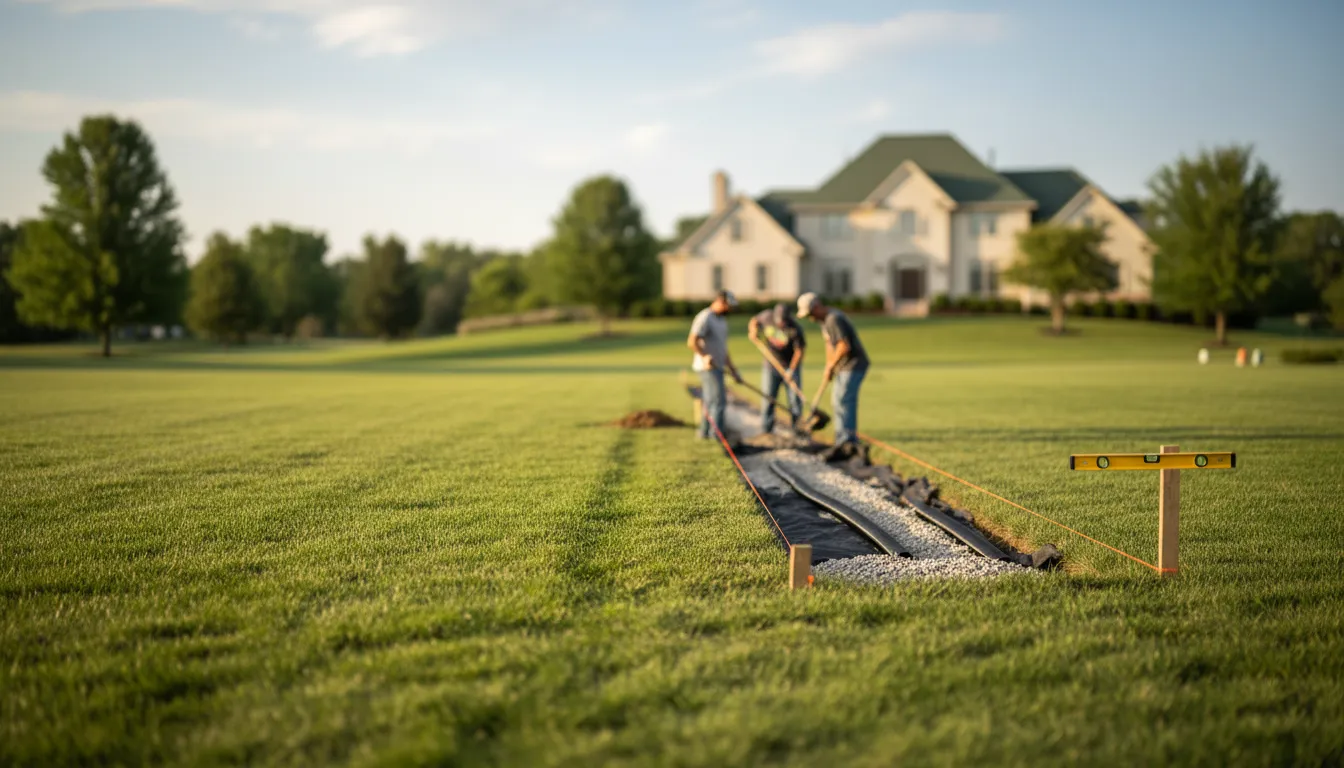
A French drain is a sloped trench filled with gravel or rock containing a perforated pipe. It is wrapped in landscape fabric to prevent soil clogging. This system collects subsurface (ground) water and surface runoff, channeling it away from problem areas. French drains are highly effective for relieving hydrostatic pressure against basement walls and solving soggy yard spots. Installation costs vary widely; a section might cost $500 to $2,500, while a full perimeter system for a home can range from $2,000 to $5,000 or more for complex installations.
3. Swales
Swales are broad, shallow, vegetated channels designed to slow and capture runoff. They are often integrated naturally into the landscape, following the property's contour. Swales not only manage water flow but also help filter out pollutants as water passes through the grass and plants. They are a key feature of many Low Impact Development (LID) strategies promoted for stormwater management in Connecticut.
4. Rain Gardens
A rain garden is a depressed garden bed planted with native shrubs, perennials, and flowers. It is positioned to collect runoff from roofs, driveways, or lawns. The plants and soil filter pollutants, and the depression allows water to pool and slowly infiltrate into the ground. Rain gardens are a beautiful, functional solution that reduces runoff volume and improves water quality. Installed rain gardens typically cost between $500 and $2,000, depending on size and plant selection 4.
5. Catch Basins and Dry Wells
This system captures concentrated water, typically from downspouts. A catch basin (an underground basin with a grate) collects the water, which is then piped to a dry well-a large, underground chamber filled with gravel or a pre-fabricated structure that allows water to slowly percolate into the surrounding soil. This is an excellent solution for properties with poor infiltration where water cannot be safely discharged to the surface.
6. Permeable Pavers and Surfaces
Replacing impervious surfaces like solid concrete driveways or patios with permeable pavers, gravel, or other porous materials allows rainwater to seep through the gaps and into a stone reservoir below, where it gradually infiltrates the soil. This significantly reduces surface runoff. While a larger investment, with permeable paver installations often costing $15 to $30+ per square foot, they are a long-term solution that addresses runoff at its source 5 6.
Find the perfect yard drainage contractors for your needs
Get personalized recommendations and expert advice
Integrating Drainage into Your Landscape Design
Modern drainage solutions don't have to be purely utilitarian. They can be seamlessly integrated into your landscape for both function and beauty. A well-designed swale can be a gentle, grassy valley in your lawn. A rain garden becomes a vibrant habitat for birds and pollinators. Permeable paver patios offer elegant, hardscape surfaces that manage water.
Professional landscape designers or architects can help you incorporate these elements so they enhance your outdoor living space while performing their critical water management role 7. This holistic approach aligns with Connecticut's guidance on using green infrastructure to manage stormwater sustainably.
Working with Professionals in Connecticut
Given the technical aspects of soil science, hydrology, and local regulations, consulting with a professional is highly recommended for anything beyond simple grading or downspout extensions. Look for experienced landscape contractors who specialize in drainage, or for complex issues, a landscape architect or civil engineer. They can:
- Conduct a proper site assessment to diagnose the true source of water problems.
- Design a system that complies with local codes and environmental guidelines.
- Ensure correct installation techniques (like proper pipe slope and fabric wrapping) for long-term functionality.
- Provide solutions that blend effectively with your existing or planned landscape.
Key Takeaway: Protecting your Connecticut home starts at the ground level. Effective yard drainage and grading, tailored to your property's specific conditions, are non-negotiable for foundation health. With the increasing frequency of intense storms, a proactive approach-often incorporating professional design and Low Impact Development (LID) principles-is the wisest course of action.
Frequently asked questions
Sources
Footnotes
-
Local Human Impacts | METEO 3: Introductory Meteorology - https://www.e-education.psu.edu/meteo3/l10_p2.html ↩
-
Stormwater Treatment Practice Design Guidance - UConn - https://ctstormwatermanual-nemo.media.uconn.edu/wp-content/uploads/sites/2584/2018/10/SWQM_Design_GuidanceSmall.pdf ↩ ↩2
-
CONNECTICUT STORMWATER QUALITY mANUAL - CT.gov - https://portal.ct.gov/-/media/deep/water/water_quality_management/guidance/chpt_1213_swm_mar_2024.pdf?rev=6da7e9e3e9364439af4400a84349c572&hash=F5065E140879A254DF8E1E6060585E91 ↩
-
Best Landscape Yard Drainage Solutions in Connecticut - https://www.coastalcreationsct.com/best-landscape-drainage-solutions-in-connecticut/ ↩
-
10 Things You Can Do to Prevent Stormwater Runoff Pollution - https://www.farmington-ct.org/departments/engineering/stormwater/10-things-to-prevent-stormwater-pollution ↩
-
#1 Best Rated Drainage Solutions In Rocky Hill CT | Glastonbury CT - https://www.sceniclandscapingct.com/drainage-solutions/ ↩
-
Landscape Design And Drainage: 7 Functional And Beautiful ... - https://greyrocklandscape.com/landscape-design-and-drainage-7-functional-and-beautiful-approaches/ ↩