Find the Best Yard Drainage Contractors for Your Business
No obligation • Fast responses • Nationwide coverage

Why you can trust Landscape Atlas
Landscape Atlas is a leading United States resource for evaluating landscaping, lawn care, and outdoor service providers. Our team researches each category in depth, focusing on service quality, safety, and customer experience. Listings and rankings are based on independent criteria and user feedback, and companies cannot pay to influence our assessments or recommendations.
Search providers near you
Best Yard Drainage Contractors in Montana Ranked
Proper yard drainage and grading are essential for protecting your Montana property from water damage. The state's unique climate, with heavy snowmelt and freeze-thaw cycles, demands robust solutions to manage surface and subsurface water effectively. This guide will help you understand the common problems, proven solutions, and associated costs, so you can connect with qualified local professionals who can assess your specific needs.
Why Montana Properties Need Specialized Drainage
Montana's environment presents distinct challenges for managing water on your property. The rapid spring thaw, known as snowmelt, can create sudden, large volumes of water that overwhelm inadequate systems 1. Furthermore, the repeated freezing and thawing of the ground can damage improperly installed materials, leading to system failure. Many areas of the state also have dense clay soils, which drain poorly and can lead to persistent standing water, requiring more intensive drainage solutions 1. Effective water management isn't just about a dry lawn; it's about preventing costly foundation cracks, protecting your home's structural integrity, and maintaining a usable outdoor space.
Core Principles of Effective Water Management
Successful drainage in Montana hinges on two main strategies: moving water away from your home's foundation and managing it where it collects. The first line of defense is proper grading. Soil should be sloped at a minimum of 2% (about 1/4 inch per foot) away from your foundation for at least the first ten feet 2. This simple step prevents water from pooling against your basement walls. For water that has already seeped into the ground, subsurface drainage systems like French drains are critical. These systems collect water and redirect it to a safe discharge point. Managing surface water from rain and snowmelt is equally important, using solutions like swales or catch basins to channel runoff before it causes erosion or flooding 3 4.
Common Drainage & Grading Solutions for Montana Homes
Local professionals typically recommend a combination of the following methods, tailored to your property's specific topography and soil conditions.
Regrading and Lawn Leveling
This is often the first and most fundamental fix. By adjusting the slope of your land, contractors can eliminate low spots where water pools and ensure a positive flow away from structures. For minor issues like a small depression, this can be a straightforward process. More significant regrading for an entire yard perimeter is a larger project but provides long-term protection.
French Drain Systems
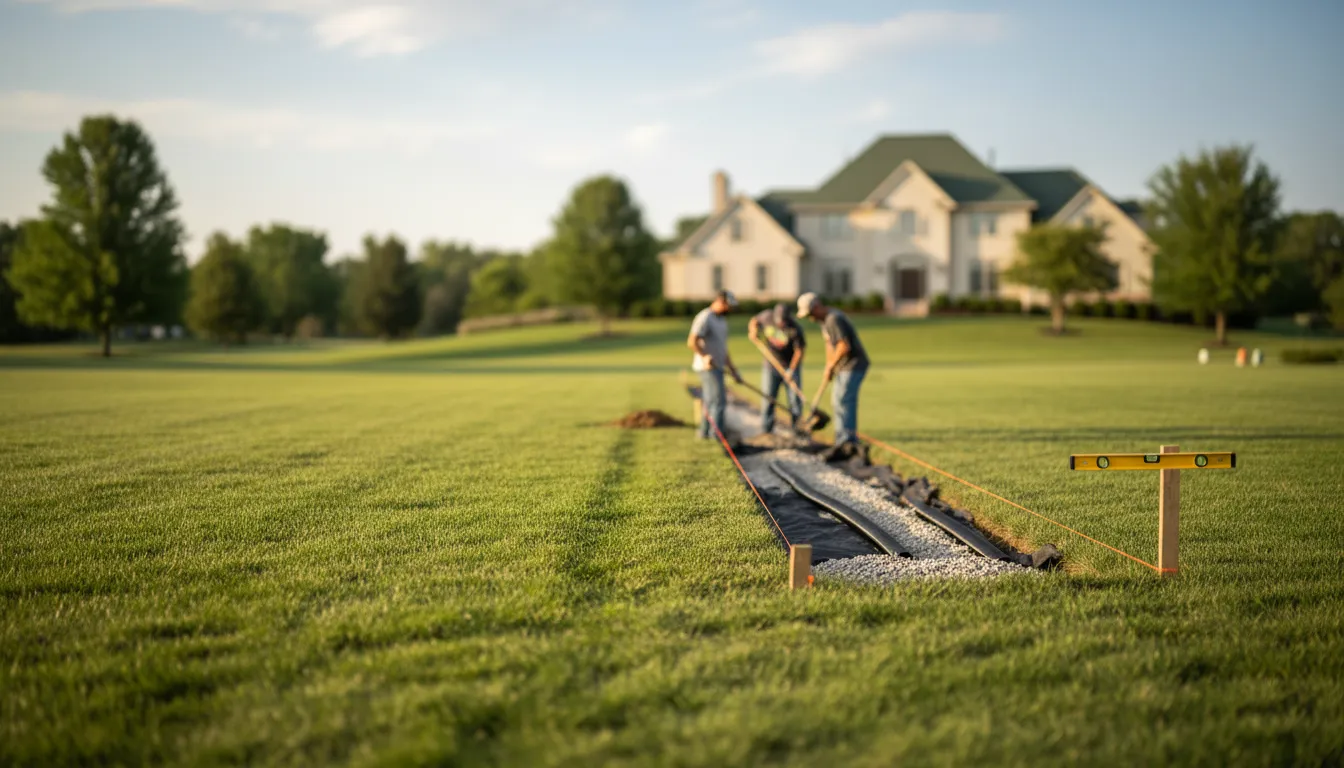
A French drain is a trench filled with gravel and a perforated pipe, wrapped in geotextile fabric. It's designed to intercept and collect groundwater, then channel it away from problem areas. In Montana, these are crucial for dealing with water-saturated clay soils and managing the high water table during spring thaw. They are often installed around foundations, in chronically wet sections of a yard, or at the base of slopes 5.
Surface Drains: Catch Basins and Channel Drains
These solutions tackle water before it soaks in. A catch basin is an underground container with a grate on top, placed in a low spot to collect surface runoff; it connects to a pipe that carries the water away. Channel drains are long, narrow grates often installed across driveways, walkways, or patio edges to intercept sheet flow. Both are excellent for dealing with water from downspouts, driveways, or paved areas.
Dry Wells and Sump Pumps
When you can't easily drain water to a street or storm sewer, a dry well-an underground pit filled with gravel-can store excess water and allow it to percolate slowly into the surrounding soil. For homes with basements experiencing seepage, a sump pump system is vital. It collects water in a pit and automatically pumps it out and away from the home via a discharge pipe.
Swales and Berms
These are landscaped, natural-looking solutions. A swale is a broad, shallow ditch, often grass-lined, designed to guide water across a property. A berm is a raised mound of soil that can divert water flow. These can be integrated beautifully into your landscape while serving an important functional purpose.
Find the perfect yard drainage contractors for your needs
Get personalized recommendations and expert advice
Understanding Costs for Drainage Projects in Montana
The investment for a drainage solution varies widely based on the size of your property, the complexity of the problem, and the materials required. It's important to view this as an investment in protecting your home's value. Here's a general breakdown of what you might expect:
- Minor Grading or Spot Fixes: Correcting a single low spot or improving grade in a small area typically ranges from $500 to $2,000.
- Standard French Drain Installation: For a typical system of 50 to 100 linear feet, including pipe, gravel, fabric, and labor, costs generally fall between $1,000 and $5,000.
- Catch Basin or Surface Drain System: Installing one or multiple basins with connecting piping can cost $2,000 to $8,000, depending on the number of basins and the complexity of the pipe network 6.
- Comprehensive Drainage Overhaul: A whole-property solution combining regrading, multiple French drains, surface drains, and potentially a sump pump can range from $5,000 to $15,000 or more 7 8.
Material Cost Factors
A portion of your project cost will be for materials. Common material costs include:
- Perforated Pipe: $1 to $5 per linear foot.
- Gravel: $30 to $60 per ton.
- Catch Basins: $50 to $500+ each, depending on size and material (plastic or concrete).
- Geotextile Fabric: $0.15 to $0.60 per square foot.
Working with Montana Drainage Professionals
Given the technical and site-specific nature of drainage work, consulting with an experienced local professional is crucial. Look for landscapers or contractors who specialize in drainage and grading. A reputable pro will:
- Conduct a thorough site assessment during a wet period if possible.
- Explain the source of your water problem and propose a tailored solution.
- Provide a detailed written estimate outlining labor, materials, and timeline.
- Be familiar with local codes and Montana DEQ standards for stormwater management, such as those outlined in state guidance documents.
A properly designed and installed drainage system will save you money on potential foundation repairs and preserve the health and beauty of your Montana landscape for years to come.
Frequently asked questions
Sources
Footnotes
-
CIRCULAR DEQ-8 - https://deq.mt.gov/files/Water/Forms/DEQ_8_2024_FINAL_2024_09_20.pdf ↩ ↩2
-
Guide to Lawn Grading: Solving Low Spots and Drainage Issues - https://cclanddesign.com/guide-to-lawn-grading/ ↩
-
Understanding Yard Drainage: French Drains vs. Surface Water ... - https://havenlandscape.design/understanding-yard-drainage-french-drains-vs-surface-water-drainage-and-the-role-of-yard-grading/ ↩
-
Post-Construction Stormwater Control Measures - https://ehs.unc.edu/topics/stormwater/program/post-construction-stormwater-control-measures/ ↩
-
Transform Your Backyard: Expert Drainage & Grading - https://bullmountainlivingllc.com/transform-your-backyard-expert-drainage-grading/ ↩
-
How Much Does Yard Drainage Cost - Alpharetta landscaping - https://www.landscapesandmore.com/blog/how-much-does-yard-drainage-cost/80 ↩
-
Landscape Grading and Drainage Costs - https://www.whiteshovel.com/blog/landscape-grading-and-drainage-costs ↩
-
Understanding the Real Cost of Yard Drainage - A Homeowner's ... - https://www.tlcincorporated.com/understanding-the-real-cost-of-yard-drainage-a-homeowners-guide/ ↩