Find the Best Yard Drainage Contractors for Your Business
No obligation • Fast responses • Nationwide coverage

Why you can trust Landscape Atlas
Landscape Atlas is a leading United States resource for evaluating landscaping, lawn care, and outdoor service providers. Our team researches each category in depth, focusing on service quality, safety, and customer experience. Listings and rankings are based on independent criteria and user feedback, and companies cannot pay to influence our assessments or recommendations.
Search providers near you
Best Yard Drainage Contractors in West Virginia Ranked
Proper yard drainage and grading are essential for protecting your West Virginia property from water damage. The state's hilly terrain and heavy rainfall can lead to significant issues like foundation erosion, basement flooding, and landscape destruction if water isn't managed correctly. This guide explains the core principles of effective stormwater management for your home, outlining common solutions from simple downspout extensions to professional grading projects. You can use this information to understand your property's needs and connect with qualified local professionals who can implement these vital solutions.
Why Drainage is Critical in West Virginia
West Virginia's unique landscape and climate present specific challenges for homeowners. The combination of steep slopes, intense rain events, and common clay soils creates a perfect storm for water-related property damage 1 2. Without a proper plan, stormwater runoff can move with enough force to erode soil, saturate foundations, and overwhelm basic gutters. Managing this runoff isn't just about avoiding puddles; it's about preventing costly structural repairs and protecting your investment. Effective systems direct water away from your home's foundation and safely disperse it into the ground or toward appropriate drainage areas 3.
Core Principles of Effective Drainage
The goal of any residential drainage plan is to control the flow of surface and subsurface water. In West Virginia, this revolves around three key strategies: diverting water away from structures, slowing its flow to prevent erosion, and infiltrating it into the soil where possible.
- Divert: This is your first line of defense. It involves creating positive slope (grading) away from your foundation and ensuring downspouts discharge water several feet away from the house.
- Slow: On sloped properties, slowing water down is crucial. Techniques like swales (shallow ditches) and check dams reduce flow velocity, minimizing erosion and allowing more time for water to soak in.
- Infiltrate: Where soil conditions allow, encouraging water to seep into the ground reduces the total volume of runoff. Rain gardens and permeable paving are excellent for this.
Common Drainage & Grading Solutions for WV Homes
A variety of methods can be combined to create a comprehensive system tailored to your property's specific issues.
1. Grading and Re-Grading
This is the process of shaping the land to control water flow. Proper grading ensures the ground slopes away from your foundation at a minimum of 2% grade (about a 2-inch drop over 8 feet) for at least 6 to 10 feet4 5. For existing homes with negative slope toward the foundation, re-grading by adding and compacting soil is often the most effective permanent solution. On steep lots, grading may involve creating terraced levels or stepped slopes to manage runoff safely6.
2. Downspout and Gutter Management
Your roof collects a massive amount of water. Efficient gutters and downspouts are worthless if they dump water right next to your foundation. Simple, cost-effective improvements include:
- Splash Blocks: Placed at the base of a downspout to deflect water away.
- Downspout Extensions: Attachable pipes (above or below ground) that carry water 5 to 10 feet away from the house.
- Rain Barrels: Collecting rooftop runoff for later use in gardens, which also reduces the immediate volume of water hitting your yard during a storm.
3. Surface Drains and Swales
For managing water that collects on the surface:
- Swales: These are broad, shallow, vegetated channels designed to guide water across your property. They are landscaped to look like a natural depression and are excellent for directing runoff from driveways or hillsides.
- Channel Drains: Often used across driveways or patio entrances, these grated drains collect surface water and pipe it away to a safe discharge point.
4. Subsurface Drainage: French Drains and Dry Wells
When water saturates the soil around your foundation or yard, subsurface solutions are needed.
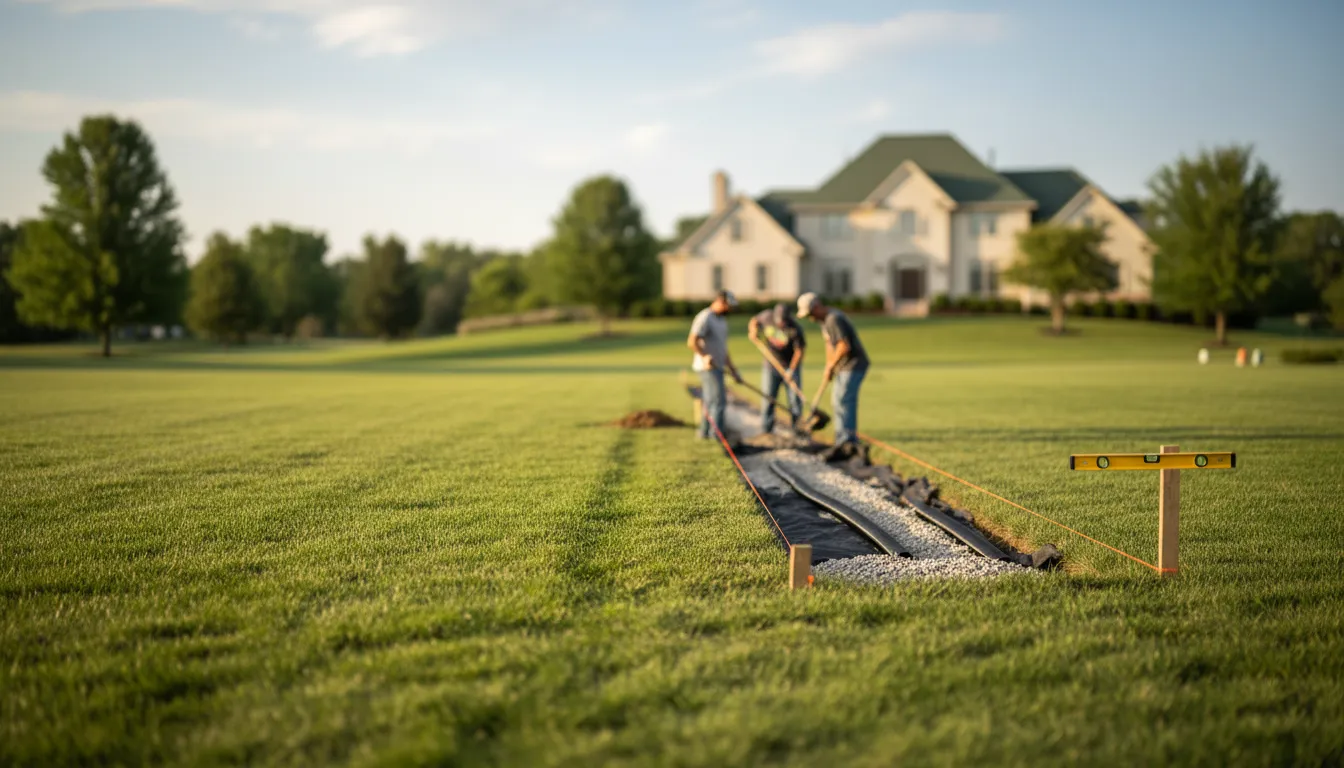
- French Drains: A trench filled with gravel and containing a perforated pipe collects groundwater and redirects it. They are ideal for solving soggy yards or relieving hydrostatic pressure against basement walls7.
- Dry Wells: An underground chamber filled with gravel that collects water from downspouts or drains and allows it to slowly percolate into the surrounding soil. These are useful when there's no convenient downhill discharge point.
5. Stormwater Best Management Practices (BMPs)
These landscape-focused solutions manage runoff in an environmentally friendly way:
- Rain Gardens: A depressed garden area planted with native, water-tolerant plants. It collects runoff from roofs or driveways, allowing it to filter into the ground naturally while removing pollutants.
- Permeable Pavers: For patios, walkways, or driveways, these interlocking pavers allow water to seep through the joints into a gravel base below, reducing runoff from paved surfaces.
Find the perfect yard drainage contractors for your needs
Get personalized recommendations and expert advice
Protecting Your Home's Foundation
Your home's foundation is the most critical area to keep dry. Persistent moisture can lead to cracks, mold, and catastrophic structural failure. Beyond general grading, take these protective steps:
- Regular Inspection: Check your foundation perimeter for signs of pooling water, especially after a heavy rain.
- Gutter Maintenance: Clean gutters and downspouts at least twice a year to prevent overflow that cascades down your walls.
- Seal Cracks: Promptly seal any cracks in your foundation or basement walls with appropriate hydraulic cement or sealants.
- Window Well Covers: Install covers over basement window wells to prevent them from filling with water.
Climate and Terrain Considerations
Designing drainage for West Virginia isn't one-size-fits-all. You must account for local factors:
- Hilly Terrain: Steep slopes increase runoff speed and erosion potential. Solutions often require terracing, stepped grading, or series of swales to break up the water's path.
- Heavy Rainfall Events: The state is prone to intense, short-duration storms. Systems must be designed to handle these peak flows, not just average rainfall. Oversizing pipes and ensuring ample capacity is wise.
- Soil Types: Clay-heavy soils, common in many parts of WV, have very slow infiltration rates. This makes surface drainage (grading, swales) often more effective than relying solely on infiltration-based BMPs like dry wells.
Understanding Costs and Professional Help
The cost of solving drainage problems varies dramatically based on the scale and solutions required. Here are some estimated price ranges based on common projects 8 9:
- DIY Solutions: Downspout extensions ($20 - $100 each) or a rain barrel system ($50 - $200) are affordable starting points.
- Professional Grading: Regrading a yard to fix slope issues can range from $500 to $2,000 or more, depending on the machinery needed and amount of soil moved.
- French Drain Installation: A professionally installed French drain system typically costs between $1,000 and $4,000+, influenced by length, depth, and complexity.
- Rain Garden Installation: Having a rain garden professionally designed and installed may cost $300 to $1,500, varying with size and plant selection.
For complex issues involving foundation protection, significant regrading, or subsurface drainage, hiring a professional is strongly recommended. Look for experienced contractors specializing in landscaping, excavation, or foundation waterproofing who understand local codes and the West Virginia landscape.
Frequently asked questions
Sources
Footnotes
-
Local Human Impacts | METEO 3: Introductory Meteorology - https://www.e-education.psu.edu/meteo3/l10_p2.html ↩
-
🥇 Landscape Yards | J-Drain Landscape Solutions - https://www.j-drain.com/yards/ ↩
-
Urbanization and Stormwater Runoff | US EPA - https://www.epa.gov/sourcewaterprotection/urbanization-and-stormwater-runoff ↩
-
West Virginia Stormwater Management and Design Guidance ... - https://dep.wv.gov/WWE/Programs/stormwater/MS4/Documents/West_Virginia_Stormwater_Management_and_Design_Guidance_Manual_FULL_November_2012-v2.pdf ↩
-
10 Things You Can Do to Prevent Stormwater Runoff Pollution - https://www.farmington-ct.org/departments/engineering/stormwater/10-things-to-prevent-stormwater-pollution ↩
-
How to Grade Your Yard | Lawn & Garden Care - https://www.youtube.com/watch?v=FecN3Reknrw ↩
-
Residential Stormwater Management: Best Practices & Remediation ... - https://www.valorenv.com/residential-stormwater-management-best-practices-remediation/ ↩
-
Stormwater Best Management Practices - https://spcwater.org/topics/stormwater-management/stormwater-best-management-practices-2/ ↩
-
Stormwater - | YourHome - https://www.yourhome.gov.au/water/stormwater ↩