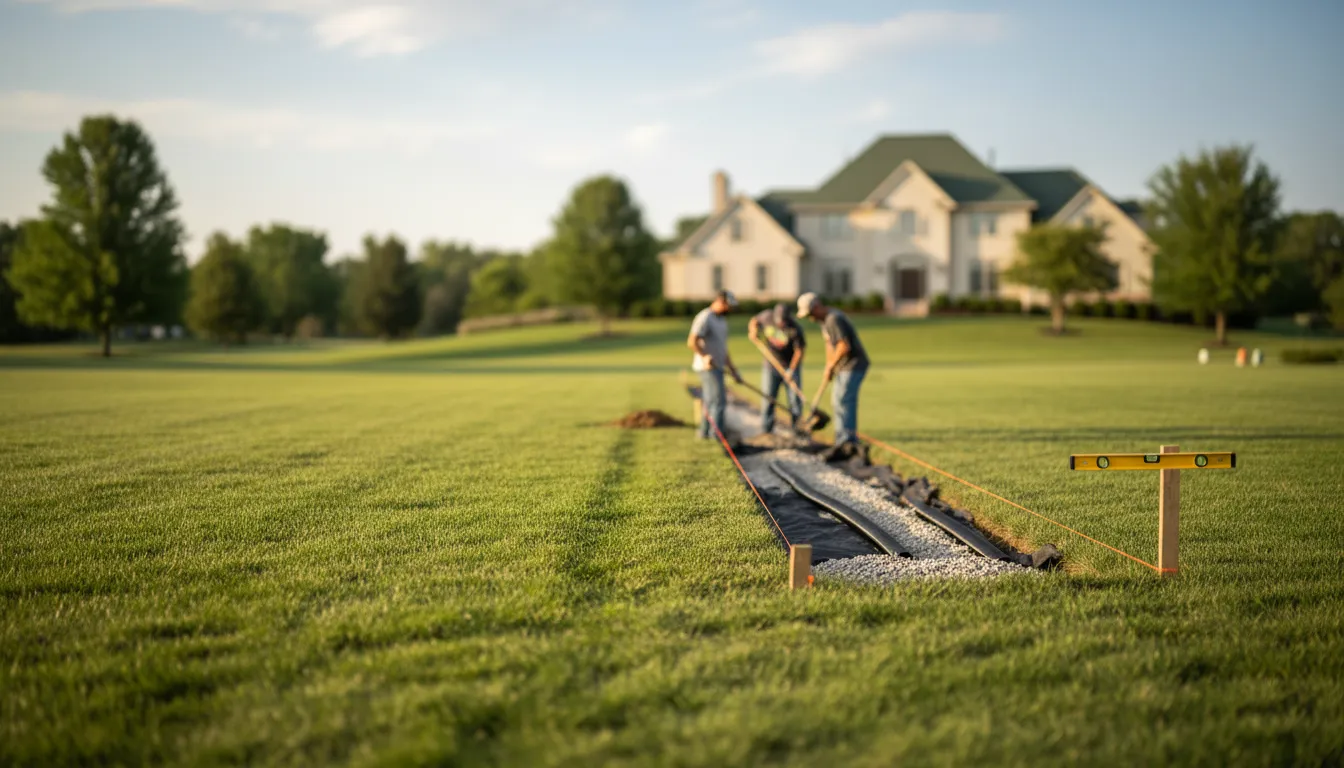
Find the Best Yard Drainage Contractors for Your Business
No obligation • Fast responses • Nationwide coverage

Why you can trust Landscape Atlas
Landscape Atlas is a leading United States resource for evaluating landscaping, lawn care, and outdoor service providers. Our team researches each category in depth, focusing on service quality, safety, and customer experience. Listings and rankings are based on independent criteria and user feedback, and companies cannot pay to influence our assessments or recommendations.
Search providers near you
Best Yard Drainage Contractors in Massachusetts Ranked
Managing stormwater on your property is a critical part of homeownership in Massachusetts. Effective yard drainage and grading systems protect your foundation, prevent basement flooding, control erosion, and help manage the increasing volume of rainwater driven by our changing climate. This guide explains the core principles, common solutions, and local considerations for residential stormwater management. You can use this information to understand your property's needs and connect with qualified local professionals who can assess, design, and implement the right system for your home.
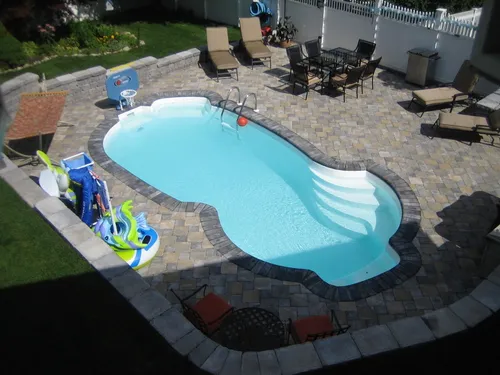
Pave Tech LLC
27 Wendell Rd, Newton, MA 02459
Pave Tech LLC is a licensed and insured contractor based in Boston, MA, specializing in asphalt paving, hardscaping, yard drainage, and grading services. With over 30 years of experience, they serve both commercial and residential clients throughout the Greater Boston area. Their services include driveway and parking lot paving, asphalt milling, excavation, drainage system installation, and snow removal. Pave Tech is equipped to handle demolition and hardscaping projects such as pavers and retaining walls, ensuring proper ground preparation and quality materials for lasting results.
Conserva Irrigation of Southwest Boston
Boston, MA
Conserva Irrigation of Southwest Boston provides residential and commercial irrigation services in Boston, MA, and surrounding areas. They specialize in eco-friendly sprinkler system installation, repair, and maintenance, focusing on water conservation through smart irrigation technology and sustainable practices. Their services include system inspections, drip irrigation installation, grading for proper drainage, and seasonal maintenance to keep landscapes healthy year-round. Conserva Irrigation partners with leading brands like Toro and Hunter to offer advanced irrigation solutions and has built a reputation for knowledgeable and thorough service. They serve a wide range of nearby communities and emphasize water-saving technologies in their work.
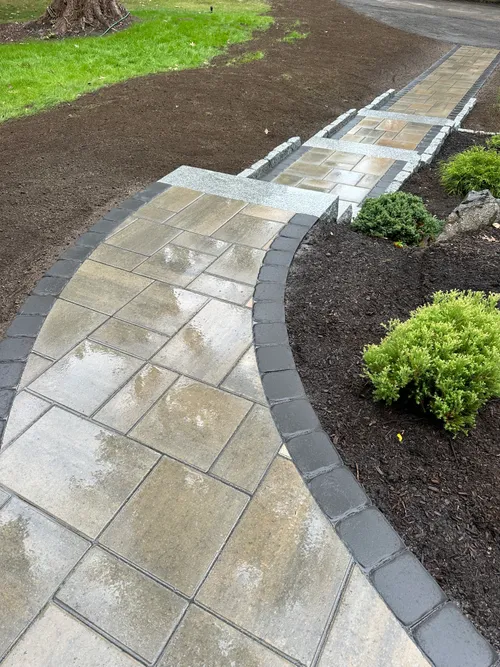
Land Solutions & Hardscapes, LLC
685 Main St, Wilmington, MA 01887
Land Solutions & Hardscapes, LLC is a full-service landscape and hardscape contractor based near Boston, MA. With over 20 years of experience, they provide design and installation services for residential and commercial outdoor living spaces. Their offerings include custom walkways, paver patios with fire pits, outdoor kitchens, and retaining walls. The company also specializes in grading and excavation services, ensuring a well-prepared site for any landscaping or hardscaping project.
EP Landscape Demo & Services LLC - Boston
Boston, MA
EP Landscape Demo & Services LLC - Boston is a landscaping company serving Boston, MA, and surrounding communities. They offer a wide range of services including lawn mowing, fertilization, weed control, landscape design, tree and stump removal, yard drainage, grading, land clearing, and brush removal. Their expertise covers residential, commercial, and industrial landscaping needs, with capabilities such as large-scale land clearing, site preparation, and storm damage cleanup. The company understands Boston's unique climate and terrain, adapting their services to local conditions including coastal weather and seasonal changes. They provide ongoing maintenance and specialized services like bi-weekly weeding and mulch installation to support healthy landscapes throughout the year.
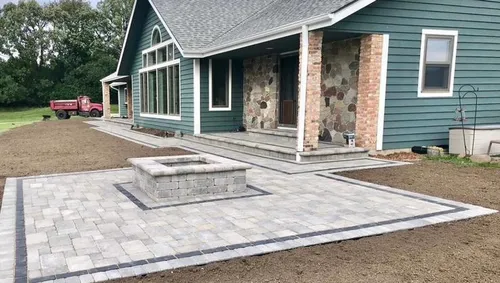
Omar Masonry And Painting LLC
39 Alpena Ave, Dedham, MA 02026
Omar Masonry And Painting LLC is a landscaping and hardscaping company based in Boston, MA. They offer a wide range of services including landscape design, yard drainage, grading, lawn care, and hardscaping such as patios, walkways, and retaining walls. The company also provides masonry, painting, basement cleanouts, demolition, power washing, gutter repair, and carpentry services. Omar Masonry And Painting LLC serves both residential and commercial clients in the Boston area, focusing on enhancing outdoor spaces with durable and functional designs.
Why Proper Drainage is Essential in Massachusetts
Massachusetts experiences intense, frequent rainfall events, and many areas contend with high groundwater tables or coastal influences. Without proper management, stormwater runoff can cause significant damage. The primary goals of a residential drainage system are to protect your home's structure by directing water away from the foundation, to prevent soil erosion that can undermine landscapes and hardscapes, and to manage water on-site to reduce the burden on municipal systems and prevent pollution of local waterways. State and local regulations often guide how stormwater should be handled, especially for new construction or major renovations, making it important to understand the basic standards 1.
Key Climate and Site Considerations
Designing an effective system starts with understanding your specific site conditions, which are heavily influenced by Massachusetts' climate and geology.
- Increased Rainfall Intensity: Modern designs must account for more frequent and heavier downpours. This requires systems with greater capacity for capturing and infiltrating water or safely conveying it off-site, along with robust erosion control measures during construction and after.
- High Groundwater and Coastal Impacts: In areas with high water tables or those affected by sea-level rise, deep excavation for traditional infiltration systems like dry wells may be limited or ineffective. In these cases, shallower, vegetated solutions like rain gardens or swales are often more suitable and adaptable 2.
- Soil Conditions: Massachusetts soils vary widely. Heavy clay soils (often classified as Type D) have very slow infiltration rates. A percolation test is often a crucial first step to determine how quickly water soaks into your ground. State guidelines generally require designed infiltration systems to fully drain within 72 hours to function properly and prevent mosquito breeding 3.
Common Residential Drainage & Grading Solutions
A variety of techniques can be used alone or in combination to solve drainage problems. The best approach depends on the source of water, your soil, and your property's layout.
1. Grading and Positive Drainage
This is the most fundamental step. The ground should slope gently away from your home's foundation-a minimum of 3-5% grade for at least the first 10 feet is a common target. This "positive drainage" ensures surface water flows away from your basement walls and toward a designated drainage area, such as a vegetated swale or dry well 4.
2. Rain Gardens and Bioretention Cells
These are landscaped depressions filled with a special soil mix and planted with water-tolerant native species. They are designed to capture runoff from roofs, driveways, or lawns, allowing it to pool temporarily, filter through the soil and plant roots, and slowly infiltrate into the ground. They are excellent for treating and absorbing relatively shallow flows of water and can be a beautiful landscape feature.
3. Dry Wells and Infiltration Trenches
A dry well is an underground structure, typically a pit filled with gravel or rubble, that collects roof runoff or surface water and allows it to percolate slowly into the surrounding soil. They are often used where downspouts discharge in a confined area. Pre-treatment, like a catch basin or filter fabric, is usually needed to prevent sediment from clogging the well.
4. French Drains and Catch Basins
A French drain is a trench filled with gravel containing a perforated pipe that collects groundwater or subsurface water and redirects it. A catch basin is a grated inlet installed in a low spot to capture surface water, which is then piped away. These are conveyance systems often used to move water from a problem area (like a soggy yard) to a solution area (like a rain garden or dry well) or a safe discharge point like a storm drain.
5. Permeable Paving
Replacing solid concrete or asphalt with permeable materials-such as porous pavers, pervious concrete, or gravel-allows rainwater to pass through the surface into a stone reservoir below, where it can slowly infiltrate. This is an effective way to reduce runoff from driveways, patios, and walkways 5.
Find the perfect yard drainage contractors for your needs
Get personalized recommendations and expert advice
Proactive Measures and Maintenance
Beyond installed systems, simple property management plays a huge role in stormwater control.
- Minimize Hard Surfaces: Reduce impervious cover on your property. Consider gravel, permeable pavers, or stepping stones instead of solid concrete for paths and patios 6.
- Use Vegetation: Plant bare soil areas with grass, groundcover, or other plants. Their roots help absorb water and hold soil in place, reducing erosion 7 8.
- Manage Gutters and Downspouts: Ensure gutters are clean and downspouts direct water at least 5-10 feet away from your foundation using splash blocks, extensions, or buried drain lines connected to a rain barrel or infiltration area.
- Implement Erosion Control: On slopes or in disturbed areas, use mulch, erosion control blankets, or even small check dams made of stone or logs to slow water flow and prevent soil loss 9.
Understanding Project Costs
Pricing for drainage work in Massachusetts varies significantly based on the scale, complexity, site access, and local labor rates. The following are general price ranges for common projects:
- Minor Grading/Landscaping: Adjusting soil slopes and regrading a section of yard can range from $500 to over $2,000, depending on whether it's a DIY project or requires professional equipment and labor.
- Rain Garden Installation: Installing a typical residential rain garden, including excavation, soil amendment, and plants, typically costs between $500 and $3,000+ 10.
- French Drain or Catch Basin System: Installing a linear French drain or a catch basin with underground piping is more involved. Costs often range from $1,500 to $5,000 or more, depending on length, depth, and connection complexity.
- Permeable Pavers: For a driveway or patio section, material and installation for permeable pavers can range from $15 to $30+ per square foot 11.
It's important to note that these are estimates. Many projects require a site evaluation by a landscape contractor, civil engineer, or landscape architect to provide an accurate quote. Permits may also be required, adding to the timeline and cost. For detailed technical guidance, professionals and homeowners alike often consult the Massachusetts Stormwater Handbook and local municipal regulations 12.
Frequently asked questions
Sources
Footnotes
-
Recommendations for Addressing Climate Change Impacts to ... - Mass.gov ↩
-
Massachusetts Stormwater Management Policy Standards - Mass.gov ↩
-
climate resilient design standards & guidelines - Boston.gov ↩
-
Volume 2 Chapter 2: Structural BMP Specifications for the ... - Mass.gov ↩
-
Controlling Overland Runoff to Reduce Coastal Erosion - Mass.gov ↩
-
10 Things You Can Do to Prevent Stormwater Runoff Pollution - Farmington, CT ↩
-
Developing Your Stormwater Pollution Prevention Plan - US EPA ↩