Find the Best Yard Drainage Contractors for Your Business
No obligation • Fast responses • Nationwide coverage

Why you can trust Landscape Atlas
Landscape Atlas is a leading United States resource for evaluating landscaping, lawn care, and outdoor service providers. Our team researches each category in depth, focusing on service quality, safety, and customer experience. Listings and rankings are based on independent criteria and user feedback, and companies cannot pay to influence our assessments or recommendations.
Search providers near you
Best Yard Drainage Contractors in Texas Ranked
Effective yard drainage and grading are essential for protecting your Texas home from water damage. The state's diverse climate, from heavy coastal rains to intense inland storms, can overwhelm a poorly managed landscape, leading to foundation issues, soil erosion, and mosquito-breeding standing water. This guide explains the critical drainage solutions for Texas properties and how you can connect with local experts to assess your needs and implement a system that directs water safely away from your home.
Southwest Irrigations Systems
6739 Theall Rd Suite A, Houston, TX 77066
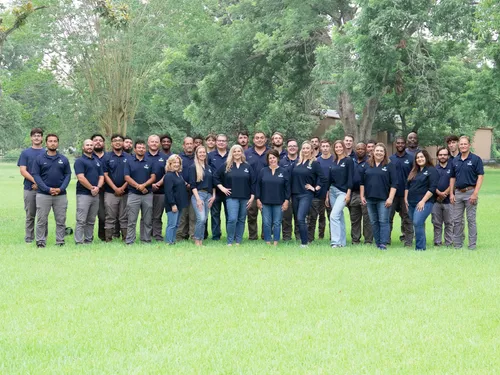
Southwest Irrigation Systems is a Houston, TX-based company specializing in sprinkler system installation and repair, yard drainage, grading services, and outdoor landscape lighting. Serving the greater Houston area, they have over 35 years of experience providing irrigation and drainage maintenance along with outdoor lighting solutions. The company is licensed in Texas and is affiliated with local irrigation and turf associations. Their team is known for using top-quality parts and delivering thorough, professional service.

Casas Irrigation Drainage & More
110A Rose Ln Suite 204, Frisco, TX 75036
Casas Irrigation Drainage & More provides drainage, irrigation, and landscape lighting services in Dallas, TX. They offer sprinkler installation, repair, and maintenance, along with grading and yard drainage solutions tailored to local environmental needs. Their expertise includes fixing broken sprinkler heads, underground leaks, low water pressure, and uneven coverage to maintain healthy lawns and efficient water use. The company serves the Dallas area with a focus on customized outdoor lighting and irrigation systems designed to enhance both function and appearance.

Southern Love Landscaping & Design
111 Congress Ave. Suite 400, Austin, TX 78701
Southern Love Landscaping & Design is a landscaping and outdoor living company based in Austin, TX. They offer a wide range of services including custom landscaping, fire pits, patios, sod installation, irrigation installation and repair, fence installation, retaining walls, and landscape lighting. The company serves Austin and nearby areas such as Cedar Park and Round Rock, providing tailored outdoor solutions that enhance both residential and commercial properties. Their expertise includes building durable retaining walls and designing functional irrigation systems to support healthy landscapes. Southern Love Landscaping & Design emphasizes personalized service and craftsmanship to meet client needs.
Lone Star Artificial Turf Austin
Austin, TX
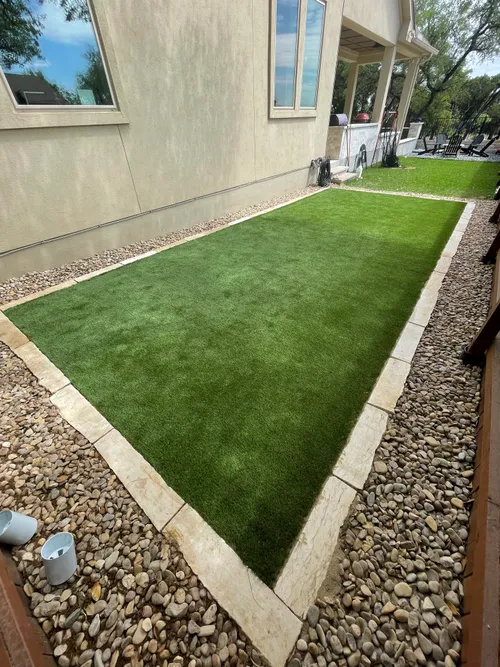
Lone Star Artificial Turf Austin is a landscaping contractor based in Austin, TX, specializing in artificial turf installation, yard drainage, and grading services. They provide customized turf solutions designed for residential and commercial properties, including safe, hypoallergenic turf options suitable for kids and pets. Their installations feature perforated turf for effective drainage and site preparation to prevent water issues, ensuring a mud-free yard year-round. Lone Star offers a 10 to 15-year warranty on turf and installation, supporting customers with ongoing service and repairs, including correcting previous poor installations.
Thrive Outdoor Solutions of San Antonio
10401 I-10 Suite G-101, San Antonio, TX 78230
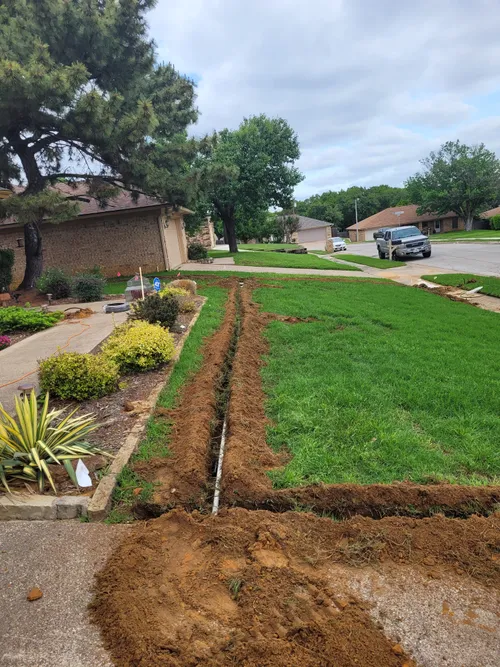
Thrive Outdoor Solutions of San Antonio provides landscape lighting installation, yard drainage, grading, and sprinkler system services in San Antonio, TX. Since 2007, they have specialized in custom lawn sprinkler design, installation, and repair, serving San Antonio and surrounding Texas areas including Austin, Dallas, and Fort Worth. Their team is licensed and insured, offering warranty-backed work to ensure long-lasting and efficient irrigation systems. Thrive Outdoor Solutions focuses on maintaining healthy lawns through expert sprinkler solutions and effective drainage services.
Why Proper Drainage is Critical in Texas
Texas weather is notoriously unpredictable, with periods of drought punctuated by intense rainfall. This cycle places unique stress on residential landscapes. Without proper grading and drainage systems, water can pool around your home's foundation, leading to costly cracks, basement or crawl space flooding, and mold growth. In areas with heavy clay soils, like much of East Texas, water absorbs slowly, creating persistent soggy yards that kill grass and create muddy messes. In the Hill Country, rocky terrain can cause rapid runoff that erodes soil and damages landscaping. Implementing the right water management strategy is not just about curb appeal-it's a fundamental investment in your property's structural integrity and value 1.
Common Texas Drainage Problems
Identifying the symptoms of poor drainage is the first step toward a solution. Common issues across Texas include:
- Standing Water: Puddles that remain for more than 24 hours after rain indicate poor surface grading or a low spot where water collects.
- Soil Erosion: Gullies or washed-out areas in your yard show that water is moving too quickly and unchecked across the surface.
- Soggy Lawn Areas: Spongy, constantly wet grass, especially away from downspouts, often points to a high water table or subsurface water flow that needs to be intercepted.
- Water in the Basement or Crawl Space: This is a serious sign that water is pressing against your foundation, often due to improper slope away from the house.
- Foundation Cracks: Horizontal or stair-step cracks in your home's exterior walls can be caused by expansive clay soils that swell when wet and shrink when dry-a cycle exacerbated by poor drainage.
Regional Drainage Considerations Across Texas
A one-size-fits-all approach doesn't work in a state as geographically diverse as Texas. The optimal solution depends heavily on your specific region and soil type.
- East Texas (Piney Woods): Characterized by heavy clay soils with poor permeability. While surface grading is crucial to move water away quickly, these soils often require deeper subsurface solutions like French drains to handle water that doesn't soak in.
- Central Texas & Hill Country: Rocky, shallow soils over limestone bedrock. Water runs off quickly, causing erosion. Solutions often involve rock-filled infiltration trenches, dry creek beds, and terracing to slow down and manage runoff over the hard surfaces.
- South & Coastal Texas: High humidity, flat terrain, and potential for tropical storms and flash floods. The focus is on moving large volumes of water away from structures rapidly. This often requires robust systems of catch basins, channel drains, and positively sloped discharge lines to prevent dangerous pooling.
- West Texas & Panhandle: Generally arid but prone to intense, sudden thunderstorms. The priority shifts toward capturing precious rainwater for landscape use (via rain barrels or cisterns) while also implementing solutions to prevent erosion and flash flooding during heavy downpours.
Essential Yard Drainage Solutions
Professional landscapers and drainage contractors utilize a range of techniques to solve water problems. The right combination for your home will depend on a detailed site evaluation.
1. Grading and Re-sloping
This is the most fundamental and critical step. The goal is to create a positive slope of at least 1/4 inch per foot for the first 5 to 10 feet away from your home's foundation 2. This ensures surface water flows away from the structure, not toward it. Regrading may involve adding fill dirt and compacting it to create the proper slope.
2. French Drains
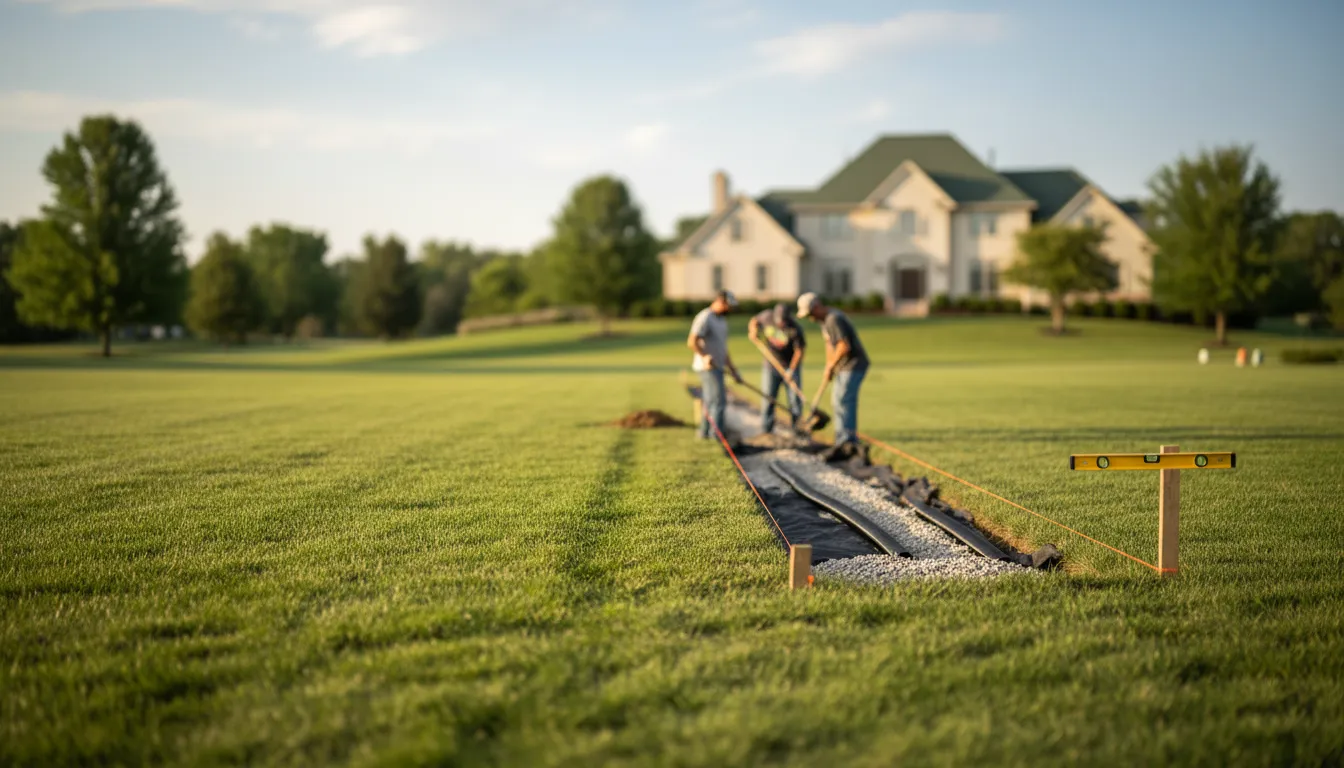
A French drain is a subsurface solution for collecting and redirecting groundwater. It consists of a trench lined with landscape fabric, filled with gravel, and containing a perforated pipe at the bottom. The pipe collects water from saturated soil and carries it to a safe discharge point, such as a street gutter, storm drain, or dry well. This is ideal for solving chronically soggy areas in the middle of a yard.
3. Catch Basins and Channel Drains
These are designed for managing concentrated surface runoff. A catch basin is a grated box set into the ground at a low point, connected to an underground pipe. It captures large volumes of water from downspouts or driveway runoff. Channel drains are long, grated trenches perfect for across driveways, patios, or walkways where water tends to flow. Both connect to solid pipes that discharge water away from the property.
4. Dry Creek Beds
A dry creek bed is a decorative and functional solution that mimics a natural stream. It involves creating a shallow, winding trench lined with river rock and gravel. During a rainstorm, it channels and slows down runoff, reducing erosion while adding a natural landscape feature. It's an excellent choice for the Hill Country aesthetic.
5. Rain Gardens
A rain garden is a landscaped depression planted with native, water-tolerant vegetation. It is strategically placed to capture runoff from roofs or driveways, allowing the water to slowly infiltrate the soil while being filtered by the plants. This reduces the total volume of runoff and recharges groundwater, making it an eco-friendly Best Management Practice (BMP) encouraged in many Texas communities 3.
Find the perfect yard drainage contractors for your needs
Get personalized recommendations and expert advice
6. Permeable Paving
For patios, walkways, or driveways, using permeable materials like porous pavers, gravel, or permeable concrete allows rainwater to seep through the surface into a stone reservoir below, where it gradually infiltrates the soil. This significantly reduces surface runoff from hardscapes.
Proactive Maintenance and Prevention
Many drainage issues can be mitigated with simple, regular maintenance:
- Clean Gutters and Downspouts: Clogged gutters cause overflow that pours directly next to your foundation. Ensure they are clear and that downspout extensions carry water at least 5-10 feet away from the house.
- Install Window Well Covers: These prevent rain from flooding basement window wells, a common entry point for water.
- Mind Your Landscaping: Avoid overwatering plants near your foundation. Use mulch to reduce erosion, but ensure it doesn't create a dam that traps water. Slope soil away from the base of trees and shrubs.
- Divert Water from Hardscapes: Ensure your driveway, patio, and walkways slope to drain onto lawn areas or into a drainage system, not toward your home.
Understanding Costs for Drainage Projects in Texas
Costs vary widely based on the solution's complexity, materials, yard size, and labor. Here is a general overview:
- Simple Grading/Re-sloping: $100 - $500 for a professional to adjust the slope in a key area near your foundation.
- French Drain Installation: $500 to $2,000+ for a 100-foot run, depending on depth, pipe type, and trenching difficulty (e.g., through rock).
- Catch Basin System: $800 - $3,000+ for a system with multiple basins and underground piping to handle roof and driveway runoff.
- Rain Garden: $300 - $1,500+ for materials, plants, and professional labor to shape and plant the garden.
- Permeable Patio or Driveway: $2,000 - $10,000+, heavily dependent on size and the materials chosen (e.g., permeable pavers vs. gravel) 4 5 6.
Investing in proper drainage often pays for itself by preventing exponentially more expensive foundation repairs.
Frequently asked questions
Sources
Footnotes
-
Stormwater - | YourHome - https://www.yourhome.gov.au/water/stormwater ↩
-
What Is Drainage Grading? | Castle Point Landscape - https://castlepointlandscape.com/what-is-drainage-grading/ ↩
-
Transform Your Space with a Texas Rain Garden - https://nativegardeners.com/blogs/news/texas-rain-garden-transformation ↩
-
Top 8 Backyard Drainage Solutions for Your South Texas ... - https://fischerlandscapingusa.com/backyard-drainage-solutions/ ↩
-
Stormwater Best Management Practices - https://spcwater.org/topics/stormwater-management/stormwater-best-management-practices-2/ ↩
-
10 Things You Can Do to Prevent Stormwater Runoff Pollution - https://www.farmington-ct.org/departments/engineering/stormwater/10-things-to-prevent-stormwater-pollution ↩