Find the Best Yard Drainage Contractors for Your Business
No obligation • Fast responses • Nationwide coverage

Why you can trust Landscape Atlas
Landscape Atlas is a leading United States resource for evaluating landscaping, lawn care, and outdoor service providers. Our team researches each category in depth, focusing on service quality, safety, and customer experience. Listings and rankings are based on independent criteria and user feedback, and companies cannot pay to influence our assessments or recommendations.
Search providers near you
Top Yard Drainage Contractors in El Paso, Texas Ranked
Managing water flow on your property is a critical aspect of homeownership in El Paso. Yard drainage and grading involves shaping the land and installing systems to control runoff, preventing water from pooling near your foundation, eroding your landscape, or creating soggy, unusable areas. In our unique desert climate, where intense, short-lived rainstorms can create sudden torrents of water, having a properly graded yard with effective drainage solutions is essential for protecting your home's structural integrity and maintaining a healthy, functional outdoor space. This guide will help you understand the common problems, proven solutions, and local considerations for managing stormwater on your El Paso property.
Five Musketeers LLC, Landscaping and hardscaping services in Texas
El Paso, TX
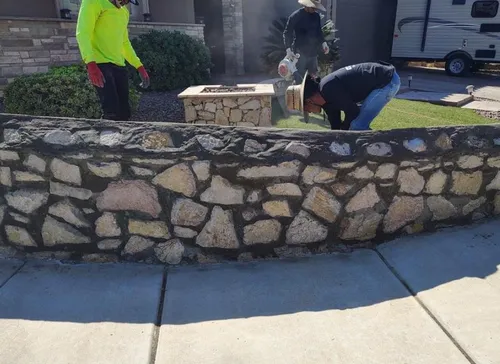
Five Musketeers LLC provides full-service landscaping and hardscaping solutions in El Paso, TX. The company specializes in desert-smart landscape design, artificial turf installation, yard drainage, sprinkler systems, and durable hardscape features like retaining walls and concrete patios. They manage projects from design through installation and maintenance, ensuring water-efficient and low-maintenance outdoor spaces tailored to the local climate. Founded by a group of friends who started with small projects, Five Musketeers has grown into a trusted team serving El Paso and nearby communities, including Socorro, Horizon City, and Fort Bliss.
SP & LC Sprinklers and Landscape Contractors
840 Redd Rd #1C, El Paso, TX 79912
SP & LC Sprinklers and Landscape Contractors is a full-service landscaping company based in El Paso, TX. They offer a wide range of services including lawn care, sod and artificial turf installation, landscape lighting, tree removal, yard drainage, sprinkler system installation and repair, hardscaping, and complete landscape design and installation for both residential and commercial clients. With over 15 years of experience, the company is insured and bonded, serving the local community with expertise in creating outdoor environments that include patios, driveways, retaining walls, and decorative concrete features.
Conserva Irrigation of El Paso
El Paso, TX
Conserva Irrigation of El Paso is a family-owned irrigation company serving El Paso, TX, and surrounding areas including Anthony, Canutillo, Fort Bliss, Horizon City, and Sunland Park. They specialize in sprinkler installation, repair, and yard drainage services with a focus on water conservation and efficient irrigation tailored to the local desert climate. Their expertise includes smart irrigation systems featuring weather-based timers, moisture sensors, and zoning controls to optimize water use and maintain healthy lawns. Conserva Irrigation partners with leading brands like Toro and Hunter to provide modern, sustainable irrigation solutions. They offer inspections, repairs, system upgrades, and maintenance plans to ensure ongoing efficiency and environmental stewardship.
El Paso Concrete Contractors
El Paso, TX
El Paso Concrete Contractors is a locally owned company serving El Paso, TX, with concrete construction and irrigation services. They specialize in site preparation, grading, concrete flatwork, foundations, patios, and sprinkler systems. The team uses advanced techniques like laser leveling and 3000+ PSI concrete mixes to ensure durable results. Founded by an El Paso native, the company has over 22 years of industry experience and has been licensed as a Texas irrigator since 2007. They are fully bonded, insured, and ACI certified, offering reliable solutions for both residential and commercial projects.
Why Proper Drainage is Critical in El Paso
El Paso's environment presents specific challenges for property drainage. The region is characterized by a high desert climate with infrequent but often intense rainfall events1. When rain does fall, the hard, sun-baked soil has a low infiltration rate, meaning water runs off the surface quickly rather than soaking in. This leads to rapid, high-volume runoff that can overwhelm poorly prepared landscapes. Furthermore, properties near the Franklin Mountains may deal with additional runoff from higher elevations2. Without proper land grading and drainage systems, this water can seep into foundations, cause soil erosion, create standing water that breeds mosquitoes, and even lead to costly basement or crawl space flooding. Effective stormwater management isn't just about convenience; it's a key part of responsible property stewardship that aligns with local guidelines for controlling runoff and pollution3.
Core Principles: Grading and Drainage
At its heart, managing yard water involves two interconnected concepts: grading and drainage.
Grading refers to the process of shaping the soil's surface to direct water flow. The fundamental rule is to slope the ground away from your home's foundation. Professionals recommend a minimum slope of 2% to 5% (a drop of 2 to 5 inches per 10 feet) for at least the first 10 feet surrounding your house 4. This primary grading ensures that water from rain or irrigation doesn't pool against your foundation walls. Regrading a yard may involve adding topsoil, excavating, or using machinery to sculpt the earth into the correct slopes and swales (broad, shallow channels) to guide water toward a safe discharge point, like a street gutter or a dry well5 6.
Drainage involves the systems installed to collect and redirect water that grading alone cannot manage. These are especially important in low spots, at the base of slopes, or where water naturally converges. Think of grading as the broad strategy for moving water, and drainage systems as the tactical solutions for handling concentrated flow.
Common Yard Drainage Solutions
For El Paso homeowners dealing with pooling water, soggy lawns, or erosion, several effective drainage techniques are available. The right solution depends on your specific problem, yard layout, and budget.
French Drains
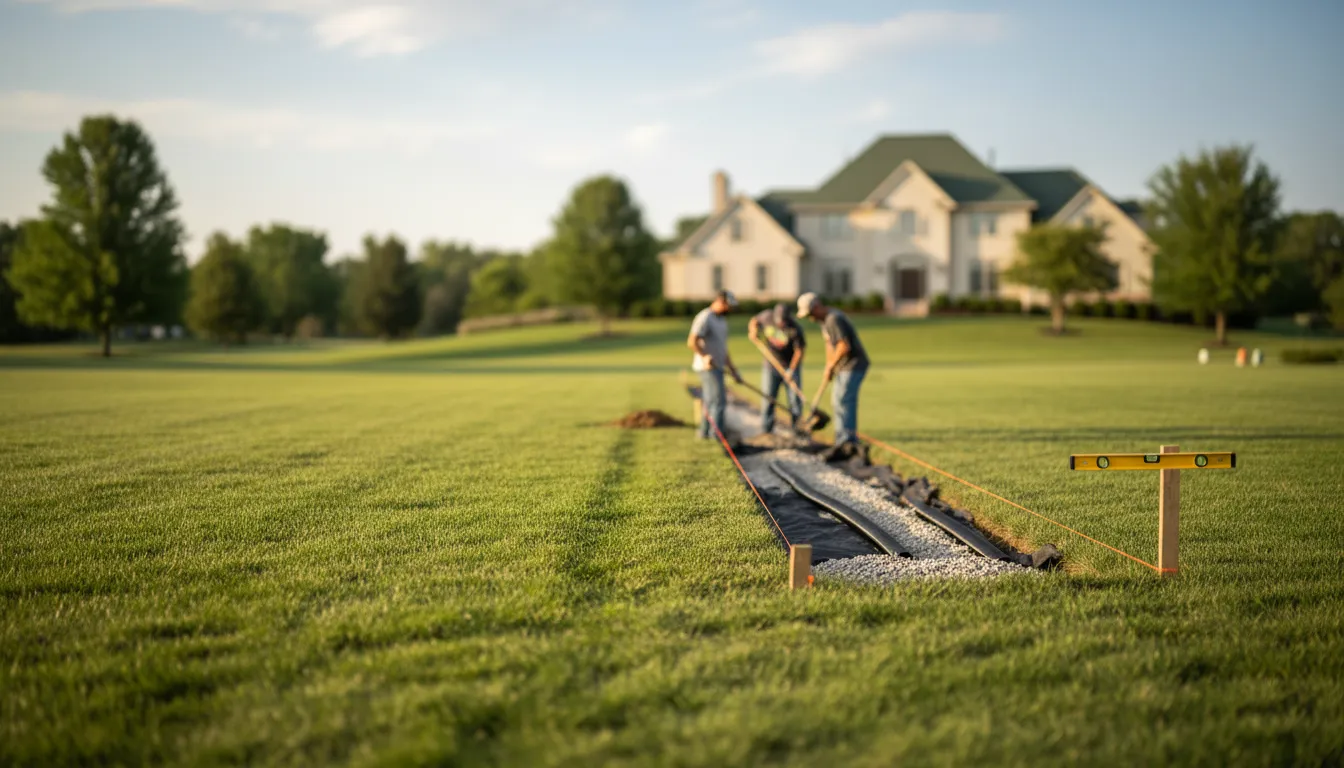
A French drain is a versatile, subsurface drainage workhorse. It consists of a trench lined with landscape fabric, filled with gravel, and containing a perforated pipe at the bottom. The fabric prevents soil from clogging the gravel and pipe. Water from the surrounding soil seeps through the gravel, enters the perforated pipe, and is carried away to a designated outlet. French drains are excellent for solving problems with soggy soil, intercepting water moving down a slope, or relieving hydrostatic pressure against foundation walls. Installation requires careful excavation and precise sloping of the pipe to ensure water flows correctly.
Catch Basins and Trench Drains
These are surface-level solutions for capturing water before it spreads. A catch basin is essentially a grate set into a low point in the yard, connected to an underground pipe that carries the water away. They are perfect for collecting runoff from downspouts or draining a concrete patio or driveway where water pools. A trench drain is a long, narrow grate system, often used along the edge of a driveway or walkway to intercept sheet flow. Both systems are highly effective for managing large volumes of surface water quickly.
Swales and Rain Gardens
These are "green" or landscape-integrated solutions that manage water while adding aesthetic value. A swale is a wide, shallow, vegetated channel designed to slow down and direct runoff, allowing some water to infiltrate the soil along the way. A rain garden is a strategically placed depression planted with native, water-tolerant plants. It collects runoff from roofs or paved areas and allows it to soak into the ground naturally, filtering pollutants in the process. These solutions are encouraged in many stormwater management plans as they reduce the burden on municipal systems and improve water quality.
Dry Wells and Rain Harvesting
For properties where diverting water to the street isn't ideal or possible, dry wells offer an alternative. A dry well is an underground chamber filled with gravel that collects water from downspouts or drains and allows it to percolate slowly into the surrounding subsoil. Rain barrels or larger cisterns capture roof runoff for later use in irrigation, which simultaneously reduces the volume of water your yard drainage system needs to handle.
Find the perfect yard drainage contractors for your needs
Get personalized recommendations and expert advice
The Professional Process: From Assessment to Completion
A successful drainage and grading project follows a logical sequence. Understanding this process can help you know what to expect when working with a professional.
-
Site Assessment and Problem Identification: A thorough evaluation is the first and most crucial step. A professional will inspect your property during or after a rain event if possible, identify where water is coming from and where it pools, check the existing slope (or lack thereof) near your foundation, and locate all underground utilities. They will determine the root cause of the drainage issue, whether it's improper grading, a low spot, or excessive runoff from a hard surface.
-
Design and Planning: Based on the assessment, a plan is created. This includes determining the necessary slope for regrading, calculating the size and placement of drainage systems like French drains or catch basins, and selecting appropriate materials. In El Paso, professionals must also consider local regulations, such as those outlined in the City's Stormwater Design Manual, which may dictate how and where water can be discharged.
-
Excavation and Earthwork: This is the physical transformation phase. For grading, machinery is used to cut and fill soil to create the designed slopes. For drainage systems, trenches are dug to precise depths and gradients. This stage requires skill to maintain the planned slopes and avoid damaging any underground lines.
-
System Installation: Drainage components are installed. For a French drain, this involves laying landscape fabric, adding a layer of gravel, placing and connecting the perforated pipe, and covering it with more gravel and fabric before backfilling. Catch basins are set in concrete and connected to solid piping. Swales and rain gardens are sculpted and prepared for planting.
-
Backfill, Finishing, and Revegetation: The excavated areas are filled in with soil. The final grade is carefully checked and smoothed. New sod, seed, or mulch is applied to restore the landscape and prevent erosion. For rain gardens and swales, the selected plants are installed to stabilize the soil and complete the functional landscape feature.
Understanding Costs for Drainage and Grading Projects
The investment for a drainage solution varies widely based on the project's scale, complexity, and the solutions chosen. It's always best to get multiple detailed quotes for your specific situation. Here is a general overview of potential cost ranges:
- Basic Yard Regrading/Sloping: For correcting the slope around a foundation or recontouring a section of a yard, costs can range from several hundred dollars for a small DIY project to $1,000 or more for professional regrading of a typical residential area with machinery and new topsoil7 8.
- French Drain System: As one of the most common and effective solutions, a professionally installed French drain for a residential property typically costs between $1,000 and $5,000+. The final price depends heavily on the length (e.g., 20 ft. vs. 50 ft.), depth, accessibility, and the type of surface (grass, rock, etc.) that must be restored after installation.
- Catch Basin or Trench Drain: Installing a single catch basin with connecting pipe can range from $500 to $2,000 or more, depending on depth, materials, and the complexity of tying it into an existing drainage line or outlet9.
- Rain Garden or Bioswale: These landscape-focused solutions can be a cost-effective option, with material and labor costs often falling between $300 and $1,500, heavily influenced by the size, plants selected, and any necessary soil amendments10 11.
Remember, these are estimates. The unique soil conditions, accessibility of your yard, and specific requirements of El Paso can all influence the final price. A professional assessment will provide the most accurate quote.
Local El Paso Regulations and Environmental Considerations
When planning any significant grading or drainage work on your property, it's important to be aware of local guidelines. The City of El Paso Stormwater Design Manual provides standards for erosion control, stormwater conveyance, and discharge. For example, simply piping all your runoff onto a neighbor's property or the public sidewalk is not permitted. El Paso Water also manages stormwater issues and can be a resource for understanding broader watershed concerns.
Furthermore, El Paso County has standard notes for grading and erosion control plans that professionals follow, especially for larger projects, to prevent sediment from leaving the site and polluting waterways12. Using permeable solutions like rain gardens and dry wells is not only effective but also environmentally beneficial, as it helps recharge groundwater and filters pollutants.
Frequently asked questions
Sources
Footnotes
-
El Paso Water | Stormwater - https://www.epwater.org/our-water/stormwater ↩
-
STORMWATER DESIGN MANUAL - City of El Paso - https://www.elpasotexas.gov/assets/Documents/CoEP/Planning-and-Inspections/Planning-Divisions/Combined-Storm-Water-Design-Manual.pdf ↩
-
10 Things You Can Do to Prevent Stormwater Runoff Pollution - https://www.farmington-ct.org/departments/engineering/stormwater/10-things-to-prevent-stormwater-pollution ↩
-
How Land Grading Helps with Yard Drainage - Dirt Connections - https://www.dirtconnections.com/how-land-grading-helps-with-yard-drainage/ ↩
-
Grading Yard for Drainage: A Homeowner's Step-by-Step Guide - https://tamuradesigns.com/grading-yard-for-drainage/ ↩
-
Swales, Drains, and Site Grading for Stormwater Control - https://basc.pnnl.gov/resource-guides/swales-drains-and-site-grading-stormwater-control ↩
-
Expert Landscape Grading to Stop Yard Flooding Fast - https://everlastlandscapellc.com/landscape-grading-solutions-solving-drainage-issues/ ↩
-
15 DIY Yard Drainage Methods You Should Know - The Spruce - https://www.thespruce.com/diy-yard-drainage-methods-5080419 ↩
-
Top 8 Backyard Drainage Solutions for Your South Texas Property - Fischer Landscaping - https://fischerlandscapingusa.com/backyard-drainage-solutions/ ↩
-
Control Heavy Runoff - Solving Drainage and Erosion Problems - https://www.fairfaxcounty.gov/soil-water-conservation/drainage-problem-control-runoff ↩
-
Stormwater Best Management Practices - https://spcwater.org/topics/stormwater-management/stormwater-best-management-practices-2/ ↩
-
Standard Notes for El Paso County Grading and Erosion ... - https://epc-assets.elpasoco.com/wp-content/uploads/sites/13/Stormwater/Current_Website/Standard-Notes-For-El-Paso-County-Grading-and-Erosion-Control-Plans.docx ↩