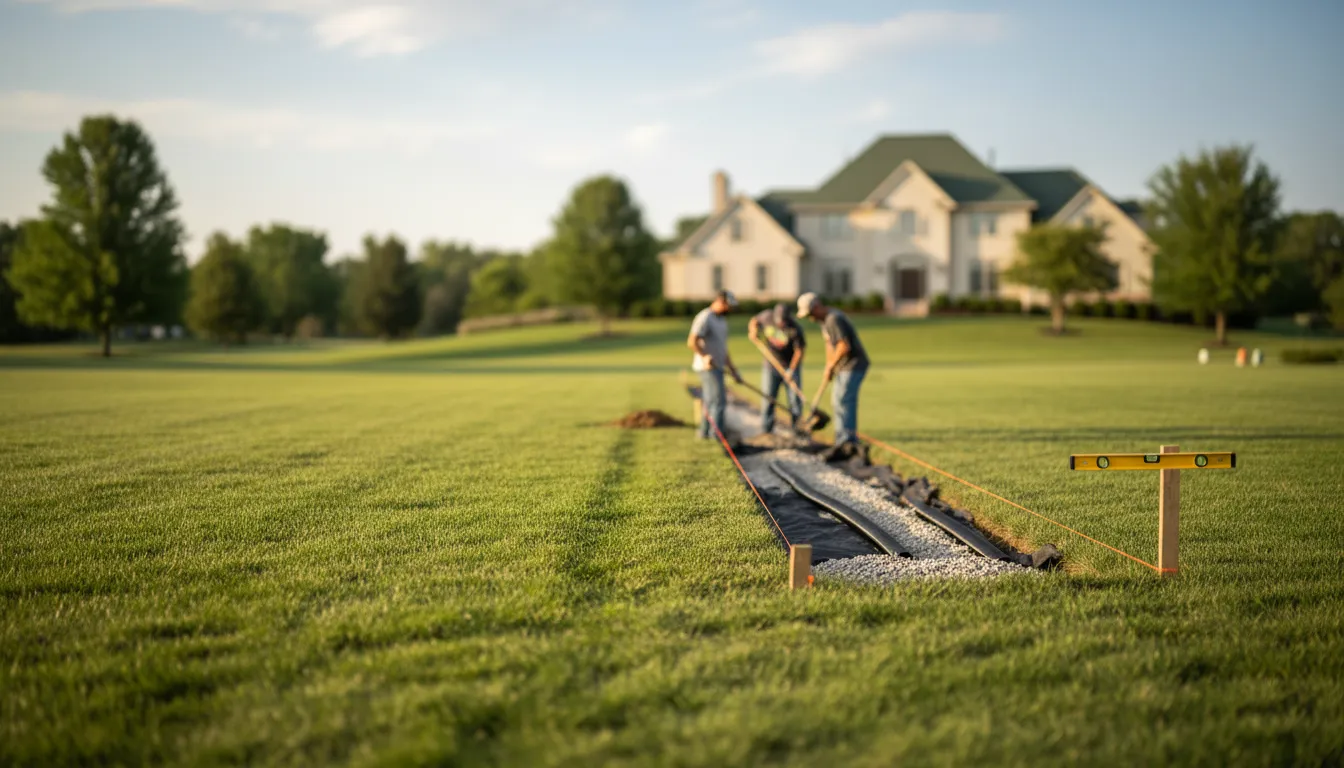
Find the Best Yard Drainage Contractors for Your Business
No obligation • Fast responses • Nationwide coverage

Why you can trust Landscape Atlas
Landscape Atlas is a leading United States resource for evaluating landscaping, lawn care, and outdoor service providers. Our team researches each category in depth, focusing on service quality, safety, and customer experience. Listings and rankings are based on independent criteria and user feedback, and companies cannot pay to influence our assessments or recommendations.
Search providers near you
Best Yard Drainage Contractors in Michigan Ranked
Proper yard drainage and grading are essential for protecting your Michigan home's foundation, preventing basement flooding, and managing the significant water from heavy rains and spring snowmelt. Effective systems direct water away from your home, reduce soil erosion, and can even enhance your landscape's health and beauty. This guide will help you understand the unique drainage challenges in Michigan, explore effective solutions, and connect with local professionals who can assess your property and implement the right fix for your situation.
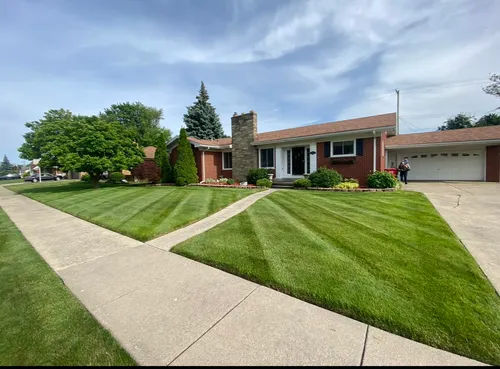
DJ Wyatt's Landscaping LLC
Detroit, MI
DJ Wyatt's Landscaping LLC is a landscaping company serving Detroit, MI, and nearby areas including Roseville, Warren, Fraser, and St. Clair Shores. They provide a range of outdoor services such as lawn care, landscaping, French drain installation, and snow removal. The company is known for its focus on customer satisfaction and strong communication, operating as a family-owned business with a commitment to quality workmanship. DJ Wyatt's Landscaping has built a reputation for reliability and professionalism in Macomb County.
Capek's Landscaping
Detroit, MI
Capek's Landscaping is a family-operated landscaping company serving Detroit, MI, and the surrounding metro Detroit area. With over 22 years of experience, they offer a wide range of services including landscape design and build, hardscaping with retaining walls and custom patios, sod and sprinkler installation, fencing, grading, and yard drainage. They also provide landscape supplies and delivery, focusing on both residential and commercial projects across Macomb and Wayne Counties. Their expertise extends to complete yard maintenance and snow removal, making them a comprehensive yard solutions provider.

Stoneys Landscaping
5060 Leafdale Blvd, Royal Oak, MI 48073
Stoneys Landscaping is a landscaping company based in Detroit, MI, offering a variety of lawn and landscape services. Their expertise includes weekly lawn maintenance, landscape design and installation, mulch application, sod and seed planting, grading to manage yard drainage, and shrub trimming. With over 35 years of experience, they focus on balancing client vision with practical landscape solutions to enhance property health and appearance.
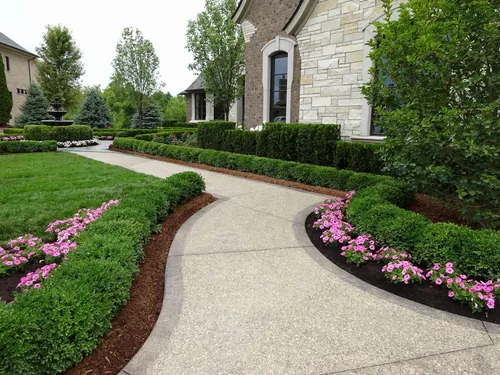
Andy's Landscape Services
28475 Greenfield Rd, Southfield, MI 48076
Andy's Landscape Services is a landscaping company based in Detroit, MI, offering comprehensive outdoor solutions including landscape design, lawn care, yard drainage, grading, and hardscaping. They specialize in creating tailored outdoor spaces that combine beauty and functionality, with capabilities such as terrain engineering, retaining walls, and drainage solutions. Established in 2005, Andy's Landscape Services has completed over 350 custom landscapes across Southeast Michigan, serving both residential and commercial clients.
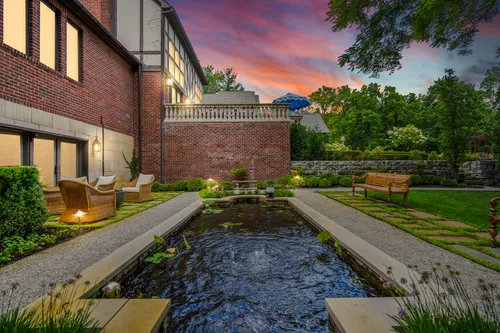
Great Lakes Landscape Design
13201 Northend Ave, Oak Park, MI 48237
Great Lakes Landscape Design is a full-service landscape design and maintenance company serving Detroit, MI. Established in 1989, the firm offers custom landscape design, hardscaping, softscaping, lawn care, yard drainage, and hydrology system installation. Their team includes masons, horticultural specialists, and landscape designers who work together from concept through installation and ongoing maintenance to create functional and visually appealing outdoor spaces. They also provide commercial snow removal to keep properties accessible during Michigan winters.
Why Michigan Homes Need Specialized Drainage
Michigan's climate and geology create a perfect storm for drainage problems. Homeowners must contend with two major water events: large volumes of spring snowmelt and intense summer thunderstorms. When combined with the region's prevalent clay soils, which drain very slowly, these conditions can quickly lead to saturated yards, standing water, and hydrostatic pressure against foundation walls 1.
Furthermore, Michigan follows the "Natural Flow Doctrine" or common law for surface water 2. This means water naturally flowing downhill across your property cannot be unlawfully blocked to the detriment of your neighbor. Your drainage solutions must manage water responsibly, not simply divert problems onto adjacent properties. A well-designed system addresses water on-site through infiltration or proper conveyance, aligning with local ordinances and good neighbor practices.
Core Principles: Grading and Foundation Protection
The first and most critical line of defense is positive grading. This means the ground should slope away from your home's foundation to guide surface water elsewhere. The Michigan Building Code and experts recommend a minimum slope of 5% (about 6 inches of fall over 10 feet) for at least 10 feet from the foundation 3. This simple, yet vital, step is often the most cost-effective way to prevent water intrusion.
Over time, soil settles, landscaping beds get built up, and the original grade can flatten or even reverse, causing water to flow toward your home. Regularly checking and maintaining this slope is a key part of home maintenance. Professional regrading or adding topsoil and sod to create the proper slope is a common and highly effective project.
Key Drainage Solutions for Michigan Yards
Beyond proper grading, several proven techniques can manage Michigan's water volume.
- Downspout Management: Never let your gutter downspouts empty directly next to your foundation. Extending them at least 5-10 feet away from the house using splash blocks or buried drain pipe is a crucial, low-cost step 4. Many Michigan municipalities encourage or require "downspout disconnection" from the sewer system to reduce runoff volume.
- French Drains: A French drain is a trench filled with gravel containing a perforated pipe. It's designed to intercept and redirect subsurface water (waterlogging) or to capture surface water from downspouts. They are particularly useful in yards with clay soil where surface grading alone isn't enough to move water.
- Rain Gardens & Bioretention: These are landscaped depressions planted with native, water-tolerant vegetation. They collect runoff from roofs or driveways, allow it to pond temporarily, and then slowly filter it into the ground. Rain gardens are a form of Low Impact Development (LID) that reduces stormwater volume, filters pollutants, and adds beauty to your yard.
- Dry Wells & Infiltration Trenches: These are underground structures or trenches filled with gravel that collect water from downspouts or drains and allow it to percolate slowly into the surrounding soil. They are excellent for managing water in areas with limited space for surface solutions.
- Permeable Pavements: For driveways, patios, or walkways, permeable pavers, porous asphalt, or pervious concrete allow rainwater to seep through the surface into a stone reservoir below, where it slowly infiltrates the soil. This significantly reduces runoff from paved surfaces 5.
- Dry Creek Beds: Also called swales or bioswales, these are shallow, landscaped channels designed to move surface water across your property. They can be lined with stone and plants to create an attractive, natural-looking feature that also serves a vital drainage function.
Find the perfect yard drainage contractors for your needs
Get personalized recommendations and expert advice
Understanding Costs and Planning Your Project
The cost of drainage work in Michigan varies widely based on the solution's complexity and scale.
- DIY/Minor Fixes: Extending downspouts or installing a rain barrel can range from $50 to $300 in materials.
- Professional Grading: Regrading a yard and re-sodding to correct slope can cost between $500 and $2,000 or more, depending on the size and amount of earth moved 6.
- Rain Gardens: A professionally installed rain garden typically costs between $500 and $2,500, influenced by size and plant selection 7.
- French Drains: Installing a single French drain line is a more involved project, generally ranging from $1,000 to $4,000 8.
- Permeable Pavers: As a driveway or patio replacement, permeable pavers are a premium option, with installed costs ranging from $10 to $30 or more per square foot 9.
A logical approach to solving drainage issues starts with assessment. Identify where water pools, check for basement dampness, and observe flow during a heavy rain. Always address grading and downspouts first, as they are foundational. For persistent subsurface water or large volumes of runoff, consult with a local landscaping or drainage professional. They can provide a detailed site evaluation and recommend a tailored system, which may combine several of the solutions above.
Local Regulations and Incentives
Before starting any major project, check with your local municipality. Many cities in Michigan, including Detroit, have stormwater management manuals and may offer credits on drainage charges for implementing approved Best Management Practices (BMPs) like rain gardens, cisterns, or permeable pavement 10. These incentives can help offset installation costs. Always call 811 before digging to have underground utility lines marked.
Investing in proper yard drainage and grading is an investment in your home's structural integrity, your basement's dryness, and your property's long-term value. By understanding Michigan's specific challenges and solutions, you can make informed decisions to create a drier, healthier, and more resilient landscape.
Frequently asked questions
Sources
Footnotes
-
Grading Management - State of Michigan - https://www.michigan.gov/-/media/Project/Websites/egle/Documents/Programs/WRD/NPS/Tech/BMP/bmp-gm.pdf?rev=676ed4c745fd4e77b5a85dd7c7c5ee6d ↩
-
Basics for Private Property Owner Disputes Related to Drainage - https://shiawassee.net/wp-content/uploads/2023/01/FSBR_BRO_DrainLaw_020313_Web.pdf ↩
-
2015 Michigan Building Code - 1804.4 Site grading. - https://codes.iccsafe.org/s/MIBC2015P1/chapter-18-soils-and-foundations/MIBC2015P1-Ch18-Sec1804.4 ↩
-
Proper Grading Around Your Home | MMSD - https://www.mmsd.com/what-you-can-do/managing-water-on-your-property/proper-grading-around-your-home ↩
-
Low Impact Development Manual for Michigan - https://www.swmpc.org/downloads/lidmanual.pdf ↩
-
How Proper Yard Grading Protects Your Foundation - https://www.drymich.com/resources/foundation-repair/yard-and-soil-grading-foundation/ ↩
-
A Guide to Drainage Charge Credits - City of Detroit - https://detroitmi.gov/sites/detroitmi.localhost/files/2018-05/A%20Guide%20to%20Drainage%20Charge%20Credits_web.pdf ↩
-
Top 5 Signs Your Michigan Yard Needs a Drainage Solution - https://www.transitionsoutdoors.com/blog/five-signs-yard-needs-drainage-solution/ ↩
-
Stormwater Best Management Practices - https://spcwater.org/topics/stormwater-management/stormwater-best-management-practices-2/ ↩
-
Stormwater Management Design Manual - City of Detroit - https://detroitmi.gov/sites/detroitmi.localhost/files/2022-10/PCSWMO%20Design%20Manual%20October%202022.pdf ↩