Find the Best Yard Drainage Contractors for Your Business
No obligation • Fast responses • Nationwide coverage

Why you can trust Landscape Atlas
Landscape Atlas is a leading United States resource for evaluating landscaping, lawn care, and outdoor service providers. Our team researches each category in depth, focusing on service quality, safety, and customer experience. Listings and rankings are based on independent criteria and user feedback, and companies cannot pay to influence our assessments or recommendations.
Search providers near you
Best Yard Drainage Contractors in Oklahoma Ranked
Effective yard drainage and proper grading are essential for protecting your Oklahoma home from water damage. The state's intense thunderstorms and heavy clay soils can quickly turn a gentle rain into a problematic pool of water around your foundation, leading to basement flooding, soil erosion, and costly structural repairs. This guide explains the unique drainage challenges in Oklahoma and outlines the most effective solutions-from simple grading to complex French drain systems-to help you identify the right approach for your property and connect with qualified local professionals who can implement a lasting fix.
Quality Irrigation, Inc.
3824 NE 104th St, Oklahoma City, OK 73131
Quality Irrigation, Inc. is a landscape and irrigation company based in Oklahoma City, OK. They specialize in designing and installing custom irrigation systems for residential and commercial properties, along with landscape lighting and yard drainage solutions. Their drainage services focus on preventing water damage and managing excess water effectively. Quality Irrigation, Inc. offers expert installation of irrigation and lighting systems tailored to enhance the beauty and functionality of outdoor spaces.
GreenPro Landscape and Design
7374 W 51st St, Tulsa, OK 74107
GreenPro Landscape and Design is a full-service landscaping company based in Tulsa, OK. They offer a wide range of services including landscape design, lawn fertilization and weed control, sprinkler installation and repair, yard drainage solutions, outdoor lighting installation, and hardscaping such as patios and retaining walls. Their team works closely with clients to create detailed landscape designs that consider property grading, elevations, and personal preferences. GreenPro uses premium materials and skilled workers to build and maintain outdoor spaces that last for decades.
Pro Sprinkler
10338 E 11th St, Tulsa, OK 74128
Pro Sprinkler is a sprinkler and irrigation contractor serving Tulsa, OK. Since 2003, they have provided residential and commercial sprinkler system installation, repair, and redesign services, along with yard drainage solutions such as French drain installation. Their team offers custom irrigation designs and handles system winterization and startup. Pro Sprinkler is available 24/7 for emergency services, ensuring timely assistance when sprinkler issues arise.
Living Water Outdoor Services | Artificial Turf Tulsa and Private Putting Greens
Tulsa, OK
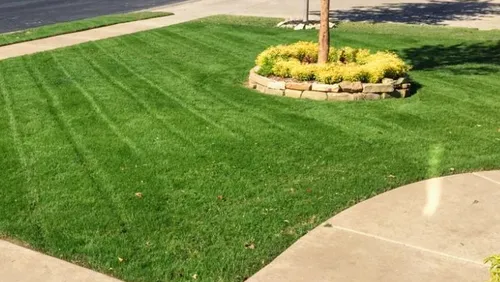
Living Water Outdoor Services | Artificial Turf Tulsa and Private Putting Greens provides artificial turf installation and yard drainage solutions in Tulsa, OK. They specialize in installing low-maintenance artificial lawns that include grading and drainage features to prevent puddling and water buildup. Their turf products are designed to resist fading and reduce bacteria, making them suitable for families and pets. The company also offers private putting greens as part of their outdoor services.
Edgington Construction
10211 E 46th Pl, Tulsa, OK 74146
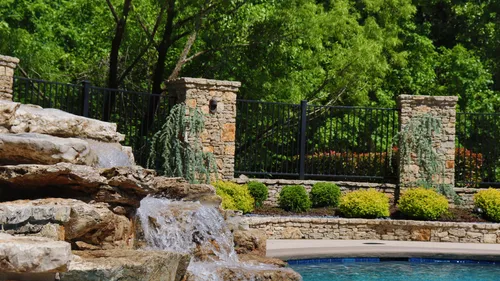
Edgington Construction is a landscaping and hardscaping contractor based in Tulsa, OK. They provide services including yard drainage, grading, land clearing, brush removal, landscaping, and the construction of patios, pavers, and retaining walls. The company is known for its expertise in building retaining walls and drainage systems, handling complex projects with creative solutions and quality materials. With over a decade of experience in luxury home building and landscaping, Edgington Construction has established a reputation for dependable project execution and attention to detail.
Understanding Oklahoma's Drainage Challenges
Oklahoma's climate and geology create a perfect storm for residential drainage issues. Successfully managing water on your property starts with recognizing these specific local factors.
Sudden, Intense Rainfall: Oklahoma is no stranger to powerful thunderstorms that can drop several inches of rain in a short period. A drainage system that works for a light, steady drizzle may be completely overwhelmed by the volume and speed of water from a typical Oklahoma storm. Effective systems must be designed to handle these large influxes quickly, moving water away from your home before it can pool and infiltrate.
Clay-Rich Soils: Much of Oklahoma has heavy clay soil, which presents a significant drainage hurdle. Clay has very small pores, causing it to absorb water slowly. Instead of percolating down, water often sits on the surface or runs off, leading to saturation and erosion. This often means surface solutions like regrading may not be enough, and deeper subsurface systems like French drains are necessary to manage the water below the impermeable clay layer.
Flash Flooding Risk: Properties located in low-lying areas or downslope from neighbors are at particular risk. In these situations, your yard may be receiving not only its own rainfall but also runoff from surrounding properties. Effective drainage planning must account for this additional water volume and direct it safely through or around your lot to a suitable discharge point, such as a storm sewer or dry well.
Core Principles of Effective Drainage & Grading
Regardless of the specific solutions you choose, all effective residential drainage in Oklahoma is built on a few foundational principles. Adhering to these will ensure your system performs as intended during the next downpour.
The Golden Rule: Slope Away from the Foundation. This is the single most important step. The ground should slope away from your home's foundation for a minimum of 10 feet, with a drop of at least 6 inches over that distance 1. This positive grading is your first line of defense, encouraging surface water to flow away from your basement or crawlspace walls before it can cause problems.
Intercept and Redirect. The goal is to intercept water at key points-like where it pours from a downspout or collects in a low spot-and redirect it to a safe discharge location. This prevents water from taking the path of least resistance, which is often toward your foundation. Systems work by creating a preferred path for the water to follow.
Manage Water at Multiple Levels. A robust approach addresses water on the surface, just below the surface, and deeper in the soil. Combining solutions, such as proper grading (surface) with downspout extensions (surface channeling) and a French drain (subsurface), creates a comprehensive defense that handles different types of water flow from the same storm.
Essential Yard Drainage Solutions for Oklahoma Homes
From simple maintenance to engineered systems, here are the most common and effective methods used to solve drainage problems in Oklahoma yards.
1. Proper Grading and Re-Grading
This is the process of shaping the soil to create the crucial slope away from your home. If your yard is flat or slopes toward the house, regrading is the necessary first step. It often involves bringing in fill dirt (typically a clay-sand mix that compacts well) to build up areas immediately around the foundation. For severe issues, professionals may use laser levels to ensure precise slope over the entire property.
2. Downspout and Gutter Management
Your roof collects a massive amount of water. If downspouts dump it right next to your foundation, you're inviting trouble. Simple, affordable solutions include adding downspout extensions (either above-ground or decorative) to carry water 4 to 6 feet away. For a cleaner look, underground downspout pipes can be installed to channel water to a pop-up emitter in a distant part of the yard or directly into a drainage system.
3. French Drains
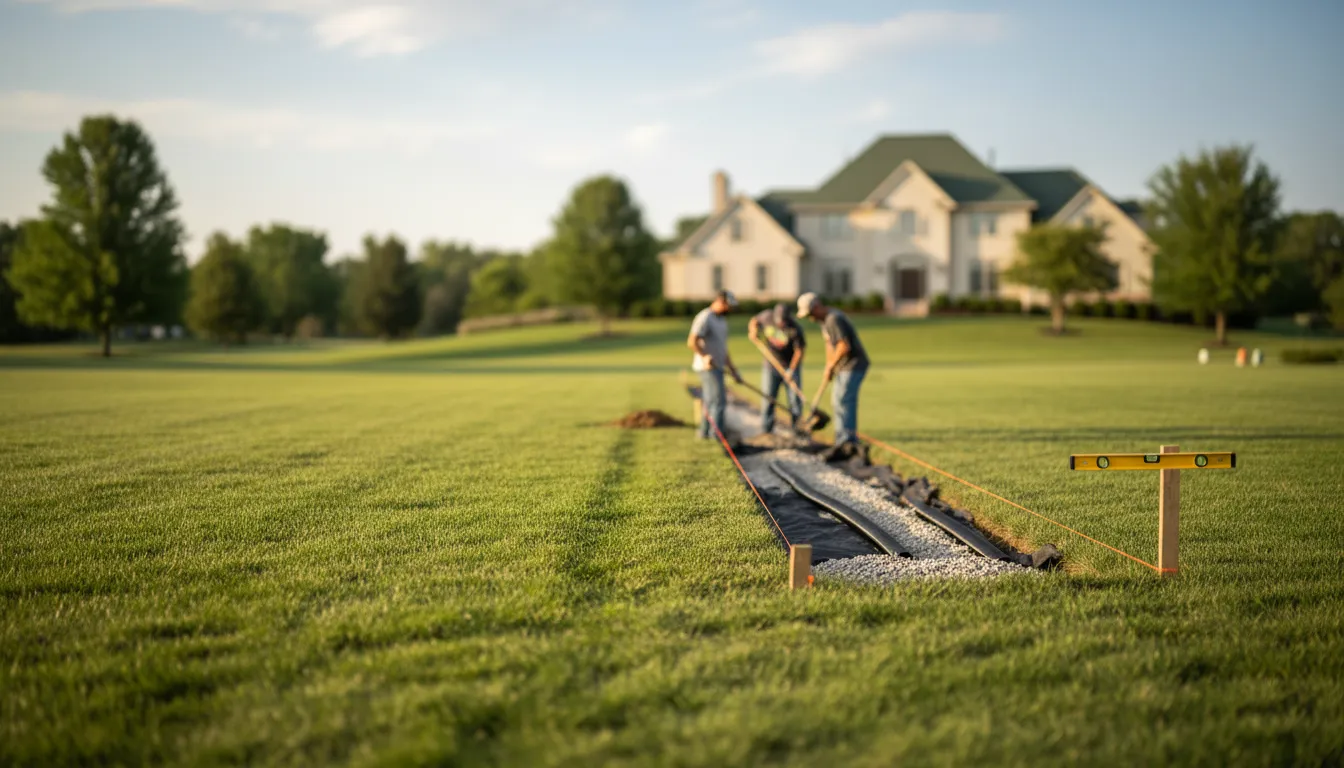
A French drain is a trench filled with gravel containing a perforated pipe, wrapped in landscape fabric to prevent clogging. It's designed to collect subsurface water (saturation in the soil) and surface water that seeps through the gravel, then carry it away. They are ideal for solving persistent wet spots in the middle of a yard or for intercepting water along a hillside or foundation footer. In Oklahoma's clay soil, they are often a necessary component for moving water that won't soak in.
4. Catch Basins and Channel Drains
These are inlets designed to capture concentrated surface water. A catch basin is a grated pit connected to an underground pipe, perfect for collecting water from a low spot in your lawn or patio. A channel drain is a long, narrow grated trench, commonly used across driveways, walkways, or at the edge of patios to stop water from pooling. Both connect to solid pipes that discharge the water to a safe location.
5. Dry Creek Beds and Riprap
Also known as swales, dry creek beds are shallow, landscaped trenches lined with river rock or riprap (larger, angular stone) 2. They are a decorative and functional way to manage surface runoff, particularly in sloped yards. The rocks slow the water flow, reducing erosion, and the channel directs it predictably. They mimic natural drainage paths and can be integrated beautifully into your landscape.
6. Rain Gardens
A rain garden is a depressed, bowl-shaped garden planted with native, water-tolerant plants. It's designed to temporarily hold and absorb runoff from roofs, driveways, or lawns. The plants and soil filter pollutants as the water slowly soaks into the ground. Rain gardens are an excellent eco-friendly solution for managing moderate amounts of runoff while adding beauty and supporting local pollinators.
Find the perfect yard drainage contractors for your needs
Get personalized recommendations and expert advice
Maintenance and Prevention Tips
A drainage system is only as good as its upkeep. Incorporate these simple habits to keep your yard's water management functioning optimally.
- Keep Gutters and Downspouts Clear: Clogged gutters overflow, dumping water directly next to your foundation and defeating the purpose of your roof drainage system. Clean them at least twice a year, in late fall and early spring.
- Inspect and Clean Drain Grates: Regularly remove leaves, grass clippings, and debris from the grates of any catch basins or channel drains to prevent blockages that can cause the system to back up.
- Check for Soil Settlement: Over time, soil around foundations can settle, reducing the crucial slope. Periodically check the grade and add topsoil as needed to maintain the 6-inch drop over 10 feet.
- Seal Foundation Cracks: Use hydraulic cement or specialized masonry sealant to fill any cracks in your foundation walls or floor. This prevents water that does reach the foundation from seeping inside.
- Use Gravel for Positive Backfill: When landscaping next to the foundation, use gravel instead of soil for the first few inches of backfill. Gravel creates a zone that drains water away from the wall more effectively than dense soil 3.
Understanding Costs for Drainage Work in Oklahoma
The investment for solving drainage problems varies widely based on the solution's complexity, the size of your yard, and the extent of the issue. Here's a general overview of potential costs:
- DIY Grading/Downspout Extensions: If you handle the labor, material costs for soil, extensions, and basic tools can range from $50 to $500.
- Professional Grading: Hiring a professional with the right equipment to regrade a typical residential yard typically costs between $500 and $2,000+, depending on the yard size and amount of dirt required.
- French Drain Installation: A professionally installed French drain system, due to the significant excavation and materials, usually ranges from $1,000 to $4,000 or more per section, based on length and depth.
- Catch Basin/Channel Drain System: Installing a system with inlets and underground piping generally falls in the range of $800 to $2,500+.
- Rain Garden Installation: Costs are primarily for plants and soil amendments, typically ranging from $300 to $1,500+ for a residential-sized garden 4 5 6 7 8.
Frequently asked questions
Sources
Footnotes
-
International Residential Code - Part III, Chapter 4, Foundations - https://kingstonpa.org/wp-content/uploads/2023/11/International-Residential-Code-Part-III-Chapter-4-Foundations.pdf ↩
-
Sloped Yard Drainage: 12 Best DIY Solutions for 2024 - https://salcorplandscaping.com/sloped-yard-drainage/ ↩
-
Rainwater Drainage Systems - https://rainguardok.com/gutter-services/downspouts-rainwater-drainage/ ↩
-
Addressing Drainage Issues in the Urban Landscape - https://extension.okstate.edu/fact-sheets/addressing-drainage-issues-in-the-urban-landscape.html ↩
-
12 Residential Backyard Drainage Solutions - Protect Your Yard - https://wilsonslawncare.com/12-residential-backyard-drainage-solutions/2024/ ↩
-
Oklahoma City Drainage Criteria Manual - https://www.okc.gov/files/assets/city/v/1/public-works/documents/dcm-final-september-24-2024-signed-debbie-miller.pdf ↩
-
10 Things You Can Do to Prevent Stormwater Runoff Pollution - https://www.farmington-ct.org/departments/engineering/stormwater/10-things-to-prevent-stormwater-pollution ↩
-
Effective Yard Drainage Solution - Transforming Backyards in ... - https://billscustomconcrete.com/effective-yard-drainage-solutions-transforming-backyards-in-okc/ ↩