Find the Best Yard Drainage Contractors for Your Business
No obligation • Fast responses • Nationwide coverage

Why you can trust Landscape Atlas
Landscape Atlas is a leading United States resource for evaluating landscaping, lawn care, and outdoor service providers. Our team researches each category in depth, focusing on service quality, safety, and customer experience. Listings and rankings are based on independent criteria and user feedback, and companies cannot pay to influence our assessments or recommendations.
Search providers near you
Top Yard Drainage Contractors in Tulsa, Oklahoma Ranked
If you're a Tulsa homeowner, you're likely familiar with the frustration of a soggy lawn, a perpetually damp basement, or standing water that just won't go away. Effective yard drainage and grading is the essential process of managing surface and subsurface water to protect your property's foundation, landscape, and usability. In a city with our unique clay soil, proper water management isn't just a luxury-it's a necessity for preventing costly structural damage and maintaining a healthy, beautiful yard. This guide will help you understand the common solutions available, from simple grading to complex French drain systems, so you can make an informed decision and connect with the right local experts to solve your water woes.
GreenPro Landscape and Design
7374 W 51st St, Tulsa, OK 74107
GreenPro Landscape and Design is a full-service landscaping company based in Tulsa, OK. They offer a wide range of services including landscape design, lawn fertilization and weed control, sprinkler installation and repair, yard drainage solutions, outdoor lighting installation, and hardscaping such as patios and retaining walls. Their team works closely with clients to create detailed landscape designs that consider property grading, elevations, and personal preferences. GreenPro uses premium materials and skilled workers to build and maintain outdoor spaces that last for decades.
Living Water Outdoor Services | Artificial Turf Tulsa and Private Putting Greens
Tulsa, OK
Living Water Outdoor Services | Artificial Turf Tulsa and Private Putting Greens provides artificial turf installation and yard drainage solutions in Tulsa, OK. They specialize in installing low-maintenance artificial lawns that include grading and drainage features to prevent puddling and water buildup. Their turf products are designed to resist fading and reduce bacteria, making them suitable for families and pets. The company also offers private putting greens as part of their outdoor services.
Pro Sprinkler
10338 E 11th St, Tulsa, OK 74128
Pro Sprinkler is a sprinkler and irrigation contractor serving Tulsa, OK. Since 2003, they have provided residential and commercial sprinkler system installation, repair, and redesign services, along with yard drainage solutions such as French drain installation. Their team offers custom irrigation designs and handles system winterization and startup. Pro Sprinkler is available 24/7 for emergency services, ensuring timely assistance when sprinkler issues arise.
Edgington Construction
10211 E 46th Pl, Tulsa, OK 74146
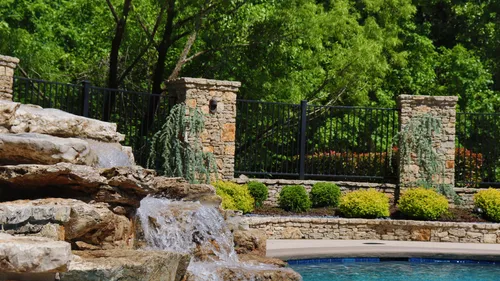
Edgington Construction is a landscaping and hardscaping contractor based in Tulsa, OK. They provide services including yard drainage, grading, land clearing, brush removal, landscaping, and the construction of patios, pavers, and retaining walls. The company is known for its expertise in building retaining walls and drainage systems, handling complex projects with creative solutions and quality materials. With over a decade of experience in luxury home building and landscaping, Edgington Construction has established a reputation for dependable project execution and attention to detail.
Outside Inc.
3503 N 225th E Ave, Catoosa, OK 74015
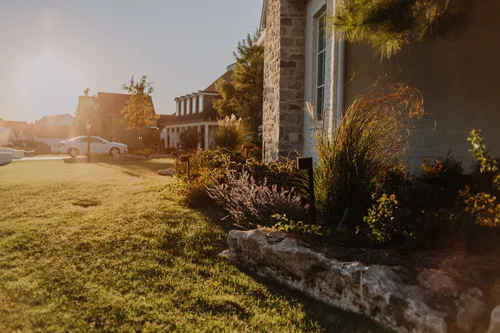
Outside Inc. is a landscaping and yard drainage contractor based in Tulsa, OK. They provide services including French drains, landscaping, and home maintenance solutions. Their offerings focus on outdoor drainage and landscaping projects to improve property functionality and appearance. Outside Inc. emphasizes competitive pricing and customer satisfaction in the Tulsa area.
Why Tulsa Homes Struggle with Drainage
The primary culprit behind many Tulsa drainage issues is our native soil composition. The region is known for its dense, heavy clay soil. Unlike sandy or loamy soils that allow water to percolate through quickly, clay particles are tiny and pack tightly together, creating a nearly impermeable layer. Water sits on the surface or moves very slowly, leading to pooling, erosion, and saturation. When this saturated soil is near your home's foundation, it can exert hydrostatic pressure, leading to cracks, leaks, and a damp basement or crawl space. Understanding this fundamental challenge is the first step toward an effective solution.
Core Solutions for Yard Drainage Problems
Tulsa professionals employ a range of techniques to combat water issues, often combining methods for a comprehensive solution. Here's a breakdown of the most common and effective systems.
Lawn Grading & Resloping
This is often the first line of defense. Grading involves reshaping the land's contour to create a gentle, consistent slope (typically a 2% grade, or about a 2-inch drop over 8 feet) away from your home's foundation 1. This directs surface runoff away from vulnerable areas. For more targeted flow, contractors may install swales-broad, shallow, grassy ditches that act as channels to guide water across your property to a safe discharge point, like a storm drain or dry well.
French Drain Systems
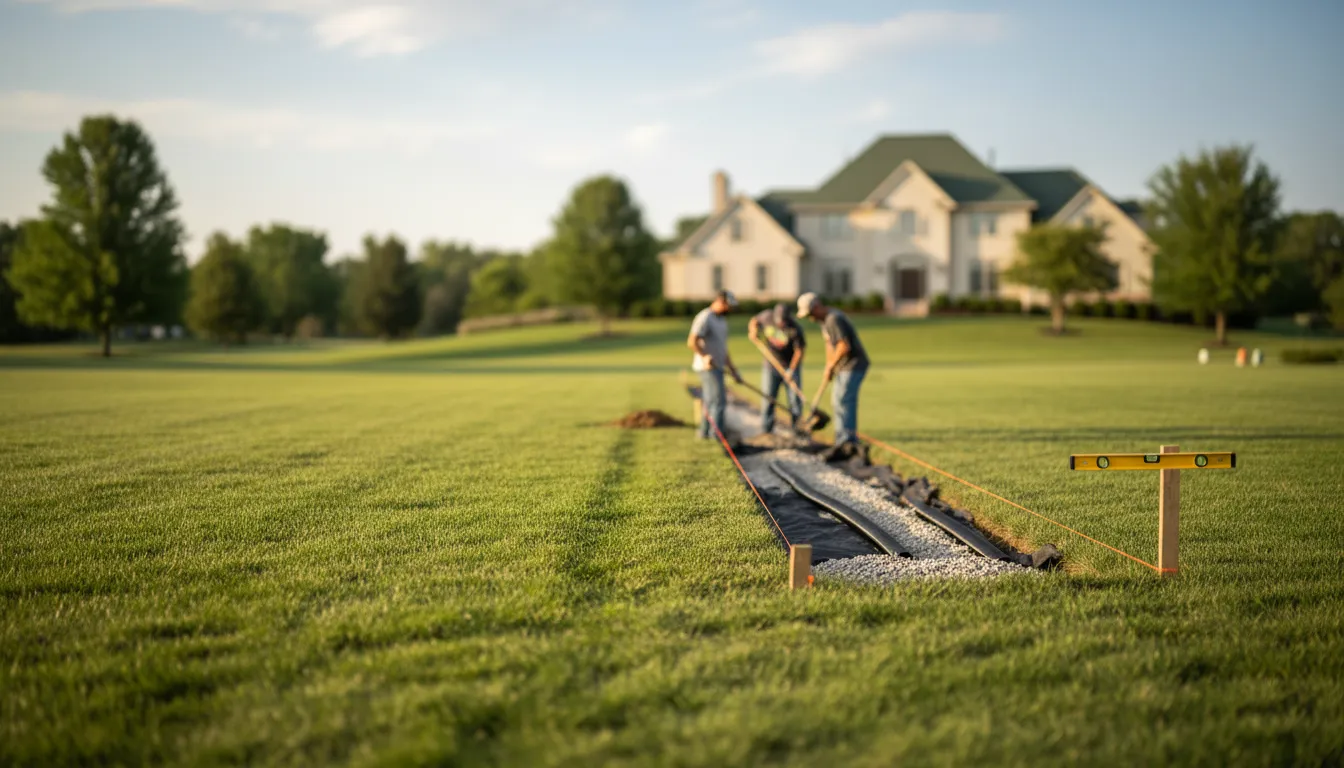
When surface grading isn't enough, a French drain (or subsurface drain) is a go-to solution. This involves digging a trench, lining it with filter fabric, laying a perforated pipe in a bed of gravel, and then covering it back up. The fabric prevents soil and roots from clogging the pipe, while the gravel bed allows water to seep in from the surrounding saturated soil. The pipe then collects this water and carries it away from the problem area. These systems are highly effective for solving soggy lawns and foundation water problems.
Catch Basins and Trench Drains
For dealing with heavy runoff from hard surfaces like driveways, patios, or pool decks, catch basins (also called drain inlets) and trench drains are ideal. A catch basin is a covered basin set into the ground at a low point, connected to an underground pipe. Water flows into the grate, is collected, and piped away. A trench drain is a long, narrow channel with a grate that runs along a surface, perfect for intercepting water running across a slope or patio.
Downspout Management and Extensions
One of the simplest yet most overlooked solutions is managing roof runoff. A single downspout can discharge thousands of gallons of water during a heavy rain. Downspout extensions, splash blocks, or underground piping can move this water at least 5 to 10 feet away from your foundation, preventing it from pooling right at your home's base 2. This is a low-cost intervention that can solve a surprising number of moisture issues.
Rain Gardens and Soil Amendment
For a more natural, ecological approach, a rain garden can be a beautiful solution. This is a shallow depression planted with native, water-tolerant plants. It's designed to collect runoff from roofs or yards, allowing it to slowly infiltrate into the ground while being filtered by the plants. For general soil health, amending clay soil with compost or sand can improve its structure and slightly increase permeability over time, though it is rarely a standalone fix for serious drainage problems 3.
The Professional Installation Process: What to Expect
Hiring a professional ensures the job is done correctly and complies with any local codes. Here's a typical process for installing a drainage system like a French drain:
- Site Assessment and Diagnosis: A specialist will inspect your property during or after a rain if possible. They'll identify the source of the water, its flow path, and the best discharge location. This step is crucial for a correct design.
- System Design and Planning: Based on the assessment, the contractor will design a system, determining the layout, depth, and type of pipes and components needed. They will mark utilities (call 811 before you dig!) and plan the trenching route.
- Excavation and Trenching: Trenches are dug, typically 12 to 24 inches deep and 6 to 12 inches wide, depending on the system. The soil is carefully removed and often saved for backfilling.
- Fabric Lining and Gravel Bed: The trench is lined with a geotextile filter fabric. A base layer of washed gravel is then added.
- Pipe Installation: The perforated drainage pipe is laid in the trench on the gravel bed, ensuring a consistent slope (usually 1% minimum) for proper water flow.
- Backfilling and Restoration: More gravel is added to cover the pipe, the fabric is wrapped over the top to create a "gravel burrito," and the trench is filled with soil. The area is then graded, seeded, or sodded to restore your lawn 4.
Find the perfect yard drainage contractors for your needs
Get personalized recommendations and expert advice
Understanding Costs for Drainage Work in Tulsa
The investment for yard drainage solutions in Tulsa varies widely based on the complexity of the problem, the size of your property, and the solutions chosen. It's important to get multiple quotes for your specific situation.
- Downspout Extensions and Splash Blocks: This is the most affordable option, often costing under $100 to $200 for materials and basic labor 5.
- Lawn Grading and Swales: Resloping a yard can range from a few hundred dollars for a small area to several thousand dollars for regrading an entire property, depending on the machinery and labor required.
- Catch Basins and Trench Drains: Installing a single catch basin with connecting pipe can cost several hundred to over a thousand dollars, with trench drains being similarly priced per linear foot 6.
- French Drain Systems: This is where most significant investments occur. For a standard residential French drain in Tulsa, homeowners can expect an average cost range of $2,500 to $3,700 7. However, simpler installations may come in under $1,000, while extensive systems for large properties or complex water issues can exceed $6,000 8 9 7. The depth, length, and accessibility of the area all dramatically affect the price.
Remember, Tulsa's challenging clay soil can make installations more complex, which is often reflected in the cost compared to areas with sandier soil 10. A proper installation by a qualified professional, though an upfront investment, protects the much larger investment you have in your home.
Maintaining Your Drainage System
Once installed, a good drainage system requires minimal maintenance, but a little care goes a long way. Periodically inspect the outlets of any pipes or extensions to ensure they are clear of debris and flowing freely. Check that splash blocks haven't shifted. Keep grass over swales mowed but avoid covering them with mulch or soil. For French drains and catch basins, ensure the surface grates or inlets are not clogged with leaves or lawn clippings. An annual visual check after the first big fall rain and again in spring is a smart habit.
Frequently asked questions
Sources
Footnotes
-
Yard Grading 101: Everything you need to know - This Old House - https://www.thisoldhouse.com/lawns/yard-grading ↩
-
How to Solve Yard Drainage Problems | Lowe's - https://www.lowes.com/n/how-to/solve-simple-drainage-problems ↩
-
How to improve drainage in your garden - Decorative Aggregates - https://decorativeaggregates.com/blogs/garden-inspiration/how-to-improve-drainage-in-your-garden ↩
-
How To Install An Outdoor Drainage System To Prevent Flooding - https://fixedtoday.com.au/blog/how-to-install-an-outdoor-drainage-system ↩
-
Standing Water in Yard: Causes & Solutions | AHS - https://www.ahs.com/home-matters/repair-maintenance/how-to-rid-standing-water-in-yard/ ↩
-
Yard Drainage Solutions for Tulsa Homeowners - https://affordabledrainageoftulsa.com/yard-drainage-solutions-for-tulsa-homeowners/ ↩
-
French Drains in Tulsa, OK - Costs 12 / 2025 - Homeyou - https://www.homeyou.com/ok/french-drains-tulsa-costs ↩ ↩2
-
Yard Drainage Services in Tulsa, OK - Fairway Lawns - https://fairwaylawns.com/location/tulsa-ok/yard-drainage-services-in-tulsa-ok/ ↩
-
Control Heavy Runoff - Solving Drainage and Erosion Problems - https://www.fairfaxcounty.gov/soil-water-conservation/drainage-problem-control-runoff ↩
-
Yard Drainage Solutions for Tulsa Homes | Fix Soggy Lawns - https://everythingoutdoorstulsa.com/yard-drainage-solutions-for-tulsa-homes-fix-soggy-lawns/ ↩