Find the Best Yard Drainage Contractors for Your Business
No obligation • Fast responses • Nationwide coverage

Why you can trust Landscape Atlas
Landscape Atlas is a leading United States resource for evaluating landscaping, lawn care, and outdoor service providers. Our team researches each category in depth, focusing on service quality, safety, and customer experience. Listings and rankings are based on independent criteria and user feedback, and companies cannot pay to influence our assessments or recommendations.
Search providers near you
Top Yard Drainage Contractors in Euclid, Ohio Ranked
Proper yard drainage and grading are essential for protecting your Euclid home from water damage. These services manage stormwater runoff, prevent soil erosion, and keep your basement dry by ensuring water flows away from your foundation. This guide explains the common water management solutions available locally, helping you understand your options for addressing pooling water, soggy lawns, and foundation concerns.
Clean N’ Green Lawn Services LLC
Cleveland, OH
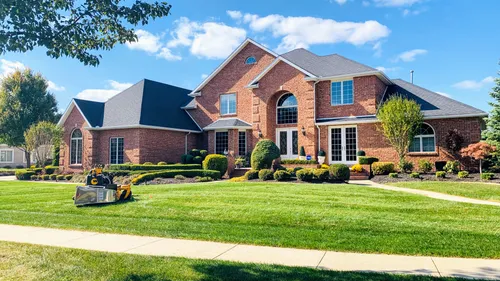
Clean N' Green Lawn Services LLC provides professional lawn care and landscaping services in Cleveland, OH. Their offerings include lawn mowing, fertilization and weed control, aeration and overseeding, yard drainage solutions, and hardscaping such as decorative concrete and retaining walls. The company serves multiple nearby communities including Brunswick, Medina, and Strongsville. Clean N' Green is fully licensed and insured, with a hands-on approach to customer service and project management.
Innovative Companies LTD
11148 Chardon Rd, Chardon, OH 44024
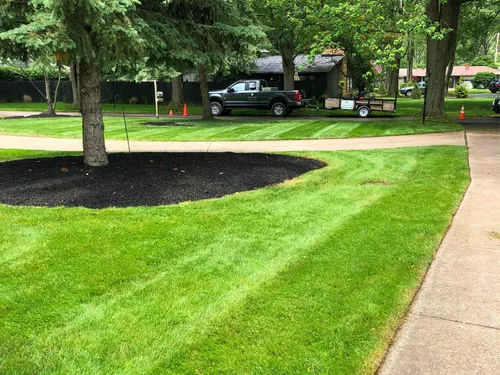
Innovative Companies LTD is a landscaping and hardscaping contractor serving Cleveland, OH, and nearby communities. They offer a wide range of services including landscape design and installation, lawn care, tree services, yard drainage, and outdoor lighting. Their capabilities include custom hardscaping such as retaining walls and fire pits, as well as hydroseeding for large or difficult areas. With 13 years of direct experience and a combined team skill of 75 years, they have completed numerous residential and commercial projects. The company also provides after-hours availability to accommodate customer scheduling needs.
Irrigation Incorporated
Cleveland, OH
Irrigation Incorporated is a Cleveland, OH-based company specializing in sprinkler system installation, irrigation repair, landscape lighting, yard drainage, and grading services. Established in 1998, they serve Cleveland and surrounding communities within a 30-mile radius, including Olmsted Falls, North Ridgeville, and Westlake. The company is known for its comprehensive sprinkler system services, including design, installation, maintenance, and backflow testing. They also handle drainage solutions to improve yard functionality. With over two decades of experience, Irrigation Incorporated offers expertise in installing multi-zone irrigation systems and adapting to changes in yard layouts to ensure effective water management.
Doskoch Lawn Care & Landscaping Services
605 Clague Rd, Bay Village, OH 44140
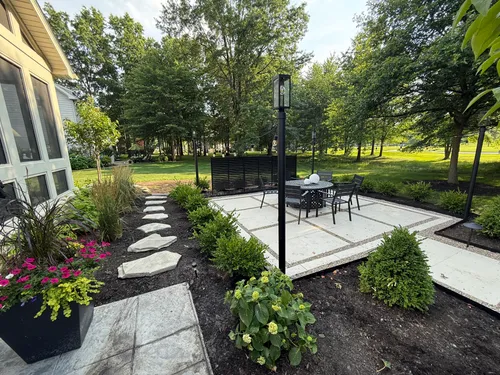
Doskoch Lawn Care & Landscaping Services provides full landscaping and snow removal services to residential and commercial customers in Cleveland, OH, and surrounding suburbs. Since 2018, they have offered year-round property maintenance including lawn mowing, spring and fall cleanups, weed control, sod installation, hardscaping, landscape lighting, and snow and salt management. Their expertise includes grading and sod installation to ensure proper drainage and a healthy lawn. Doskoch serves multiple communities such as Avon, Bay Village, Lakewood, and Westlake, offering comprehensive outdoor care throughout the year.
The Grounds Guys of Twinsburg, OH
Cleveland, OH
The Grounds Guys of Twinsburg, OH offers comprehensive landscaping services in Cleveland, OH, including lawn mowing, fertilization, weed control, sod installation, landscape lighting, irrigation system installation and repair, hardscaping, and yard drainage solutions. They provide both residential and commercial landscape maintenance, design, and installation services tailored to local climate and customer preferences. Their capabilities include custom irrigation systems and hardscaping features such as patios, retaining walls, and fire features. The Grounds Guys emphasize sustainable landscaping options like xeriscaping and native plant palettes to reduce water use while maintaining curb appeal.
Why Drainage and Land Grading Matter in Euclid
Euclid's proximity to Lake Erie and its location within the Euclid Creek Watershed means the area receives significant rainfall and snowmelt 1. Combined with the region's prevalent clay-heavy soil, which drains slowly, properties are at a higher risk for standing water, basement seepage, and landscape erosion 2. Effective surface and subsurface drainage systems are not just about a dry yard; they are a critical defense for your home's structural integrity. Proper lot grading directs water away from the foundation, while installed drainage systems capture and redirect excess water, safeguarding your investment and preventing costly repairs.
Common Yard Drainage and Landscaping Solutions
Local contractors employ a variety of techniques to solve water issues, from simple regrading to complex underground systems. The right solution depends on your property's specific topography, soil, and the source of the water problem.
Surface Re-Grading
This fundamental process involves adjusting the slope of your land. The goal is to create a gentle grade (typically a 2-5% slope) that channels surface water away from your home's foundation and toward a suitable outlet, like a storm drain or a vegetated swale 3. Regrading is often the first step in correcting drainage and can resolve issues caused by improper initial construction or soil settlement over time 4.
French Drains
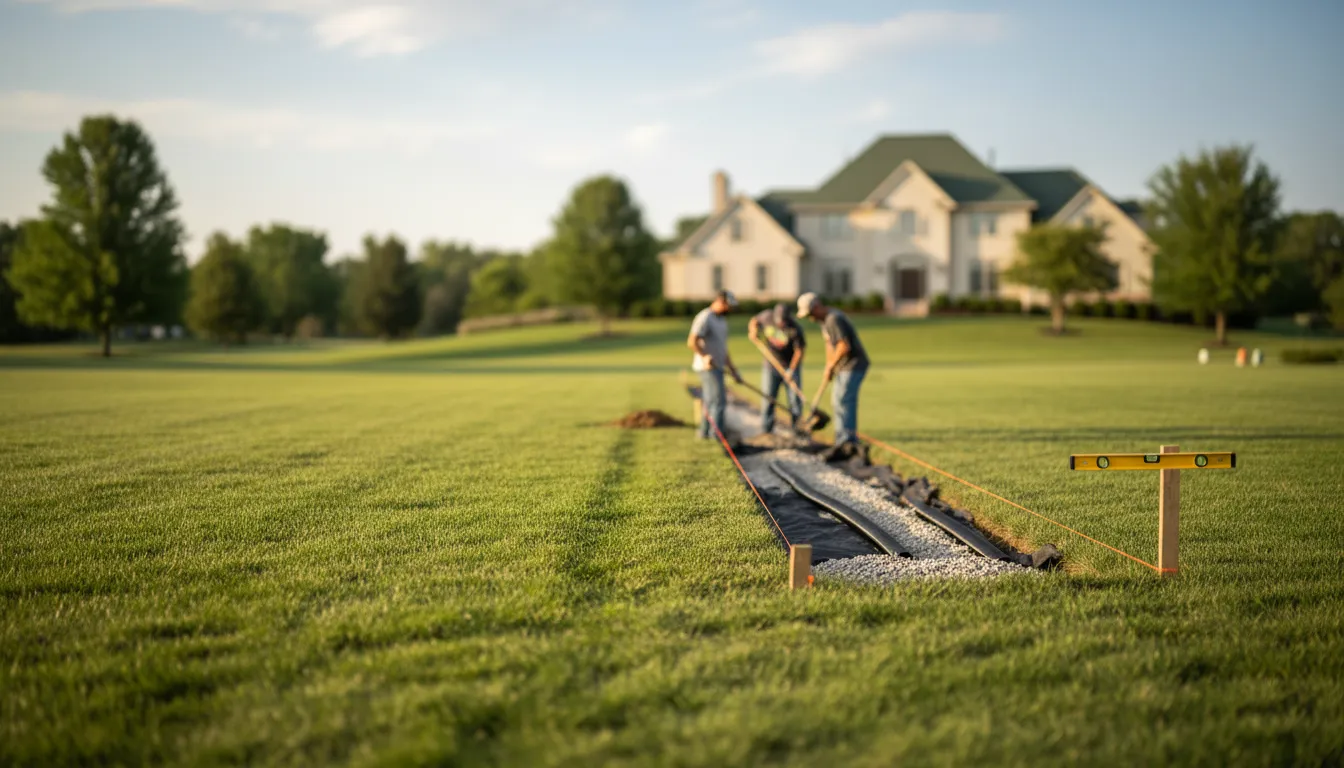
A French drain is a gravel-filled trench containing a perforated pipe. It is designed to intercept groundwater and subsurface water, collecting it and channeling it to a safe discharge point. These are particularly effective for relieving hydrostatic pressure against basement walls and preventing seepage. They are often installed around the perimeter of a home or in specific yard areas where water tends to accumulate.
Catch Basins and Channel Drains
These are surface-level inlets designed to capture pooling water. A catch basin is a grated drain set in a low spot, connected to an underground pipe that carries the water away 5. Channel drains (or trench drains) are long, narrow grates often used along driveways, patios, or walkways to quickly remove sheet flow. They are excellent for solving problems where water collects on hardscapes or at garage entries.
Downspout and Gutter Management
Often overlooked, managing roof runoff is a crucial part of a drainage plan. Simply extending downspouts several feet from the foundation can make a significant difference. For a more permanent solution, downspouts can be "tied-in" to underground drain pipes that direct roof water directly to a storm sewer or a designated drainage area, preventing soil saturation near the foundation 6.
Rain Gardens and Bioswales
These are landscaped, eco-friendly drainage features. A rain garden is a shallow depression planted with native species that can tolerate both wet and dry conditions; it collects runoff and allows it to slowly infiltrate the soil, filtering pollutants in the process 7. Bioswales are similar but are often longer, sloped channels designed to slow and treat water as it flows. The Northeast Ohio Regional Sewer District (NEORSD) even provides resources on potential credits for installing such green infrastructure 8.
Dry Wells and Infiltration Systems
A dry well is an underground chamber, often filled with gravel or rubble, that collects stormwater from downspouts or drainage pipes and allows it to percolate slowly into the surrounding soil. This is a good option when discharging water to the street or storm sewer isn't feasible, but it requires soil with adequate percolation rates.
Find the perfect yard drainage contractors for your needs
Get personalized recommendations and expert advice
The Professional Drainage Project Process
Understanding the typical steps can help you know what to expect when hiring a contractor for water management and erosion control services.
- Site Assessment and Diagnosis: A reputable contractor will first perform a thorough inspection, especially during or after rain. They will identify low spots, evaluate slope, locate the source of water, and check the condition of existing gutters and downspouts. This diagnosis is critical for designing an effective system 9.
- Design and Planning: Based on the assessment, the contractor will design a solution, which may combine several techniques like regrading and a French drain. They will also handle necessary steps like calling 811 to have underground utility lines marked 10.
- Permitting: Depending on the scope of work and local Euclid regulations, a permit may be required, especially if the work involves connecting to a municipal storm sewer or significantly altering lot drainage patterns 11. Your contractor should manage this process.
- Excavation and Installation: This is the construction phase. For grading, heavy equipment like skid-steers or small excavators may be used to move soil and establish the correct slope. For drainage systems, trenches are dug, pipes are laid and connected, and catch basins are set in place 12.
- Backfill and Restoration: Once pipes and structures are installed and tested, trenches are backfilled, often with gravel and soil. The final step is restoring your landscape by re-seeding sod, laying new topsoil, or re-establishing planting beds to blend the work seamlessly into your yard 13.
Local Considerations and Regulations in Euclid, OH
When planning a drainage or land grading project, it's important to consider local factors:
- Soil Conditions: Euclid's clay soil compacts easily and has slow permeability, which influences the choice and design of drainage solutions. Systems in clay often require more meticulous planning for water movement.
- Ohio Drainage Law: Ohio has specific laws regarding surface water. Generally, you have the right to improve drainage on your property, but you cannot divert water in a manner that causes harm to a neighboring property. Your new system should discharge water to a lawful outlet, such as a storm sewer, ditch, or your own rear yard where it can safely infiltrate, without creating a new problem for others 14.
- Watershed Awareness: Being in the Euclid Creek Watershed, managing stormwater on your property contributes to the health of the local ecosystem. Solutions like rain gardens that promote infiltration are encouraged.
Understanding Project Investment
Costs for residential grading and drainage solutions in Northeast Ohio vary widely based on the yard's size, the complexity of the problem, and the solutions chosen. Projects can range from $1,000 to $6,400 on average for combined grading and drainage work.
- Minor Corrections: Simple regrading of a small area or installing a single downspout extension might start around $500 or more.
- Major Systems: A comprehensive solution involving extensive French drains, multiple catch basins, and significant regrading for a full property can range from $3,000 to over $15,00015.
- Material Costs: As a component, materials like corrugated drainage pipe can cost roughly $100 or more per 100-foot roll, while individual channel drains may be $200-$300 each 16. Remember, professional installation includes labor, equipment, expertise, and often a warranty.
Frequently asked questions
Sources
Footnotes
-
Euclid Creek Watershed HUC-12 (04110003 05 03) - Ohio.gov - https://dam.assets.ohio.gov/image/upload/epa.ohio.gov/Portals/35/nps/Euclid%20Creek_Ver1.2_1-29-2020.pdf ↩
-
Landscaping Drainage in Northeast Ohio: Why Grading ... - https://www.pattiegroup.com/blog/posts/2025/may/landscaping-drainage-in-northeast-ohio-why-grading-drainage-are-critical-to-your-outdoor-space/ ↩
-
Protect Your Home: Essential Yard Drainage Tips - https://www.allentucklandscaping.com/grading-for-yard-drainage/ ↩
-
Land Grading | Helmling Excavating | Northeast Ohio - https://www.helmlingexcavating.com/land-grading ↩
-
Exterior Drainage Systems in the Cleveland Metro Area - https://www.choosekobella.com/plumbing/exterior-drainage/ ↩
-
Yard Water Issues and Drainage Solutions | Columbus Ohio - https://hydrabasement.com/yard-water-issues-and-drainage-solutions/ ↩
-
Drainage & Grading - Ground Works Land Design - https://groundworkslanddesign.com/design/drainage-grading/ ↩
-
I. Introduction - Northeast Ohio Regional Sewer District - https://www.neorsd.org/I_Library.php?SOURCE=library/NEORSD_Credit_Manual_Oct2021_DRAFT.pdf&a=download_file&LIBRARY_RECORD_ID=7716 ↩
-
Expert Landscape Grading Services in Cleveland, Ohio - https://thenativelandscape.com/landscape-grading/ ↩
-
Grading Services, Mentor, Concord, Painesville Township, OH - https://www.atlaslandscapingandconstruction.com/services/grading ↩
-
Grading and Drainage Solution | Solon, Ohio - https://www.ledgehillscapingoh.com/grading-and-drainage-solution ↩
-
Grading & Drainage Solutions | NW Ohio - https://www.hennessybrosllc.com/grading-and-drainage ↩
-
How To Install An Outdoor Drainage System To Prevent Flooding - https://fixedtoday.com.au/blog/how-to-install-an-outdoor-drainage-system ↩
-
Ohio Drainage Laws | Richland Soil & Water - https://richlandswcd.net/stormwater-drainage/ohio-drainage-laws/ ↩
-
Landscape Grading and Drainage Costs - https://www.whiteshovel.com/blog/landscape-grading-and-drainage-costs ↩
-
Erosion Control - https://www.jps.ca/erosion-control ↩