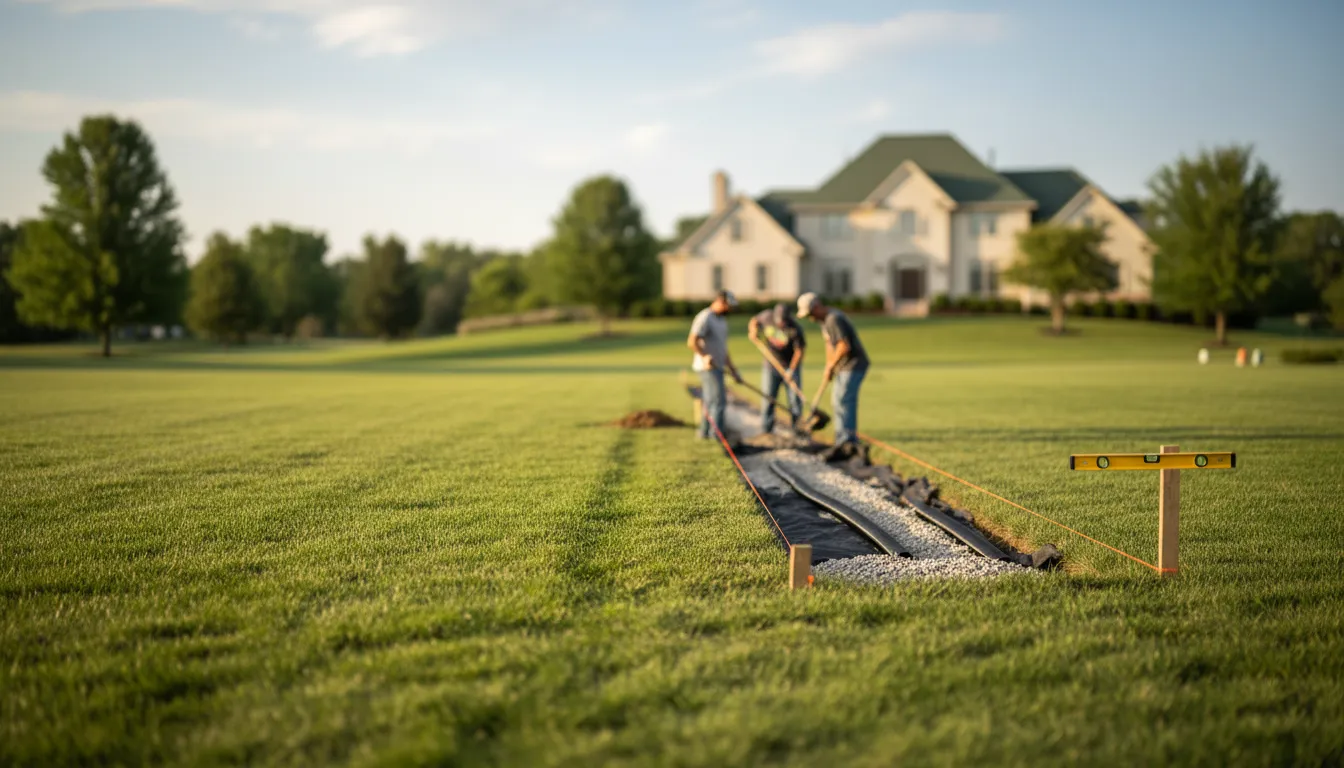
Find the Best Yard Drainage Contractors for Your Business
No obligation • Fast responses • Nationwide coverage

Why you can trust Landscape Atlas
Landscape Atlas is a leading United States resource for evaluating landscaping, lawn care, and outdoor service providers. Our team researches each category in depth, focusing on service quality, safety, and customer experience. Listings and rankings are based on independent criteria and user feedback, and companies cannot pay to influence our assessments or recommendations.
Search providers near you
Top Yard Drainage Contractors in Providence, Rhode Island Ranked
Effective water management is a critical component of maintaining a healthy, stable, and beautiful property in Providence. Yard drainage and grading services focus on controlling the flow of rainwater and runoff to protect your home's foundation, prevent soil erosion, and eliminate soggy, unusable areas in your landscape. With Providence's specific soil conditions and local stormwater regulations, finding the right solution is key. This guide will help you understand the common approaches, processes, and considerations for managing water on your property, connecting you with the expertise needed to solve drainage problems for good.
Edin And Sons Tree Service
Boston, MA
Edin And Sons Tree Service is a landscaping and tree care company serving Boston, MA. They offer a wide range of services including sod installation, landscape design, tree removal, stump grinding, yard drainage, sprinkler installation and repair, lawn care, and hardscaping such as patios and retaining walls. With 20 years of experience, they provide tailored solutions for both residential and commercial customers, focusing on practical landscaping and irrigation needs. Their capabilities include tree planting and transplanting, as well as drainage services to prevent lawn flooding.
Jones Contracting, Inc.
735 Washington St, Walpole, MA 02081
Jones Contracting, Inc. is a family-owned excavation and underground utility contractor based in Boston, MA. They serve homeowners, builders, and property managers throughout Greater Boston, offering services in residential sewer, water, drainage, and excavation work. Their capabilities include complex utility installations and sitework for residential, commercial, and municipal projects. Founded in 2004, the company brings over 40 years of combined experience and practical insight from civil engineering and field execution backgrounds to their projects.
Why Proper Drainage Matters in Providence
Ignoring drainage issues in Providence can lead to significant and costly problems. The city's mix of urban density and older housing stock, combined with specific soil types, creates unique challenges. Poor drainage can result in water seeping into basements and crawl spaces, leading to mold, mildew, and structural damage 1. Saturated soil around your foundation can also cause cracking and settling. Beyond the home itself, standing water kills grass, creates muddy patches, and can become a breeding ground for mosquitoes. Furthermore, uncontrolled runoff can carry pollutants from your property into the local watershed, which is why the City of Providence and the State of Rhode Island have guidelines in place to manage stormwater. Implementing proper surface and subsurface drainage isn't just about yard care; it's an investment in your property's longevity and environmental responsibility.
Common Yard Drainage Problems in Rhode Island
Homeowners in the Providence area typically face a few recurring water management issues:
- Foundation Pooling: Water collects against the home's foundation after rain, often due to negative grade (slope toward the house).
- Soggy Lawn or Boggy Areas: Low spots in the yard where water has no path to escape, creating perpetually wet grass or mud.
- Erosion: Fast-moving runoff, especially on sloped properties, washes away topsoil and mulch, carving unsightly gullies into the landscape.
- Overwhelmed Gutters and Downspouts: Roof runoff is discharged too close to the foundation, overwhelming the soil's ability to absorb it quickly.
- Neighbor's Runoff: Water from a neighboring property or a higher elevation flows onto your land, creating problems you didn't cause.
Understanding the symptom is the first step toward diagnosing the right drainage solution.
Comprehensive Drainage and Grading Solutions
Professional contractors in Providence employ a toolbox of methods, often combining them for a complete system. The right choice depends on your yard's topography, soil composition (Providence has areas with heavy clay soil), and the specific source of the water.
Regrading and Land Contouring
This is the process of reshaping the land's surface to create a gentle, positive slope that directs water away from structures. A common standard is achieving a minimum of 6 inches of vertical fall over the first 10 horizontal feet away from your foundation 2. Regrading is often the first and most fundamental fix for surface water issues and may involve creating swales (broad, shallow ditches) to channel water to a safe discharge point.
Subsurface Drainage Systems
When surface grading isn't enough, or the issue is groundwater, these underground systems are installed.
- French Drains: A trench is dug, filled with gravel, and contains a perforated pipe that collects and redirects subsurface water. It's capped with more gravel and often soil or sod, making it a discreet solution for wet basements or soggy lawns 3.
- Dry Wells and Catch Basins: A catch basin is a grated inlet at a low point that collects surface water. It connects to a pipe that channels water to a dry well-an underground chamber filled with gravel or rubble that allows water to slowly percolate into the surrounding soil 4.
- Underground Downspout Extensions: Instead of letting gutter water pour out at the base of your house, these systems connect downspouts to solid, buried pipes that carry roof runoff a safe distance away, often to a dry well or a drainage swale 5.
Green Infrastructure and Sustainable Solutions
The City of Providence actively encourages green infrastructure, which manages stormwater by mimicking natural processes.
- Rain Gardens: These are strategically placed, landscaped depressions filled with deep-rooted native plants and specialized soil. They are designed to capture and absorb runoff from roofs, driveways, and lawns, filtering pollutants and recharging groundwater.
- Permeable Pavers: For driveways, patios, and walkways, these interlocking pavers are set on a base of open-graded gravel that allows water to filter through the surface and into the ground below, drastically reducing runoff from paved areas 6.
Find the perfect yard drainage contractors for your needs
Get personalized recommendations and expert advice
The Professional Drainage Project Process
Hiring a professional for landscape drainage in Providence ensures the job is done correctly, safely, and in compliance with local codes. A typical project follows these steps:
- Site Assessment and Diagnosis: A contractor will visit after a rain event if possible to observe water flow. They will evaluate soil type, identify low points, check the existing grade, and locate underground utilities. This diagnosis determines the root cause of the problem 7 8.
- Design and Planning: Based on the assessment, the contractor designs a tailored system. This plan must consider Rhode Island Department of Environmental Management (RIDEM) and Coastal Resources Management Council (CRMC) regulations, especially if the project involves significant new impervious surfaces.
- Permitting: In Providence, a regulated municipality under the RIPDES stormwater program, many drainage projects require permits to ensure they meet state and local stormwater management plans 9. A reputable contractor will handle this process.
- Excavation and Installation: The physical work begins. This involves carefully digging trenches for pipes, shaping the land for regrading or swales, and installing all drainage components like pipes, basins, gravel, and amended soil for features like rain gardens 10.
- Backfill, Compaction, and Restoration: Once components are in place, soil is backfilled and mechanically compacted to prevent future settling. The area is then restored with topsoil, sod, seed, or the specific plantings required for a rain garden 11.
- Maintenance Guidance: A good contractor will provide a simple maintenance plan, which may include periodically clearing debris from catch basin grates, flushing pipes, and inspecting the system to ensure long-term functionality.
Understanding Costs for Drainage Work in Providence
The investment for yard drainage and grading solutions in Providence varies widely based on the system's complexity, yard size, soil conditions (rocky soil increases excavation costs), and labor 12. Below is a general cost breakdown based on typical project scopes.
| Solution Type | Average Cost (per linear foot or unit) | Typical Total Project Cost Range |
|---|---|---|
| Regrading/Excavation | $2 - $5 per sq. ft. (for a swale) | $1,400 - $6,000+ |
| French Drain | $10 - $50 per linear foot | $1,000 - $10,000+ |
| Underground Downspouts | $25 - $40 per foot | $300 - $2,000 per downspout |
| Dry Well/Catch Basin | N/A | $1,150 - $4,800 |
| Rain Garden | $5 - $25 per square foot | $500 - $3,000+ |
Professional labor rates typically range from $50 to $150 per hour. For most integrated drainage projects, homeowners can expect to spend between $2,500 and $8,000, with complex or large-scale systems costing more 13 14. It's important to view this not just as a cost, but as a protective investment in your property that can prevent far more expensive foundation repairs or basement waterproofing down the line.
Key Regulations and Environmental Considerations
Providence homeowners must be aware of local guidelines. The state's Stormwater Management Guidance for Single Family Lots provides a framework. Key points include:
- Impervious Surface Limits: Adding or replacing 600 square feet or more of impervious surface (like a large patio or driveway) triggers specific stormwater management requirements under RIDEM regulations.
- Discharge Locations: Water from drainage systems must be discharged to a suitable location, such as a storm sewer (with permission), a wooded area, or a designated drainage easement, without causing erosion or flooding on neighboring properties.
- Green Infrastructure Incentives: The City of Providence promotes solutions like rain gardens and permeable pavers as preferred methods for managing runoff sustainably and improving water quality in Narragansett Bay 15 16.
Working with a knowledgeable local contractor is the best way to ensure your project meets all necessary codes and contributes positively to the local environment.
Frequently asked questions
Sources
Footnotes
-
State of Rhode Island Stormwater Management Guidance for ... - https://www.crmc.ri.gov/stormwater/Single-Family-Lot-Guidance.pdf ↩
-
2021 International Residential Code (IRC) - R401.3 Drainage. - https://codes.iccsafe.org/s/IRC2021P3/chapter-4-foundations/IRC2021P3-Pt03-Ch04-SecR401.3 ↩
-
Landscape Drainage | Rhode Island - https://rainonelandscaping.com/construction/landscape-drainage-rhode-island/ ↩
-
Understanding Residential Drainage Solutions | Dry Wells ... - https://landdesignassociates.com/residential-drainage-solutions/ ↩
-
Patio Drainage Solutions for Your Rhode Island Backyard - https://www.rockhouseconstruction.com/patio-drainage-solutions-for-your-rhode-island-backyard ↩
-
A Homeowner Guide to Backyard Drainage Solutions - https://tamuradesigns.com/backyard-drainage-solutions/ ↩
-
Residential Drainage Systems: Common Lawn ... - J&J Materials - https://jjmaterials.com/residential-drainage-systems-common-lawn-drainage-problems/ ↩
-
How Do I Grade My Yard So It Can Drain Properly? - Dirt Connections - https://www.dirtconnections.com/how-do-i-grade-my-yard-so-it-can-drain-properly/ ↩
-
Rhode Island Stormwater Design and Installations Standards Manual - https://dem.ri.gov/sites/g/files/xkgbur861/files/programs/benviron/water/permits/ripdes/stwater/t4guide/slides/sess12.pdf ↩
-
How to Grade a Yard: Step-by-Step Guide for Proper Drainage - https://www.schmittwaterproofing.com/blog/yard-grading-101-how-to-grade-a-yard-for-proper-drainage-step-by-step/ ↩
-
How to Grade or Regrade Your Yard and Landscape - YardCare - https://www.yardcare.com/fixing-grade-problems-in-your-lawn/ ↩
-
How Much Does Yard Drainage Cost in 2025? Homeowner's ... - https://warelandscaping.com/how-much-does-yard-drainage-cost-in-2025 ↩
-
How Much Does Yard Drainage Cost? [2026 Data] | Angi - https://www.angi.com/articles/how-much-does-it-cost-install-landscape-drainage.htm ↩
-
How Much Does Yard Drainage Cost? - https://drainagefirst.com/how-much-does-yard-drainage-cost/ ↩
-
Stormwater Management - City of Providence - https://www.providenceri.gov/sustainability/stormwater-management/ ↩
-
REPORT - City of Providence - https://www.providenceri.gov/wp-content/uploads/2024/02/City-of-Providence-SWMPP-Full-Report.pdf ↩