Find the Best Land Clearing Contractors for Your Business
No obligation • Fast responses • Nationwide coverage

Why you can trust Landscape Atlas
Landscape Atlas is a leading United States resource for evaluating landscaping, lawn care, and outdoor service providers. Our team researches each category in depth, focusing on service quality, safety, and customer experience. Listings and rankings are based on independent criteria and user feedback, and companies cannot pay to influence our assessments or recommendations.
Search providers near you
Top Land Clearing Contractors in Denver, Colorado Ranked
Land clearing is the essential first step in transforming a raw piece of land into a usable space, whether for a new home, a commercial development, a fire-resistant landscape, or productive pasture. In Denver and the surrounding Front Range, this process involves the careful removal of trees, brush, stumps, and rocks to prepare a site for its next purpose. This guide explains the local process, methods, costs, and key considerations to help you understand your options and connect with qualified professionals for your specific project.
Tree Service Denver LLC
Denver, CO
Tree Service Denver LLC is an ISA-certified arborist company based in Denver, CO, offering a wide range of tree care services including tree removal, stump grinding, tree trimming, and land clearing. They specialize in safe removal of hazardous and storm-damaged trees, precision pruning to promote tree health, and emergency response services available 24/7. The company uses advanced equipment such as cranes and bucket trucks to handle complex urban tree removals while ensuring zero damage to property. Serving Denver families since 2011, they provide expert assessments, disease treatments, and sustainable solutions like tree planting and cabling to maintain healthy landscapes.
Clear Creek Fire Mitigation
3719 Evergreen Pkwy, Evergreen, CO 80439
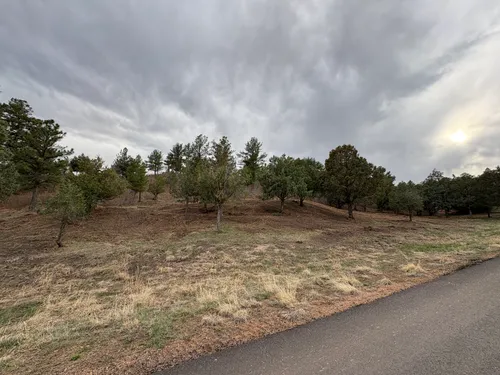
Clear Creek Fire Mitigation is based in Denver, CO, and specializes in fire mitigation, tree removal, stump grinding, and land clearing services. They serve landowners, homeowners, and business owners in Jefferson, Clear Creek, Park, Boulder, and Gilpin counties, focusing on properties larger than one acre. Their services include reducing wildfire risks through hazardous vegetation removal, thinning dense tree stands, and creating defensible spaces using specialized forestry equipment. They also provide forestry mulching to clear and grind trees, brush, and stumps into mulch, promoting soil health and reducing erosion.
Natural Tree Care and Recycling
Denver, CO
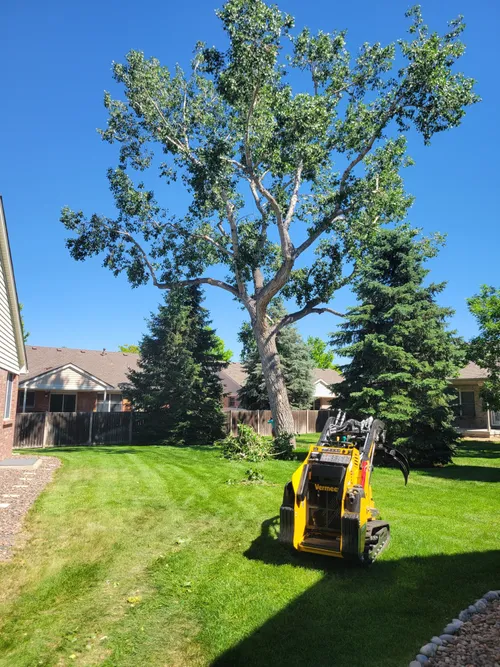
Natural Tree Care and Recycling provides a range of tree services including pruning, removal, fire mitigation, planting, pest management, and site clearance in Denver, CO. The company emphasizes natural and professional tree care, maintaining safety and aesthetic values while supporting local communities. With a combined 130 years of experience, their team is licensed and insured across the Denver metropolitan area, equipped to handle various tree care needs including consultations and recycling. The business is led by an ISA Certified Arborist and offers knowledgeable, skilled service focused on maintaining healthy and beautiful trees.
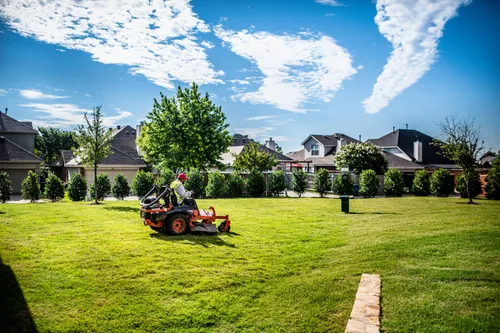
GKC Tree Care and Landscape Design Group
Denver, CO
GKC Tree Care and Landscape Design Group is a landscaping company based in Denver, CO, offering full-service landscape design, construction, and maintenance for homes and businesses. Founded in 2019 with over 15 years of experience from its founder, the company provides custom outdoor solutions including tree care, sod installation, fence and hardscape construction, yard drainage, sprinkler systems, and innovative jellyfish lighting installation. Their services emphasize tailored designs and functional outdoor living spaces, with capabilities like emergency tree removal and programmable permanent lighting. GKC also offers commercial landscaping and seasonal property maintenance, combining creativity and craftsmanship to transform outdoor areas.
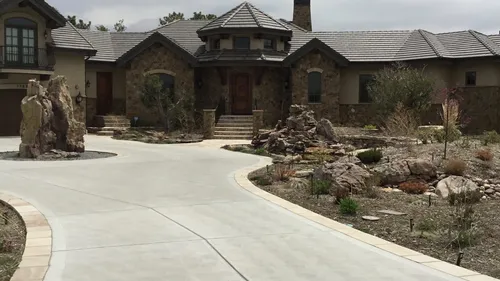
Mile High Land Concepts
Denver, CO
Mile High Land Concepts is a landscaping company based in Denver, CO. They provide a range of services including natural stone work such as patios, retaining walls, fire pits, and outdoor kitchens, as well as concrete and paver installations for driveways and pathways. The company also offers xeriscaping with rock gardens and decorative boulders, lawn maintenance including seasonal cleanups and trimming, tree and bush removal, fence installation, irrigation system setup, water features, sod installation, and mulch application.
Understanding the Land Clearing Process in Denver
A successful site clearing project in Denver follows a structured sequence to ensure safety, efficiency, and compliance with local regulations. It's more than just removing trees; it's a systematic preparation of your property.
Initial Consultation and Site Assessment Every project begins with a professional assessment. A specialist will visit your property to discuss your goals-be it for construction, wildfire mitigation, agricultural use, or landscape renovation. They will identify sensitive areas, such as drainage paths or protected vegetation, and clearly mark which trees or features are to be preserved. This planning stage is crucial for developing an accurate scope of work and quote.
Site Preparation and Safety Before any equipment arrives, the site must be prepared. This involves marking the precise boundaries of the clearing area and, most importantly, having all underground utilities located and flagged by calling 811. Erosion control measures are also planned at this stage to prevent soil runoff, which is a key environmental concern in Colorado.
Vegetation and Debris Removal This is the core phase where the chosen clearing method is executed. Depending on the density and type of growth, crews will use machinery or manual tools to cut, uproot, and process trees, shrubs, and brush. The approach varies significantly between clearing a lightly overgrown lot and clearing a densely wooded acre.
Stump and Root Extraction (Grubbing) For many projects, especially those involving future construction or grading, simply cutting trees is not enough. Grubbing is the process of removing stumps and root systems to create a truly clean slate and prevent future regrowth or interference with foundations and utilities.
Final Site Grading and Stabilization Once the land is cleared and grubbed, the final step is to shape and stabilize the soil. This may involve grading to ensure proper drainage, adding topsoil, and installing permanent erosion control measures like silt fencing or seeding. This prepares the land for its intended use, whether it's ready for a builder or simply a clean, open space 1 2.
Common Land Clearing Methods Used in the Denver Area
The terrain and vegetation along the Front Range demand specific techniques. Professional land clearing services select the method based on your site's characteristics and your end goal.
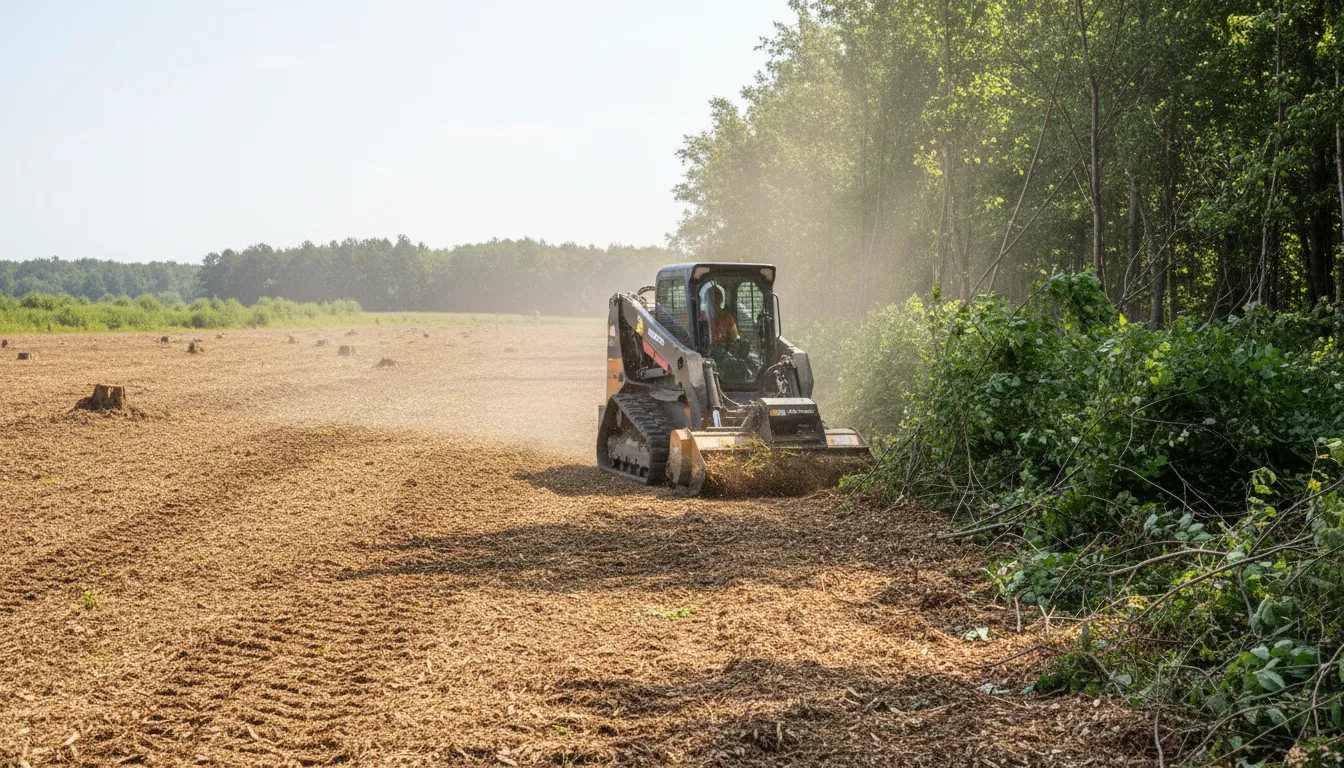
Mulching (Forestry Mowing) This is an excellent, low-impact method for clearing dense brush, small trees, and undergrowth. A heavy-duty mulching machine shreds vegetation into small wood chips, which can be left on-site as a natural ground cover that suppresses weeds and enriches the soil as it decomposes. It's less disruptive to the soil structure than other methods 3.
Grubbing and Dozing For larger trees and stubborn stumps, bulldozers equipped with specialized root rakes or rakes are used. This method, known as grubbing or dozing, physically pushes over and uproots trees, extracting the majority of the root ball. It's highly effective for total clearing but disturbs the soil more significantly 4.
Excavator-Based Clearing Tracked excavators are incredibly versatile for tough clearing jobs. Their powerful hydraulic arms and various attachments (like thumbs and shears) can selectively remove large trees, dig out deep stumps, and move boulders. Excavators are often the tool of choice for sloped or uneven terrain where precision is needed 5.
Manual Clearing For small, sensitive, or hard-to-access areas, manual clearing with chainsaws, brush cutters, and hand tools may be the best approach. This allows for maximum selectivity and minimal disturbance, though it is more labor-intensive and time-consuming for larger areas.
Find the perfect land clearing contractors for your needs
Get personalized recommendations and expert advice
What Happens to the Debris? Disposal and Recycling Options
Responsible debris management is a major component of a land clearing project. Denver-area companies typically offer several disposal pathways.
On-Site Processing: Chipping and Mulching As mentioned, mulching machines process debris immediately. Additionally, standalone wood chippers can turn tree limbs and trunks into usable mulch or wood chips, which can be spread on your property or sometimes removed by the contractor.
Hauling and Off-Site Disposal For material that cannot be left on-site, it is hauled away. Debris may be taken to local landfills, composting facilities, or biomass processors that convert wood waste into energy. Disposal fees are a significant part of the project cost and depend on the volume and type of material 6 7.
Burn Piles In some rural parts of the Denver metro area, controlled burn piles may be a permitted disposal method during certain times of the year. This is highly regulated. Any burning requires strict adherence to local fire department and air quality regulations, and professional services will handle the necessary permits and safety protocols if this option is viable.
Stump-Specific Solutions For stumps that are not removed via grubbing, stump grinding is a common service. A grinder reduces the stump below ground level into a pile of wood chips. The resulting chips can often be used as mulch, while larger logs from tree removal may be hauled away or even milled for lumber 8.
Cost Factors for Land Clearing in Denver
Land clearing costs in Denver are rarely a flat fee and are influenced by numerous variables. Understanding these factors will help you interpret quotes more accurately.
Pricing Structures: Per Acre vs. Per Hour For larger parcels, pricing is often quoted per acre. This can range dramatically from around $1,000 per acre for light brush clearing to $10,000 or more per acre for land with dense, large trees and complex stumps 9 10. For smaller or more complex projects, contractors may charge per hour for equipment and labor, with heavy machinery like dozers and excavators typically costing between $150 and $300+ per hour 11 12.
Key Variables That Affect Price
- Density and Type of Vegetation: A field of sagebrush costs far less to clear than a forest of mature pine trees.
- Terrain and Slope: Steep, rocky, or uneven land requires more time, specialized equipment, and skill to clear safely.
- Tree Size and Stump Quantity: Large-diameter trees and numerous stumps exponentially increase the labor and equipment needs.
- Site Access: Easy access for large equipment keeps costs down. Tight, restricted access may require smaller machines or manual labor, increasing time and price.
- Disposal Fees and Method: Hauling debris to a landfill incures tipping fees, while on-site mulching may reduce disposal costs.
- Local Regulations: Permit requirements, erosion control mandates, and protected tree ordinances can add to project planning and cost.
The most important step is to get multiple detailed, written quotes that break down the scope, method, timeline, and disposal plan.
Preparing for a Land Clearing Project
Being an informed property owner leads to a smoother project. Before you hire a service, confirm they are licensed, insured, and have experience with Denver-area regulations. Discuss your long-term vision for the land so they can advise on the best clearing approach. Ensure your contract clearly outlines the work scope, cleanup standards, debris disposal method, and final site condition. Proper planning transforms the complex process of land clearing into a straightforward path toward realizing your property's potential.
Frequently asked questions
Sources
Footnotes
-
What is Land Clearing Excavation and Why is It Important? - https://glacierridgeexcavation.com/what-is-land-clearing/ ↩
-
Land Clearing 101: What You Need to Know Before Starting - https://www.regstreeservices.com/land-clearing-101-what-you-need-to-know-before-starting ↩
-
How to Clear Land for Farming! | 48-Year Veteran Explains - https://www.victoriafarmeq.com/blog/how-to-clear-land-for-farming ↩
-
Methods and Equipment for Land Clearing - https://rrconstructioninc.com/2023/10/methods-and-equipment-for-land-clearing/ ↩
-
Top 5 Methods of Land Clearing | Which Is Right for You? - Valor - https://www.valorenv.com/top-5-methods-of-land-clearing-which-is-right-for-you/ ↩
-
Land Clearing, Brush Removal | Denver, Brighton, CO - https://www.cowgirldemolition.com/land-clearing/ ↩
-
A Quick Guide to Clearing Land for Your Business - https://wattstreeservice.com/a-quick-guide-to-clearing-land-for-your-business/ ↩
-
Guide to Effective Land Clearing - Dreamworks Tree - https://www.dreamworkstrees.com/your-guide-to-land-clearing/ ↩
-
Top 5 Methods of Land Clearing | Which Is Right for You? - Valor - https://www.valorenv.com/top-5-methods-of-land-clearing-which-is-right-for-you/ ↩
-
What is Land Clearing? - Tidd Tree - https://tiddtree.com/what-is-land-clearing/ ↩
-
Equipment Needed for Land Clearing | The Cat Rental Store - https://www.catrentalstore.com/en_US/blog/equipment-land-clearing.html ↩
-
Land Clearing Services in North Metro Denver - https://www.monstertreeservice.com/north-metro-denver/our-services/tree-removal/land-clearing/ ↩