Find the Best Yard Drainage Contractors for Your Business
No obligation • Fast responses • Nationwide coverage

Why you can trust Landscape Atlas
Landscape Atlas is a leading United States resource for evaluating landscaping, lawn care, and outdoor service providers. Our team researches each category in depth, focusing on service quality, safety, and customer experience. Listings and rankings are based on independent criteria and user feedback, and companies cannot pay to influence our assessments or recommendations.
Search providers near you
Top Yard Drainage Contractors in New Haven, Connecticut Ranked
A soggy lawn, a perpetually flooded patio, or water pooling against your foundation are more than just nuisances-they are signs of a yard drainage problem that can threaten your property's structural integrity and landscape health. Proper yard drainage and grading involves managing the flow of water across your property to prevent erosion, flooding, and water damage. This guide explains the common solutions for New Haven homeowners, from simple regrading to complex French drain systems, and how to connect with local professionals who understand Connecticut's specific soil conditions and climate to implement an effective, long-term fix.
Why Proper Drainage is Critical in New Haven
New Haven's weather patterns, with seasonal snowmelt and heavy rainstorms, can quickly overwhelm poorly graded landscapes. The region's clay-heavy soils, common in Connecticut, are particularly prone to poor drainage as they absorb water slowly, leading to surface runoff and saturation. Without proper water management, you risk foundation cracks, basement flooding, destroyed landscaping, and the creation of mosquito-breeding grounds. Effective drainage solutions protect your investment and enhance your outdoor living space's usability and safety.
Common Yard Drainage Problems and Their Signs
Identifying the issue is the first step toward a solution. Look for these telltale signs in your New Haven yard:
- Standing Water: Puddles that remain for more than 24 hours after rain.
- Soil Erosion: Gullies or washed-away soil in planting beds or on slopes.
- Soggy Lawn: Spongy, constantly wet grass, often with moss or fungus growth.
- Water in the Basement: Damp walls, efflorescence (white, chalky residue), or active seepage.
- Foundation Issues: Cracks in exterior foundation walls or inward-bowing basement walls.
- Downspout Overflow: Water cascading directly from gutters onto the ground next to the house.
A simple "hose test" can help confirm poor drainage: run a hose in a suspected problem area and observe where the water flows (or doesn't). If it pools, you have a grading or subsurface drainage issue.
Core Solutions for Yard Drainage and Grading
A range of techniques exists to manage water, from surface redirection to subsurface collection. The right solution depends on your yard's specific topography, soil type, and the problem's severity.
1. Grading and Sloping
This is the foundational practice of shaping the soil's surface. The goal is to create a gentle, consistent slope (ideally 3-5%) away from your home's foundation and other structures to guide surface runoff to a safe dispersal area like a street gutter, storm drain, or dry well. Regrading is often the first line of defense against water pooling near foundations.
2. French Drains
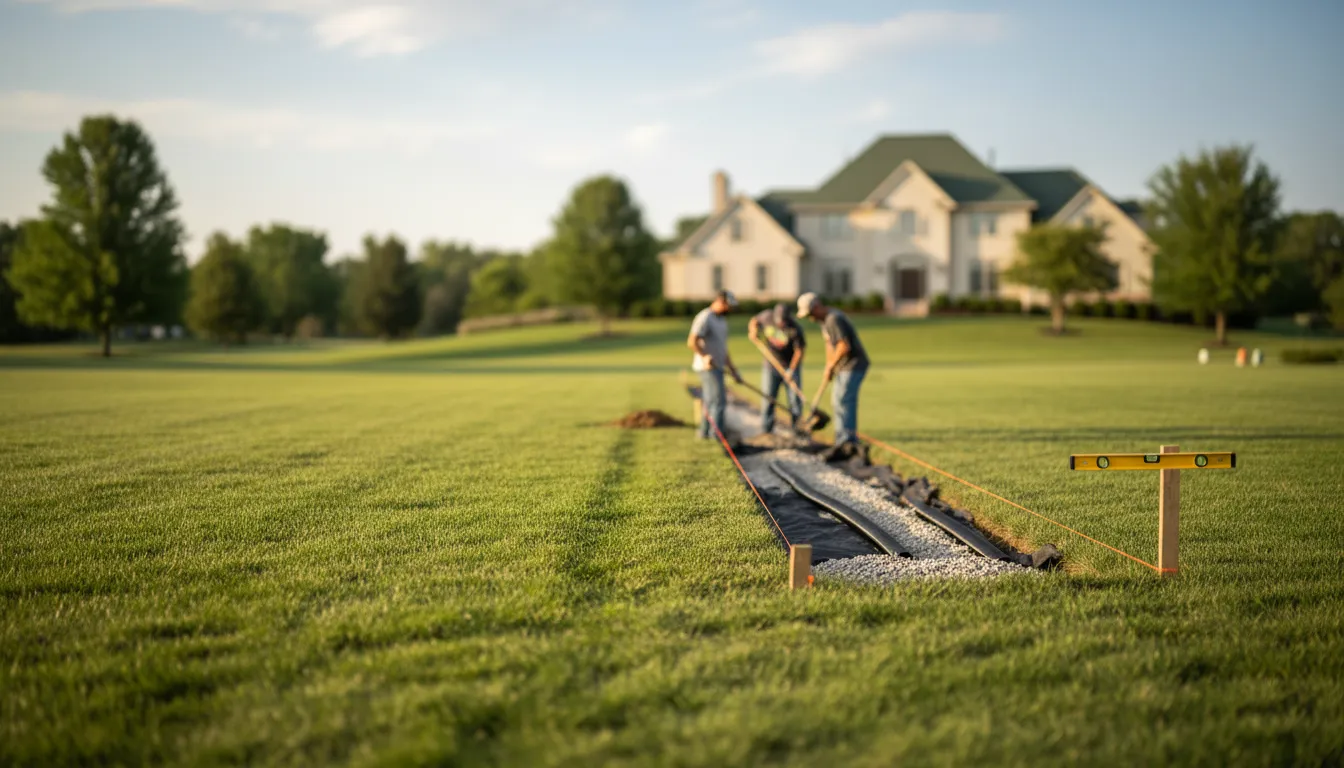
A French drain is a subsurface workhorse for managing groundwater and soggy lawns. It consists of a sloped trench filled with gravel and a perforated pipe wrapped in filter fabric. The system collects water from saturated soil and redirects it to a designated outlet. French drains are highly effective for New Haven yards with persistent dampness or where regrading alone is insufficient.
3. Swales and Dry Stream Beds
Swales are broad, shallow, vegetated channels designed to move surface water across your landscape. They can be seamlessly integrated into your landscaping. A "dry stream bed" is a more decorative version, using river rock and stones to line a swale, creating a natural-looking drainage path that handles runoff during storms 1 2.
4. Rain Gardens
A rain garden is a beautiful and eco-functional solution. It's a depressed area planted with native, water-tolerant vegetation that collects runoff from roofs, driveways, or lawns. The plants and soil filter pollutants and allow water to infiltrate slowly into the ground, recharging groundwater. They are an excellent option for managing runoff in a specific low spot.
5. Dry Wells and Catch Basins
A dry well is an underground chamber filled with gravel or rubble that collects water from downspouts or drainage pipes and allows it to percolate slowly into the surrounding soil. A catch basin is a grated inlet placed in a low spot that connects to a pipe, channeling surface water away. These are key components for managing concentrated flows 3.
6. Downspout and Surface Management
Often, the simplest fixes yield big results. Extending downspouts at least 5-10 feet away from your foundation is crucial. Using splash blocks, buried drain pipes, or connecting to a dry well can prevent a torrent of roof water from undermining your home's perimeter. Similarly, using permeable materials like gravel, mulch, or porous pavers for walkways and patios helps water soak in rather than run off 4.
Find the perfect yard drainage contractors for your needs
Get personalized recommendations and expert advice
The Professional Installation Process
For anything beyond minor DIY fixes, working with a licensed Connecticut contractor ensures the job is done correctly, safely, and in compliance with local codes. Here's what a typical professional drainage project entails:
- Assessment and Design: A specialist will evaluate your yard's slope, soil, and water flow to diagnose the core issue. They will then design a system tailored to your property, determining the optimal location, size, and outlet for any drains or swales. In New Haven, this stage may involve checking if a permit is required for major excavation or connection to municipal systems 5.
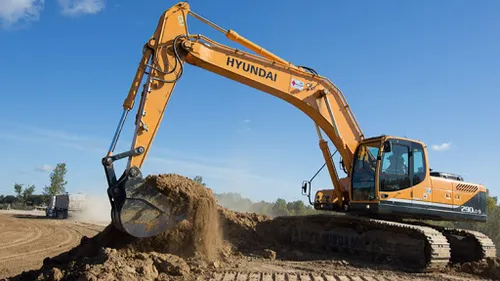
- Excavation: Using machinery or hand tools, crews dig the necessary trenches for pipes or basins, ensuring a consistent, downward slope for water flow.
- System Installation: For a French drain, this involves lining the trench with filter fabric (to prevent soil clogging), placing the perforated pipe, and backfilling with clean gravel or stone 6. For grading, soil is moved and compacted to the precise grade.
- Finishing: The fabric is wrapped over the gravel, and the trench is topped with soil and sod or decorative stone. For regrading, new topsoil and grass seed or sod are applied to restore the lawn.
Understanding Costs for Drainage Work in New Haven
Costs vary significantly based on the solution's complexity, yard size, accessibility, and materials. Here's a general range to help set expectations:
- DIY/Minor Fixes: $50 - $500 for materials like soil for regrading a small area, splash blocks, or plants for a small rain garden 7.
- Rain Garden Installation: $300 - $1,500+ for professional design, excavation, soil amendments, and native plants 8 9.
- Basic French Drain: $1,000 - $3,000+ for a professionally installed system of 50-100 linear feet 10.
- Dry Well or Catch Basin: $1,000 - $2,500+ per unit, including excavation and connection to downspouts or drains 11.
- Extensive Grading or Complex Drainage Systems: $2,000 - $10,000+ for projects involving significant earthmoving, multiple integrated systems, or challenging landscapes 12.
Investing in a proper drainage system can save tens of thousands in potential foundation or basement repair costs down the line.
Choosing a Local New Haven Professional
For effective, lasting results, it's essential to hire a contractor with specific experience in yard drainage and grading in Connecticut. Look for licensed landscapers or drainage experts who understand local soil conditions (like our prevalent clay) and weather patterns. They should be able to provide a clear assessment, a detailed plan, and references for similar projects. Reputable local companies are familiar with New Haven's permitting process and can ensure your system is both effective and code-compliant 13.
Frequently asked questions
Sources
Footnotes
-
Control Heavy Runoff - Solving Drainage and Erosion Problems - https://www.fairfaxcounty.gov/soil-water-conservation/drainage-problem-control-runoff ↩
-
Sloped Yard Drainage: 12 Best DIY Solutions for 2024 - https://salcorplandscaping.com/sloped-yard-drainage/ ↩
-
6 Ways to Divert Water - The Home Depot - https://www.homedepot.com/c/ai/6-ways-to-divert-water/9ba683603be9fa5395fab90120dc3412 ↩
-
5 Effective Methods of Managing Urban Stormwater Runoff - https://www.pathlightpro.com/5-effective-methods-of-managing-urban-stormwater-runoff/ ↩
-
Quick Ways to Check the Quality of Yard Drainage - C&T Landscape - https://ctlandscaping.ca/quick-ways-to-check-the-quality-of-yard-drainage/ ↩
-
How To Install An Outdoor Drainage System To Prevent Flooding - https://fixedtoday.com.au/blog/how-to-install-an-outdoor-drainage-system ↩
-
How to Solve Yard Drainage Problems | Lowe's - https://www.lowes.com/n/how-to/solve-simple-drainage-problems ↩
-
Solving Yard Drainage Problems: A Homeowners Guide - https://www.jdconstruction-ct.com/blog/comprehensive-drainage-solutions/solving-yard-drainage-problems ↩
-
What You Can Do to Soak Up the Rain | US EPA - https://www.epa.gov/soakuptherain/what-you-can-do-soak-rain ↩
-
#1 Best Rated Drainage Solutions In Rocky Hill CT - https://www.sceniclandscapingct.com/drainage-solutions/ ↩
-
12 Residential Backyard Drainage Solutions - Protect Your Yard - https://wilsonslawncare.com/12-residential-backyard-drainage-solutions/2024/ ↩
-
Yard Grading 101: Everything you need to know - This Old House - https://www.thisoldhouse.com/lawns/yard-grading ↩
-
Best Landscape Yard Drainage Solutions in Connecticut - https://www.coastalcreationsct.com/best-landscape-drainage-solutions-in-connecticut/ ↩