Find the Best Yard Drainage Contractors for Your Business
No obligation • Fast responses • Nationwide coverage

Why you can trust Landscape Atlas
Landscape Atlas is a leading United States resource for evaluating landscaping, lawn care, and outdoor service providers. Our team researches each category in depth, focusing on service quality, safety, and customer experience. Listings and rankings are based on independent criteria and user feedback, and companies cannot pay to influence our assessments or recommendations.
Search providers near you
Top Yard Drainage Contractors in Battle Creek, Michigan Ranked
A well-drained yard is the foundation of a healthy, usable outdoor space. Yard drainage and grading services focus on solving water problems by reshaping the land and installing systems to manage surface and subsurface water flow. This is crucial in Battle Creek to protect your home's foundation, prevent basement flooding, eliminate soggy lawns, and control erosion. The following guide will help you understand the common solutions available from local professionals, so you can find the right expertise to address your property's specific needs.
Understanding Battle Creek's Drainage Challenges
Michigan's climate, with its seasonal snowmelt and heavy spring rains, presents unique challenges for homeowners. Battle Creek's soil composition can vary, with some areas having heavy clay that drains poorly, leading to standing water and saturated ground. Effective water management isn't just about fixing a puddle; it's about protecting your investment. Poor drainage can undermine foundations, ruin landscaping, create hazardous icy patches in winter, and foster mold and insect problems. A professional assessment is the first step toward a permanent solution that works with the local environment.
Core Solutions for Residential Drainage
Local contractors employ a range of techniques to redirect water away from your home and into appropriate discharge areas. The right solution depends on the source, volume, and flow path of the water on your property.
Regrading and Swales
This is often the first line of defense. Regrading involves reshaping the earth's surface to create a gentle, consistent slope-typically a minimum 2% grade-away from your home's foundation. A swale is a shallow, grassy channel designed to carry surface runoff across your yard to a safe outlet, like a storm drain or a dry well. It's a simple, natural-looking, and highly effective method for correcting minor to moderate surface water issues 1 2.
French Drain Systems
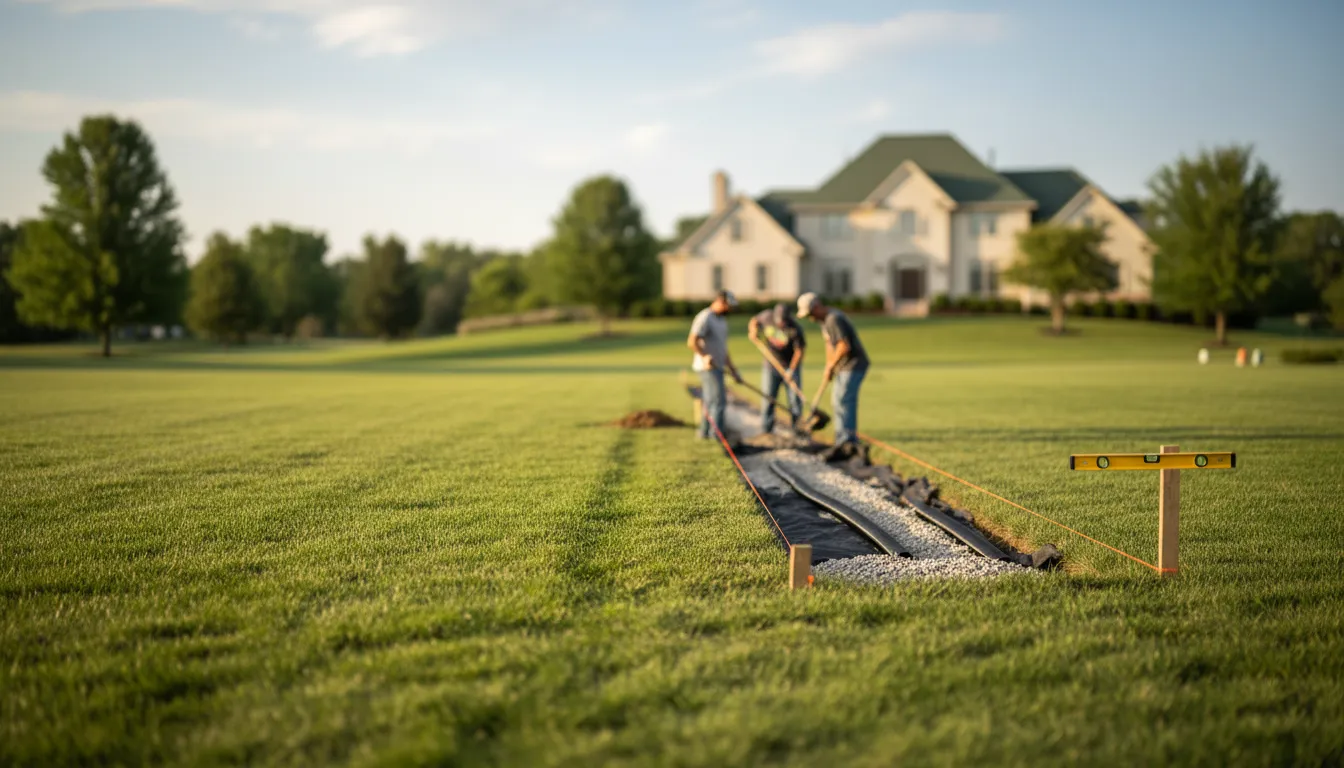
For persistent soggy spots or subsurface water pressure against foundation walls, a French drain is a classic solution. This involves digging a trench, lining it with landscape fabric, adding a bed of gravel, laying a perforated pipe, and covering it with more gravel. The system collects groundwater and channels it away from the problem area. It's particularly effective for managing water that seeps into lawns or basements from the sides.
Catch Basins and Channel Drains
These are surface-level solutions for collecting heavy runoff from hardscapes. A catch basin is a grated inlet installed in a low spot in your yard, driveway, or patio, connected to an underground pipe that carries the water away. Channel drains are linear grates often placed along driveways, walkways, or garage aprons to intercept sheet flow. They are essential for dealing with concentrated water flow from roofs or large impervious surfaces 3.
Dry Wells and Rain Gardens
When there's no convenient storm sewer or ditch to discharge into, storage solutions become key. A dry well is an underground pit filled with gravel or a specialized chamber that collects runoff from downspouts or drains, allowing it to slowly percolate into the surrounding soil. A rain garden is a landscaped depression planted with native, water-tolerant vegetation. It collects runoff, filters pollutants, and allows water to infiltrate the ground, embodying Low Impact Development (LID) principles that mimic natural hydrology.
Find the perfect yard drainage contractors for your needs
Get personalized recommendations and expert advice
The Professional Installation Process
A successful drainage project follows a logical sequence to ensure longevity and effectiveness. Understanding this process can help you know what to expect when working with a Battle Creek contractor.
- Site Assessment & Planning: A specialist will inspect your property during or after a rain to identify problem areas, trace water paths, and determine the best discharge point. They will then design a system tailored to your yard's slope, soil, and the volume of water.
- Site Preparation: The work area is cleared of vegetation, rocks, and debris. Utilities are located and marked to avoid accidental damage.
- Excavation & Earthmoving: This stage involves the physical reshaping of the land. For grading, soil is cut and filled to create the proper slope. For drain systems, trenches are dug to precise depths and gradients to ensure water flows by gravity.
- System Installation: Components like perforated pipes, catch basin structures, dry well chambers, or rain garden beds are installed according to the plan. Proper connections and filter fabric are critical to prevent clogging.
- Backfilling & Compaction: Excavated soil or clean gravel is used to backfill trenches and around structures. It is then compacted in layers to prevent future settling that could reverse the drainage slope.
- Restoration & Finishing: The final step involves adding topsoil, seeding sod, laying mulch, or planting a rain garden to restore the landscape's aesthetics and provide erosion control 4.
Investment and Value Considerations
The cost of drainage work in Battle Creek varies significantly based on the solution's complexity, the size of your property, and the extent of the problem. Here's a general overview of what you might expect:
- Regrading/Swales: Often priced by the linear foot or as a total project, ranging from $5 to $15 per linear foot for swale creation, with total grading projects starting in the hundreds for small areas.
- French Drains: A common and effective solution, typically costing between $20 and $50 per linear foot installed. Complete residential systems often range from $2,000 to $7,000 or more.
- Catch Basins: The basin unit itself may cost $200-$500, with total installation for a basic basin system ranging from $600 to $2,000.
- Dry Wells: These subsurface storage solutions are more involved, generally ranging from $1,000 to $4,000 or more per unit installed.
- Complete Projects: A full-yard drainage solution integrating multiple techniques can range from $500 for a simple fix to well over $10,000 for complex, large-scale systems involving significant excavation and multiple components.
These figures are estimates. For an accurate quote tailored to your Battle Creek home, consulting with a local professional who can assess your specific site conditions is essential.
Frequently asked questions
Sources
Footnotes
-
8 Creative Landscaping Solutions for Your Drainage Problem - https://www.ringerslandscaping.com/post/8-creative-landscaping-solutions-for-your-drainage-problem ↩
-
Yard Grading - drainagekingsmi - https://www.drainagekingsmi.com/yardgrading.html ↩
-
12 Yard Drainage Solutions for your Landscape Design - https://cclandscapes.ca/yard-drainage-solutions/ ↩
-
Low Impact Development Manual for Michigan - https://www.swmpc.org/downloads/lidmanual.pdf ↩