Find the Best Yard Drainage Contractors for Your Business
No obligation • Fast responses • Nationwide coverage

Why you can trust Landscape Atlas
Landscape Atlas is a leading United States resource for evaluating landscaping, lawn care, and outdoor service providers. Our team researches each category in depth, focusing on service quality, safety, and customer experience. Listings and rankings are based on independent criteria and user feedback, and companies cannot pay to influence our assessments or recommendations.
Search providers near you
Top Yard Drainage Contractors in Kalamazoo, Michigan Ranked
A soggy lawn, a perpetually flooded patio, or water pooling against your home's foundation are more than just nuisances-they are signs of a drainage problem that can threaten your property's structural integrity and landscape health. Effective yard drainage and grading involves shaping the land and installing systems to manage stormwater, directing it safely away from your home and into appropriate areas. For Kalamazoo homeowners, understanding local solutions is key to protecting your investment. This guide will help you identify common issues, explore proven water management strategies, and connect with skilled professionals in the area who can assess and correct your property's unique drainage needs.
Why Proper Drainage is Critical in Kalamazoo
Michigan's climate, with its heavy spring rains and snowmelt, combined with the region's prevalent clay soils, creates a perfect storm for drainage issues. Clay soil is dense and absorbs water slowly, leading to rapid surface runoff and prolonged pooling. When water isn't directed away from your home's foundation, it can seep into basements, cause cracks in walls and floors, and lead to costly mold remediation. Beyond the foundation, poor drainage kills grass, drowns plant roots, creates muddy messes, and can even attract mosquitoes. Investing in proper yard grading and drainage isn't just about fixing a wet spot; it's a crucial step in preventative home maintenance that safeguards your property's value and usability.
Common Residential Drainage Problems
Recognizing the symptoms is the first step toward a solution. Here are the most frequent drainage issues faced by Kalamazoo property owners:
- Foundation Pooling: Water collects within 5-10 feet of your home's foundation after a rainstorm, often due to negative grading where the soil slopes toward the house.
- Soggy Lawn or Boggy Areas: Sections of your yard remain wet and spongy long after the rain has stopped, indicating poor subsurface drainage or a high water table.
- Erosion: Fast-moving runoff carves gullies into your landscape, washing away topsoil and mulch, especially on sloped properties.
- Overwhelmed Gutters and Downspouts: Gutters overflow or downspouts discharge water directly into a concentrated area, creating erosion and saturation points.
- Standing Water on Patios or Walkways: Water pools on hardscapes because the surface isn't sloped correctly or the base material lacks proper drainage.
Core Solutions for Yard Drainage and Grading
A combination of grading the land and installing specific drainage features typically provides the most effective and long-lasting solution. Here are the primary methods used by local experts.
Regrading and Earth Shaping
This is often the foundational fix. Regrading involves mechanically moving soil to create a gentle, consistent slope (usually a minimum of 2% grade, or about a 2-inch drop over 8 feet) away from your home and toward a suitable discharge point like a street gutter, storm drain, or dry well 1 2. For larger properties or significant corrections, professionals use equipment like bobcats or bulldozers to excavate and reshape the land 3 4. Proper grading is the first and most critical line of defense against water intrusion.
Subsurface Drainage Systems
When surface grading alone isn't enough, water needs to be managed below ground.
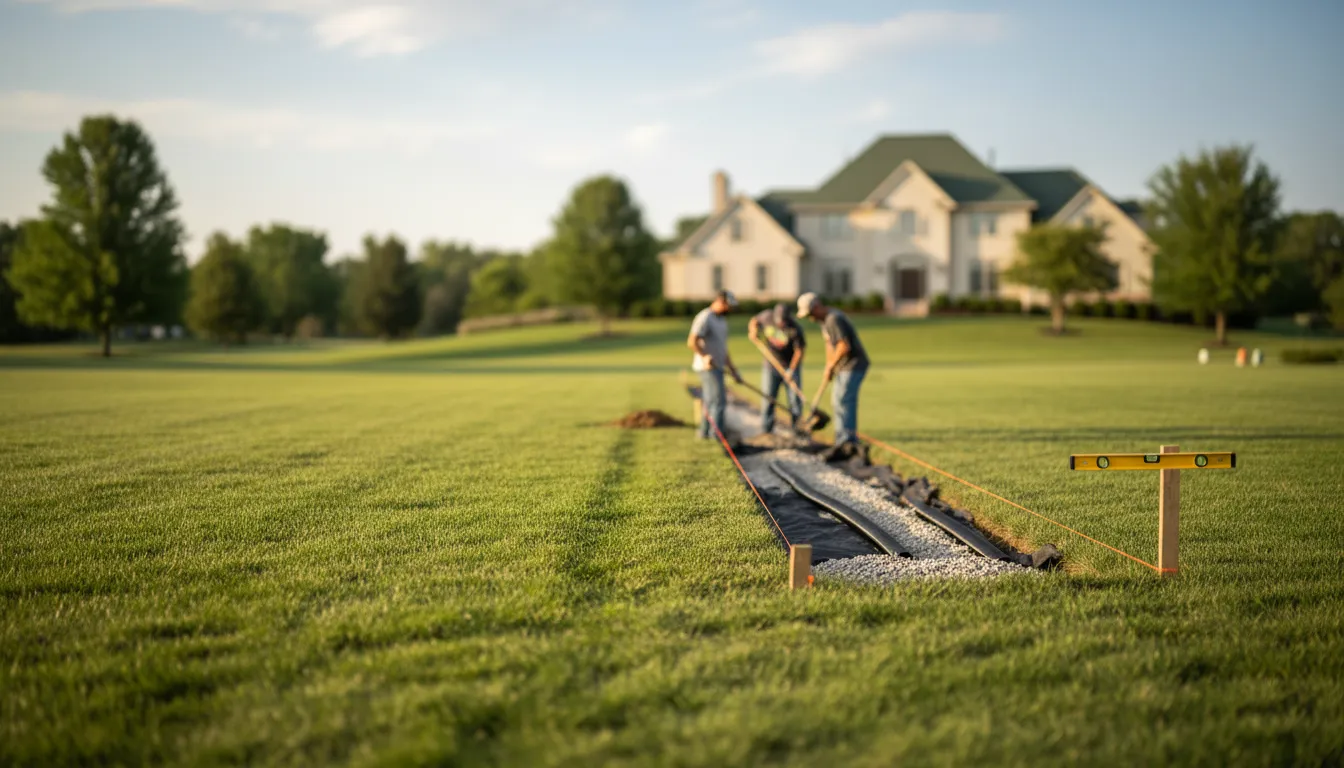
- French Drains: A highly effective solution for intercepting groundwater. A trench is dug, lined with landscape fabric, filled with gravel, and contains a perforated pipe that collects and redirects water. They are ideal for channeling water from soggy areas or foundation perimeters.
- Catch Basins and Drain Grates: These are grated inlets installed in low spots to capture surface water runoff. They connect to a solid pipe that carries the water away underground to a safe discharge location.
- Dry Wells: An underground chamber filled with gravel or a prefabricated structure that collects water from downspouts or drains and allows it to slowly percolate back into the soil, used when diverting water to the street isn't feasible.
Surface Water Management
These solutions handle rainwater where it falls or as it flows across the surface.
- Swales: Broad, shallow, vegetated ditches designed to slow down and channel runoff, allowing water to infiltrate the soil gradually.
- Downspout Extensions and Pop-up Emitters: Simple, cost-effective tools to carry roof runoff several feet away from the foundation. Pop-up emitters release water at ground level away from the house when the system is active 5.
- Rain Gardens: A landscaped depression planted with native, water-tolerant vegetation. It collects runoff from roofs or driveways and filters it through the soil, removing pollutants while solving a drainage problem beautifully 6.
- Permeable Pavers: For patios, walkways, or driveways, these interlocking pavers allow water to seep through the joints into a gravel base below, reducing runoff from hard surfaces 7.
Find the perfect yard drainage contractors for your needs
Get personalized recommendations and expert advice
The Professional Installation Process
Tackling a significant drainage project requires careful planning and execution. Here's what you can expect when working with a Kalamazoo-area drainage specialist:
- Site Assessment and Diagnosis: A professional will inspect your property during or after a rain event to identify the water source, flow paths, and soil conditions. They will look for grading issues, test soil composition, and determine the best outlet for diverted water.
- Planning and Design: Based on the assessment, they will design a customized system, which may combine several solutions like regrading with a French drain or catch basins. They will mark the proposed locations for all components.
- Site Preparation and Excavation: The area is cleared of plants and obstacles. Using machinery like mini-excavators, trenches are dug for drains, or large areas are reshaped for grading.
- System Installation: This involves laying perforated pipe in gravel beds for French drains, setting catch basins, constructing rain garden beds, or installing downspout connections. All components are carefully leveled and connected.
- Final Grading and Compaction: The soil is finely graded to the precise slope needed for positive drainage. It is then compacted to prevent future settling that could reverse the grading work.
- Finishing: The site is restored with topsoil, sod, seed, mulch, or decorative gravel. Plants are added to rain gardens or swales. The system is tested with water to ensure proper flow.
Understanding Project Costs in Kalamazoo
The investment for drainage work varies greatly based on the size of your yard, the complexity of the problem, and the solutions required. Here's a general overview of potential costs, though obtaining a site-specific quote from a local pro is essential 8 9.
- Basic Downspout Management: Installing rain barrels or simple downspout extensions can range from $100 to $500+.
- Regrading or Swale Creation: For correcting the slope of a moderate-sized area, budgets often start around $500 and can exceed $2,000, heavily dependent on the amount of earth that needs to be moved and soil type.
- French Drain Installation: A typical residential French drain system (20-50 feet in length) generally costs between $1,000 and $3,000+ for materials and professional labor.
- Complex Integrated Systems: Projects involving multiple catch basins, long runs of piping, and connections to municipal storm systems or dry wells can range from $1,500 to $5,000 or more.
- Rain Gardens: A professionally installed rain garden, including excavation, soil amendments, and plants, might cost $300 to $1,000+, with DIY being a lower-cost option for the handy homeowner.
Choosing a Local Drainage Expert
For projects beyond simple extensions, hiring a professional with local experience is crucial. Look for companies specializing in land grading, site drainage, or excavation services. Local firms like Kalamazoo Premier Services explicitly offer grading solutions for drainage and foundation stability, while others like Grapids Irrigation and RH Tractor Services list comprehensive drainage installations for the Kalamazoo region 10. Ensure they are licensed, insured, and can provide references for similar projects. A reputable pro will always start with a thorough assessment and clear explanation of their proposed solution before any work begins.
Frequently asked questions
Sources
Footnotes
-
Yard Grading - drainagekingsmi - https://www.drainagekingsmi.com/yardgrading.html ↩
-
Landscaping in Michigan | Yard Drainage | Brick Paver ... - https://highergroundlandscaping.net/ ↩
-
Drainage Installations | Hastings | Grand Rapids | Kalamazoo MI - https://www.rhtractorservices.com/drainage-installations/ ↩
-
Yard Prep and Grading | Hastings | Grand Rapids - https://www.rhtractorservices.com/yard-prep-and-grading/ ↩
-
12 Residential Backyard Drainage Solutions - Protect Your Yard - https://wilsonslawncare.com/12-residential-backyard-drainage-solutions/2024/ ↩
-
Simple Steps to Manage Stormwater in Your Backyard - JP Operations - https://www.jpoperations.com/blog/simple-steps-to-manage-stormwater-in-your-backyard ↩
-
Making Your Yard RainReady - https://rainready.org/sites/default/files/factsheets/Factsheet-RainReady-Yard_0.pdf ↩
-
Drainage - Grapids Irrigation - https://grapids.com/services/drainage/ ↩
-
Rainwater Management - A Guide for Homeowners - https://nr.tulaliptribes.com/Content/documents/Rainwater-Management.pdf ↩
-
Landscape Grading - Kalamazoo, MI - https://www.kalamazoopsllc.com/grading-solutions ↩