Find the Best Yard Drainage Contractors for Your Business
No obligation • Fast responses • Nationwide coverage

Why you can trust Landscape Atlas
Landscape Atlas is a leading United States resource for evaluating landscaping, lawn care, and outdoor service providers. Our team researches each category in depth, focusing on service quality, safety, and customer experience. Listings and rankings are based on independent criteria and user feedback, and companies cannot pay to influence our assessments or recommendations.
Search providers near you
Top Yard Drainage Contractors in Rock Hill, South Carolina Ranked
A soggy lawn, water pooling against your foundation, or a perpetually muddy backyard are more than just nuisances-they can threaten your home's structural integrity and create an unusable outdoor space. Proper yard drainage and grading is the science and practice of managing surface and subsurface water on your property, directing it safely away from your home and into appropriate areas. This guide is designed for Rock Hill homeowners to understand the importance of effective water management, the common solutions available, and how to connect with local expertise to protect your investment and enhance your landscape.
Carolina Terrain
1515 Waxhaw Indian Trail Rd S, Waxhaw, NC 28173
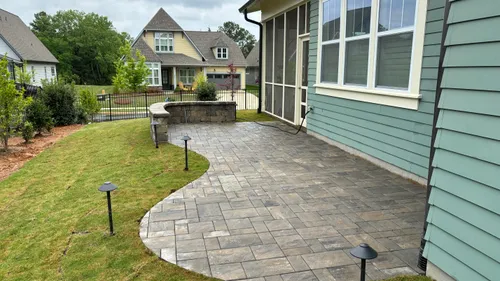
Carolina Terrain is a licensed landscaping, hardscaping, and drainage contractor based in Charlotte, NC. They offer comprehensive property services including custom landscape design, sod installation, grading, drainage solutions, and hardscape construction for residential, commercial, industrial, and HOA properties. Their certified capabilities include Keystone-certified retaining walls and permeable pavers, as well as NDS-certified drainage systems such as French drains and stormwater management. Carolina Terrain serves a 20-mile radius around Waxhaw, NC, covering areas like Marvin, Weddington, and South Charlotte. They also provide pressure washing and property cleaning with a high-capacity hot water system. The company is experienced in handling HOA approvals and municipal projects, ensuring compliance and quality results.
GreenWorx180
6425 Bannington Rd Unit A, Charlotte, NC 28226
GreenWorx180 is a landscaping and lawn care company based in Charlotte, NC, serving the city and nearby communities including Indian Trail, Cornelius, Matthews, and Fort Mill, SC. They offer a wide range of services such as sod installation, shrub and tree planting, hardscape design, drainage solutions, landscape lighting, fence installation, and seasonal yard maintenance. The company is experienced in both residential and commercial landscaping projects, with capabilities including custom paver patios and efficient irrigation systems. Established in 2017, GreenWorx180 has built a reputation supported by numerous positive reviews and local awards, reflecting their commitment to quality and customer satisfaction.
Haven Landscape Design
Charlotte, NC
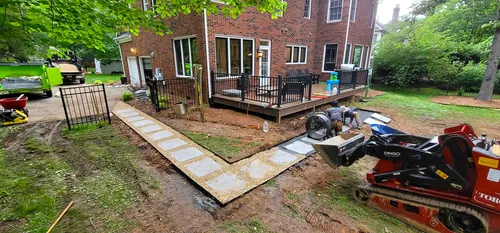
Haven Landscape Design is a landscape design and installation company based in Charlotte, NC. They offer a range of services including custom landscape design, hardscaping with patios, walkways, and retaining walls, landscape lighting, sod installation, yard drainage solutions, and outdoor kitchens and fire pits. Their work focuses on blending beauty, functionality, and sustainability to create personalized outdoor spaces. Haven Landscape Design serves Charlotte and nearby areas such as Matthews, Huntersville, Concord, and Fort Mill. They are experienced in installing advanced drainage systems to protect properties and enhance landscape health.
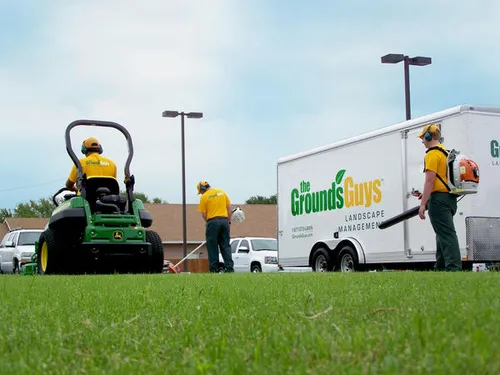
The Grounds Guys of Ballantyne
Charlotte, NC
The Grounds Guys of Ballantyne is a landscaping company serving Charlotte, NC, offering a wide range of lawn and landscape services. Their expertise includes lawn mowing, fertilization, weed control, sod installation, landscape lighting, irrigation installation and repair, tree services, yard drainage, and hardscaping such as patios and retaining walls. They provide customized landscape design and maintenance plans tailored to local soil and climate conditions. The company emphasizes eco-friendly solutions like drought-tolerant plants and efficient irrigation. Their services cover both residential and commercial properties, with flexible scheduling and clear communication to support year-round landscape health.
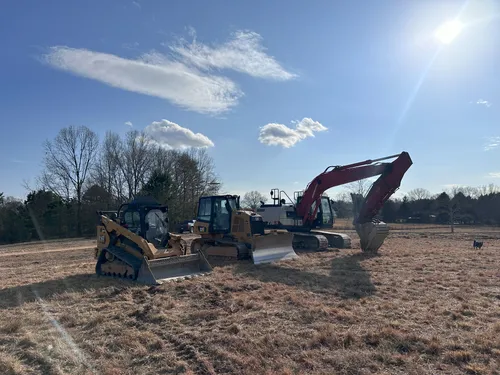
Palmetto Land Services
Charlotte, NC
Palmetto Land Services is a land preparation and clearing company based in Charlotte, NC. They provide services including land clearing, forestry mulching, construction pad grading, stone driveway installation and repair, tree removal, and yard drainage solutions. Their expertise includes proper soil compaction and grading to ensure solid foundations and prevent issues like washouts or sinkholes. Palmetto Land Services works with homeowners, builders, and local developers in the Charlotte area and surrounding regions.
Why Proper Drainage is Critical in Rock Hill
The clay-heavy soils common in the Rock Hill area can be slow to absorb water, leading to rapid runoff during our frequent summer storms. When water isn't properly managed, it can seep into basements and crawl spaces, cause foundation cracks, erode landscaping, kill grass, and create breeding grounds for mosquitoes. Furthermore, the City of Rock Hill manages a municipal stormwater system, and how your property handles runoff can be part of a community-wide effort to reduce pollution and flooding. Investing in correct grading and drainage isn't just about fixing a puddle; it's about preventative home maintenance and responsible property stewardship.
Common Signs You Need Drainage Work
How do you know if your property has a water management issue? Look for these telltale signs:
- Standing Water: Puddles that remain for more than 24 hours after rain.
- Soil Erosion: Gullies or washed-away soil in your yard, especially near downspouts.
- Foundation Dampness: Moisture, mildew, or efflorescence (white, chalky stains) on your home's exterior foundation walls.
- Basement or Crawl Space Leaks: Water intrusion during or after heavy rain.
- Soggy Lawn: Spongy, constantly wet grass that struggles to grow.
- Overflowing Gutters: Gutters that spill over because water cannot flow away from the house quickly enough.
Core Solutions for Yard Water Management
A professional will assess your property's specific challenges and often recommend a combination of the following solutions to create an integrated system.
Regrading and Sloping
This is the first line of defense. The goal is to create a gentle, consistent slope away from your home's foundation-typically a drop of about 6 inches over the first 10 feet 1. Regrading involves moving and compacting soil to reshape the land, ensuring surface water flows away from the house and toward a designated drainage area or system. It's often the foundational step before installing other drainage features.
French Drains
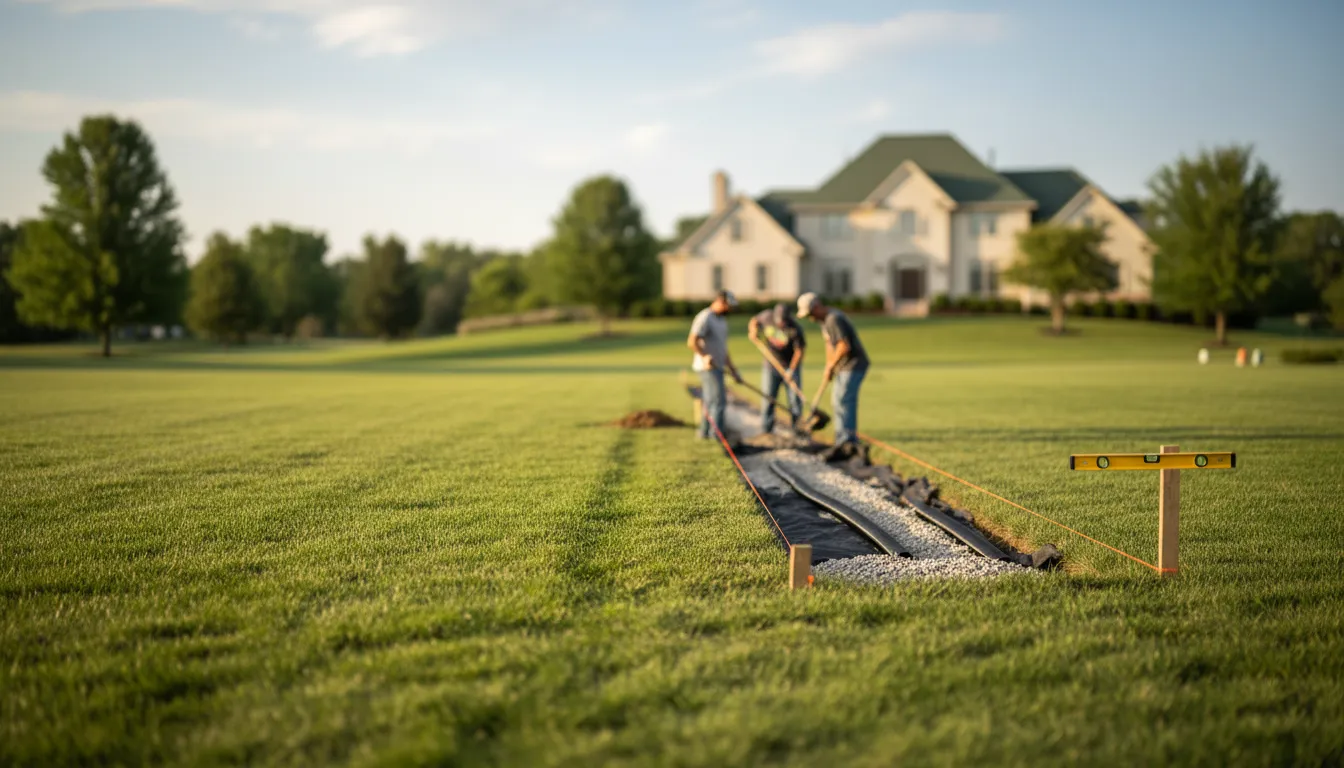
A French drain is a subsurface solution for collecting and redirecting groundwater. It consists of a trench lined with landscape fabric, filled with gravel, and containing a perforated pipe. Water seeps through the gravel into the pipe, which then carries it away to a safe discharge point like a storm drain or dry well. These are ideal for yards with persistent soggy spots or where the water table is high.
Catch Basins and Channel Drains
These are surface-level solutions for capturing heavy runoff from hardscapes. A catch basin is a box with a grate (often found at low points in a yard or driveway) that connects to an underground pipe. A channel drain is a long, linear grate system, perfect for across a driveway, patio, or walkway where water tends to sheet across. Both collect surface water before it can pool and channel it into the drainage pipe network 2.
Swales
A swale is a broad, shallow, vegetated ditch designed to slow down and spread out runoff, allowing it to infiltrate the soil gradually. Unlike a ditch, a swale is gently graded and often landscaped with grass or other plants. They are an effective, natural-looking way to manage water flow across larger areas of a property and are considered a "green" infrastructure practice 3.
Rain Gardens
A rain garden is a landscaped depression planted with native, water-tolerant plants. It's designed to capture runoff from roofs or driveways, hold it temporarily, and allow it to soak into the ground while filtering out pollutants. The Clemson Extension provides excellent guides for designing rain gardens suited to our region, and the City of Rock Hill may offer stormwater credits for implementing such Best Management Practices (BMPs).
Downspout and Gutter Management
Often overlooked, your roof collects a massive amount of water. Simply ensuring gutters are clean and downspouts discharge at least 5-10 feet away from your foundation is a critical and low-cost step. This can be achieved with splash blocks or, more effectively, with buried downspout extensions that tie into your drainage system.
Find the perfect yard drainage contractors for your needs
Get personalized recommendations and expert advice
The Professional Installation Process
Understanding the process can help you know what to expect when you hire a local Rock Hill specialist for landscape drainage work.
- Site Assessment & Diagnosis: A professional will inspect your property during or after a rain event to identify the source and flow of water, test soil composition, and locate utility lines.
- Design & Planning: They will design a system that may combine several solutions, creating a plan that addresses the root cause, not just the symptoms. This is when they will mark the proposed locations for drains, pipes, and grading changes.
- Excavation & Grading: The crew will reshape the soil to create the correct slope away from structures. This is heavy work, often involving small excavators or skid-steers.
- System Installation: Trenches are dug for pipes, basins are set, and drainage fabric and gravel are installed. For rain gardens or swales, the area is excavated and prepared for planting.
- Connection & Integration: All components are connected-downspouts are tied into the drain pipes, catch basins are linked, and the entire system is routed to a proper outlet.
- Backfilling & Finishing: Trenches are filled, soil is compacted, and the surface is restored with sod, seed, or mulch. Rain gardens are planted with appropriate vegetation.
- Final Inspection & Maintenance Guidance: The contractor should walk you through the completed system and explain simple maintenance, like cleaning grate inlets and checking for debris.
Understanding the Investment
Costs for drainage and grading projects in Rock Hill vary widely based on the property's size, slope, soil conditions, and the complexity of the solutions required. Here's a general breakdown based on regional data 4 5:
- Basic Corrections: Simple regrading or installing downspout extensions and splash blocks may range from a few hundred to a couple thousand dollars.
- French Drains: A common solution, typically costing between $10 to $50 per linear foot installed, making most projects fall in the $1,000 to $4,000 range.
- Catch Basins & Channel Drains: Individual plastic basins start around $200-$500+, while larger concrete basins or complex channel drain systems can cost $2,000-$5,000+.
- Rain Gardens & Swales: These can be moderate in cost, heavily dependent on size and plant selection, but may offer long-term value through potential city stormwater credits 6 7.
- Complete System Installation: For a whole-yard solution combining grading, multiple drains, and basins, most homeowners can expect to invest between $2,000 and $6,400. Extensive projects on large or challenging lots can reach $15,000 or more.
Always get multiple detailed quotes from established local contractors. Companies like JAMROCK Grading and Demolition, which services the Rock Hill area, can provide assessments specific to our local conditions 8.
Maintaining Your Drainage System
A well-installed system is low-maintenance but not no-maintenance. Perform a visual inspection after major storms. Keep gutter systems clean and free of leaves. Ensure the grates on catch basins are clear of debris like grass clippings and mulch. Periodically check the outlets of your drain pipes to ensure water is flowing freely. For rain gardens, weed and maintain the plants as needed to keep the basin functional.
Frequently asked questions
Sources
Footnotes
-
How to Grade a Yard: Step-by-Step Guide for Proper Drainage - https://www.schmittwaterproofing.com/blog/yard-grading-101-how-to-grade-a-yard-for-proper-drainage-step-by-step/ ↩
-
Yard Drain Types: What's the Best Option for Your Backyard? - https://warelandscaping.com/resources/types-of-yard-drains/ ↩
-
Stormwater: Low Impact Development | South Carolina ... - https://des.sc.gov/programs/bureau-water/stormwater/stormwater-management/stormwater-pollution-prevention-plans-swppps/stormwater-low-impact-development ↩
-
Landscape Grading and Drainage Costs - https://www.whiteshovel.com/blog/landscape-grading-and-drainage-costs ↩
-
Understanding the Real Cost of Yard Drainage - A Homeowner's ... - https://www.tlcincorporated.com/understanding-the-real-cost-of-yard-drainage-a-homeowners-guide/ ↩
-
Rock Hill Stormwater Fees and Yard Grading: What to Know - https://joshtuschak.com/blog/stormwater-fees-and-yard-grading-for-rock-hill-homes ↩
-
Stormwater | Rock Hill, SC - https://www.cityofrockhill.com/departments/public-works/stormwater ↩
-
Drainage Installation - JAMROCK Grading and Demolition - https://www.jamrockgradinganddemolition.com/drainage-installation-and-grading ↩