Find the Best Yard Drainage Contractors for Your Business
No obligation • Fast responses • Nationwide coverage

Why you can trust Landscape Atlas
Landscape Atlas is a leading United States resource for evaluating landscaping, lawn care, and outdoor service providers. Our team researches each category in depth, focusing on service quality, safety, and customer experience. Listings and rankings are based on independent criteria and user feedback, and companies cannot pay to influence our assessments or recommendations.
Search providers near you
Top Yard Drainage Contractors in West Allis, Wisconsin Ranked
A soggy lawn, water pooling against your foundation, or a perpetually muddy patio are more than just nuisances-they are signs of a drainage problem that can threaten your home's structural integrity and your property's value. Proper yard drainage and grading involves reshaping the land and installing systems to manage rainwater and groundwater, directing it safely away from your home. This guide will help you understand the common solutions used by West Allis professionals, from simple regrading to complex French drain systems, so you can make an informed decision to protect your property.
Crawford Tree & Landscape Services, Inc.
8760 W Calumet Rd, Milwaukee, WI 53224
Crawford Tree & Landscape Services, Inc. is a full-service tree and landscape care company based in Milwaukee, WI. They offer a wide range of services including tree risk assessment, removal, pruning, shrub trimming, lawn mowing, landscaping, grading, drainage solutions, and hardscape installation. Their plant health care services include disease management, pest control, fertilization, and specialized treatments such as Emerald Ash Borer protection. Established in 1969, Crawford Tree & Landscape Services provides 24/7 availability for urgent needs and uses advanced equipment to ensure safe and efficient operations.
Badgerland LLC
Milwaukee, WI
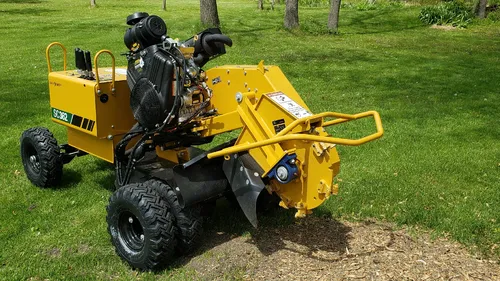
Badgerland LLC is a Milwaukee, WI-based company offering fence installation, tree services including stump grinding, and yard drainage solutions. They handle projects ranging from basic stump grinding for lawn restoration to more complex tasks like driveway expansion, pool installation, and regrading after tree removal. The company is certified to manage utility marking through Digger's Hotline ProPortal and provides custom saw milling and woodworking services tailored to client needs.
VLA Grading LLC - Concrete Flatwork
3920 W National Ave, Milwaukee, WI 53215
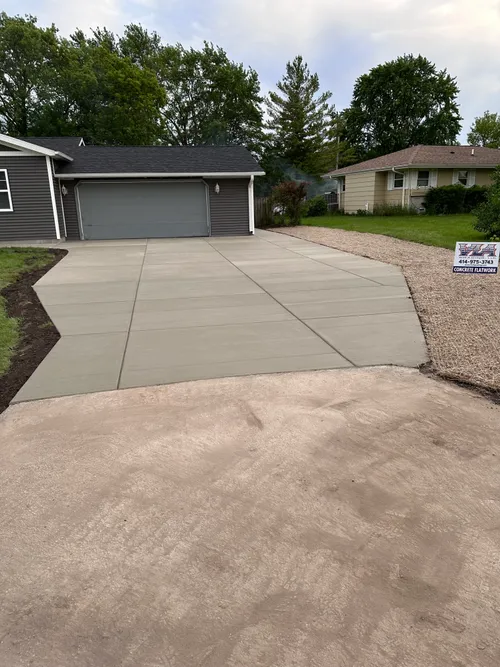
VLA Grading LLC - Concrete Flatwork is a yard drainage and grading contractor based in Milwaukee, WI. They provide specialized grading and concrete flatwork services for projects of various sizes. The company focuses on creating strong foundations to support construction needs.
Waukesha Lawn Service
675 N Brookfield Rd #107, Brookfield, WI 53045
Waukesha Lawn Service is a family-owned lawn care and landscaping company based in Milwaukee, WI. They provide full-season yard care services including lawn maintenance, landscape design, sod installation, yard drainage solutions, and snow removal. Serving the Waukesha County area and surrounding communities, they focus on creating healthy, well-maintained lawns and custom landscape renovations. Their team has over 30 years of experience and uses premium products to ensure lasting results. Waukesha Lawn Service offers year-round availability, including snow removal during winter months.
DEL - Diverse Environmental Landscapes
21124 Good Hope Rd Suite 2, Lannon, WI 53046
DEL - Diverse Environmental Landscapes is a landscaping company based in Milwaukee, WI, specializing in ecological landscape design and yard drainage solutions. They focus on creating custom landscaping plans that support wildlife habitats, reduce pollution, and improve water management through grading and drainage services. The company emphasizes environmentally responsible practices to enhance both the property and the surrounding community. DEL is known for its detailed approach to landscape design and its commitment to sustainable solutions.
Understanding Drainage Problems in West Allis
West Allis, like much of Southeastern Wisconsin, experiences significant rainfall and snowmelt. When the ground is saturated or the natural slope of your property directs water toward your home, problems arise. Common signs include:
- Standing water in your yard or basement.
- Soil erosion around your foundation or in garden beds.
- A perpetually wet or muddy lawn.
- Water seepage into your basement or crawl space.
- Mosquito infestations from stagnant water.
These issues are often caused by improper initial grading during construction, compacted soil, or the installation of impermeable surfaces like patios and driveways that alter natural water flow. Addressing them is not just about comfort; it's a critical home maintenance task to prevent foundation cracks, mold growth, and landscape damage.
Core Solutions for Water Management
Local drainage contractors employ a range of techniques tailored to a property's specific challenges. The right solution depends on whether the issue is surface water, subsurface water, or a combination of both.
Regrading and Sloping
This is often the first line of defense. Regrading involves reshaping the soil to create a gentle, consistent slope (typically a minimum of 2% grade) away from your home's foundation for at least 10 feet. This fundamental correction ensures surface rainwater runs off instead of pooling. It's a crucial step for any new construction or major landscaping project and can sometimes resolve minor issues on its own.
Swales and Dry Creek Beds
For guiding water across a flat yard or through a specific path, landscapers use swales. These are shallow, vegetated channels designed to move surface water to a safe discharge point, like a storm drain or a lower area of your property. They can be grass-lined or, for a more decorative and functional approach, lined with stone to create a dry creek bed. The City of West Allis encourages such green infrastructure options that help manage water sustainably.
French Drains (Drain Tile)
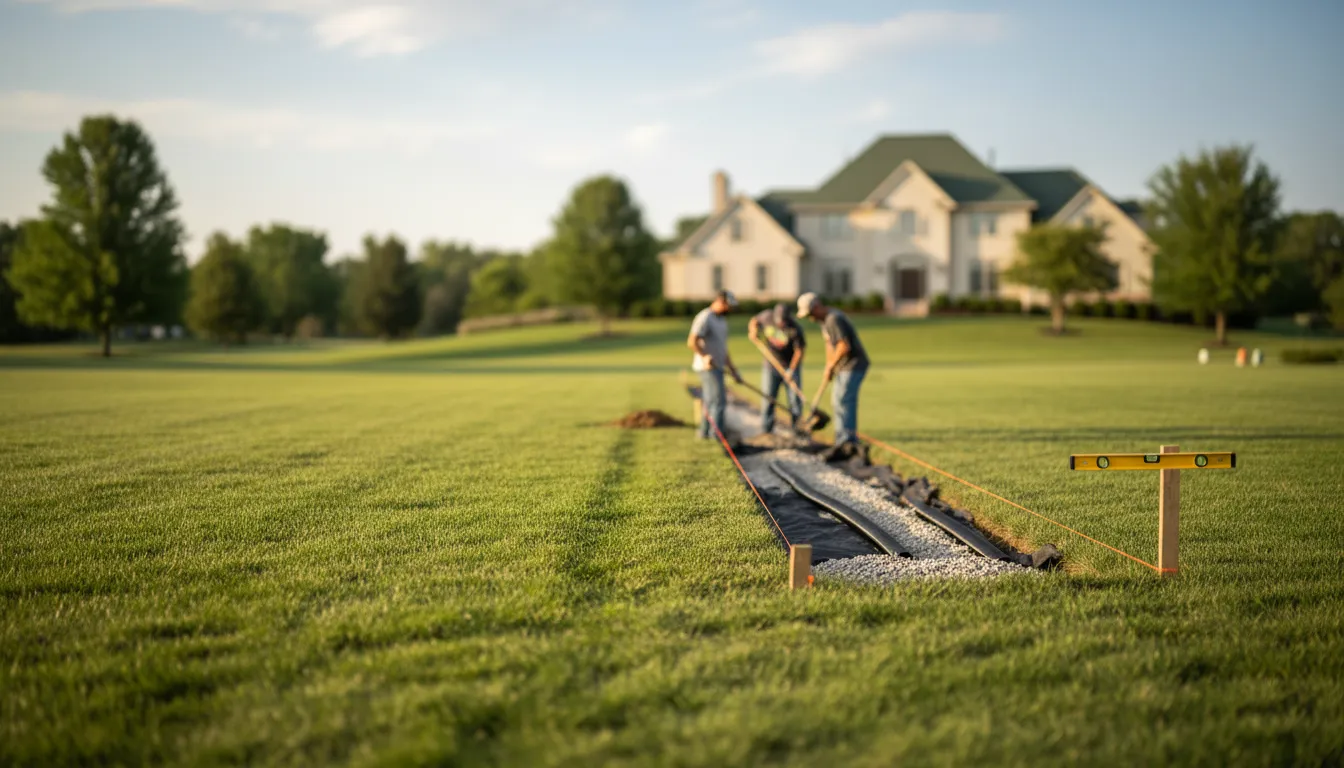
When water is seeping into your basement or saturating the subsoil, a French drain (often called drain tile) is the standard solution. This involves digging a trench, lining it with landscape fabric, adding a bed of gravel, laying a perforated pipe, and covering it with more gravel and fabric before backfilling. The system collects subsurface water and channels it away, often discharging it to a storm sewer, dry well, or a lower, safe part of your yard. This is a highly effective method for solving chronic wet basement problems.
Retaining Walls and Terracing
On properties with significant slopes, retaining walls serve a dual purpose. They hold back soil to prevent erosion and create level terraces, which can be strategically graded to redirect water flow. When integrated with a drainage plan, walls often include weep holes or drainage pipes behind them to relieve hydrostatic pressure and channel water away.
Downspout and Gutter Extensions
A simple yet critical component of any drainage plan. Ensuring your gutters are clean and downspouts extend at least 5 to 10 feet away from your foundation is a low-cost, high-impact step. For a more permanent solution, downspouts can be connected to underground drain pipes that tie into a French drain system or discharge far from the house.
The Professional Installation Process
Tackling a yard drainage project is a multi-stage process best left to experienced professionals who understand local soil conditions and regulations.
- Site Assessment and Diagnosis: A reputable contractor will inspect your property during or after a rain event to identify the source and path of water. They will check the existing grade, look for low spots, and assess your foundation1.
- Design and Planning: Based on the assessment, a plan is created. This may involve a grading plan to reshape the yard, the layout for drainage trenches, or the design of a retaining wall. The goal is to create an integrated system that moves water from collection points to a safe outlet.
- Excavation and Earthwork: This is the most labor-intensive phase. Trenches are dug for drain pipes, or large areas are excavated to adjust the landscape grading. Heavy machinery is often used for larger projects.
- System Installation: Perforated pipes are laid in trenches with gravel beds, retaining wall blocks are assembled, and new soil is shaped and compacted to the precise slope required. All components are connected to ensure water flows correctly.
- Backfilling and Restoration: Once the system is in place and tested, trenches are filled, and the site is restored. This includes adding topsoil, reseeding grass, or replanting landscaping to blend the work seamlessly into your yard.
Find the perfect yard drainage contractors for your needs
Get personalized recommendations and expert advice
What Influences the Cost of Drainage Work?
The investment in a drainage solution varies widely, as it is highly customized to each property. Key cost factors include:
- Yard Size and Topography: A large, sloped yard is more complex and expensive to address than a small, flat one.
- Solution Complexity: A simple regrading job costs significantly less than a full-yard French drain system tied into multiple downspouts.
- Materials: The type of drain pipe (corrugated vs. PVC), the quality of gravel, and materials for retaining walls (timber, concrete block, natural stone) all affect price.
- Labor and Equipment: Extensive excavation requiring mini-excavators or skid-steers increases costs.
- Permits and Regulations: Some projects, especially those tying into municipal storm sewers, may require permits from the City of West Allis.
Based on typical project scopes in the region:
- Small Fixes & Targeted Grading: Addressing a specific area like regrading around a foundation or installing a single downspout extension may range from $500 to $2,000.
- Moderate Systems: Installing a French drain for a patio or a series of swales to handle runoff from a section of the yard often falls in the $2,000 to $5,000 range.
- Comprehensive Yard Drainage: A whole-property solution involving extensive regrading, multiple interconnected French drains, and/or retaining walls can range from $5,000 to $12,000 or more, depending on the scale2 3.
West Allis Initiatives and Green Infrastructure
Homeowners in West Allis should be aware of the city's proactive stance on water management. West Allis has been recognized as a "Green Luminary City" by the Milwaukee Metropolitan Sewerage District (MMSD) for its efforts to manage water with green infrastructure. This includes encouraging property-level solutions like:
- Porous Pavement: Allows rainwater to seep through into the ground below.
- Rain Gardens and Bioswales: Depressed, planted areas that collect and absorb runoff from roofs and driveways.
- Rain Barrels: Capture roof water for later garden use.
When planning your drainage project, incorporating these elements can not only solve your water problem but also contribute to broader community goals for sustainability and reduced stormwater runoff4.
Choosing a Qualified Professional in West Allis
Given the technical nature of the work and its importance to your home's health, selecting the right contractor is essential. Look for a specialist in landscape drainage or excavation services with:
- Proven experience with French drain installation and grading projects.
- Knowledge of local soil types (often heavy clay in this area) and city requirements.
- Proper licensing and insurance.
- A portfolio of before-and-after photos or local references.
- A clear, detailed written estimate that outlines the diagnosis, proposed solution, materials, and timeline.
A trustworthy professional will focus on creating a long-term solution, not just a quick fix, ensuring your West Allis property stays dry and stable for years to come.
Frequently asked questions
Sources
Footnotes
-
Drainage Problems in West Allis WI, 53219 - https://www.4nowater.com/wisconsin/drainage-solutions-west-allis-53219-wi/ ↩
-
Grading & Drainage - Integrity Landscape Services - https://www.integritylandscapeservices.com/grading-drainage-milwaukee/ ↩
-
Landscape Grading and Drainage Costs - https://www.whiteshovel.com/blog/landscape-grading-and-drainage-costs ↩
-
West Allis Uses Green Infrastructure to Manage Water Where It Falls - https://www.mmsd.com/about-us/news/mmsd-green-luminary-city-west-allis ↩